
ASTM D882, Standard Test Method for Tensile Properties of Thin Plastic Sheeting, is the ASTM International method for measuring the tensile properties of plastic films and sheeting less than 1.0 mm thick. The current edition is D882-26. The test specimen is a rectangular strip 5.0 to 25.4 mm wide, and its width must be at least 8 times its thickness. The test speed is the initial grip separation multiplied by a strain rate that depends on the expected elongation. Unless the material specification says otherwise, it is 12.5, 50 or 500 mm/min. The modulus of elasticity is measured on a separate specimen, with 250 mm between grips and 25 mm/min.
In short:
- Scope: plastics in the form of sheeting or film less than 1.0 mm thick. From 1.0 mm up, the standard is ASTM D638.
- Test specimen: a strip 5.0 to 25.4 mm wide, at least 50 mm longer than the grip separation, cut with no nicks.
- Conditioning: at least 40 h at 23 °C and 50% relative humidity, with the test run in the same atmosphere.
- Results: tensile strength, yield, elongation, modulus (tangent or secant), breaking factor in N/m and energy to break.
- It is not ISO 527-3: ASTM states that the two are technically similar, but the specimen, gauge length and speeds differ.
The standard is a paid document sold by ASTM. This guide explains it in our own words for people who will apply it in quality control of packaging film, agricultural film or technical film, or who are buying the equipment. It gives the essential numerical requirements and the source of each one.
What ASTM D882 is and the current edition
ASTM D882 is the tensile test standard for plastic film and thin sheeting under 1.0 mm thick. The current edition, checked on October 1, 2026 in the ASTM store, is D882-26. A tensile test applies an increasing axial force to the test specimen at a controlled speed until it breaks, and records the force and the extension. On a 50 µm film, though, almost everything that works for a steel bar or an injection-molded plastic dumbbell stops working. The cross section is so thin that an error of a few micrometers in thickness changes the stress by several percent. A grip that holds without slipping can easily cut the film. And the material may stretch hundreds of percent before it breaks. ASTM D882 sets out how to deal with each of these problems.
According to the official page of the standard, checked on September 30, 2026 and again on October 1, 2026, D882-26 is active in the ASTM store, updated on April 29, 2026. It is maintained by subcommittee D20.19 on film and sheeting, under committee D20 on plastics. The scope covers plastics in the form of thin sheeting, including film, less than 1.0 mm thick. Under the ASTM D883 terminology, "film" is the optional term for sheeting with a nominal thickness of up to 0.25 mm. Above that and below 1.0 mm, the material is called thin sheeting, but the method is the same. From 1.0 mm up, ASTM D638 applies, and D638-22 itself names D882 as the preferred method below that thickness. The details of D638 are in the ASTM D638 guide.
The standard provides three ways to measure extension (from grip separation, with an extension indicator or with gauge marks on the strip) and a dedicated procedure for the modulus of elasticity. Many web pages, and even Google's automatic summary, still cite D882-18 or D882-02. Those editions have been superseded. The summary of changes between D882-18 and D882-26 is not available on the public ASTM page, and this guide does not claim to know what changed: it covers the requirements that remain in the structure of the standard and cites the current edition.
What a tensile test on plastic film is used for
The D882 tensile test identifies and characterizes the film with comparable numbers: how much force per cross section it withstands, how much it stretches before breaking, how stiff it is and how much energy it absorbs up to fracture. The significance and use section of the standard lists three purposes: quality control and specification, research and development, and data for engineering design. It is also the referee method when the material specification does not name another one. When a material specification exists and modifies the procedure, the material specification takes precedence over the standard.
In industry, the test is used for incoming inspection of film rolls and for line control of flexible packaging film, agricultural and greenhouse film, barrier film, medical packaging film and, more recently, lithium-ion battery separator film, a polyolefin film a few micrometers thick that is also anisotropic. The standard itself limits the scope of the numbers: behavior at a force and time scale very different from that of the test, such as long-term creep or impact, is not represented by it.
The strip test specimen
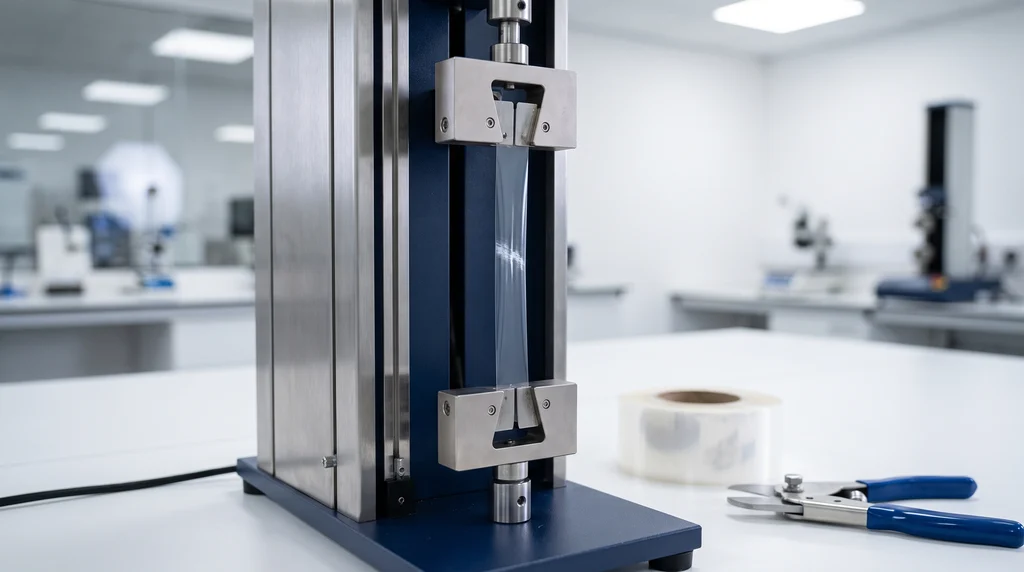
The ASTM D882 test specimen is a rectangular strip of uniform width and thickness, not the D638 dumbbell (dog-bone). Strain is distributed along the whole length between the grips. A strip is the natural choice for film because die-cutting a dumbbell from a thin film leaves burrs and micro-nicks at the fillets, and the film tends to break exactly there. The photo shows a strip of clear film held between flat-faced grips on a single-column machine. Next to it are the roll the strip was cut from and the cutter that ensures clean edges, free of nicks that would cause premature fracture.
Strip dimensions
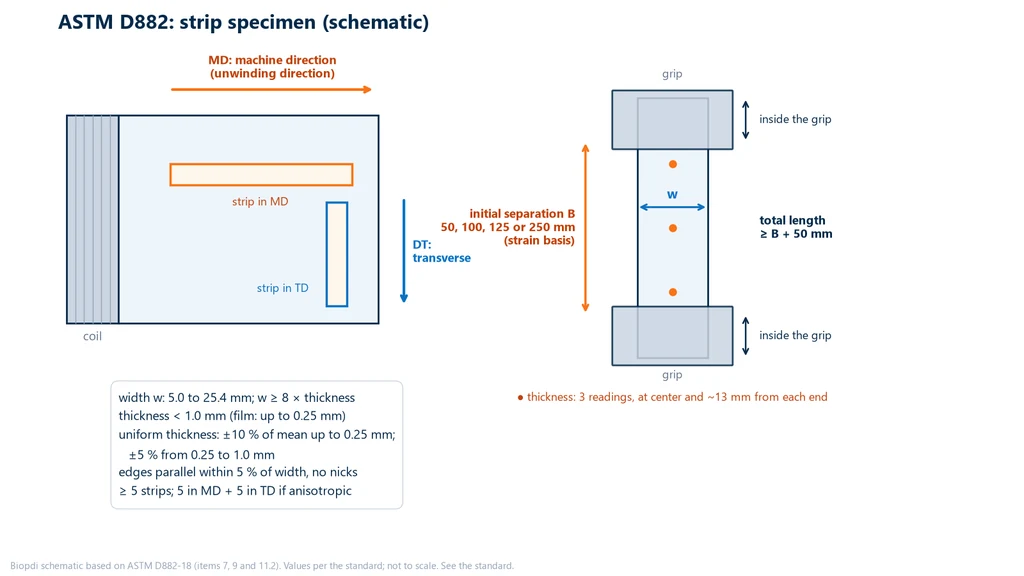
The nominal width is between 5.0 and 25.4 mm, and the width-to-thickness ratio must be at least 8. The reason is the edge: cutting always leaves some irregularity at the edge, and in a narrow, thick strip that edge accounts for a larger share of the cross section. For a 50 µm film the ratio is generous (a 25 mm strip gives 500). For 0.90 mm thin sheeting, the minimum width becomes 8 × 0.90 = 7.2 mm, and a 5 mm strip no longer complies. In practice, the 25 mm (1 in) strip is the most common.
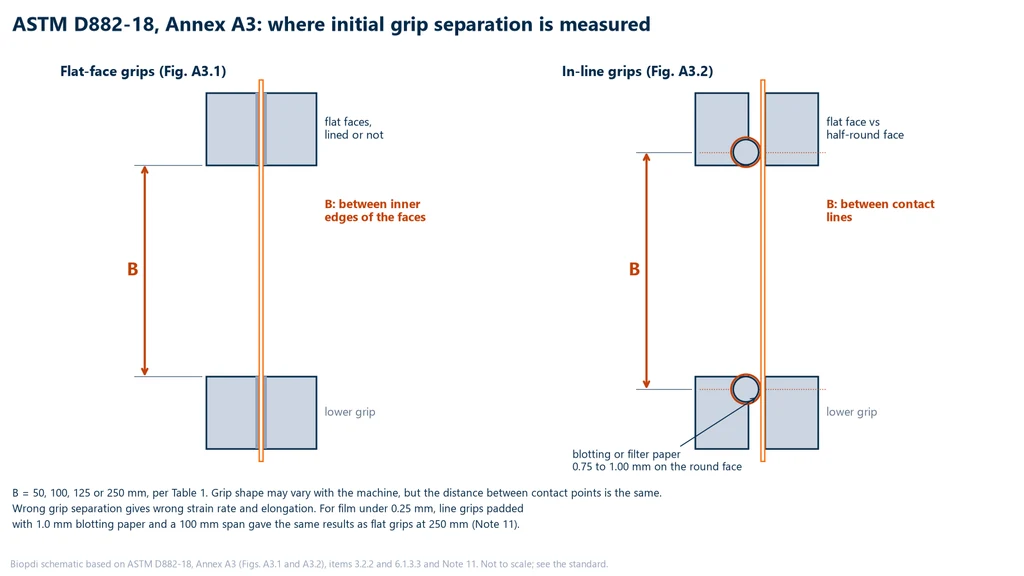
The initial grip separation, which this guide calls B, is the distance between the inner faces of the two grips at the start of the test, and it is the basis for the strain calculation. The strip must be at least 50 mm longer than this separation, so that each grip holds a sufficient length. The separation ranges from 50 to 250 mm depending on the test, as shown in the test speed section, so the strip length also varies. The edges must be parallel within 5% of the width, and the thickness must be uniform within 10% of the average over the length between the grips for strips up to 0.25 mm, and within 5% for strips from 0.25 to 1.0 mm.
Cutting and preparation
Cutting is the largest source of scatter in film testing. An edge nick invisible to the naked eye concentrates stress and makes the strip break earlier and with less elongation. D882 refers to a dedicated cutting practice, ASTM D6287-25, which covers the equipment and techniques for obtaining specimens without nicks and without stretching. Fixture-mounted parallel-blade cutters give good results on films with high elongation. Die cutting, common for dumbbells, tends to leave poor edges on film, and a single-blade template easily loses parallelism. Gauge marks, when used, are made with ink or wax crayon, never scribed, because a scribe line becomes a stress concentrator.
Machine direction, transverse direction and number of strips
Blown or cast film leaves the extruder stretched in a preferred direction, and the polymer chains are more oriented in that direction. The machine direction (MD), or longitudinal direction, is the direction in which the film runs on the production line, which is the direction in which the roll unwinds. The transverse direction (TD) is the perpendicular direction, across the width. Tensile properties are usually different in the two. In a Brazilian study of LDPE tubular film tested to D882-09 at 500 mm/min, the strength at break was 30 MPa in MD and 23 MPa in TD with a blow-up ratio of 1.5:1, about 30% higher in MD. With blow-up ratios of 2.5:1 and 3.5:1, the two directions were equal (Ferreira and Santana, Polímeros journal, 2015).
That is why the standard requires, for isotropic material, at least 5 strips per sample and, when anisotropy is suspected, two sets, one parallel and one perpendicular to the suspected direction, with at least 5 strips each. For film, this means 5 strips in MD and 5 in TD, with results reported separately for each direction. As an option (section 9.3 of D882-18), the standard allows testing only 3 strips, or 3 in each direction if the material is anisotropic, for in-line quality control or when there is not enough sample for 5. In that case the standard deviation is neither calculated nor reported. The diagram below shows the two cutting directions on the roll and the strip mounted between the grips, with the width, the initial separation, the extra length each grip holds and the three points where thickness is read, at the center and about 13 mm from each end:
General care in preparing, identifying and counting test specimens, common to all tests, is covered in test specimen.
Conditioning and thickness measurement
ASTM D882 conditioning is at least 40 hours at 23 ± 2 °C and 50 ± 10% relative humidity, per ASTM D618-21, Procedure A, with the test run in the same atmosphere, unless the material specification or an agreement between the parties requires otherwise. The requirement exists because plastic properties change with temperature and absorbed moisture, and film, with a lot of surface for little volume, responds quickly to its environment. In case of disagreement between laboratories, the reference becomes the narrow range of ±1 °C and ±5% humidity. When the film is used cold or hot, as in frozen food packaging or greenhouse covers, the specification may call for testing at the service temperature, in an environmental chamber, and the result is valid only for that temperature.
Thickness is the measurement that weighs most on the stress result. The standard requires a resolution of 0.0025 mm (2.5 µm) or better for strips under 0.25 mm, and of 1% of the thickness for strips from 0.25 to 1.0 mm, with readings at three points: at the center and about 13 mm from each end of the tested length. Width is measured with a resolution of 0.25 mm. The micrometer is the dead-weight type described in ASTM D5947 or in the ASTM D6988-26 guide, depending on the material, both with controlled contact pressure. An ordinary shop micrometer, tightened with its ratchet, crushes soft film and reads less than the actual thickness.
A simple calculation shows the size of the problem: on a 50 µm film, a 2.5 µm thickness error, which is exactly the minimum resolution required, already changes the area and the stress by 2.5 / 50 = 5%. That is why the standard offers an alternative for very thin films, the breaking factor in force per width, explained in the calculation section.
Grip separation and test speed
In D882, the grip separation speed is calculated, not chosen. The standard defines an initial strain rate, C, in millimeters per millimeter of length per minute, and an initial separation, B, for each case. The speed is the product of the two:
A = B × C
With B in millimeters and C per minute, A comes out in mm/min, and it must be held within ±5% of the set value with the specimen under load. The physical idea is that the same strain rate produces the same state in the material, regardless of the strip length: doubling the separation while keeping the speed would halve the strain rate, and the polymer, which is rate-sensitive, would respond like a softer material.
For strength, yield and elongation, the strain rate and the separation depend on the film's expected elongation at break, in three ranges. The modulus of elasticity has its own combination, valid for any film. The diagram below shows the four combinations, with the separations drawn to scale relative to each other:
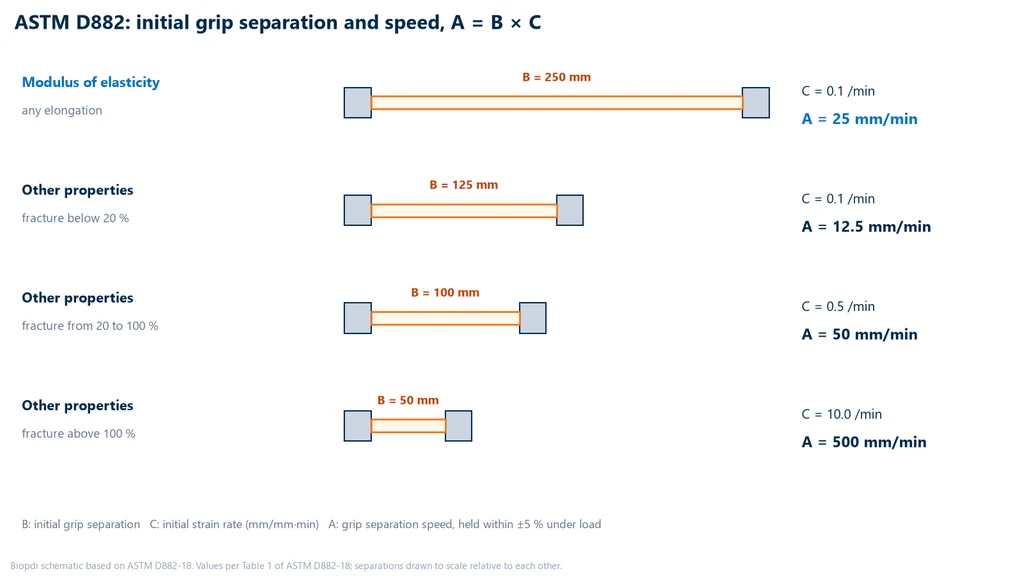
The table summarizes the same combinations, checked against Table 1 of ASTM D882-18. The full text of D882-26 was not checked:
| Determination | Elongation at break | B and C | Speed A |
|---|---|---|---|
| Modulus of elasticity | any | 250 mm; 0.1 /min | 25 mm/min |
| Other properties | below 20% | 125 mm; 0.1 /min | 12.5 mm/min |
| Other properties | 20 to 100% | 100 mm; 0.5 /min | 50 mm/min |
| Other properties | above 100% | 50 mm; 10 /min | 500 mm/min |
Three rules go with the table. Results obtained at different strain rates are not comparable. When the film's elongation falls on the boundary between two ranges and the classification is ambiguous, the lower rate is used. And the modulus test is run on a separate specimen: 250 mm is the standard separation and the referee separation in case of disagreement. When there is not enough film, the separation may be reduced to as little as 100 mm, adjusting the speed to keep the strain rate at 0.1 /min, provided it is shown that the result does not change.
Grips, slippage and extension measurement
The grip is the critical point of a film test. It has to transmit the force without letting the strip slip and without marking it, and these two requirements work against each other: a tighter clamp prevents slippage but increases the risk of cutting the film at the grip edge. D882 accepts fixed or self-aligning grips and lists faces that have worked well with film, such as thin rubber, fine bonded abrasive paper and adhesive tape, as well as line-contact grips. Abrasive paper, when used, must be fine, with a grit of at least 800. The standard also lists serrated and file-faced grips among those that work with many materials, but on thin film the serrations tend to notch the film along the clamping line; in these cases, lined smooth faces or line-contact grips usually produce fewer grip breaks. If the strip frequently breaks at the grip edge, the standard allows that edge to be slightly rounded.
In film testing labs, the most repeatable combination in practice is the side-acting pneumatic grip with flat rubber faces. Adjustable air pressure applies the same clamping force to every strip, which a hand-tightened screw grip cannot guarantee, and the rubber follows the thinning of the film without cutting it. The face must be at least as wide as the strip (25 × 25 mm is the most common, for the 25 mm strip), and the strip must be mounted in line with the tensile axis, because a skewed strip fails by tearing from one edge. For films too thin for rubber faces, line-contact grips (a flat face against a rounded face) are used or, as market practice rather than a requirement of the standard, self-tightening roller grips.
The grip type changes the point from which the initial separation B is measured, as shown in the diagram below, based on Annex A3 of the standard: with flat-faced grips, it runs from the inner edge of one face to that of the other; with line-contact grips, from one contact line to the other. Note that the standard considers the line-contact grip with the round face lined with 0.75 to 1.00 mm blotting or filter paper to be superior, and that an incorrectly set separation gives an incorrect strain rate and elongation.
Slippage shows up on the curve as steps or as inflated elongation, because the grip displacement no longer corresponds to the deformation of the strip. The standard acknowledges that it is hard to avoid in high-modulus sheeting thicker than 0.25 mm. A break next to the grip face is the other symptom: the result is only included in the average if it is shown that grip breaks agree with those occurring in the free length; otherwise, the strip is discarded and replaced.
In D882, extension is normally measured by the grip separation itself, and strain is the change in that separation divided by the initial separation. This is an important difference from D638, which requires an extensometer for modulus. The standard also allows an extensometer, which for the modulus test must be accurate to 1% (ASTM E83 class C or better), and ink marks as a gauge length. For large-elongation measurements, the requirement drops to about 10% of the value. In a film that elongates by hundreds of percent, the section that narrows near the grip "loosens" at its inner edge, and grip separation overestimates the extension of the gauge section; that is why the standard allows marking a gauge length or using a long-travel extensometer. Extensometer principles are covered in extensometer and strain gauge.
Force is measured by the load cell, with an accuracy of ±1% of the indicated value, verified per ASTM E4; in Brazil, class 1 of ABNT NBR ISO 7500-1:2023 (the Brazilian adoption of ISO 7500-1) corresponds to the same ±1%. D882 also requires the force range to be chosen so that the break falls within the upper two-thirds of the range. For film, this is the rule that weighs most in choosing the equipment, because forces are in the tens of newtons.
Since strain is normally read from grip separation, the standard requires the crosshead displacement indicator to be accurate to 1% of the indicated value or better (section 6.1.6 of D882-18), much stricter than the 10% accepted by D638. Without an extensometer, the movement of the force measuring system itself also must not exceed 2% of the measured extension.
What is calculated and how
D882 works with nominal stresses: every force is divided by the average initial area, A0 = w × t, where w is the width and t the average thickness of the strip. Tensile strength is the maximum force divided by A0. Tensile strength at break uses the force at the moment of break instead of the maximum; the two often coincide, but not always, and the standard requires both. Yield is the point on the curve where strain starts to increase without an increase in force; in polyolefins, it appears as a knee or a small peak, followed by a long drawing region in which the force barely changes as the film elongates, and then by hardening up to break. The concept of strength is covered in ultimate tensile strength, yield in yield strength, drawing in necking and drawing, and reading the curve in stress-strain curve. For a material with a linear region, the standard allows offset yield as an alternative, using the procedure described in D638.
Elongation, at yield or at break, is the extension at the event divided by the initial grip separation (or by the marked gauge length), as a percentage.
Breaking factor
The breaking factor is the maximum force divided by the original width, in newtons per meter. It does not use thickness. The standard recommends it for films 0.13 mm thick or less, whose thickness is hard to measure accurately, and for laminar-structure films, in which non-uniform orientation or crystallinity makes the "cross-section" unrepresentative. When it is reported, the average thickness goes with it in the report. It is a common result in packaging specifications, because film buyers think in terms of force the film withstands per unit width.
Tangent modulus and secant modulus
The modulus of elasticity is the slope of the initial linear region of the stress-strain curve; D882 also calls it the tangent modulus. Polyethylene film, however, rarely has a clear linear region: the curve already starts to bend at a few tenths of a percent. In this case the standard calls for the secant modulus, the stress at a designated strain divided by that strain, which is the slope of the line joining zero to the point on the curve at that strain. The standard prefers the tangent modulus whenever it can be obtained, and does not set the designated strain for the secant: it comes from the material specification. Film data sheets generally use 1% or 2%, and that is why the result is always reported with the strain, as in "1% secant modulus". The concept of modulus is covered in modulus of elasticity.
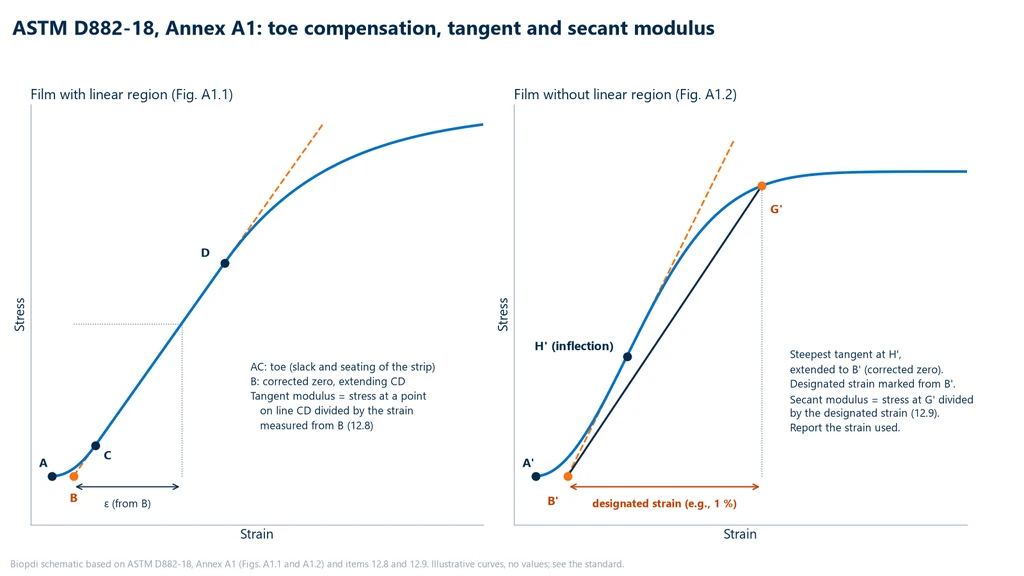
Before any modulus, the curve goes through toe compensation. The initial concave region, called the toe, comes from slack and seating of the strip in the grips and is not a material property. The correction extends the line of the steepest region to the strain axis and uses that point as the new zero; all strain, including the 1% for the secant, is counted from it. In lab practice, a small preload at the start of the test reduces the toe, but does not eliminate the need for the correction.
Annex A1 of the standard distinguishes two cases. In a film with a linear region, the extended line CD gives the corrected zero B, and the tangent modulus is the stress at any point on that line divided by the strain measured from B. In a film without a linear region, the tangent of maximum slope at the inflection point H' gives the corrected zero B'; the designated strain is marked from B', and the secant modulus is the stress at point G' on the curve divided by that strain. The diagram below shows both cases, with the points named by the standard.
Tensile energy to break
Tensile energy to break (TEB, the abbreviation used by D882 itself; some texts call this quantity toughness) is the area under the stress-strain curve up to break, in MJ/m³; it equals the absorbed energy, integrated by the software, divided by the initial volume between the grips, B × w × t. It measures the toughness of the film in tension and is used to evaluate films subject to severe service or that may jam roll handling on machines: two films with the same strength can have very different energies if one elongates much more. The standard itself advises caution with TEB in design, because strain rate, strip dimensions and above all flaws make the value vary widely. For the same reason, a strip that fails by tearing, propagating a crack from the edge instead of breaking normally, gives anomalous data that cannot be compared with the others; the report notes the tear and calculates the results at the point where it starts. The table gathers the formulas and how to report each result:
| Result | Formula | Unit and rounding |
|---|---|---|
| Initial area | A0 = w × t | mm², with average t |
| Tensile strength | σ = Fmax / A0 | MPa, 3 significant figures |
| Tensile strength at break | σr = Fr / A0 | MPa, 3 significant figures |
| Yield stress | σe = Fe / A0 | MPa, 3 significant figures |
| Breaking factor | Fmax / w | N/m or kN/m, 3 significant figures |
| Elongation | ε = ΔL / B × 100 | %, 2 significant figures |
| Secant modulus | Es = σ(εd) / εd | MPa, 3 significant figures, with the strain εd stated |
| Tensile energy to break (TEB) | energy / (B × w × t) | MJ/m³, 2 significant figures |
| Standard deviation | of each result | 2 significant figures |
What goes in the report
The D882 report identifies the material and the sample, including the cutting direction (MD or TD), and records the average length, width and thickness of the strips, the strain rate, the initial grip separation and the speed, the grip type and face lining, the gauge length when it is not the grip separation, the use of an extensometer, the conditioning and test atmosphere, the number of strips, the mean and standard deviation of each result by direction, the discarded strips and the reason, and the strain used for the secant modulus. It is also good practice to record the thickness measurement method and the edition of the standard. The edition matters: a report citing D882-02 does not declare the same method as a report to D882-26.
How to interpret the standard
D882 is short and prescriptive, and several decisions are left to the lab. The points below are the ones that raise the most questions in routine testing, with the reason for each answer.
Which grip separation should I use if I don't know the film's elongation yet?
The elongation range comes from the material specification, the data sheet or a preliminary test. A film that breaks at around 80% falls in the 20 to 100% range: B = 100 mm, C = 0.5 /min and A = 100 × 0.5 = 50 mm/min. If the preliminary test shows an elongation at the boundary, near 100% or 20%, the standard calls for the lower rate. What you must not do is test some strips in one range and some in another and pool the results: at different rates, they are not comparable.
Can I measure modulus on the same test specimen as strength?
Not under D882. The modulus test has its own separation (250 mm) and rate (0.1 /min), and the other properties use another strip, with the separation and rate of the elongation range. On an LDPE film, the strength strip runs at 500 mm/min with 50 mm separation: the initial region goes by in fractions of a second, over a short gauge length in which the toe and seating weigh heavily. The modulus test can be stopped as soon as it reaches the strain needed for the calculation.
Can I use 100 mm separation in the modulus test?
Yes, when there is not enough film for a 300 mm strip (250 + 50), provided it is shown that the result does not change and the 0.1 /min rate is kept. With 100 mm, the speed drops to 100 × 0.1 = 10 mm/min and the strip needs to be 150 mm long. In case of disagreement between labs, the referee result is the one at 250 mm, because the long gauge length dilutes the effect of the grips.
1% or 2% secant?
Whichever the material or customer specification calls for. D882 leaves the designated strain open, and the two values are not comparable: since the polyethylene curve bends early, the 2% secant is lower than the 1% secant on the same film. A data sheet that says only "secant modulus" without the strain is incomplete.
When should I report the breaking factor instead of MPa?
When thickness cannot be measured with the precision that stress requires, which happens with films up to about 0.13 mm, and when the contract calls for force per width. On a 25 µm film, a 2.5 µm resolution already represents 10% of the thickness. Both results can come from the same test, and reporting both is common.
Does a break next to the grip go into the average?
As a rule, no. The strip is discarded and replaced, and the discard goes in the report. The standard only accepts these breaks if it is shown that they agree with those occurring in the free length. If most strips break at the grip, the problem is the grip or the cutting, not the material: changing the faces, adjusting the pressure or checking the cutter comes before repeating the test.
Worked example: 50 µm LDPE film
A packaging laboratory receives a blown LDPE film with a nominal thickness of 50 µm. The strips are 25.0 mm wide with a measured average thickness of 0.050 mm; the expected elongation, according to the supplier's data sheet, is above 100%. The numbers below are for one strip in the MD; the TD strips follow the same calculation and are reported separately.
Part 1: strength, yield, elongation and energy
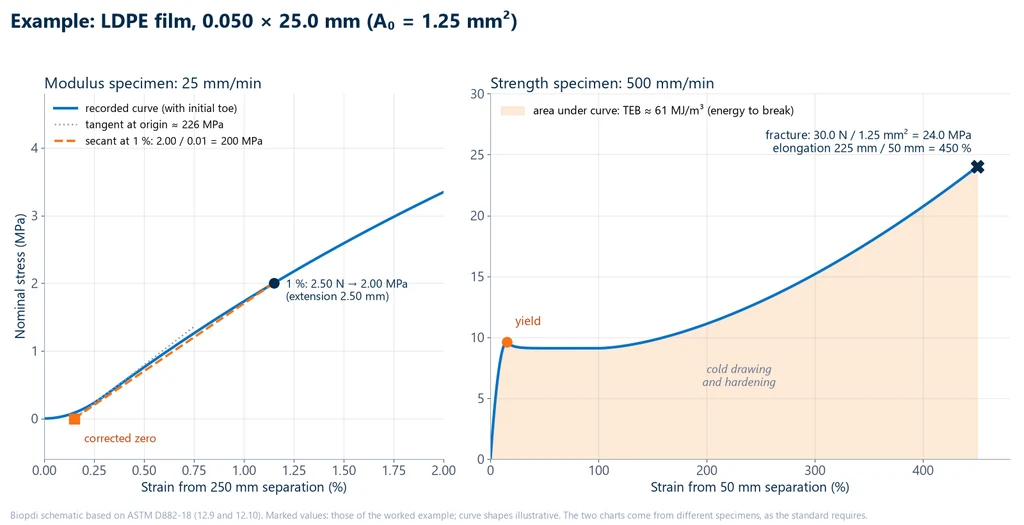
The strength strip breaks at a maximum force of 30.0 N and an extension of 225 mm; the yield force is 12.0 N, at an extension of 7.5 mm; and the software integrates an energy of 3.79 J up to break.
- Range and speed. Elongation above 100%: B = 50 mm and C = 10 /min, so A = 50 × 10 = 500 mm/min.
- Strip. Minimum length of 50 + 50 = 100 mm. Width-to-thickness ratio: 25.0 / 0.050 = 500, above 8.
- Area: A0 = 25.0 × 0.050 = 1.25 mm².
- Tensile strength: σ = 30.0 / 1.25 = 24.0 MPa.
- Yield: σy = 12.0 / 1.25 = 9.60 MPa, with an elongation of 7.5 / 50 × 100 = 15% (the 7.5 mm are already measured from the corrected zero point, as the standard requires).
- Breaking factor: 30.0 N / 0.0250 m = 1,200 N/m = 1.20 kN/m, reported together with the 0.050 mm thickness.
- Elongation at break: 225 / 50 × 100 = 450% (two significant figures, 4.5 × 10² %).
- Tensile energy to break: initial volume = 50 × 25.0 × 0.050 = 62.5 mm³ = 6.25 × 10⁻⁸ m³. TEB = 3.79 / 6.25 × 10−8 = 6.06 × 10⁷ J/m³ = 61 MJ/m³.
Check: the TEB divided by the elongation gives the average stress over the test, 61 / 4.5 ≈ 13.5 MPa, a value between the drawing plateau, near 9 MPa, and the break, at 24 MPa, as expected for a curve that hardens at the end. The strength of 24 MPa falls within the 23 to 30 MPa range measured by Ferreira and Santana on LDPE films.
Part 2: 1% secant modulus
A second strip, 300 mm long, is mounted with a 250 mm grip separation at 25 mm/min (250 × 0.1). After toe compensation, the extension at 1% strain is 0.01 × 250 = 2.50 mm, and the force read at that point is 2.50 N.
- Stress at 1%: σ = 2.50 / 1.25 = 2.00 MPa.
- Secant modulus: Es = 2.00 / 0.01 = 200 MPa, reported as "1% secant modulus: 200 MPa".
- Time to 1%: 2.50 mm / 25 mm/min = 0.1 min = 6 s, counted from the corrected zero point. Data acquisition must record enough points in those seconds.
The secant modulus is lower than the initial slope of the curve, about 226 MPa in this example, because the curve already bends before 1%. The moduli of 278 to 283 MPa measured by Ferreira and Santana on LDPE are of the same order of magnitude, but they were obtained under different test conditions and cannot be compared number for number. The charts below show the two strips: on the left, the initial portion of the modulus test, with the toe, the corrected zero point and the secant line up to 1%; on the right, the complete curve of the strength strip, with yield, drawing, break and the shaded area that corresponds to the tensile energy to break.
Part 3: force range and load cell
The break must fall in the upper two-thirds of the force range. With Fmax = 30.0 N:
- 50 N range: the upper two-thirds run from 16.7 to 50 N. The 30.0 N falls inside: complies.
- 100 N range: runs from 33.3 to 100 N. The 30.0 N falls below: does not comply.
- 1 kN range: 30 N is 3% of the range: does not comply.
In the modulus test, the 2.50 N read at 1% is 5% of a 50 N cell and 0.25% of a 1 kN cell; with the latter, the signal at the point that defines the modulus is the same size as the cell's noise and resolution. For the modulus, D882 also requires the most sensitive force range that keeps the force-extension curve between 30° and 60° to the horizontal axis of the chart. For this film, the 50 N cell is the right choice for both tests. Total displacement also matters: 450% over 50 mm is 225 mm of travel, and more ductile films need more.
ASTM D882, ASTM D638 and ISO 527-3
ASTM D882, ASTM D638 and ISO 527-3 measure the same tensile properties of plastics, and the choice between them starts with thickness: below 1.0 mm, D882 or ISO 527-3; from 1 mm up, D638. D638 is the tensile standard for plastics up to 14 mm thick, with dumbbell specimens, and it names D882 as the preferred method below 1.0 mm; it is explained in the ASTM D638 guide. ISO 527-3:2018, confirmed by ISO in 2024, is the part of the ISO 527 series for films and sheets less than 1 mm thick; it relies on the general principles and speeds of ISO 527-1. In Brazil, film laboratories usually apply the ISO standard itself or ASTM.
ASTM declares D882 technically similar to ISO 527-3, and similar does not mean interchangeable. The 2018 edition of D882 explained the difference: ISO 527-3 allows more specimen types and other speeds, and requires an extensometer or gauge marks. In secondary sources, the preferred ISO 527-3 specimen appears as the type 2 strip, 10 to 25 mm wide, with a marked gauge length of 50 mm; these dimensions were not checked against the full ISO text, so verify them in the 2018 edition. In ISO, strain is read over the marked gauge length or with an extensometer, not over the grip separation, and the speed follows the ISO 527-1 list according to the material specification, without the three elongation ranges of D882. The table summarizes:
| Item | ASTM D882-26 | ASTM D638-22 | ISO 527-3:2018 |
|---|---|---|---|
| Thickness | less than 1.0 mm | up to 14 mm (D882 is preferred below 1.0 mm) | less than 1 mm |
| Test specimen | strip of 5 to 25.4 mm, width ≥ 8 × thickness | dumbbell, types I to V | several types; type 2 strip (dimensions to be checked in the standard) |
| Strain basis | grip separation (or marks and extensometer) | extensometer on the narrow section | gauge marks or extensometer |
| Speed | 12.5, 50 or 500 mm/min by elongation; modulus at 25 mm/min | 5, 50 or 500 mm/min, break between 0.5 and 5 min | ISO 527-1 list, per specification |
| Specific results | breaking factor and tensile energy to break | modulus with extensometer, optional Poisson's ratio | modulus and nominal strains |
A data sheet produced under ISO 527-3 cannot be compared number for number with a specification written under D882: gauge length and speed change together, and the same film gives different elongations. When the customer asks for a standard, the test follows that standard.
Common mistakes when applying ASTM D882
The mistakes below show up in laboratories and on pages that explain the standard, and each one has a direct fix:
- Using the wrong standard for the thickness. Below 1.0 mm, the film standard is D882; a D882 strip cut from a 1.5 mm sheet is out of scope. The boundary is 1.0 mm.
- Citing D882-18 or D882-02 as current. The current edition is D882-26.
- Taking the modulus from the strength strip. The modulus has its own strip, separation and rate.
- Reporting "secant modulus" without the strain. The 1% and 2% secant moduli are different numbers.
- Mixing rates. Strips tested in different ranges do not go into the same average.
- Excessive clamping or grip faces unsuited to the film. They notch the film and cause breaks at the grip, which are excluded from the average.
- Cutting with an impact die or a worn blade. Edge nicks reduce strength and, even more, elongation.
- Skipping toe compensation. The initial slack inflates elongation and lowers the modulus.
- Measuring thickness with an unsuitable micrometer. On a 50 µm film, a 2.5 µm error is 5% in stress. For very thin films, also report the breaking factor.
- Ignoring direction. When anisotropy is suspected, test 5 strips in the MD and 5 in the TD and report them separately.
- Load cell too large. The break must fall in the upper two-thirds of the range; 30 N on a 1 kN cell does not comply.
- Adopting a fixed speed, such as 200 or 300 mm/min. Service pages and even Google's automated summary cite these values, which are not in D882: the speed comes from B × C and is 12.5, 50 or 500 mm/min, and 25 mm/min for the modulus, unless the material specification states another rate.
- Treating D882 and ISO 527-3 as interchangeable. Gauge length, specimen and speed differ; ASTM declares them similar, not equivalent.
- Including a strip that tore in the average. Failure by tearing from the edge gives anomalous data and cannot be compared with a normal break.
- Confusing it with other film standards. Puncture (such as ASTM D5748, for stretch wrap film), tear and film friction have their own standards and do not replace the tensile test; see the puncture resistance test, the tear test and the coefficient of friction (ASTM D1894).
Equipment for ASTM D882 testing
Film testing calls for a universal testing machine with characteristics different from those used for metals: the force is low, tens of newtons on a 25 mm LDPE strip, so a small load cell with resolution at the low end of the scale matters; the speed must reach 500 mm/min and stay within ±5% with the strip under load; the stroke must accommodate elongations of hundreds of percent; and the grips must hold without notching. In Biopdi's M2 line, the MBIOI-1P-M2 portable machine is offered in 200 N, 500 N or 1 kN, with speeds from 0.02 to 600 mm/min, 425 mm of vertical travel and interchangeable 0.05, 0.1, 0.5 and 1 kN cells, and lists films and packaging among its stated applications. The extended-column MBIOI-10-M2, from 2 to 10 kN, has 1,290 mm of travel and speeds from 0.02 to 500 mm/min, for high-elongation films. The cells are class 1 per ISO 7500-1 (ABNT NBR ISO 7500-1:2023 in Brazil), and the BioLab software plots the curve and generates the report. The panel below shows the machine, the role of each part in a D882 test and the line's fixtures used in tensile testing of polymers.
The universal testing machine in tensile testing of films
The M2 line has single-column models, from 200 N to 10 kN, covering the forces of films and thin sheets, and dual-column models, from 5 kN to 1,000 kN. In a film test, each part of the machine has a function:
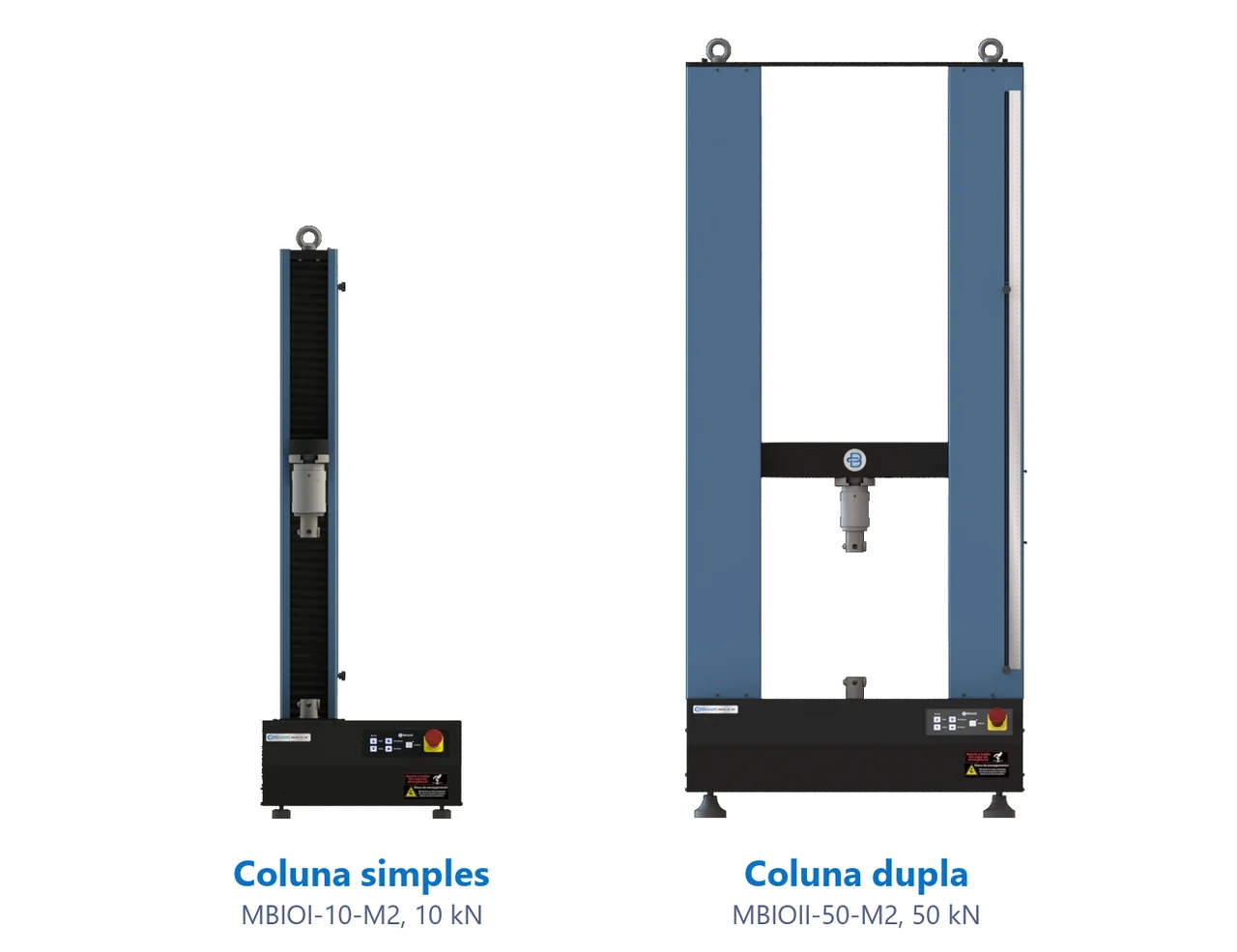
- Moving crosshead separates the grips at 12.5, 25, 50 or 500 mm/min
- Load cell small, with the break in the upper 2/3 of the range
- Grips hold the strip without slipping and without notching
- Stroke accommodates elongations of hundreds of percent
- BioLab software curve, toe compensation, averages by direction and report
- Control panel and emergency stop positions and stops the test
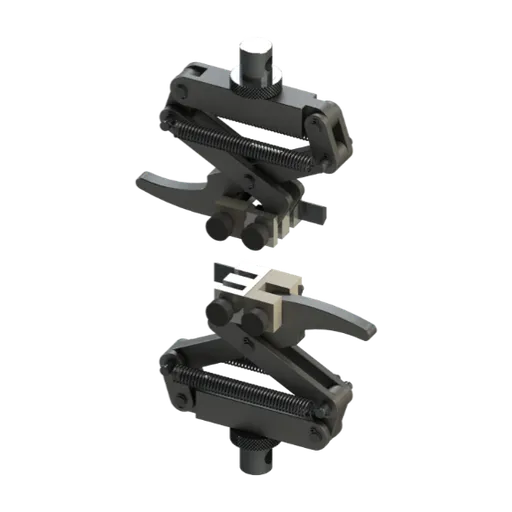
Fixtures for tensile testing of polymers
The grips and extensometers below mount on the same machine; the face and grip configuration for each film is defined with the technical team:
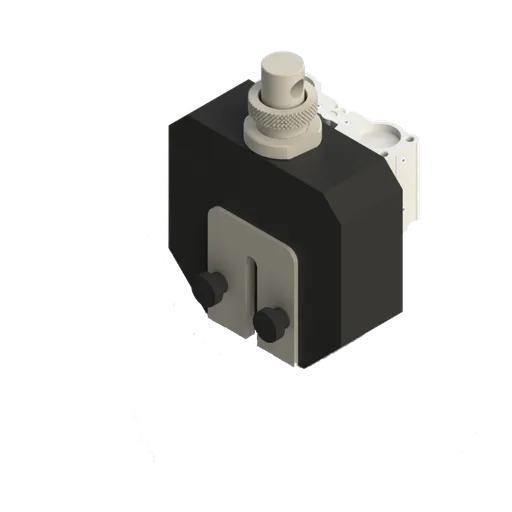
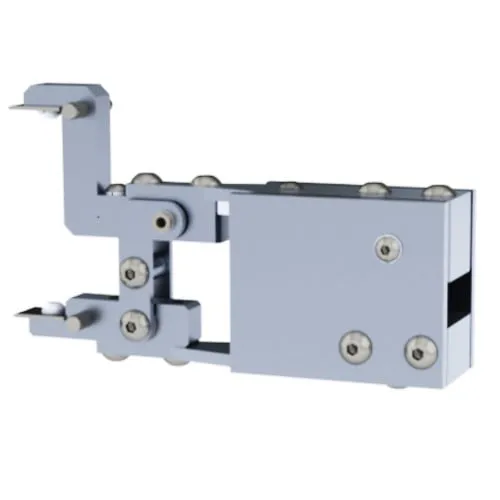
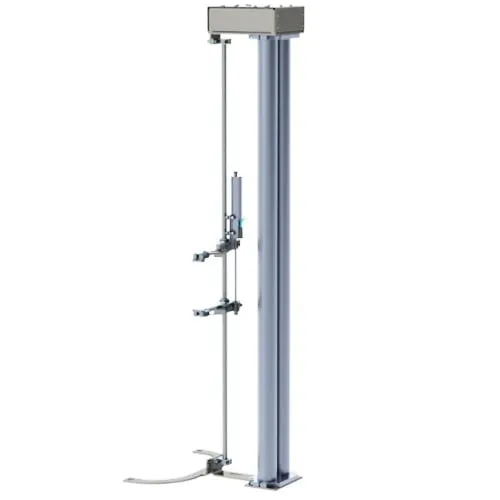
Model selection starts from the expected maximum force, F ≈ σ × w × t, and the displacement to break, B × elongation. The table below indicates the model by application:
| Material | Typical force | Biopdi model |
|---|---|---|
| Packaging and agricultural films, strips up to 25 mm | tens of N | MBIOI-1P-M2 (200 N to 1 kN) |
| Very high elongation films | tens to hundreds of N | Extended-column MBIOI-10-M2 |
| Rigid thin sheets, close to 1 mm | above 1 kN | MBIOI-10-M2 (2, 5 or 10 kN) |
A 0.90 mm polycarbonate sheet, in a 25 mm strip, with a strength near 65 MPa, requires 65 × 25 × 0.90 = 1,463 N, about 1.5 kN: above the portable machine and within the 2 kN single-column model. A film that elongates 700% over 50 mm, on the other hand, travels 350 mm, and the stroke margin of the extended column becomes the criterion. The same machine performs tensile testing of rigid plastics per D638 and flexural testing per ASTM D790, as well as film tests such as those described in biodegradable polymers. How the machine works internally is covered in universal testing machine; to define the load cell, grips and stroke for your films, request a quote.
Standards cited
The table lists the standards cited in this guide with their current edition, checked on September 30, 2026 on each organization's official page; D882 and D412 were checked again on October 1, 2026:
| Standard | Subject | Edition |
|---|---|---|
| ASTM D882 | tensile testing of thin plastic sheeting and film, less than 1.0 mm | D882-26 |
| ASTM D638 | tensile testing of plastics, up to 14 mm | D638-22 |
| ASTM D412 | tensile testing of vulcanized rubber and thermoplastic elastomers | D412-16 (reapproved 2021) |
| ASTM D618 | conditioning of plastics | D618-21 |
| ASTM D6287 | cutting film and sheeting test specimens | D6287-25 |
| ASTM D6988 | thickness of film test specimens | D6988-26 |
| ASTM D883 | terminology relating to plastics | D883-26b |
| ASTM E4 | force verification of testing machines | E4-24 |
| ASTM E83 | extensometer classes | E83-25 |
| ISO 527-3 | tensile testing of films and sheets | 2018 (confirmed in 2024) |
| ISO 527-1 | tensile testing of plastics: general principles | 2019 |
| ABNT NBR ISO 7500-1 | force verification of testing machines (Brazilian adoption of ISO 7500-1) | 2023 |
| ABNT NBR ISO 6892-1 | tensile testing of metals at room temperature (Brazilian adoption of ISO 6892-1) | 2024 |
Source of the MD and TD data: R. L. R. Ferreira and R. M. C. Santana, "Estudo comparativo da influência da razão de sopro nas propriedades de filmes tubulares de PEBD e PEAD" (a comparative study of the effect of blow-up ratio on the properties of LDPE and HDPE blown films), Polímeros, v. 25, n. 1, 2015, DOI 10.1590/0104-1428.1618.
Other tests and technical references
Tests performed on the Biopdi universal testing machine







Related technical references
ASTM D638: tensile testing of plastics, Type I to V specimens, test speed and calculations
ASTM D638-22 is the ASTM method for the tensile properties of plastics up to 14 mm thick, using Type I to V dumbbell specimens. See dimensions, test speed, conditioning, extensometer, formulas, a worked example and the differences from ISO 527-2:2025.
ASTM E8 vs ISO 6892-1: tensile testing of metals, differences and requirements (NBR ISO 6892-1 and A370)
ASTM E8/E8M-25 and ISO 6892-1:2019, adopted in Brazil as ABNT NBR ISO 6892-1:2024, cover the same tensile test of metals at room temperature. They differ in the specimen gauge length (4D in E8, 5D in E8M and 5.65√S0 in ISO), in speed control and its tolerance, in symbols, in rounding and in the standards for the machine and the extensometer. For that reason, elongation from one cannot be compared directly with elongation from the other.
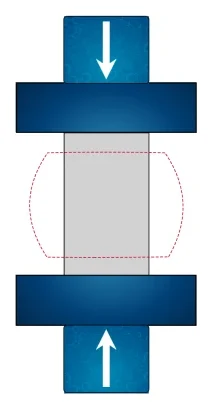
ASTM D695: compression testing of rigid plastics (test specimen, 1.3 mm/min and calculations)
ASTM D695-26 measures compressive strength, yield and modulus of rigid plastics: a 12.7 × 12.7 × 25.4 mm prism at 1.3 mm/min. Calculations and ISO 604.
Frequently asked questions
What is ASTM D882?
It is the ASTM International test method for the tensile properties of thin plastic sheeting and film, less than 1.0 mm thick. It uses rectangular strips 5.0 to 25.4 mm wide and provides tensile strength, yield, elongation, modulus of elasticity or secant modulus, breaking factor and energy to break. The current edition is D882-26.
What is the current edition of ASTM D882?
D882-26, active in the ASTM store with an update dated April 29, 2026, checked on October 1, 2026. Pages and test reports that cite D882-18, D882-12 or D882-02 refer to superseded editions.
What is the tensile test of plastic film used for?
It measures how much load the film withstands, how far it stretches, how stiff it is and how much energy it absorbs before breaking, with numbers that can be compared between batches and suppliers. It is used in quality control and in the specification of packaging, agricultural, barrier and medical films, in research and development, and as design data.
Which ASTM standard covers the tensile test?
It depends on the material. Metals follow ASTM E8/E8M; rigid, semirigid and nonrigid plastics up to 14 mm follow D638, which names D882 as the preferred method below 1.0 mm; film and sheeting less than 1.0 mm follow D882; fiber-reinforced polymer matrix composites follow D3039/D3039M; rubber and thermoplastic elastomers follow D412.
Which ABNT standard covers the tensile test?
It depends on the material. For metals, ABNT NBR ISO 6892-1:2024, the Brazilian adoption of ISO 6892-1. For plastic film, testing in Brazil generally follows ASTM D882 or ISO 527-3 itself, depending on the product or customer specification.
What is the difference between ASTM D638 and ASTM D882?
D638 tests plastics up to 14 mm on dumbbell (dog-bone) specimens, with an extensometer for the modulus and a speed chosen to break the specimen in 0.5 to 5 minutes. D882 tests film and sheeting less than 1.0 mm on straight strips, generally measures strain from grip separation and calculates the speed from the expected elongation. D638-22 itself names D882 as the preferred method below 1.0 mm.
What is ASTM D638 used for?
ASTM D638 is the tensile test method for rigid, semirigid and nonrigid plastics up to 14 mm thick, on Type I to V dumbbell specimens. It provides tensile strength, yield, elongation and modulus of elasticity measured with an extensometer, and the current edition is D638-22.
What is ASTM D412 and how does it differ from ASTM D638?
ASTM D412 is the tensile test method for vulcanized rubber and thermoplastic elastomers, using dumbbell, straight-strip or ring specimens, and the current edition is D412-16, reapproved in 2021. The difference from D638 is the material: D412 covers elastomers, which stretch hundreds of percent and recover their shape, and reports stresses at fixed elongations; D638 covers rigid, semirigid and nonrigid plastics.
What is the specimen width in ASTM D882?
From 5.0 to 25.4 mm, with a width of at least 8 times the thickness and a length at least 50 mm greater than the grip separation. The 25 mm strip is the most common for film.
What is the test speed in ASTM D882?
It is the initial grip separation multiplied by the initial strain rate. For elongation at break below 20 %, 125 mm and 12.5 mm/min; from 20 to 100 %, 100 mm and 50 mm/min; above 100 %, 50 mm and 500 mm/min. The modulus is measured with 250 mm and 25 mm/min, on a separate strip.
What is the 1 % secant modulus?
It is the stress at 1 % strain, counted from the corrected zero of the curve, divided by 0.01. D882 uses it when the curve has no clear linear region, as with polyethylene, and does not fix the designated strain: it comes from the specification, so the result is always reported together with the strain, at 1 % or at 2 %.
How many specimens does ASTM D882 require?
At least 5 per sample of isotropic material. When anisotropy is suspected, as in extruded film, two sets of at least 5 are tested: one in the machine direction and one in the transverse direction, reported separately.
Why test film in the machine direction and the transverse direction?
Because extrusion orients the polymer chains in the production direction and the film becomes anisotropic. In a study of blown LDPE film with a 1.5:1 blow-up ratio, the tensile strength was 30 MPa in the machine direction and 23 MPa in the transverse direction (Ferreira and Santana, 2015).
What conditioning does ASTM D882 require?
At least 40 hours at 23 ± 2 °C and 50 ± 10 % relative humidity, per ASTM D618 Procedure A, with the test performed in the same atmosphere, unless the material specification requires otherwise.
Is ASTM D882 equivalent to ISO 527-3?
No. ASTM states that it is technically similar, but ISO 527-3:2018 allows more specimen types, reads strain from gauge marks or with an extensometer and selects the speed from the ISO 527-1 list. Results from the two standards should not be mixed.
What is the breaking factor?
It is the maximum force divided by the original width of the strip, in N/m or kN/m. The standard indicates it as useful for films 0.13 mm thick or less, whose thickness is hard to measure accurately. A 25 mm strip that breaks at 30 N has a breaking factor of 1.20 kN/m.
Does a break at the grip invalidate the test?
As a rule, yes: the strip is discarded and replaced, and the discard is recorded in the report. The standard only accepts these breaks if it is shown that they agree with breaks that occur in the free length between the grips.
Which grip should be used for film testing to ASTM D882?
A flat-faced grip that does not notch the film: the most common is the side-acting pneumatic grip with rubber faces, because its clamping pressure is adjustable and repeatable. Very thin films call for a line-contact grip, which the standard considers superior when the round face is lined with blotting paper, or, in common industry practice, a roller grip. Serrated jaw faces tend to notch thin film at the clamping line; use lined faces instead.
What goes in an ASTM D882 tensile test report?
The report identifies the material, the cutting direction (MD or TD) and the edition of the standard, and records the average width and thickness, strain rate, initial grip separation, speed, grip type and lining, use of an extensometer, conditioning, number of strips, the mean and standard deviation of each result by direction, discarded strips with the reason, and the strain used for the secant modulus.