
Biodegradable polymers are plastics that microorganisms can convert into CO₂, water and biomass, not just break into fragments. Biodegradation depends on the environment: materials such as PLA only reach 90% in six months under industrial composting, as required by EN 13432 and ASTM D6400.
For packaging to be sold as compostable in Europe, EN 13432 requires that at least 90% of the organic carbon is converted to CO₂ within six months and that, after 12 weeks of composting, at least 90% of the material passes through a 2 mm sieve, with no toxic effect on the compost. Where the raw material comes from decides none of this: PBAT and PCL are made from petroleum and biodegrade, while green polyethylene is made from sugarcane and does not biodegrade. This article covers the types of biodegradable polymers, the biodegradation conditions and standards, their mechanical properties and how to test them.
The photo shows objects sold as sustainable alternatives. The bamboo toothbrushes, the wooden clothespins and the cotton bag are made of natural polymers, such as cellulose, which biodegrade; the bottles are glass, which is not a polymer. The image captures the confusion this article clears up: looking natural does not tell you whether, where or how fast a material biodegrades.

What are biodegradable polymers
According to the IUPAC terminology for polymers of biological interest (Vert et al., Pure and Applied Chemistry, 2012), a biodegradable polymer is one that is susceptible to degradation by biological activity, with a reduction in molar mass. The same recommendation advises against using "biopolymer" as a synonym, because the term mixes origin and end of life. Polymers are one of the major families of materials, alongside metals, ceramics and composites, as shown in the article on types of materials.
Biodegradation happens in stages. First the long chains are broken, usually by hydrolysis of the ester bonds (water reacts with the chain and cuts it) or by enzymes that microorganisms release into the environment. The molar mass drops, leaving small fragments, oligomers and monomers, that can pass through the cell wall. Inside the cell they are used as a source of carbon and energy: with oxygen, the result is CO₂, water and biomass; without oxygen, as in a landfill or an anaerobic digester, methane is also produced. Without this last stage, the plastic has not biodegraded: it has only fragmented.
The rate depends on the polymer and on the environment. On the material side, what matters is the chain chemistry (aliphatic polyesters, with accessible ester bonds, are the most vulnerable), crystallinity, molar mass and thickness; on the environment side, temperature, moisture, oxygen and the amount of microorganisms able to attack that polymer.
The conceptual image below sums up the idea of an engineering material that, at the end of its life, returns to the biological cycle as CO₂, water and biomass. It is an illustration, not a record of a real process.

Biodegradable, compostable, bio-based and oxo-degradable
The four terms appear together on packaging and mean different things. Biodegradable describes an end of life: microorganisms convert the material. Without stating in which environment and how long it takes, the claim is vague, because almost everything biodegrades on some time scale. Compostable is a biodegradable material with a time frame, conditions and outcome verified in a composting process: it must biodegrade, disintegrate and leave no toxic compost. Every compostable material is biodegradable, but not every biodegradable material is compostable.
Bio-based (in Portuguese, de base biológica) describes the origin: the carbon comes from a renewable source, such as sugarcane, corn or vegetable oil. Bioplastic is a market term, used by the European Bioplastics association for plastics that are bio-based, biodegradable or both. The table summarizes the terms:
| Term | What it means | Examples |
|---|---|---|
| Biodegradable | microorganisms convert the material into CO₂ (or methane), water and biomass | PHA, PBAT, PBS, PCL, PLA under suitable conditions |
| Compostable | biodegrades and disintegrates within the time set by the standard, with no ecotoxicity in the compost | products certified to EN 13432 or ASTM D6400 |
| Bio-based | carbon of renewable origin; says nothing about end of life | green PE (does not biodegrade), PLA (biodegrades) |
| Oxo-degradable | conventional plastic with an additive that speeds up fragmentation by oxidation | PE with a pro-oxidant additive |
Origin does not define end of life
The most common mistake is to assume that a plant-based plastic biodegrades. Crossing the two questions, where the carbon comes from and whether the material biodegrades, plastics fall into four groups, and there are commercial examples in all of them:
| Origin | Biodegradable | Non-biodegradable |
|---|---|---|
| Renewable | PLA, PHA, thermoplastic starch (TPS) | green PE, partially bio-based PET |
| Fossil | PBAT, PCL, fossil-based PBS | conventional PE, PP, PET and PVC |
Green PE has the same molecule as petroleum-based polyethylene and therefore the same end of life: it is recyclable, but it persists in the environment. PBAT and PCL, on the other hand, are synthesized from petroleum derivatives and biodegrade, because what decides is the chain chemistry, not the origin of the carbon.
Oxo-degradable plastic: why the European Union banned it
Oxo-degradable plastic, also sold as "oxo-biodegradable", is ordinary polyethylene or polypropylene with an additive that speeds up oxidation. Directive (EU) 2019/904, on single-use plastics, defines it as plastic with additives that, through oxidation, lead to fragmentation into micro-fragments or to chemical decomposition, and Article 5 requires Member States to prohibit placing products made from it on the market. Recital 15 gives the reason: this plastic does not biodegrade properly and contributes to microplastic pollution. The directive also notes that it is not compostable and harms recycling. In 2024, the General Court of the EU dismissed the action brought by a manufacturer of oxo-biodegradable additives against the ban (case T-745/20).
The most cited experimental data come from Napper and Thompson (Environmental Science & Technology, 2019), who exposed biodegradable, oxo-biodegradable, compostable and conventional HDPE bags for three years in open air, buried in soil and submerged in the sea. In open air, all of them fragmented within nine months. The compostable bag disappeared within three months in the sea, but was still present in the soil after 27 months, although it could no longer hold weight without tearing. The authors' conclusion: none of the bags showed substantial deterioration in all environments, and it was not clear that the oxo-biodegradable or biodegradable formulations offered any advantage over the conventional bag in reducing marine litter.
Types of biodegradable polymers
Commercial biodegradable polymers are almost all aliphatic polyesters or materials based on starch and cellulose. They differ in origin, in the environment where they biodegrade and in mechanical behavior: some are stiff and brittle, others flexible and highly ductile. The property ranges given below are from Wang and Guo (Frontiers in Chemistry, 2026, Table 1).
PLA, poly(lactic acid)
PLA is the most produced and best known biodegradable polymer. Sugar from corn, sugarcane or beet, or glucose obtained by hydrolysis of starch, is fermented by bacteria into lactic acid; the acid is purified and polymerized, usually by ring-opening of lactide, the cyclic dimer of lactic acid. The result is a stiff, transparent plastic, with a modulus of 2,000 to 3,500 MPa and a strength of 21 to 70 MPa, but brittle: it elongates less than 10% before fracture. The glass transition lies between 50 and 80 °C. It is used in cups and rigid packaging, fibers, 3D printing filament and, in medical grades, in absorbable implants and sutures.
PHA, PHB and PHBV
Polyhydroxyalkanoates (PHA) are polyesters that bacteria accumulate inside the cell as a carbon and energy reserve when they grow with an excess of carbon source (sugars or vegetable oils) and a shortage of another nutrient. The simplest is PHB, poly(3-hydroxybutyrate); the copolymer with hydroxyvalerate, PHBV, is less crystalline and slightly less brittle. They are stiff (modulus of 2,000 to 3,500 MPa for PHBV) and elongate 1 to 8%. They are among the few biodegradable polymers that also degrade in soil and in the sea, and they have a practical drawback: they age at room temperature, as the section on degradation shows.
PBAT
PBAT, poly(butylene adipate-co-terephthalate), is a fossil-based aliphatic-aromatic copolyester. The aromatic part provides thermal resistance and the aliphatic part, biodegradability. It is the "polyethylene" of biodegradables: a modulus of only 40 to 100 MPa, a strength of 18 to 35 MPa and an elongation above 500%. It is the base of compostable bags and agricultural mulch films (mulching), almost always blended with PLA or starch, which increase stiffness and lower cost.
PBS
PBS, poly(butylene succinate), is made from succinic acid and butanediol, which can come from petroleum or from fermentation. It sits in the middle: a modulus of 300 to 700 MPa, a strength of 30 to 40 MPa and an elongation that depends heavily on processing, from 100 to 400% in the Wang and Guo review and only 7.1% in a compression-molded film measured by Costa et al. (Polymers, 2020). It is found in films, disposables and blends with PBAT.
PCL, polycaprolactone
PCL is biodegradable and fossil-based. It is obtained by ring-opening of ε-caprolactone, a cyclic ester, with a catalyst. It is very flexible (modulus of 200 to 500 MPa, elongation of 300 to 1,000%) and melts at only 55 to 65 °C, which limits its use at temperature and makes it easy to mold. Because it is biocompatible and degrades slowly in the body, it is used in biomedical devices, controlled drug release and as a blend component.
Thermoplastic starch (TPS)
Granular starch does not melt. With a plasticizer, usually glycerol and water, and with heat and shear in the extruder, the granules are destructured and the material can be processed as a plastic: this is thermoplastic starch. It is cheap, renewable and biodegrades quickly, but it is the weakest of the group (strength of 2 to 15 MPa) and its properties change with air humidity. For this reason it is hardly ever used on its own: it goes into blends with PBAT or PLA and into protective foams.
Cellulose and derivatives
Cellulose, which makes up the cotton, wood and bamboo in the opening photo, biodegrades in soil and in compost. To become a film or fiber, it is converted into cellophane (regenerated cellulose) or cellulose acetate; in acetate, biodegradation is slower the more cellulose groups have been substituted. Properties vary so much among these products that there is no single typical range for comparison.
The table summarizes the seven groups, with the condition under which each one biodegrades within a useful time frame, explained in the next section:
| Polymer | Origin | Where it biodegrades well | Mechanical behavior |
|---|---|---|---|
| PLA | renewable (sugar fermentation) | industrial composting; slow in soil, sea and home composting | stiff and brittle |
| PHA (PHB, PHBV) | renewable (bacteria) | compost, soil and sea | stiff and brittle; ages |
| PBAT | fossil | industrial composting; soil, as films | highly ductile, low modulus |
| PBS | fossil or partially renewable | compost and soil | intermediate |
| PCL | fossil | compost and soil | very flexible, melts at 60 °C |
| TPS (starch) | renewable | compost and soil | weak, sensitive to moisture |
| Cellulose and derivatives | renewable | depends on the degree of substitution | varies with the product |
Biodegradation conditions: where each one biodegrades
Because biodegradation depends on the environment, the standards distinguish four settings. Industrial composting is the most aggressive: the pile of organic waste, with controlled moisture and aeration, heats up on its own through microbial activity and spends weeks in the thermophilic range, above 50 °C. Laboratory tests of biodegradation in compost, such as ISO 14855-1, are run at 58 °C. Home composting stays at ambient temperature, which varies with climate and management; soil and sea are mesophilic, colder and, in the case of the sea, with far fewer microorganisms per volume.
A result in one environment does not apply to another, and PLA shows why temperature matters so much. The 58 °C of industrial composting falls within the glass transition range of PLA, and above it the chains gain mobility, water penetrates and hydrolysis speeds up. Below that temperature, in soil, in the sea or in a backyard composter, PLA degrades very slowly. The table summarizes the four environments:
| Environment | Condition | Reference standards | Which polymers tend to pass |
|---|---|---|---|
| Industrial composting | thermophilic; tests at 58 °C | EN 13432, ASTM D6400, ISO 17088 | PLA, PBAT, PBS, PHA, TPS |
| Home composting | ambient temperature, variable | private certification schemes | PHA, TPS, PCL; PLA is slow |
| Soil | mesophilic | EN 17033, ISO 23517 (mulching films) | PBAT and blends, PHA, PCL |
| Sea | mesophilic, low microbial load | ISO 22403 (laboratory) | PHA; PLA degrades poorly |
Compostability and biodegradation standards
Standards turn the word "compostable" into measured criteria. The European EN 13432, the American ASTM D6400 (edition D6400-26) and the international ISO 17088:2021 specify when a plastic can be labeled as compostable in industrial facilities, under thermophilic conditions. All three require four checks, which in EN 13432 are these:
- Biodegradation: at least 90% of the organic carbon converted to CO₂ within six months, in absolute terms or relative to a reference material such as cellulose. The method is respirometry in controlled compost, per ISO 14855-1.
- Disintegration: after 12 weeks of composting, at least 90% of the mass passes through a 2 mm sieve. The pilot-scale test is the one in ISO 16929:2021.
- Compost quality: the resulting compost must not harm plant germination and growth.
- Constituents: limits on heavy metals and other substances.
A word of caution when reading these: the six months are the maximum duration of the test under controlled composting, not the time the material takes to disappear anywhere. The soil standards, EN 17033 and ISO 23517, cover agricultural mulch films, which are plowed into the soil after harvest. The marine standard, ISO 22403, assesses biodegradability in the laboratory with a marine inoculum; it does not simulate the real sea and does not allow anyone to claim that the product "disappears in the ocean".
The Brazilian NBR 15448 standards
In Brazil, ABNT (the Brazilian standards body) published two standards in 2008 for degradable plastic packaging or packaging from renewable sources: NBR 15448-1, on terminology, and NBR 15448-2, on biodegradation and composting, with requirements and test methods. Part 2 adopts the same threshold as EN 13432, with at least 90% of the organic carbon converted to CO₂ within a maximum of six months. Part 1 left out the term "oxo-biodegradable", which, according to the Brazilian magazine Plástico Moderno (February 2008), did not appear in any international technical standard. The history of both standards records confirmations by ABNT in 2014, 2018 and 2023; before citing them in a contract, check their current status in the ABNT catalog.
How the degree of biodegradation is calculated
In respirometry, the material is mixed with compost in an aerated reactor, and the CO₂ released is measured throughout the test. A reactor with compost only, the blank, subtracts the CO₂ produced by the compost itself. The result is compared with the theoretical CO₂, ThCO₂, that the carbon in the sample would generate if it were fully converted:
- Theoretical CO₂: ThCO₂ = m × wC × 44/12, where m is the sample mass, wC is the carbon mass fraction and 44/12 is the ratio between the molar masses of CO₂ and carbon.
- Degree of biodegradation: D = (CO₂ from sample − CO₂ from blank) / ThCO₂ × 100.
Example. A 10 g sample of PLA, whose repeat unit C3H4O2 has 72 g/mol, of which 36 g are carbon (wC = 0.50). ThCO₂ = 10 × 0.50 × 44/12 = 18.33 g. If, after 150 days, the net CO₂ (sample minus blank) totals 16.9 g, D = 16.9 / 18.33 = 92%, and the criterion of 90% within six months has been met. The values are for illustration, not from a real test.
Compostability certification labels
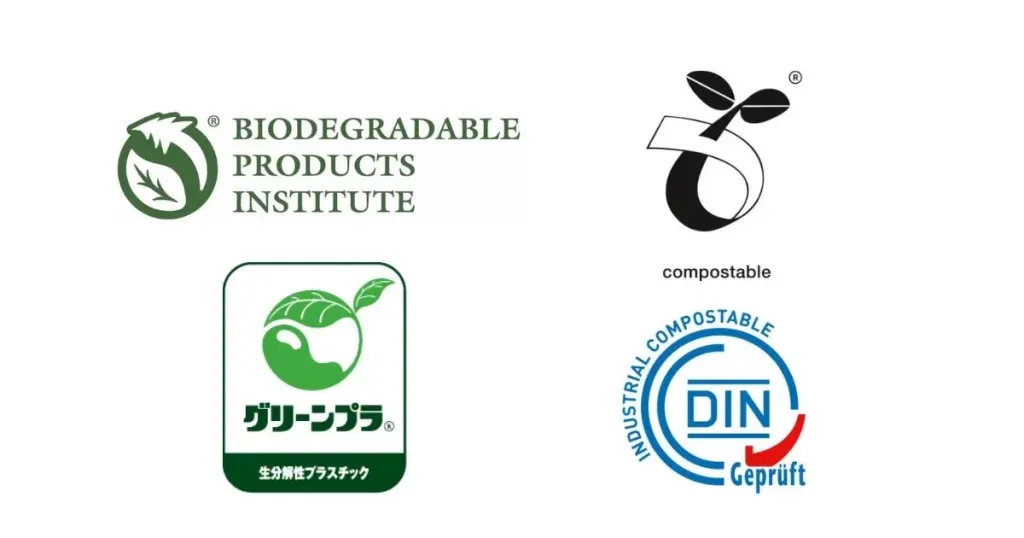
The label on the package indicates that an independent laboratory performed these tests and a certification body approved that product. The standard defines the criteria, but the label is issued by the certification body, which is why each region has its own. The image below brings together four real marks:
- BPI (Biodegradable Products Institute): a North American certification body; the certified product meets ASTM D6400 (plastics) or ASTM D6868 (coated paper and fibers). The image shows the institute's logo.
- Seedling, "compostable": a registered trademark of European Bioplastics that attests industrial compostability per EN 13432; certification is carried out by DIN CERTCO and TÜV AUSTRIA, and the label must be accompanied by the registration number.
- GreenPla: the mark of the identification system for biodegradable plastics of the Japan BioPlastics Association (JBPA), created in 2000. The characters below the logo read "biodegradable plastic".
- DIN-Geprüft Industrial Compostable: a mark of DIN CERTCO, in Germany, granted to products that comply with EN 13432, with parallel certifications under ISO 17088 and other standards.
Mechanical properties of biodegradable polymers
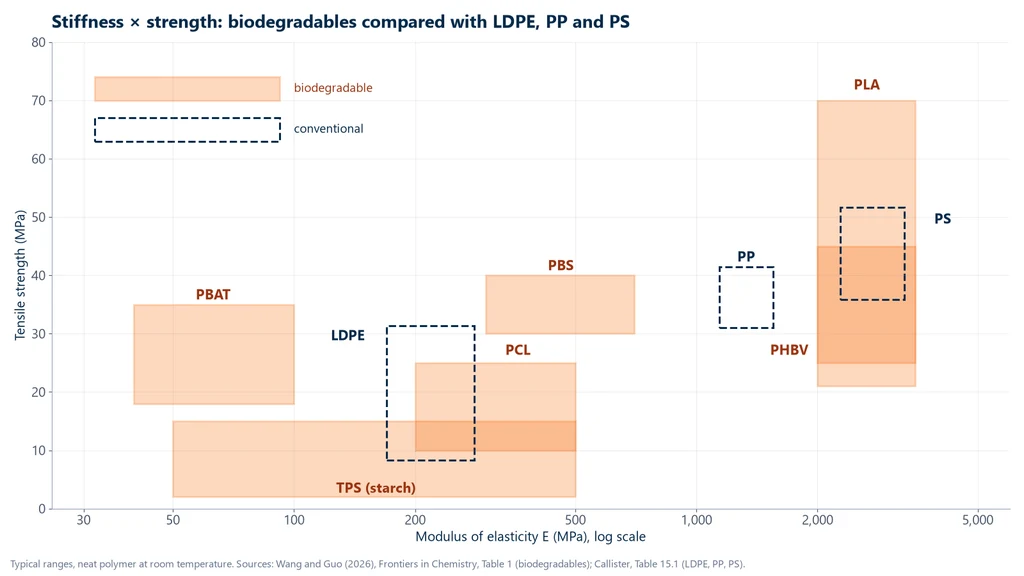
Saying that biodegradable polymers are "weaker" than conventional plastics is inaccurate. The group is as varied as that of conventional plastics: PLA and PHBV have stiffness and strength in the range of polystyrene, while PBAT and PCL behave like low-density polyethylene. The typical problem of PLA and PHAs is not strength, it is brittleness. The three properties involved come from the tensile test: the modulus of elasticity, which measures stiffness; the ultimate tensile strength; and the elongation at break, which measures ductility. The overview is in mechanical properties of materials.
The table gives the typical ranges for the neat polymer at room temperature and, in the rows with the source highlighted, values measured in a specific test, with the condition stated:
| Polymer (source) | Tensile strength (MPa) | Modulus (MPa) | Elongation at break (%) |
|---|---|---|---|
| PLA (Wang and Guo) | 21 to 70 | 2,000 to 3,500 | less than 10 |
| PHBV (Wang and Guo) | 25 to 45 | 2,000 to 3,500 | 1 to 8 |
| PHB after 1 day (Righetti et al., 2019) | 31.6 | 3,200 | 1.1 |
| PBS (Wang and Guo) | 30 to 40 | 300 to 700 | 100 to 400 |
| PBS, 0.25 mm film (Costa et al., 2020) | 29.6 ± 1.5 | 725.6 ± 15.6 | 7.1 ± 0.3 |
| PCL (Wang and Guo) | 10 to 25 | 200 to 500 | 300 to 1,000 |
| PBAT (Wang and Guo) | 18 to 35 | 40 to 100 | more than 500 |
| PBAT, 0.25 mm film (Costa et al., 2020) | 20.1 ± 2.4 | 81.0 ± 2.5 | 689.5 ± 110.3 |
| TPS, thermoplastic starch (Wang and Guo) | 2 to 15 | 50 to 500 | 10 to 150 |
The films of Costa et al. were tested at 23 °C and 45% relative humidity, at 5 mm/min, after 48 hours of conditioning, and the reported strength is the stress at break. The difference between the 7.1% elongation of this PBS film and the 100 to 400% range of the review is not an error: commercial grade, crystallinity, molar mass, molding process and thickness greatly change the ductility of polyesters. That is why a polymer property value is only comparable when the standard, the test specimen and the conditioning are stated.
The chart below compares the stiffness and strength ranges of biodegradable polymers with those of three conventional plastics, using the values from Callister (Table 15.1): LDPE, PP and PS. PLA and PHBV occupy the PS region; PBS sits between LDPE and PP; PBAT and PCL sit in the LDPE region; thermoplastic starch is the weakest of all.
Elongation separates the groups even more clearly. The chart below shows that PLA and PHBV break at a few percent, like PS, while PCL and PBAT exceed 300%, like LDPE and PP. The diamonds are the measured values from the table, and the PBS one shows how far a real film can depart from the typical range.
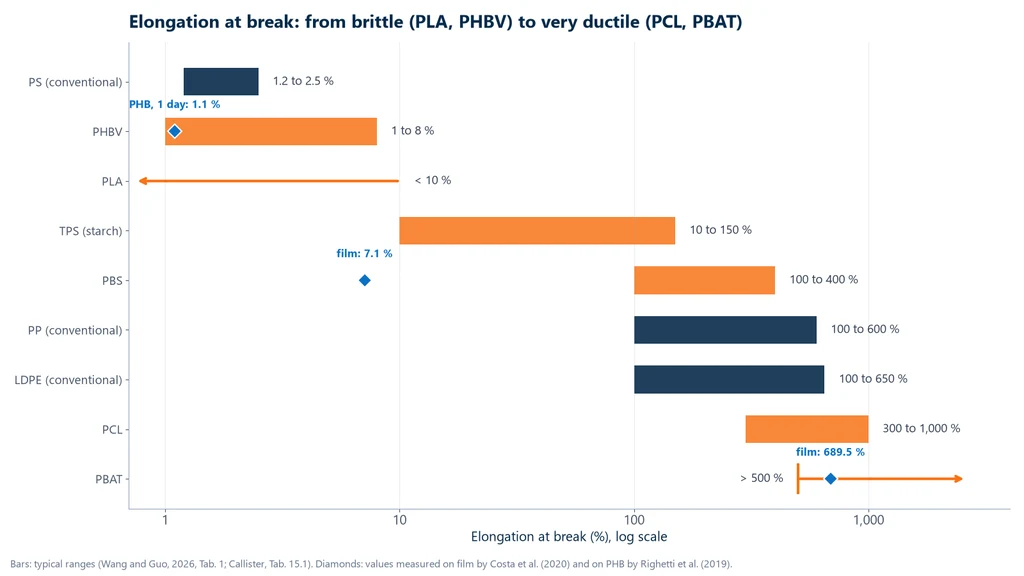
This complementarity explains the blends on the market: PLA provides stiffness and PBAT provides toughness. PLA has the curve of a brittle polymer, which breaks shortly after the elastic region and absorbs little energy (low toughness); PBAT has that of a ductile polymer, which yields and stretches to several times its initial length. The typical shapes are in the article on the stress-strain curve.
How to test biodegradable polymers
Biodegradable polymers are tested to the same standards as conventional plastics, on a universal testing machine, with extra care regarding moisture and the age of the test specimen.
Tensile: ISO 527 and ASTM D638, and ASTM D882 for films
The tensile test is the main one. Molded or extruded plastics follow ISO 527-1 (general principles) together with ISO 527-2, whose injection-molded type 1A test specimen has a narrow section of 10 × 4 mm and a gauge length of 75 mm, or ASTM D638-22, with the type I specimen (13 mm wide). Films and sheets thinner than 1 mm, such as those used for bags and mulching, go to ASTM D882-26 or ISO 527-3, with strips or small dumbbell specimens. The factors that weigh most on the result are these:
- Conditioning: the specimen is held at controlled temperature and humidity before the test (23 °C and 50% relative humidity is the standard for plastics). In thermoplastic starch, air humidity changes the glass transition and the properties; in PHAs, the age of the specimen changes the result. Report both.
- Extensometer for the modulus: ISO 527-1 calculates the modulus as the chord between 0.05% and 0.25% strain and requires an extensometer. Using crosshead displacement, the modulus comes out underestimated, because the specimen's shoulder regions, seating in the grips and the deformation of the machine itself are included. The tensile test article details the use of extensometers on polymers.
- Large elongation and low forces: PBAT and PCL elongate by hundreds of percent, which requires crosshead travel and a long-travel extensometer; and, with low forces, the load cell must be small, because measuring at a tiny fraction of capacity increases the relative error.
Flexural and impact
The flexural modulus in data sheets comes from the 3-point flexural test, per ISO 178 (80 × 10 × 4 mm bar, span of 16 times the thickness, 64 mm) or ASTM D790, on the same universal testing machine, with a flexural fixture. It is the usual test for comparing the stiffness of PLA formulations and blends. Brittleness under a blow is measured in the Charpy or Izod impact test, on a pendulum, per the plastics standards ISO 179-1, ISO 180 and ASTM D256.
Calculation examples
The three examples use the tensile test formulas: stress σ = F / A0, strain ε = ΔL / L0 and chord modulus E = (σ2 − σ1) / (ε2 − ε1).
1. Strength of a PLA, ISO 527-2 type 1A. Cross section of 10 × 4 mm, A0 = 40 mm², maximum force of 2.40 kN: σ = 2,400 / 40 = 60 MPa, within the 21 to 70 MPa range for PLA. A 70 MPa PLA would break at 2.8 kN, and a 20 MPa PBAT in the same specimen, at 0.8 kN.
2. Chord modulus with an extensometer. In the same test, the extensometer with L0 = 75 mm records 1.6 MPa at 0.05% and 8.6 MPa at 0.25%: E = (8.6 − 1.6) / (0.0025 − 0.0005) = 7.0 / 0.0020 = 3,500 MPa. 0.25% of 75 mm is only 0.19 mm of elongation: this is the order of magnitude that grip slack distorts when the crosshead is used.
3. PBAT film. A strip 4 mm wide and 0.25 mm thick has a cross section of 1 mm²; at 20 MPa, it breaks at about 20 N. On a 1 kN load cell, that is 2% of capacity, and a 50 N or 100 N load cell measures with better resolution. With 690% elongation, an initial grip separation of 50 mm requires 345 mm of crosshead travel, and one of 100 mm, 690 mm.
How degradation affects mechanical properties
Degradation changes the properties long before the material disappears, and the order in which they drop is predictable. Hydrolysis cuts the chains and reduces the molar mass; with shorter chains there is less entanglement between them, and the material first loses its ability to deform: elongation and toughness drop. Strength drops later.
PHAs show another mechanism, physical aging at room temperature. Righetti et al. (Frontiers in Chemistry, 2019) followed PHB and PHBV stored at room temperature: crystallinity and the rigid amorphous fraction (trapped between the crystals) increased, modulus and strength rose and elongation fell. Neat PHB was so stiff that it could only be tested after one day of aging: 3.2 GPa modulus, 31.6 MPa strength and 1.1% elongation. In thermoplastic starch, the effect comes from moisture: water plasticizes the material and lowers the glass transition. In all three cases, the practical rule is the same: condition the test specimens and report humidity, temperature and age.
In a degradation study, the metric is property retention: R = P(t) / P(0) × 100, where P is the strength, modulus or elongation after exposure time t. The typical protocol exposes series of specimens to compost, soil, water or an aging chamber, removes one series at each interval and tests it in tension. The bag in the Napper and Thompson study that could no longer hold weight without tearing is this loss, seen without a test. In biomedical devices made of PLA or PCL, the question is the same under repeated loading, and the fatigue test comes into play.
Retention example. The PLA from example 1 (60 MPa and 4% elongation) is aged and now breaks at 1.68 kN and 1.2%. New strength: 1,680 / 40 = 42 MPa, a retention of 42 / 60 = 70%. Elongation: 1.2 / 4 = 30% retention. Elongation dropped much more than strength, the same pattern as in PHAs: it is the most sensitive indicator of degradation.
Bioplastics market and regulation
According to the market report by European Bioplastics with nova-Institut (December 2025), global production capacity for bio-based plastics was 2.31 million tonnes in 2025, about 0.5% of the 431 million tonnes of plastic produced per year, and actual production was 1.67 million tonnes, 72% of capacity. The projection is to reach about 4.69 million tonnes in 2030, with growth driven by PHA, PLA and the bio-based versions of PP and PE. Packaging is the largest market, with 41.3% (0.95 million tonnes).
On regulation, the most frequently cited milestone is Directive (EU) 2019/904, which banned oxo-degradable plastic products and a list of single-use items in the European Union. In Brazil, the main federal bill on the subject is PL 2524/2022, which sets rules for the circular economy of plastics. According to a check of the Brazilian Senate's open data on September 30, 2026, it is still under consideration, with the status "matéria com a relatoria" (with the rapporteur) since March 5, 2024, in the Economic Affairs Committee (Comissão de Assuntos Econômicos).
Standards cited in this article
The table lists the compostability, biodegradation and mechanical testing standards cited, with the edition checked on September 30, 2026:
| Standard | Scope | Edition |
|---|---|---|
| EN 13432 | packaging recoverable through composting and biodegradation | 2000 |
| ASTM D6400 | labeling of plastics designed to be composted in industrial or municipal facilities | D6400-26 |
| ISO 17088 | specifications for compostable plastics | 2021 |
| ISO 14855-1 | aerobic biodegradability under controlled composting conditions, by evolved CO₂ | 2012 |
| ISO 16929 | degree of disintegration under composting conditions, pilot scale | 2021 |
| EN 17033 | biodegradable mulch films for agriculture | 2018 |
| ISO 23517 | soil-biodegradable materials for mulch films | 2021 |
| ISO 22403 | intrinsic biodegradability with marine inoculum, in the laboratory | 2020 |
| ABNT NBR 15448-1 | Brazilian standard for degradable and/or renewable-source plastic packaging: terminology | 2008 |
| ABNT NBR 15448-2 | same series: biodegradation and composting, requirements and test methods | 2008 |
| ISO 527-1 | tensile properties of plastics: general principles | 2019 |
| ISO 527-2 | tensile testing of molding and extrusion plastics | 2025 |
| ASTM D638 | tensile testing of rigid and semirigid plastics | D638-22 |
| ASTM D882 | tensile testing of plastic films and sheeting less than 1 mm thick | D882-26 |
| ISO 178 | flexural properties of plastics | 2019 |
| ASTM D790 | flexural testing of unreinforced and reinforced plastics | D790-25 |
Universal testing machine for biodegradable polymer testing
Tensile and flexural tests on polymers call for low forces measured accurately, enough stroke for elongations of several hundred percent, and an extensometer. The Biopdi M2 line universal testing machine is electromechanical, with load cells starting at 0.05 kN (11 lbf). For biodegradable polymers, three models cover the cases in this article:
- Films, threads and tapes: the MBIOI-1P-M2 portable machine, from 200 N to 1 kN, with 425 mm of stroke, for compostable bags and mulch films like the one in example 3.
- ISO 527 and ASTM D638 specimens: the single-column MBIOI-10-M2, from 2 to 10 kN, with 890 mm of stroke, suited to polymers and elastomers such as the PLA, PHB and PBS in examples 1 and 2, and also to flexural testing to ISO 178 and ASTM D790 with the flexural fixture.
- High elongation: the extended-column MBIOI-10-M2, also from 2 to 10 kN, with 1,290 mm of stroke, for PBAT and PCL films that exceed 500%.
For the modulus, the line offers clip-on extensometers attached to the specimen; for materials that elongate a lot before breaking, long-travel extensometers with a gauge length of 10 to 100 mm and up to 250 mm of travel. The BioLab software plots the stress-strain curve, calculates the modulus, strength and elongation, and builds the report.
Other tests and technical references
Types of materials: metals, ceramics, polymers and composites (properties, how to choose and how to test)
Engineering materials fall into four classes: metals, ceramics, polymers and composites. The first three differ in the type of chemical bonding, which explains stiffness, ductility and service temperature; composites combine two or more classes. See examples, typical properties with sources, the Ashby chart, how to choose and how to test each class.
Nitriding: what it is, processes (gas, plasma and salt bath), white layer, NHD and difference from carburizing
Nitriding is a thermochemical treatment that diffuses nitrogen into the steel surface below the austenitizing temperature, with no quenching: 495 to 565 °C for gas nitriding, 430 to 595 °C for plasma nitriding and about 570 to 580 °C in a salt bath. It forms a white layer of 10 to 20 µm on top of a diffusion zone of 0.1 to 0.6 mm, with 600 to over 1,000 HV depending on the steel. See the processes, the steels, how to measure the NHD per ISO 18203 and the comparison with carburizing.
Quenching steel: what it is, temperatures, quenching media, types and the quench and temper cycle
Quenching steel means heating the part until austenite forms, usually 30 to 50 °C above Ac3, then cooling it rapidly in water, oil, polymer or gas to form martensite. Carbon sets the maximum hardness and alloying sets the hardened depth. See temperatures by steel (1045 at 820 to 850 °C), the Grossmann H severity, martensite and Ms, the Jominy test, types of quenching, stainless steel, cracking and the quench and temper cycle.
Carburizing of steel: what it is, types, temperature, case depth and control
Carburizing is the thermochemical treatment that enriches the surface of a low-carbon steel with carbon, usually between 900 and 930 °C, before quenching and tempering. The part ends up with a 58 to 62 HRC surface and a tough core. See the types (gas, pack, liquid and vacuum), Harris's formula for time (about 0.63·√t mm at 925 °C), the steels used, the effective case depth at 550 HV per ISO 18203:2026, defects and solved exercises.
Frequently asked questions
What are biodegradable polymers?
They are polymers that microorganisms can convert into CO₂, water and biomass after the chain has been broken down by hydrolysis or by enzymes. The rate depends on the environment: to be labeled compostable under EN 13432, the material must convert at least 90% of its carbon into CO₂ within six months under controlled composting.
Which plastics are biodegradable?
The main ones are PLA, PHAs (PHB and PHBV), PBAT, PBS, PCL and thermoplastic starch, often used in blends. PBAT and PCL are petroleum-based and still biodegrade. Conventional PE, PP, PET and PVC are not biodegradable, and neither is green PE made from sugarcane.
What are 5 examples of biodegradable products?
PLA cups and rigid packaging, compostable bags made of PBAT with starch or with PLA, agricultural mulch films, PLA filament for 3D printing, and absorbable sutures and implants made of PLA or PCL.
Is PVC biodegradable?
No. PVC is a persistent conventional plastic and is not biodegradable in any of the environments covered by the composting, soil or marine standards. The same applies to conventional PE, PP and PET.
What is the difference between biodegradable and compostable?
Compostable means biodegradable within a proven time frame and under proven conditions: under EN 13432, at least 90% of the carbon becomes CO₂ within six months and at least 90% of the mass passes through a 2 mm sieve after 12 weeks, with no toxic effect on the compost. A material can biodegrade slowly and not be compostable.
Is bioplastic the same as biodegradable plastic?
No. Bioplastic covers both bio-based plastic, such as green PE, which does not biodegrade, and fossil-based biodegradable plastic, such as PBAT. The origin of the carbon does not determine the end of life.
What is oxo-degradable plastic and why was it banned?
It is a conventional plastic with an additive that accelerates oxidation and breaks it into smaller and smaller fragments. The European Union banned products made of this material through Directive 2019/904 (Art. 5), because it does not biodegrade properly, contributes to microplastics, is not compostable and harms recycling.
How long does biodegradable plastic take to decompose?
It depends on the environment. In industrial composting, a certified product biodegrades at least 90% within six months. Outside it, it can take years: in a three-year study, a compostable bag disappeared in the sea within three months but was still present in soil after 27 months (Napper and Thompson, 2019).
What are the disadvantages of biodegradable plastic?
Many of them, such as PLA, only biodegrade quickly in industrial composting; PLA and PHAs are brittle; thermoplastic starch loses properties with moisture; the cost is higher; and, when discarded together with PE or PET, they contaminate the recycling of those plastics.
Is PLA strong?
It is stiff and strong, with a modulus of 2,000 to 3,500 MPa and a strength of 21 to 70 MPa, in the range of polystyrene. Its weak point is brittleness: it elongates less than 10% before breaking, which is why it is blended with PBAT, which exceeds 500%.
How is the strength of a biodegradable polymer measured?
By a tensile test on a universal testing machine, to ISO 527-2 (type 1A specimen, 10 × 4 mm) or ASTM D638; films follow ASTM D882. The modulus requires an extensometer, the specimens are conditioned beforehand, and the retention of strength and elongation after exposure quantifies the degradation.
Are the NBR 15448 standards still valid?
NBR 15448-1 (terminology) and NBR 15448-2 (biodegradation and composting), Brazilian standards from ABNT, date from 2008, and ABNT recorded confirmations of them in 2014, 2018 and 2023. Part 2 uses the same criterion as EN 13432. Before citing them in a contract, check their status in the ABNT catalog.