
Mechanical strength is the highest stress a material can withstand before it yields or fractures, calculated as force divided by cross-sectional area (σ = F/A). It is expressed in MPa, which is the same as N/mm², and it depends on the type of load: tension, compression, bending, shear or torsion, each measured in a standardized test.
An example gives the order of magnitude: a steel test specimen 10 mm in diameter that fractures in tension at a maximum force of 33.0 kN has a strength of 33,000 N ÷ 78.54 mm² = 420 MPa. This article covers strength as a material property: what it is, the formula and the unit, the types, how it is measured, the values for steel, aluminum, concrete, wood and plastic, what increases it and how to read a value without error. The full list of properties is in the article on the mechanical properties of materials, and the design of parts is covered by strength of materials.
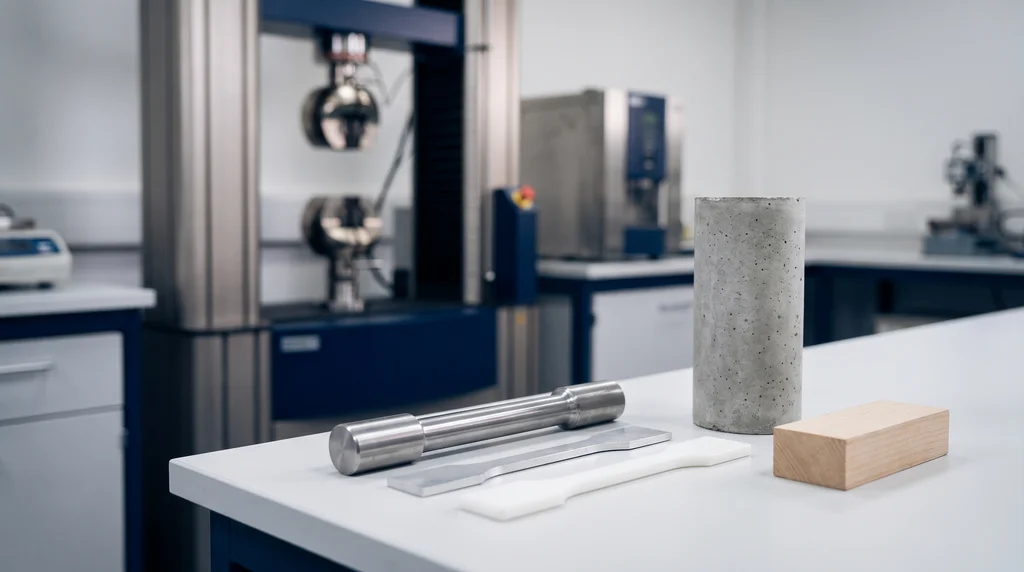
The photo shows test specimens of five materials on the bench, with the universal testing machine in the background: a cylindrical steel bar, an aluminum strip, a dog-bone plastic specimen, a concrete cylinder and a wood block. Each has a different strength and is tested in a different way, which is the subject of the next sections.
What is mechanical strength
Mechanical strength is a stress, not a force. Stress is the force divided by the area of the cross-section that carries it, and that is what makes the number a property of the material and not of the part. Saying that a bar "holds 3,365 kgf (33.0 kN)" describes that bar; saying that its steel has a strength of 420 MPa describes the steel. A bar of the same steel with twice the diameter has four times the area and holds four times the force, but the strength is still 420 MPa. That is why materials of different sizes can only be compared by stress.
The same idea explains why strength always comes with the type of load. A material can be very strong in compression and weak in tension, like concrete, or have similar strengths in both directions, like steel. So there is no such thing as "the" strength of a material without saying which load is meant, and the type most often quoted, when nothing is said, is tensile strength.
Two numbers: yield and fracture
In materials that deform plastically, such as metals, strength has two numbers, both read from the stress-strain curve of the tensile test. The first is the yield strength, the stress at which permanent deformation begins: ReH and ReL in steels with a yield point, and Rp0.2, the stress that leaves 0.2% permanent strain, in the others. The second is the ultimate tensile strength, Rm, the stress at the maximum force of the test. The symbols are those of ISO 6892-1 (ABNT NBR ISO 6892-1:2024 in Brazil).
The two answer different questions. Yield tells how far the part can work without being permanently bent, and it is the basis for the design of metal parts. Rm tells how much the material withstands before it starts to fracture, and it is the number that distinguishes one material from another in certificates and specifications. Ultimate tensile strength has its own article, with the table of steels and the breaking load.
The charts below show where these numbers lie. On the left, a ductile steel with the values from exercise 1 in this article: the detail of the start of the curve marks the Rp0.2 of 259.7 MPa, at the intersection with the line parallel to the elastic portion offset by 0.2%; the highest point is the Rm of 420.2 MPa; fracture comes later, at a lower stress, because the section thinned during necking. On the right, a brittle material, in an illustrative curve: it does not yield, it fractures at the peak itself, and the ultimate tensile strength and the fracture stress practically coincide.
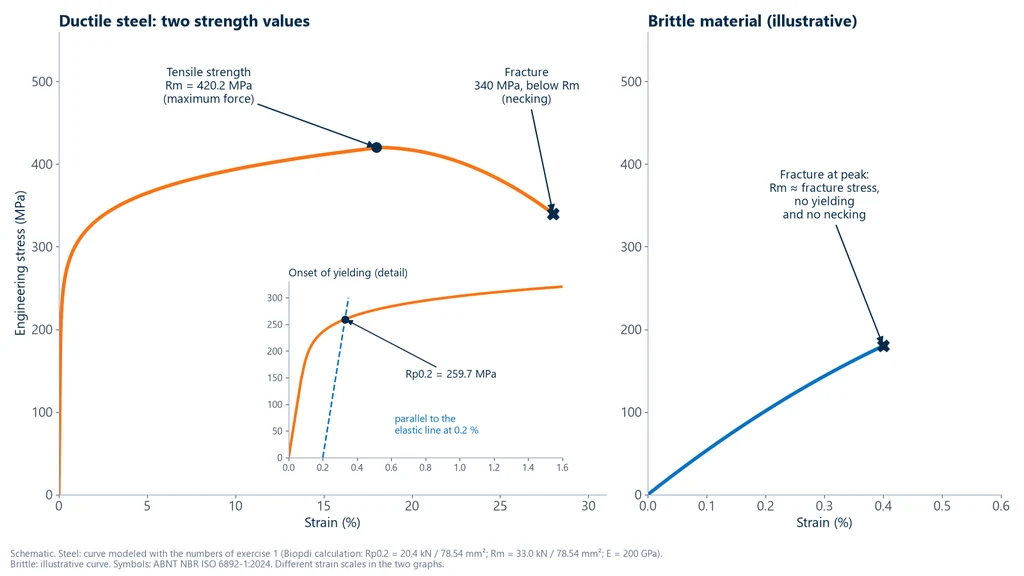
The stress on the curve is engineering stress: the force is always divided by the original area of the test specimen. After Rm, the actual area of the neck decreases sharply, and the true stress keeps rising until fracture; the drop in the curve is an effect of the calculation. The full reading of the points on the curve is in the article on the stress-strain curve, and the thinning of the neck, in the article on necking.
What mechanical strength is not
Three uses of the word "resistance" appear close to this topic and are not the property this article deals with:
- Friction: the force that opposes sliding between two surfaces is sometimes called "resistance" in physics texts. It depends on the pair of surfaces, not on a single material, and it is measured by the coefficient of friction, which is dimensionless.
- Chemical and corrosion resistance: these describe how much the material degrades in its environment. They affect mechanical strength over time, but they are a different property.
- Endurance in physical therapy and physical education: this is the ability of a muscle to sustain repeated effort. It has nothing to do with stress in MPa.
Property and discipline
Mechanical strength and strength of materials are not the same thing. The first is the property, a number for each material measured in a test. The second is the engineering discipline that calculates stresses and strains inside loaded parts (bars, beams, shafts and columns) and compares those stresses with the strength of the material, using safety factors. Internal forces, beam bending, shaft torsion, buckling and allowable stress belong to the discipline, covered in the article on strength of materials. Here, the formulas appear only to calculate the result of a test.
Mechanical strength formula and unit
The mechanical strength formula is σ = F / A: the force, in newtons, divided by the area of the cross-section that carries it, in square millimeters. With these units the result comes out directly in N/mm², which is the same as megapascal (MPa). In the tensile test, the force used is the maximum force and the area is the original area, and the formula takes the symbols of the standard: Rm = Fm / S0. The other loads have their own formulas, shown in the section on the types.
The SI unit is the pascal (Pa), equal to 1 N/m². Since the pascal is too small for structural materials, the megapascal is used, 1 MPa = 106 Pa = 1 N/mm², and for moduli of elasticity the gigapascal, 1 GPa = 1,000 MPa. Two older units are still common: kgf/cm², on construction sites, in concrete catalogs and on pressure gauges, and psi (pound-force per square inch), in American standards and data sheets. The table gathers the conversions, calculated with the exact definitions 1 kgf = 9.80665 N and 1 psi = 6,894.757 Pa (Biopdi calculation):
| Unit | Equivalent of 1 MPa | 1 unit in MPa |
|---|---|---|
| N/mm² | 1 | 1 |
| kgf/cm² | 10.197 | 0.0981 |
| kgf/mm² | 0.10197 | 9.807 |
| psi | 145.04 | 0.006895 |
| ksi (1,000 psi) | 0.14504 | 6.895 |
In practice, 1 MPa is about 10 kgf/cm², and a 25 MPa concrete is equivalent to about 255 kgf/cm². ABNT NBR 7480:2024 (the Brazilian standard for steel reinforcing bars) records a similar approximation for steel: 1 MPa ≈ 0.1 kgf/mm², which is where the name CA-50 comes from (a yield strength of about 50 kgf/mm²). Exercise 4 works through the calculations.
Types of mechanical strength
The types of mechanical strength correspond to the ways a part is loaded: tension, compression, bending, shear and torsion. Each has its own test, its own test specimen and its own formula to convert the measured force into stress. The diagram below shows the five loads, the typical test specimen for each and the formula for the result.
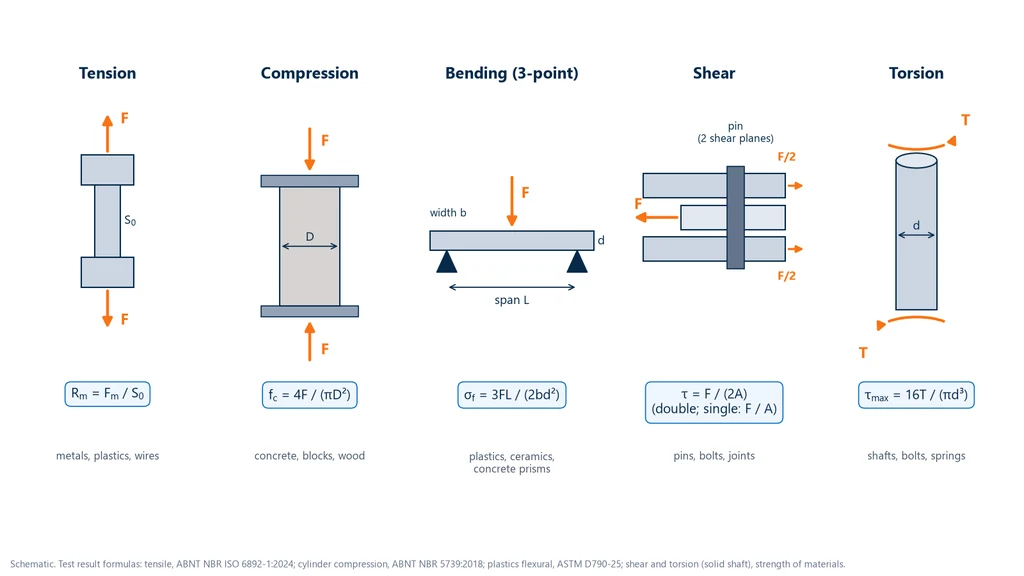
The table summarizes the same information with the reference standard for each test, for quick reference:
| Type | Result formula | Test | Reference standard |
|---|---|---|---|
| Tension | Rm = Fm / S0 | tensile test | ABNT NBR ISO 6892-1:2024 and ASTM E8/E8M-25 (metals); ASTM D638-22 (plastics) |
| Compression | fc = 4F / (πD²), cylinder | compression test | ABNT NBR 5739:2018 (concrete) |
| 3-point bending | σf = 3FL / (2bd²) | flexural test | ASTM D790-25 (plastics); ABNT NBR 12142:2010 (concrete prisms) |
| Shear | τ = F / A (single) or F / (2A) (double) | shear test | depends on the product (bolts, joints, sandwich cores) |
| Torsion | τmax = 16T / (πd³), solid shaft | torsion test | depends on the product (wires, bolts, shafts) |
Tensile strength
Tensile strength is the maximum stress a material withstands when the force tends to elongate it. It is the most widely used for metals, wires, sheets and plastics, because the same test also gives yield strength, elongation and modulus of elasticity. The main result is Rm = Fm / S0, with S0 measured before the test. The procedure is in the article on the tensile test, and the guide to the metals standard, in the article on ASTM E8 and ISO 6892-1.
Compressive strength
Compressive strength is the maximum stress under a force that tends to shorten the test specimen. It is the key property of concrete, mortars, blocks and wood parallel to the grain. In concrete, the cylinder is loaded continuously until it fractures and the strength is fc = 4F / (πD²), with D the average diameter; ABNT NBR 5739:2018 (the Brazilian standard for concrete compression testing) sets the loading rate at 0.45 ± 0.15 MPa/s and requires the result to three significant figures. In ductile metals, compression has no clear Rm, because the specimen flattens without fracturing. The compression test and the guide to NBR 5739 give the details.
Flexural strength
Flexural strength is the maximum stress on the tension face of a bar supported at two points and loaded at the center (3-point) or at two points (4-point). Bending combines tension on one face and compression on the other, which is why this test is used for materials that are difficult to hold in a tensile grip: plastics, ceramics and concrete prisms. In 3-point bending, σf = 3FL / (2bd²), with L the span, b the width and d the thickness. ASTM D790-25 uses this formula for plastics, with a span of 16 times the thickness; concrete uses ABNT NBR 12142:2010 (the Brazilian standard for flexural tensile strength of concrete prisms), with prisms in 4-point bending. The flexural test and the guide to ASTM D790 detail the method.
Shear strength
Shear strength is the stress a material withstands when two parts tend to slide over each other in the same plane, as in a pin, a rivet or a bonded joint. The average stress is τ = F / A in single shear, with one shear plane, and τ = F / (2A) in double shear, where the same force is split between two planes. In metals, shear strength is lower than tensile strength: for 6061-T6 aluminum, the typical values from the Aluminum Association are 207 MPa in shear and 310 MPa in tension, a ratio of about 0.67 (Biopdi calculation). The shear test shows the fixtures.
Torsional strength
Torsional strength is the maximum shear stress a material withstands when the part is twisted by a torque T. In a solid shaft of diameter d, the stress is highest at the surface and equals τmax = 16T / (πd³) while the material is in the elastic range. This is the strength that matters in drive shafts, bolts during tightening, springs and wires. The derivation of the formula and shaft design belong to strength of materials; the test is in the article on the torsion test.
Impact, fatigue and creep: strengths of a different kind
Three properties are also called "strength" or "resistance", but they are not measured as a stress under increasing load:
- Impact strength: the energy absorbed to fracture a notched test specimen with a single blow, measured in joules (J) in the Charpy or Izod test (ASTM E23-25, ISO 148-1). It is not a stress and cannot be converted to MPa. It is a measure of toughness, covered in the impact test.
- Fatigue strength: the stress amplitude a material withstands for a defined number of load cycles, read from the S-N curve. It is well below Rm, because cracks grow under repeated loading even at low stresses. See the fatigue test.
- Creep strength: the stress a material withstands under constant load, for a long time and usually at high temperature, without exceeding a given strain or fracturing within a defined period. See the creep test.
What are the 3 types of strength?
In engineering, the three basic loads are tension, compression and shear: every stress at a point in a part can be resolved into normal stresses (tension or compression) and shear stresses. Bending and torsion are not new loads but combinations: bending produces tension on one face and compression on the other, and torsion produces shear. So the short answer to the question is tension, compression and shear, with bending and torsion as derived cases, and impact and fatigue as strengths under other types of load.
How mechanical strength is measured
Mechanical strength is measured in a standardized destructive test. A test specimen with the shape and dimensions set by the standard is loaded in a testing machine with increasing load until it yields or fractures, while force and deformation are recorded. The force is then converted into stress using the area of the specimen. A mechanical strength test therefore has four parts:
- Standardized test specimen: a machined round bar or flat strip for tensile testing of metals, a dog-bone (dumbbell) specimen for plastics, a molded cylinder for concrete, a bar for flexural testing. The area is measured before the test, because a 1% error in the diameter becomes an error of about 2% in the stress. The article on the test specimen shows the shapes.
- Machine that applies the load: a universal testing machine (UTM), which pulls, compresses or bends the specimen depending on the grips and fixtures fitted, or a compression testing machine for concrete and blocks. The test speed is the one set by the standard.
- Load cell: measures the force. ABNT NBR ISO 6892-1:2024 (the Brazilian adoption of ISO 6892-1) and ABNT NBR 5739:2018 (the Brazilian standard for concrete compression testing, equivalent to ASTM C39) require a machine of class 1 or better according to ABNT NBR ISO 7500-1 (the Brazilian adoption of ISO 7500-1). NBR 5739 accepts class 2 in on-site laboratories and ready-mix concrete plants. The article on the load cell explains how force is measured.
- Extensometer, when needed: measures the strain over the gauge length. It is essential for Rp0.2 and the modulus of elasticity, but not for Rm, which depends only on the maximum force and the area. That is why it can be removed before fracture. See the article on the extensometer.
The testing software converts the force vs. displacement curve into a stress-strain curve and extracts the results. The same material gives different values if the test changes: a specimen of different geometry, a different speed, a different temperature or, for concrete, a different end preparation changes the result. That is why a strength value is only valid together with the standard used for the test. Machine verification, the calibration certificate and the machine class are covered in the article on universal testing machine calibration to NBR ISO 7500-1.
Mechanical strength values by material
Mechanical strength ranges from a few megapascals, for concrete in tension, to hundreds of megapascals for metals, and each value only makes sense together with the type of loading and the type of value. The table brings together reference values, each with its source. A standard minimum is what the product must achieve; a characteristic value is a statistical estimate for a batch used in design; a typical value is the average published by manufacturers and associations, useful as an order of magnitude.
| Material and property | Value (MPa) | Type of value | Source |
|---|---|---|---|
| ASTM A36 steel, yield (plates, shapes and bars up to 203 mm) | ≥ 250 | minimum | ASTM A36/A36M-19 |
| ASTM A36 steel, Rm | 400 to 550 | specified range | ASTM A36/A36M-19 |
| CA-50 rebar, yield fyk | ≥ 500 | characteristic | ABNT NBR 7480:2024 |
| CA-50 rebar, tensile strength fst | ≥ 1.10·fy (550 with fy = 500) | minimum | ABNT NBR 7480:2024 |
| Aluminum 6061-T6, Rp0.2 / Rm | 276 / 310 | typical | Aluminum Association |
| Aluminum 6061-T6, shear | 207 | typical | Aluminum Association |
| C30 concrete, compressive fck | 30 | characteristic (28 days) | ABNT NBR 8953:2015 |
| C30 concrete, mean tensile fct,m | 2.9 | design estimate | ABNT NBR 6118:2023 (calculated by Biopdi) |
| Native timber D20 to D60, compression parallel to grain fc0,k | 20 to 60 | characteristic (12% moisture content) | ABNT NBR 7190-1:2022 |
| Polypropylene homopolymer, tensile stress at yield | 33 to 34 | typical (ASTM D638) | Braskem H 401 and H 614 data sheets |
The chart below places the values on a single linear scale, in orange for tension and in blue for compression, with the A36 Rm range hatched. It shows the gap between material families: the mean tensile strength of C30 concrete is about one hundredth of the tensile strength of steel, and a common engineering plastic is in the same range as concrete in compression.
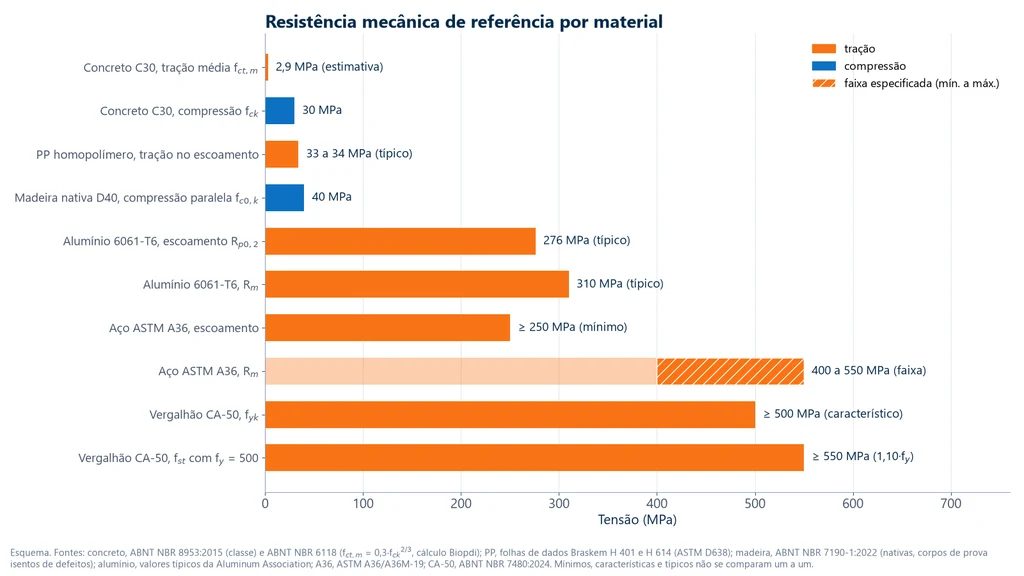
Two points to keep in mind when reading it. Values of different types cannot be compared one to one: the 276 MPa for aluminum is a typical value, while the 250 MPa for A36 is a minimum, and real steel usually yields above that. And the value for a material changes with its condition: the same steel annealed, hot-rolled or quenched has very different strengths. The full table of steels by condition is in the article on ultimate tensile strength.
Metal, concrete, timber and plastic: what changes
The way mechanical strength is specified and measured changes with the material family, because each one fails in a different way. The four most common families in engineering follow different logic.
Metals: yield strength and Rm, in tension
For metals, strength is specified in tension, with a minimum yield strength and an Rm that is either a minimum or a range, as for A36. Design uses the yield strength, because the part must work without permanent deformation, and Rm is used to check against fracture and for quality control. Rebar has its own rule: ABNT NBR 7480:2024 (the Brazilian standard for steel reinforcing bars) requires CA-50 to have fyk ≥ 500 MPa and a tensile strength of at least 1.10 times the measured yield strength. This ratio guarantees a work hardening reserve after yielding, so that the reinforcement gives warning before it breaks.
Concrete: compression at 28 days
For concrete, the strength that defines the material is compressive strength. The class, such as C30, gives the fck, the characteristic compressive strength in MPa at 28 days; the classes are those of ABNT NBR 8953:2015 (the Brazilian standard for concrete strength classes). The test is the compression of cylinders molded and cured according to ABNT NBR 5738 (the Brazilian standard for molding and curing concrete specimens) and tested according to ABNT NBR 5739:2018. Concrete has little tensile strength: ABNT NBR 6118:2023 (the Brazilian standard for the design of concrete structures) estimates the mean tensile strength as fct,m = 0.3·fck2/3 for classes up to C50, which gives 2.9 MPa for C30, about 10% of the compressive strength (calculated by Biopdi). That is why concrete is reinforced with steel in the regions under tension. Direct tension is almost never tested: tensile strength is measured by the splitting tensile test (ABNT NBR 7222:2011, the Brazilian standard for splitting tensile strength) or in flexure (ABNT NBR 12142:2010, the Brazilian standard for flexural tensile strength of concrete prisms), and NBR 6118 converts the result, taking fct as 0.9 of the splitting value or 0.7 of the flexural value.
Timber: depends on the grain direction
Timber is anisotropic: it is much stronger along the grain than perpendicular to it, and its strength changes with moisture content. In ABNT NBR 7190-1:2022 (the Brazilian standard for timber structures), native timbers are grouped into classes D20 to D60, where the number is the characteristic compressive strength parallel to grain, in MPa, obtained on defect-free specimens and referred to 12% moisture content. The same edition created classes for structural members from planted forests (D18 to D70 for hardwoods) defined by bending strength; for these, the number is not the compressive strength. A planted-forest "D40" does not have 40 MPa in compression parallel to grain, and the class must be given together with the table it comes from.
Plastics: temperature, speed and time
Plastics are much weaker than metals and far more sensitive to test conditions. A polypropylene homopolymer has a tensile stress at yield of 33 to 34 MPa in Braskem data sheets, measured to ASTM D638 at room temperature. Heating the material, testing more slowly or holding the load for a long time lowers the value, and under constant load a plastic deforms over time (creep). That is why plastics standards fix the test speed and conditioning, and the data sheet must state which stress was reported: at yield, maximum or at break.
Strength, stiffness, hardness and toughness
Strength, stiffness, hardness and toughness are four different properties, and most of the confusion about mechanical strength comes from treating them as one. Each answers a different question and has its own unit and test, as the table summarizes:
| Property | Question it answers | Unit | Test |
|---|---|---|---|
| Mechanical strength | how much stress can it withstand before yielding or fracturing? | MPa | tensile, compression, flexural |
| Stiffness (modulus of elasticity E) | how much does it deform under a given stress, in the elastic range? | GPa | tensile test with extensometer |
| Hardness | how well does it resist localized indentation at the surface? | HB, HV, HRC | hardness |
| Toughness | how much energy does it absorb before fracture? | J (impact) or J/m³ | impact, area under the curve |
Everyday examples show that one property does not predict another. Glass is hard and stiff, but has low toughness: it scratches steel and shatters with a blow. Rubber is highly elastic and has low stiffness: it deforms a lot and returns to its shape. Structural steel is strong, stiff and tough at the same time, which explains its use in structures. And replacing a common steel with a high-strength steel makes the part stronger, but not stiffer, because the modulus of elasticity of steels is close to 200 GPa in all grades. A graphical comparison of stiffness and strength is in the article on the mechanical properties of materials, and each property has its own article: modulus of elasticity, hardness and toughness.
Hardness and tensile strength have an empirical relationship in steels, and hardness can be used to estimate Rm for screening, without destroying the part. The relationship only holds for some material families and has a large error, and it does not replace the tensile test in a test report; the factors and limits are in the article on hardness.
How to increase mechanical strength (and what reduces it)
The mechanical strength of a material increases with anything that makes plastic deformation and crack initiation more difficult, and decreases with anything that makes them easier. The routes change with the material family.
In metals
In metals, strength depends on how easily dislocations, the line defects of the crystal lattice, can move. Mechanisms that block them increase strength:
- Alloying elements: dissolved atoms distort the lattice; in carbon steels, more carbon gives a higher Rm.
- Grain refinement: grain boundaries are barriers; the smaller the grain, the higher the strength.
- Cold working: cold rolling and wire drawing raise the yield strength through work hardening, at the cost of ductility.
- Quenching and tempering: quenching forms martensite, which is very strong and brittle, and tempering restores part of the toughness.
- Precipitation hardening: fine particles block dislocations; this is the T6 treatment of aluminum 6061.
Annealing does the opposite: it generally reduces strength and hardness and increases ductility, to make forming or machining easier. Saying that annealing increases strength is a common mistake. The overview is in heat treatment of metals.
In concrete
In concrete, compressive strength increases with a lower water/cement ratio, with compaction that removes voids, and with moist curing, which keeps the cement hydrating. Too much water in the mix, poor compaction and short curing leave pores, and pores are weak points.
What reduces strength
In any material, some factors reduce strength in service or in the test:
- Pores, inclusions and cracks: they concentrate stress and initiate fracture, especially in brittle materials.
- Notches and abrupt changes in cross-section: holes, threads and sharp corners raise the local stress above the average.
- High temperature: the yield strength and Rm of metals drop as they heat up, and plastics lose strength much earlier.
- Repeated loading: fatigue breaks parts at stresses well below Rm.
- Corrosion and moisture: they reduce the effective cross-section of metals and the strength of timber.
How to interpret a mechanical strength value
A strength number is only useful when you know exactly what it represents. The questions below are the ones that best prevent mistakes when reading certificates, data sheets and test reports.
Is the value a minimum, characteristic or typical?
A standard minimum is what the product must achieve to be accepted, such as the 250 MPa yield strength of A36. A characteristic value is a statistical estimate with a 5% probability of a result falling below it, such as the fck of concrete and the fyk of rebar. A typical value is a manufacturer's average, such as the 310 MPa of aluminum 6061-T6. Designing with a typical value as if it were a minimum is unsafe; comparing a minimum with a typical value exaggerates the difference between two materials.
Which stress was reported?
For a metal, "strength" can mean the yield strength or Rm, and the difference between them can reach 40% or more. For a plastic, it can be the stress at yield, the maximum stress or the stress at break. For concrete, it can be compressive strength, splitting tensile strength or flexural tensile strength. The symbol (Rp0.2, Rm, fck, fct,sp) tells you which one it is; without the symbol, ask.
In what condition was the material tested?
The value applies to the condition of the material (rolled, annealed, quenched, aged) and of the test (temperature, speed, concrete age, timber moisture content). A steel Rm without the delivery condition, or a concrete fc without the age, cannot be used for comparison.
Does the specimen result apply to the part?
The test measures the material in a standardized specimen, free of manufacturing defects, in the direction and position from which it was taken. The real part has holes, welds, notches, a different thickness and a different rolling direction. The strength of the material is the starting point; the capacity of the part comes from calculation with safety factors, which is the work of strength of materials.
Common mistakes about mechanical strength
The mistakes below appear frequently in texts on the subject and in exam answers:
- Calling force strength: "it holds 500 kg" is the load capacity of a part, not the strength of the material. Strength is force per unit area.
- Using Rm as the design stress for a metal part: the design of ductile parts uses the yield strength, with a safety factor.
- Giving impact strength in MPa: impact energy is measured in joules and cannot be converted into stress.
- Confusing stiffness with strength: a stronger steel is not stiffer; the modulus hardly changes.
- Saying that annealing increases strength: it generally reduces it, and increases ductility.
- Forgetting that concrete is weak in tension: the mean tensile strength is about 10% of the compressive strength.
- Comparing timber classes from different tables: in NBR 7190-1:2022, the D class of native timbers is based on compression and that of planted-forest members on bending.
- Copying the 1.08 ratio for CA-50: ABNT NBR 7480:2024 requires fst ≥ 1.10·fy.
Worked examples
The four examples use real test numbers and follow the order of the article: tensile testing of steel, compression testing of concrete, flexural testing of plastic and unit conversion. The calculations are by Biopdi, rechecked on October 7, 2026.
Example 1: yield strength and Rm of a steel
A cylindrical steel test specimen with a diameter of 10.0 mm was tensile tested with an extensometer. The force at the 0.2% offset yield strength was 20.4 kN and the maximum force was 33.0 kN.
- Original cross-sectional area: S0 = π × 10.0² / 4 = 78.54 mm².
- Yield strength: Rp0.2 = 20,400 / 78.54 = 259.7 MPa.
- Ultimate tensile strength: Rm = 33,000 / 78.54 = 420.2 MPa.
- Comparison with ASTM A36: yield strength ≥ 250 MPa and Rm from 400 to 550 MPa. Both values comply.
For the report, ABNT NBR ISO 6892-1:2024 (the Brazilian adoption of ISO 6892-1) recommends rounding strengths to the nearest whole MPa, unless a product standard says otherwise: 260 MPa and 420 MPa. These are the numbers behind the curve in the first chart of the article.
Example 2: compression test of a concrete cylinder
A 10 × 20 cm concrete cylinder (D = 100 mm) failed at a maximum force of 196 kN. What is its compressive strength, and what force rate corresponds to 0.45 MPa/s?
- Area: A = π × 100² / 4 = 7,853.98 mm².
- Strength: fc = 196,000 / 7,853.98 = 24.96 MPa, which, with three significant figures as required by ABNT NBR 5739:2018 (the Brazilian standard for concrete compression testing), becomes 25.0 MPa.
- Rate: 0.45 N/mm² per second × 7,853.98 mm² = 3,534 N/s, about 3.53 kN/s.
- In kgf/cm²: 25.0 × 10.197 = about 255 kgf/cm².
The 196 kN force shows why the machine capacity needs a margin: a 200 kN press would be working at 98% of its capacity, and failure must occur within the range over which the machine has been verified.
Example 3: flexural strength of a plastic
A plastic bar 12.7 mm wide and 3.2 mm thick was tested in 3-point bending with a 51.2 mm span (16 times the thickness) and broke at 90 N.
- Numerator: 3 × F × L = 3 × 90 × 51.2 = 13,824 N·mm.
- Denominator: 2 × b × d² = 2 × 12.7 × 3.2² = 260.1 mm³.
- Flexural strength: σf = 13,824 / 260.1 = 53.1 MPa.
The breaking force is only 90 N. Tests like this call for a low-capacity load cell, so that the force falls within the range where the measurement has the accuracy of its class.
Example 4: unit conversion
A design calls for 25 MPa concrete, and an American data sheet lists a material at 5,000 psi. Convert them.
- 25 MPa × 10.197 = 254.9 kgf/cm².
- 25 MPa × 145.04 = 3,626 psi.
- 5,000 psi × 0.006895 = 34.5 MPa.
- In the opposite direction, an older 250 kgf/cm² concrete has 250 × 0.0981 = 24.5 MPa.
Mechanical strength standards
Definitions and methods come from test standards; minimum values and classes come from product and design standards. The table lists the standards cited in this article, with the current edition checked on October 7, 2026 in the ABNT catalog (Target) and the ASTM store:
| Standard | Scope | Edition |
|---|---|---|
| ABNT NBR ISO 6892-1 | tensile testing of metals at room temperature (Brazilian adoption of ISO 6892-1): ReH, Rp0.2, Rm | 2024 (corrected version of July 2026) |
| ISO 6892-1 | tensile testing of metals at room temperature | 2019 |
| ASTM E8/E8M | tensile testing of metals | E8/E8M-25 |
| ASTM D638 | tensile testing of plastics | D638-22 |
| ASTM D790 | flexural testing of plastics | D790-25 |
| ASTM E23 | Charpy and Izod impact testing of metals | E23-25 |
| ABNT NBR 5739 | compression testing of cylindrical concrete specimens (Brazil) | 2018 (reaffirmed in December 2023) |
| ABNT NBR 12142 | flexural tensile strength of concrete prisms (Brazil) | 2010 |
| ABNT NBR 7222 | splitting tensile strength of concrete and mortar (Brazil) | 2011 |
| ABNT NBR ISO 7500-1 | verification of the force-measuring system of the testing machine | 2023 |
| ABNT NBR 7480 | steel for concrete reinforcement, Brazil (CA-50: fyk ≥ 500 MPa, fst ≥ 1.10·fy) | 2024 |
| ASTM A36/A36M | structural carbon steel | A36/A36M-19 |
| ABNT NBR 8953 | concrete strength classes (Brazil) | 2015 (reaffirmed in January 2025) |
| ABNT NBR 6118 | design of concrete structures, Brazil (fct,m) | 2023 |
| ABNT NBR 7190-1 | design of timber structures, Brazil (strength classes) | 2022 |
Machine for measuring mechanical strength
To measure the mechanical strength of metals, plastics, composites and wood, the universal testing machine applies the load at a controlled speed and swaps grips and fixtures to suit the type of loading: tensile, compression, flexural and shear tests on the same frame. The Biopdi M2 universal testing machine is electromechanical, with single-column models from 200 N to 10 kN and dual-column models from 5 kN to 1,000 kN. It measures force with class 1 load cells per ABNT NBR ISO 7500-1:2023 and uses the BioLab software, which converts force into stress from the entered cross-sectional area and builds the report. The panel below shows the machine, the role of each part in the measurement and the fixtures for the four types of loading.
The universal testing machine in strength measurement
The M2 line has single-column models from 200 N to 10 kN and dual-column models from 5 kN to 1,000 kN. Each part of the machine plays a role in measuring mechanical strength:
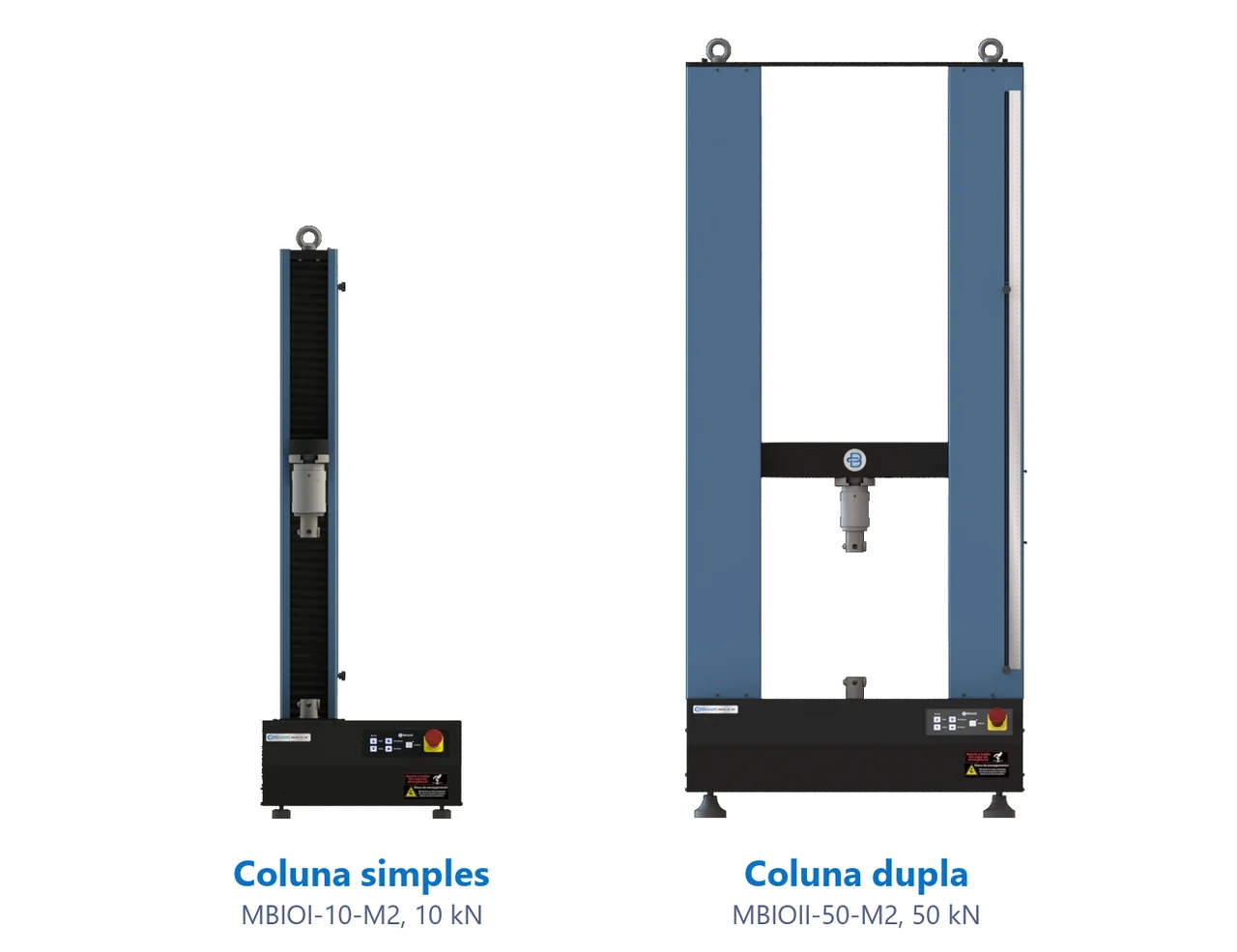
- Moving crosshead pulls, compresses or bends the test specimen at the speed set by the standard
- Load cell measures the force, class 1: the maximum force comes from it
- Grips and fixtures define the type of loading: tension, compression, bending or shear
- Extensometer optional for Rm, required for Rp0.2 and modulus
- BioLab software divides force by area and calculates the strength
- Control panel and emergency stop position and stop the test
Fixtures for strength testing
The fixtures below mount on the same machine, depending on the type of loading and the standard:
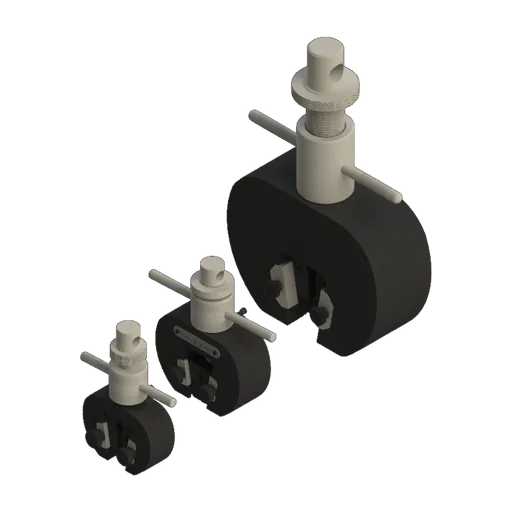 Wedge griptensile; 5, 20 and 200 kN
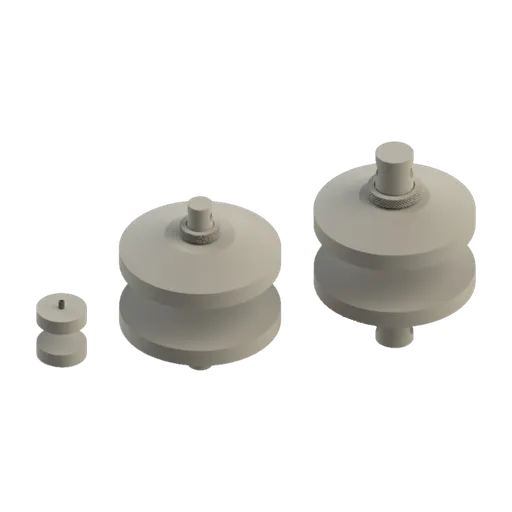 Compression platenscompression; 1, 50 and 300 kN
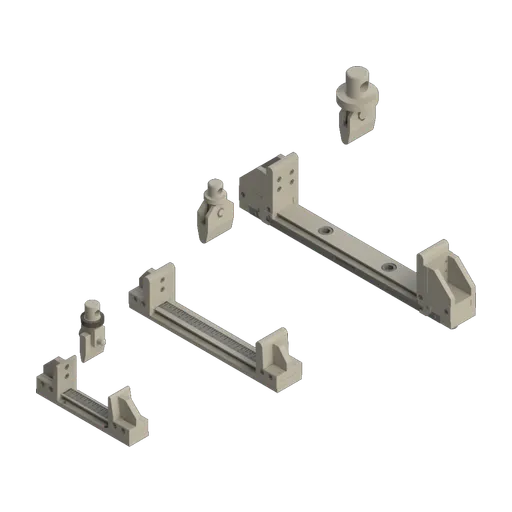 Flexural fixtureflexural; 10, 50 and 300 kN
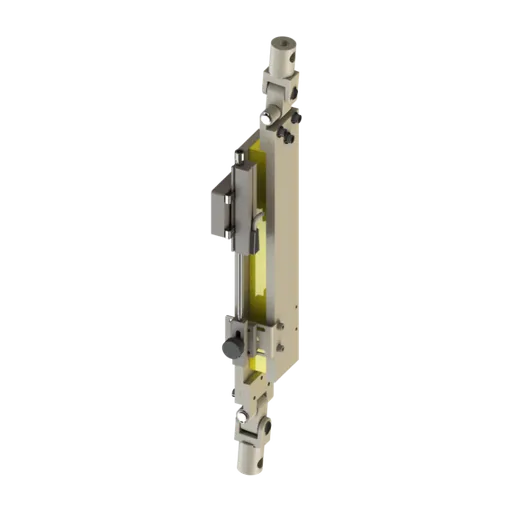 Shear fixtureASTM C273/C273M-20
Capacity follows the expected force, which is strength times area. Plastic bars in bending, like the one in example 3, and polymer specimens fit the 2 to 10 kN machine (MBIOI-10-M2); machined steel specimens, like the one in example 1, which breaks at 33 kN, fit the 5 to 50 kN machine (MBIOII-50-M2); reinforcing bars fit the 100 to 200 kN machine (MBIOII-200-M2). For concrete compression, as in example 2, the Biopdi electric concrete compression testing machine ranges from 5 kN to 1,000 kN, and BioLab converts the 0.45 MPa/s rate into kN/s from the measured diameter. For torsion, the torsion testing machine comes in a basic version, used with the universal testing machine, and a complete standalone version. The BioLab software and the other capacities are on the universal testing machine page.
Other tests and technical references
Mechanical properties of materials: what they are, the main types, tests, standards and steel values
The mechanical properties of materials define how a material responds to forces: how much it deforms, whether it returns to its shape, how much load it carries, how much energy it absorbs and how it fractures. See each property with its unit, test and standard, the values for steel (NBR 8800, the Brazilian steel structures design standard; ASTM A36; CA-50, the Brazilian rebar grade), the pairs that are often confused and solved exercises.
Ultimate tensile strength (Rm): what it is, formula, graph, steel table and how to measure it
Ultimate tensile strength (Rm) is the engineering stress at the maximum force of the tensile test: Rm = Fm/S0. See the symbols, where it sits on the graph, how it differs from yield strength and fracture stress, the steel table with material condition, CA-50 (Brazilian rebar grade), breaking load, the estimate from hardness, and exercises.
Ductility: what it is, how to calculate it, ductile vs. brittle materials and examples
Ductility is how much a material deforms plastically before it fractures. See the elongation and reduction of area formulas, ductile vs. brittle materials and real values.
Elastic and plastic deformation: what elastic deformation is, formula, difference and examples
Elastic deformation is the reversible deformation of a solid: the bonds between atoms stretch without breaking, and the part returns to its original size when the load is removed. See the formula ε = σ/E, where elastic deformation ends, how it differs from plastic deformation, how much each material deforms, resilience, elastic recovery, rubber and solved exercises.
Frequently asked questions
What is mechanical strength?
It is the highest stress a material can withstand before it yields or fractures, calculated as force divided by cross-sectional area and expressed in MPa. It depends on the type of loading: tension, compression, bending, shear or torsion.
What does mechanical strength mean?
It means how much stress, not how much force, a material can withstand. Because force is divided by area, the number describes the material and lets you compare parts of different sizes: the same steel with twice the diameter carries four times the force, with the same strength.
What is the formula for mechanical strength?
The basic formula is σ = F / A, force in newtons divided by area in mm², with the result in MPa. In tension, Rm = Fm / S0; in cylinder compression, fc = 4F / (πD²); in 3-point bending, σf = 3FL / (2bd²).
What is the unit of mechanical strength?
In the International System it is the pascal, and in practice the megapascal (MPa), equal to N/mm². 1 MPa equals 10.197 kgf/cm² and 145.04 psi.
What is a mechanical strength test?
It is a standardized test in which a machine applies an increasing load to a test specimen until it yields or fractures, measuring the force with a load cell. Examples: tensile testing of metals per ABNT NBR ISO 6892-1:2024, compression testing of concrete per ABNT NBR 5739:2018 (Brazilian standard) and flexural testing of plastics per ASTM D790-25.
What are the 3 types of strength?
In engineering, tensile, compressive and shear strength, the three basic types of loading. Bending and torsion combine these loads, and impact and fatigue are resistance to sudden and repeated loads.
What does strength of materials study?
It is the discipline that calculates stresses and strains in loaded members, such as bars, beams, shafts and columns, and compares them with the strength of the material to size the part safely. Mechanical strength is the input data for that calculation.
What is the difference between mechanical strength and hardness?
Mechanical strength is the stress the whole material withstands before yielding or fracturing, in MPa. Hardness is the resistance to localized indentation at the surface, on scales such as HB, HV and HRC. In steels the two correlate, but hardness only estimates strength.
What is the difference between strength and toughness?
Strength is the maximum stress; toughness is the energy the material absorbs before fracture. A material can be strong but not very tough, like an as-quenched steel without tempering or a ceramic, both of which fracture without deforming.
What is the mechanical strength of steel and concrete?
ASTM A36 structural steel has a minimum yield strength of 250 MPa and an Rm of 400 to 550 MPa, and Brazilian CA-50 rebar has an fyk of at least 500 MPa (ABNT NBR 7480:2024, the Brazilian standard for reinforcing steel). Concrete is specified by its 28-day compressive strength, such as 30 MPa for C30, and its tensile strength is only about 10% of that.