
Annealing is the heat treatment that heats the metal, holds it at temperature and cools it slowly, usually inside the furnace itself, to reduce hardness and internal stresses and restore ductility and machinability. In steel, full annealing heats the part to about 30 to 50 °C above the Ac3 critical temperature, until it turns into austenite, and lets it cool in the furnace. Subcritical types stay below Ac1 and do not form austenite: stress relieving and process annealing work between 550 and 650 °C, and spheroidizing between 700 and 720 °C, for many hours.
Annealing is one of the heat treatments of metals and the one most used for softening. This article covers the steps, the critical temperatures, each type with its temperature range, the microstructure, the effects with sourced figures and how to check the result by hardness testing, metallography and tensile testing. Solution annealing of stainless steel and aluminum, often called annealing, is a different phenomenon and is covered separately.
What annealing is and what it is used for
Callister and Rethwisch (Materials Science and Engineering, ch. 11, "Annealing processes") define annealing as exposing a material to an elevated temperature for an extended time, followed by slow cooling. The vocabulary standard ISO 4885 treats the annealing of ferrous materials as a family of cycles, not a single process: what changes from one type to another is the temperature relative to the critical lines of the steel and the way it is cooled.
There are four objectives, and each type of annealing achieves one of them more efficiently:
- Softening: lowering hardness and strength for machining, stamping, wire drawing or bending. This is the case of full annealing and spheroidizing.
- Relieving residual stresses: the stresses left by welding, heavy machining, forming or uneven cooling, which cause distortion and cracking. This is stress relieving.
- Restoring the ductility of a work-hardened metal: giving back the ability to deform after cold working. This is process annealing, or recrystallization annealing.
- Producing a defined microstructure: uniform coarse pearlite, globular cementite or a renewed grain structure, as a basis for machining or for a subsequent treatment such as quenching.
Annealing does not change the average chemical composition of the part. It changes the microstructure, that is, the phases present, their shape and the grain size, and through it the mechanical properties. The exception is the surface: in a furnace without a protective atmosphere, steel oxidizes and loses carbon in the outer layer (decarburization), which is controlled with an inert atmosphere, vacuum or a machining allowance.
How annealing is done: heating, soaking and cooling
Every annealing cycle has three steps: heating to the chosen temperature, holding there for the necessary time (soaking) and cooling slowly. Heating is gradual for large parts or complex geometries, so that the temperature difference between the surface and the core does not generate new stresses or cracks.
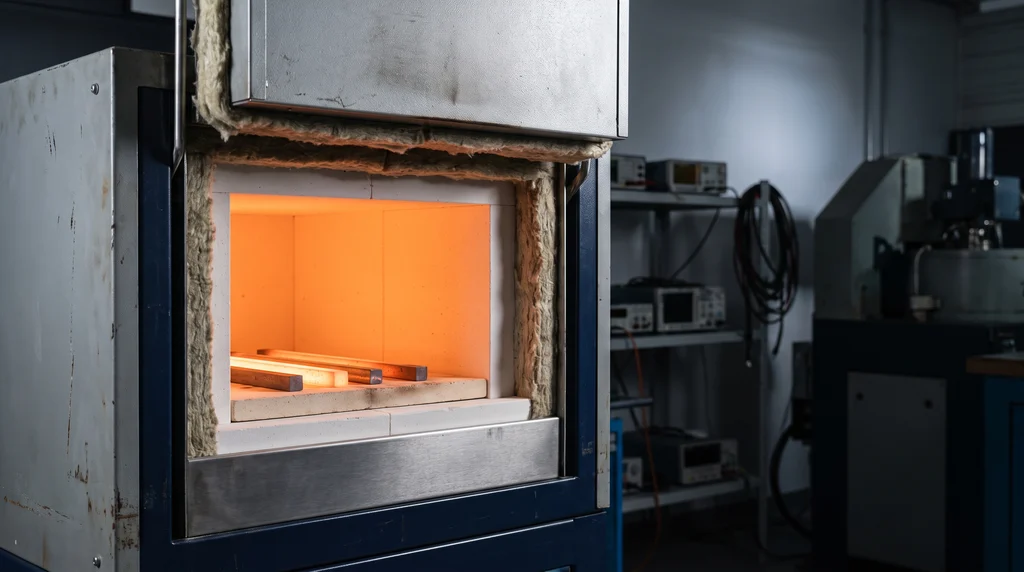
The photo shows an electric furnace with the door open and heated steel bars on the hearth: in full annealing, the part is held at the austenitizing temperature and then cools slowly inside the furnace itself.
Soaking ensures that the whole part, core included, reaches the temperature and that the intended transformation is complete. That is why the time increases with thickness. For stress relieving, the rule of thumb is 1 hour per 25 mm of thickness (Total Materia, "Stress Relief of Steels", 2016, citing the CHTA). In spheroidizing, soaking is much longer, because the cementite needs hours to change shape.
Slow cooling is what distinguishes annealing from hardening treatments. With the furnace switched off and closed, the steel passes slowly through the transformation range and forms the softest constituents; if it cooled in air, it would form a finer, stronger pearlite (that is normalizing), and if it were cooled in water or oil, it would form martensite (that is quenching). In the subcritical types there is no transformation on cooling, but cooling is still slow so as not to create new thermal stresses.
Critical temperatures of steel
Steel annealing temperatures are given relative to the lines of the iron-carbon (Fe-Fe3C) phase diagram, which shows the phases in equilibrium as a function of carbon content and temperature. Three lines matter here:
- A1 (727 °C): below it, steel is ferrite and cementite (Fe3C), usually arranged as pearlite; above it, austenite (γ) starts to form, the high-temperature phase that dissolves carbon.
- A3: the temperature at which a hypoeutectoid steel, with less than 0.77% carbon, finishes turning into austenite. It falls from 912 °C in pure iron to 727 °C at the eutectoid.
- Acm: the equivalent in hypereutectoid steels, with more than 0.77% carbon: above it, all the cementite dissolves.
The eutectoid point is at 0.77% carbon and 727 °C (Chiaverini, Aços e Ferros Fundidos, ABM), and steel with this composition becomes fully pearlitic on cooling. In real steel, with manganese, silicon and alloying elements, and with heating at a finite rate, the critical temperatures rise slightly and receive the letter c (from the French chauffage, heating): Ac1 and Ac3. For a real part, use the values in the manufacturer's data sheet. According to the Lucefin data sheet, 1045 steel (C45E) has an Ac1 of about 735 °C and an Ac3 of about 780 °C; 4140 (42CrMo4), 745 and 790 °C; 52100 (100Cr6), an Ac1 of about 750 °C and an Acm of about 850 °C.
Types of annealing
With the critical lines defined, the types fall into two groups. Full and isothermal annealing austenitize, that is, they go above Ac3 (or Ac1 in hypereutectoid steels) and rebuild the entire microstructure. Subcritical annealing, stress relieving and spheroidizing stay below Ac1 and only modify the existing structure. Recrystallization is the mechanism of process annealing, and solution annealing is a different treatment.
Full annealing
Full annealing heats hypoeutectoid steel to about 30 to 50 °C above Ac3, holds it until the entire cross section is austenitized and cools it inside the furnace. For 1045 steel, the range used is about 820 to 850 °C. In hypereutectoid steels, such as 52100, heating goes to 30 to 50 °C above Ac1, not Acm: heating above Acm and cooling slowly would leave cementite as a continuous network at the grain boundaries, which embrittles the steel. The result is ferrite and coarse pearlite, the softest condition obtainable with austenitizing. It is applied to forgings and castings before machining and to parts that need a uniform microstructure before quenching. Full annealing is carried out a few tens of degrees above the critical line, hundreds of degrees below melting (pure iron melts at 1,538 °C), and not "close to the melting temperature", as is often stated.
Isothermal annealing
Isothermal annealing austenitizes like full annealing, but instead of slowly cooling the whole furnace, it quickly brings the part to a hold temperature below A1, usually up to about 55 °C below it (IspatGuru, "Annealing of Steels"), and keeps it there until the austenite transforms into pearlite at constant temperature. The part can then be cooled in air, because no austenite is left to transform. The final hardness is practically the same as in full annealing, with two advantages: the cycle is shorter and the pearlite is more uniform, because the whole part transforms at the same temperature. The Lucefin data sheet for 52100 gives an example: austenitize at 800 °C and transform at 720 °C, for a maximum of 210 HB. It is common for alloy steel forgings produced in series.
Subcritical annealing and stress relieving
Both are in the same range, 550 to 650 °C, below Ac1, and neither forms austenite. What sets them apart is the objective. Subcritical annealing, also called process or intermediate annealing, is applied to low-carbon steel work-hardened by cold rolling or wire drawing, to restore ductility between forming passes; the mechanism is recrystallization, described below. Stress relieving does not aim to soften: it reduces the residual stresses of welded parts, parts machined with heavy roughing or straightened parts, without significantly changing the microstructure, and thereby prevents distortion during grinding and cracking in service. The usual time is 1 hour per 25 mm of thickness, with slow cooling. In a part that has already been quenched and tempered, stress relieving is done 50 °C below the last tempering temperature (Lucefin C45E and Villares VD2 data sheets), because exceeding it would soften the part.
Spheroidizing (spheroidize annealing)
Spheroidizing holds the steel just below Ac1, around 700 to 720 °C, for many hours, or cycles the steel around Ac1. During this time, the cementite lamellae of the pearlite break up and turn into globules in a ferrite matrix, because the spherical shape has less interface area and therefore less energy. The result, called spheroidite, is the softest and most ductile condition of steel. In a high-carbon steel with fine pearlite, Li and coworkers (Materials, 2026, DOI 10.3390/ma19020249) brought the hardness from about 320 HV down to 198 HV with 14 hours at 710 °C. Spheroidizing is the annealing used for medium- and high-carbon steels and bearing steels, such as 52100, before machining and before cold forming of wire and bolts. It is a steel treatment, because it depends on cementite, and not "typical of copper".
Recrystallization
A cold-worked metal accumulates dislocations and becomes work hardened: stronger and less ductile. When heated above the recrystallization temperature, which lies between 1/3 and 1/2 of the absolute melting temperature (for iron, about 450 °C to recrystallize in 1 hour, according to Callister), it goes through recovery, forms new strain-free grains and regains its ductility. In steel, this is the mechanism of subcritical annealing; in nonferrous metals such as copper, brass and aluminum, which do not have the austenite transformation, it is the main form of annealing. The three stages, the table of temperatures by metal and the effect of the degree of cold work are covered in the article on work hardening.
Solution annealing: not the annealing of carbon steel
In austenitic stainless steel and in heat-treatable aluminum alloys, "solution annealing" is something else: the material is heated to dissolve precipitates and cooled quickly, the opposite of steel annealing. In 304 stainless steel, the treatment is done from about 1,040 °C, with rapid cooling in water or forced air depending on thickness, to dissolve chromium carbides and prevent them from forming again at the grain boundaries (UTEC, citing AMS 2759/4 and ASTM A480); this is what restores corrosion resistance. In 6061 aluminum, solution treatment at about 530 °C with water quenching is the first step of the precipitation hardening that leads to the T6 temper. In both cases, the objective and the cooling are not those of steel annealing.
Summary: temperatures and cycles
The table brings together the temperature ranges, cooling and microstructure of each type in carbon steel. The values are those of the reference table used in Biopdi's heat treatment articles, and for a real part the Ac1 and Ac3 from the steel's data sheet apply:
| Type | Temperature | Cooling | Microstructure |
|---|---|---|---|
| Full | Ac3 + 30 to 50 °C (hypoeutectoid); Ac1 + 30 to 50 °C (hypereutectoid) | slow, in the furnace | ferrite and coarse pearlite |
| Isothermal | as in full annealing, then a hold below A1 | in air after the hold | uniform pearlite |
| Subcritical (process) | 550 to 650 °C | in air or slow | recrystallized ferrite, no austenite |
| Stress relieving | 550 to 650 °C (tempered part: 50 °C below tempering) | slow | practically unchanged |
| Spheroidizing | 700 to 720 °C, many hours, or cycling around Ac1 | slow | globular cementite in ferrite (spheroidite) |
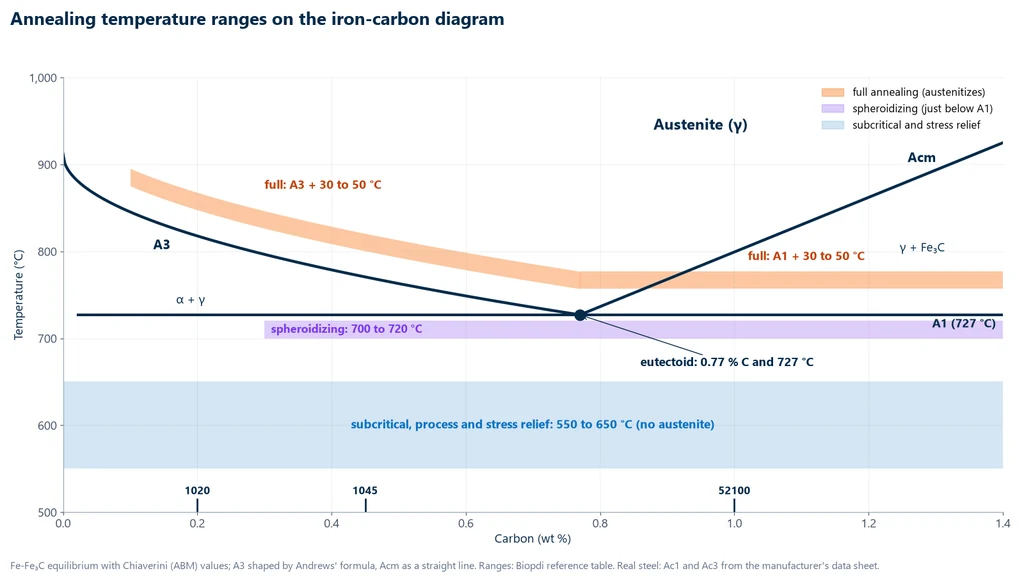
The chart below places these ranges on the steel portion of the iron-carbon diagram. It shows why full annealing follows the A3 line and is hotter for low-carbon steels (above 850 °C for 1020), while the subcritical types are horizontal bands that apply to any carbon content. The diagram is an equilibrium diagram: the A3 line for 1045 is at about 770 °C, below the 780 °C Ac3 in the data sheet.
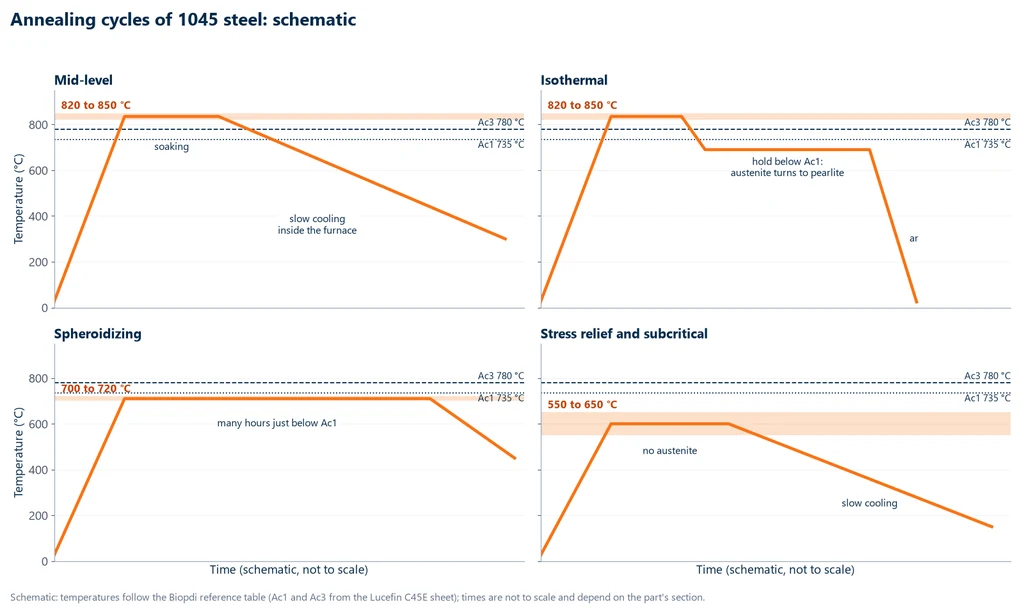
The following diagram compares the shape of the cycles for a 1045 steel, with Ac1 and Ac3 from the data sheet. Full and isothermal annealing rise above Ac3 and differ only in cooling; spheroidizing stays for a long time just below Ac1; stress relieving does not even come close to the critical lines. The time axis has no scale, because the actual times depend on the cross section of the part.
Resulting microstructure
Each type leaves a characteristic microstructure, and that is what the laboratory examines to confirm the treatment. In full annealing, slow cooling gives carbon time to diffuse over long distances, and pearlite forms with coarse lamellae of ferrite and cementite, alongside grains of proeutectoid ferrite in hypoeutectoid steels. The coarser the lamellae, the smaller the interface area that blocks dislocations, and the softer the steel.
In spheroidizing, cementite loses its plate shape and appears as small globules dispersed in the ferrite. With continuous ferrite, dislocations move with few obstacles, which is why spheroidite is softer and more ductile than any pearlite. In process annealing, what changes is the grain: the elongated grains deformed by rolling give way to new, equiaxed grains with few dislocations. In stress relieving, the microstructure remains practically the same under the microscope.
Grain size is also a result of the cycle. A temperature higher than necessary or an overly long soak makes the austenite grain grow, and the steel ends up with lower toughness; grain size is measured according to ASTM E112. The examination requires a specimen cut without heating, ground, polished, chemically etched (nital, for carbon steel) and examined under the metallurgical microscope.
What annealing changes in the properties
Annealing trades strength for ductility. Hardness, yield strength and ultimate tensile strength go down. Elongation, reduction of area and formability go up, which means higher ductility. Residual stresses disappear. The modulus of elasticity does not change, because it depends on the bonds between atoms, not on the microstructure.
The data table in Callister (7th ed., Appendix B) shows the order of magnitude. 1040 steel annealed at 785 °C has a yield strength of 355 MPa, an ultimate tensile strength of 520 MPa and an elongation of 30.2%. 4140 steel annealed at 815 °C has 417 MPa, 655 MPa and 25.7%. For comparison, the same 4140 oil-quenched and tempered at 315 °C reaches a yield strength of 1,570 MPa, with 11.5% elongation.
Published softening studies measure the drop in hardness directly. Szala and co-workers (Materials, 2020, DOI 10.3390/ma13092022) annealed 42CrMo4 (equivalent to 4140), supplied with ferrite and pearlite at about 355 HV. They held it at 750 °C, cooled it at 6 °C per hour and reached 165 HV, with the cementite partially spheroidized. In the spheroidizing example mentioned earlier, a high-carbon steel went from about 320 HV to 198 HV.
Steel producers specify the maximum hardness in the annealed condition, and that is the value used for incoming inspection. The table lists the cycles and hardness values from the Lucefin data sheets:
| Steel | Cycle | Hardness after the cycle |
|---|---|---|
| 1045 (C45E) | soft annealing at 690 °C, cooling at 10 °C/h to 600 °C | max. 207 HB |
| 1045 (C45E) | isothermal, austenitizing at 810 °C | 160 to 216 HB |
| 4140 (42CrMo4) | soft annealing at 720 °C | max. 241 HB |
| 4140 (42CrMo4) | spheroidizing at 760 to 775 °C, just above Ac1 | max. 200 HB |
| 4140 (42CrMo4) | isothermal, austenitizing at 820 °C | 180 to 240 HB |
| 52100 (100Cr6) | spheroidizing at 720 to 750 °C, 10 °C/h to 650 °C | max. 220 HB |
Machinability improves in medium- and high-carbon steels, especially after spheroidizing: a softer steel needs less cutting force and causes less tool wear. In low-carbon steels the effect can be the opposite. Once annealed, they become too soft and ductile, form long chips and a built-up edge, and leave a poorer surface finish. In these cases normalizing, which leaves the steel slightly harder, usually machines better. Toughness generally increases with annealing, provided the grain has not grown from overheating.
Annealing, normalizing, quenching and tempering
The four treatments get confused because all of them heat the steel. The difference lies in the temperature and, above all, in the cooling. Normalizing also austenitizes, slightly above full annealing (Ac3 + 50 to 60 °C), but it cools in air: the pearlite comes out finer, the grain more refined and the steel stronger. According to Callister's data, 4140 normalized at 870 °C yields at 655 MPa, against 417 MPa when annealed at 815 °C. The full comparison of annealing, normalizing and quenching, with the table of temperatures and properties, is in the article on normalizing.
Quenching austenitizes and cools fast, in water, oil or polymer, to form martensite, the hardest constituent of steel; annealing goes the opposite way. Tempering is the step that follows quenching: it reheats the part below A1 to reduce the brittleness of martensite while keeping much of the hardness. The temperatures may even overlap with those of subcritical annealing, but the starting point is different: tempering only applies to a quenched part, whereas annealing starts from any condition and aims for the lowest hardness. A full anneal is also used to "undo" a faulty quench before quenching again.
How to choose the type: worked examples
The choice starts from the problem with the part: work hardening, residual stress or high hardness for machining each call for a different type. The three examples show the reasoning and the calculations, using the values from the previous sections.
Example 1: work-hardened sheet that cracks during stamping
A low-carbon steel sheet, with about 0.10% C, was cold rolled and started cracking during stamping. Which annealing should be applied?
- The problem is work hardening: cold rolling multiplied the dislocations and used up the ductility. There is no isolated residual stress or coarse cementite to treat.
- The treatment that removes work hardening is recrystallization, which in steel takes place during subcritical annealing, at 550 to 650 °C. This range is above the roughly 450 °C recrystallization temperature of iron and below Ac1, so there is no austenitization and no risk of austenite grain growth.
- Answer: subcritical (process) annealing at 550 to 650 °C. The new equiaxed grains restore the ductility needed for stamping.
Example 2: machined shaft that distorts during grinding
A 1045 steel shaft with a 50 mm diameter was rough machined with heavy stock removal and distorts during grinding. Which treatment, and for how long?
- The distortion comes from residual stresses introduced by machining. The goal is to remove them without softening the part: this is stress relieving.
- Temperature: 550 to 650 °C, below the Ac1 of 735 °C for 1045.
- Soaking time using the 1 h per 25 mm rule: 50 mm ÷ 25 mm × 1 h = 2 h, followed by slow furnace cooling.
- If the shaft had already been quenched and tempered at 550 °C, stress relieving could not exceed 550 − 50 = 500 °C, so as not to lower the hardness obtained in tempering.
- Answer: stress relieving for 2 h at 550 to 650 °C (or up to 500 °C for the part tempered at 550 °C).
Example 3: tensile test on annealed 1040 steel
A cylindrical test specimen of annealed 1040 steel, with diameter d0 = 10 mm and gauge length L0 = 50 mm, was tested on the universal testing machine. The maximum force recorded was 40.84 kN, the yield force was 27.88 kN and, after fracture, the measured final length was Lu = 65.1 mm. Is the annealing consistent with what is expected?
- Initial area: S0 = π × 10² / 4 = 78.54 mm².
- Ultimate tensile strength: Rm = 40,840 N / 78.54 mm² = 520 MPa.
- Yield strength: Re = 27,880 N / 78.54 mm² = 355 MPa.
- Elongation after fracture: A = (65.1 − 50) / 50 × 100 = 30.2%.
- Answer: all three values match those for 1040 annealed at 785 °C in Callister's table (355 MPa, 520 MPa and 30.2%). In a real batch, a yield strength well above and an elongation well below these values would indicate incomplete annealing.
How to check the result: hardness, metallography and tensile testing
The furnace applies the cycle, but it is the tests on the treated part that show whether the annealing worked. Three checks complement each other, from the fastest to the most complete.
Hardness. This is the fastest incoming inspection check: Brinell (HB) or Rockwell B (HRB) on the annealed steel, compared with the maximum hardness on the steel's data sheet, such as the 207 HB for soft-annealed 1045. The procedure for each method is in the article on hardness testing.
Metallography. It confirms what hardness only suggests: coarse pearlite after full annealing, cementite globules after spheroidizing, equiaxed grains after process annealing, grain size per ASTM E112, and decarburization at the surface. Biopdi manufactures the complete set for preparation and observation: the metallographic cutting machine to extract the sample, the grinding and polishing machine for grinding and polishing, and the metallurgical microscope to examine the etched sample.
Tensile testing. The tensile test measures what matters for design: the drop in yield strength and ultimate tensile strength and the gain in elongation, as in example 3. The stress-strain curve of annealed steel shows a lower yield plateau and a longer plastic region. For steel bars and sheets, Biopdi's 5 to 50 kN universal testing machine (MBIOII-50-M2) from the M2 line handles the test in the example, at 40.84 kN, and the BioLab software calculates Re, Rm and A and generates the report. For sheet annealed for forming, the bend test completes the check. The other capacities are on the universal testing machine page.
Standards for annealing and for checking the result
There is no single "how to anneal" standard for all steels: the cycle comes from the producer's data sheet and the product specification. The standards below define the terms and the tests that check the result:
| Standard | Subject | Edition |
|---|---|---|
| ISO 4885 | vocabulary of heat treatment of ferrous materials | 2018 (new edition in progress, ISO/DIS) |
| ASTM A941 | terminology relating to steel, stainless steel and related alloys | A941-26a |
| ASTM E112 | determination of average grain size | E112-25e1 |
| ASTM E3 | preparation of metallographic specimens | E3-26 |
| ASTM E407 | microetching | E407-23 |
| ISO 6506-1 and ASTM E10 | Brinell hardness | 2014 and E10-23 |
| ISO 6508-1 and ASTM E18 | Rockwell hardness | 2023 and E18-25 |
| ISO 6507-1 and ASTM E92 | Vickers hardness | 2023 and E92-26 |
| ABNT NBR ISO 6892-1 | tensile testing of metallic materials at room temperature (Brazilian adoption of ISO 6892-1) | 2024 |
| ISO 6892-1 and ASTM E8/E8M | tensile testing of metals | 2019 and E8/E8M-25 |
| ASTM A480/A480M | general requirements for flat-rolled stainless steel plate, sheet and strip | A480/A480M-25b |
Other tests and technical references
Tempering steel: what it is, temperatures, hardness curve and temper embrittlement
Tempering is the reheating of quenched (hardened) steel below the critical temperature, usually between 150 and 650 °C, to trade part of the hardness of martensite for toughness and to relieve quenching stresses. See what happens in martensite, the temperature ranges, the hardness and impact curve of 4140 steel, the Hollomon-Jaffe parameter, the two types of embrittlement, temper colors and how to check the result.
Heat treatment of metals: what it is, types, iron-carbon diagram and TTT curves
Heat treatment is the controlled heating and cooling of a solid metal to change its microstructure and, with it, hardness, strength and toughness, without changing the shape of the part. See the three stages, the iron-carbon diagram (eutectoid at 727 °C and 0.77% C), TTT and CCT curves, microstructures, the families of treatments, 6061-T6, how to choose the process and how to verify the result.
Normalizing steel (heat treatment): temperature, air cooling and how it differs from annealing and quenching
Normalizing steel is the heat treatment in which steel is heated above the upper critical temperature (Ac3, or Acm in hypereutectoid steel), held until it becomes austenite and cooled in still air. The result is a refined grain and fine pearlite, with more strength than in the annealed condition and much less hardness than in the quenched condition. 1045 steel is normalized at about 850 to 880 °C.
Nitriding: what it is, processes (gas, plasma and salt bath), white layer, NHD and difference from carburizing
Nitriding is a thermochemical treatment that diffuses nitrogen into the steel surface below the austenitizing temperature, with no quenching: 495 to 565 °C for gas nitriding, 430 to 595 °C for plasma nitriding and about 570 to 580 °C in a salt bath. It forms a white layer of 10 to 20 µm on top of a diffusion zone of 0.1 to 0.6 mm, with 600 to over 1,000 HV depending on the steel. See the processes, the steels, how to measure the NHD per ISO 18203 and the comparison with carburizing.
Frequently asked questions
What is annealing?
It is the heat treatment that heats the metal, holds it at temperature and cools it slowly, usually inside the furnace. It reduces hardness and internal stresses and restores ductility and machinability (Callister and Rethwisch, ch. 11).
What is the annealing temperature of steel?
It depends on the type. Full annealing is about 30 to 50 °C above Ac3 (for 1045, about 820 to 850 °C). Stress relieving and subcritical annealing are between 550 and 650 °C, and spheroidizing between 700 and 720 °C, below Ac1.
What are the types of annealing?
Full, isothermal, subcritical (process) annealing, stress relieving and spheroidizing. Recrystallization is the mechanism of process annealing, and solution annealing of stainless steel and aluminum is a different treatment, with fast cooling.
What is the difference between annealing and tempering?
Tempering is done after quenching, below A1, to reduce the brittleness of martensite while keeping much of the hardness. Annealing starts from any condition and aims for the lowest hardness, with slow cooling.
What is the difference between annealing and normalizing?
Normalizing austenitizes slightly higher and cools in air, not in the furnace. The pearlite comes out finer and the steel stronger: normalized 4140 yields at 655 MPa, against 417 MPa when annealed (Callister).
How long does annealing take?
Soaking time increases with thickness: for stress relieving, the rule of thumb is 1 hour per 25 mm. Spheroidizing takes many hours, and the total cycle includes slow furnace cooling, which can last longer than the soak.
Does annealing change the chemical composition of the material?
The average composition does not change: annealing acts on the microstructure. The surface, however, can oxidize and lose carbon in a furnace without a protective atmosphere, which is avoided with a controlled atmosphere, vacuum or a machining allowance.
Does annealing improve machinability?
In medium- and high-carbon steels, yes, especially with spheroidizing. In low-carbon steels the material can become too soft, form long chips and leave a poorer surface finish; in that case normalizing is usually preferred.
Is annealing applied only to metals?
No. Glass is also annealed, to relieve the stresses from cooling. In metals, the mechanism varies: in steel there is a phase transformation, while in copper, brass and aluminum annealing works through recrystallization.
What is simulated annealing?
It is a computational optimization algorithm (simulated annealing), inspired by the slow cooling of metals. It is not a heat treatment.
How can you tell if a part was properly annealed?
By measuring hardness and comparing it with the maximum on the steel's data sheet, examining the microstructure through metallography (coarse pearlite, spheroidite or recrystallized grain), and running a tensile test to check yield strength and elongation.