
Ductility is the mechanical property that measures how much a material deforms plastically under tension before it fractures. It is measured in the tensile test by the elongation after fracture, A = (Lu − L0) / L0 × 100, and by the reduction of area, Z = (S0 − Su) / S0 × 100. Materials with less than about 5% elongation are considered brittle.
A ductile material stretches, forms a "neck" and gives warning before it fractures: annealed copper elongates about 45%. A brittle material breaks suddenly: gray cast iron elongates less than 1%. In this guide you will find the formulas and how to measure ductility according to ISO 6892-1 (ABNT NBR ISO 6892-1 in Brazil), why the same steel gives different elongations on different test specimens, the difference between ductile and brittle materials, a ductility table for metals and polymers, the minimum values for the Brazilian rebar grades CA-25, CA-50 and CA-60, the difference from malleability and toughness, and worked examples. The test itself is explained in tensile test.
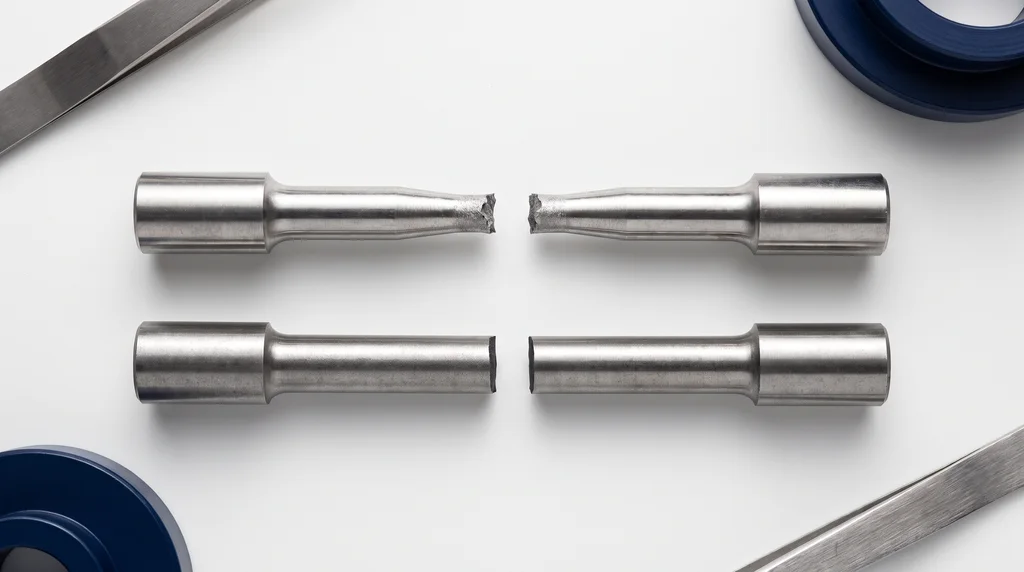
The photo shows the difference on two specimens that came out of the same type of test: the ductile steel specimen thinned and formed a neck before fracturing; the brittle cast iron specimen broke straight across, with no change in cross-section.
What is ductility
Callister and Rethwisch, in Materials Science and Engineering, define ductility as a measure of the degree of plastic deformation a material can sustain up to fracture. Plastic means permanent: the material does not return to its original size when the load is removed. This is what separates ductility from elasticity. Rubber is very elastic and springs back to its shape; a copper wire stretched beyond its limit stays stretched. The portion that springs back is the elastic deformation.
Ductility is one of the mechanical properties of materials, not a fixed physical property like density. It is measured in a mechanical test and changes with temperature, strain rate and the condition of the material: the same steel can be ductile when annealed and brittle when quenched. It is a property observed mainly under tension. The ability to deform under compression without cracking is called malleability.
In practice, ductility is what allows copper to be drawn into wire, a rebar to be bent without cracking, a steel sheet to be stamped into a car door and, above all, a structure to give warning before it collapses: an overloaded steel beam bends visibly long before it fractures.
In Portuguese, "ductilidade" or "ductibilidade"? The Priberam dictionary lists both with the same meaning, with "ductibilidade" as a variant of "ductilidade". In standards and in engineering, the form used is ductilidade (ductility), from "dúctil" (ductile). In paving there is a homonym: the ductility test for bituminous materials (DNER-ME 163/98, a Brazilian road test method), which measures in millimeters how far a thread of asphalt stretches before it breaks. That is a different quantity.
How to calculate ductility
Ductility is measured in the tensile test: a standardized test specimen is pulled along its axis, at a controlled rate, until it fractures, while the machine records force and elongation. It is a fast, reproducible test, and the same curve that gives strength and yield also gives ductility. Ductility is expressed by two numbers, both taken from the specimen before and after fracture. The notation is that of ISO 6892-1 (ABNT NBR ISO 6892-1 in Brazil).
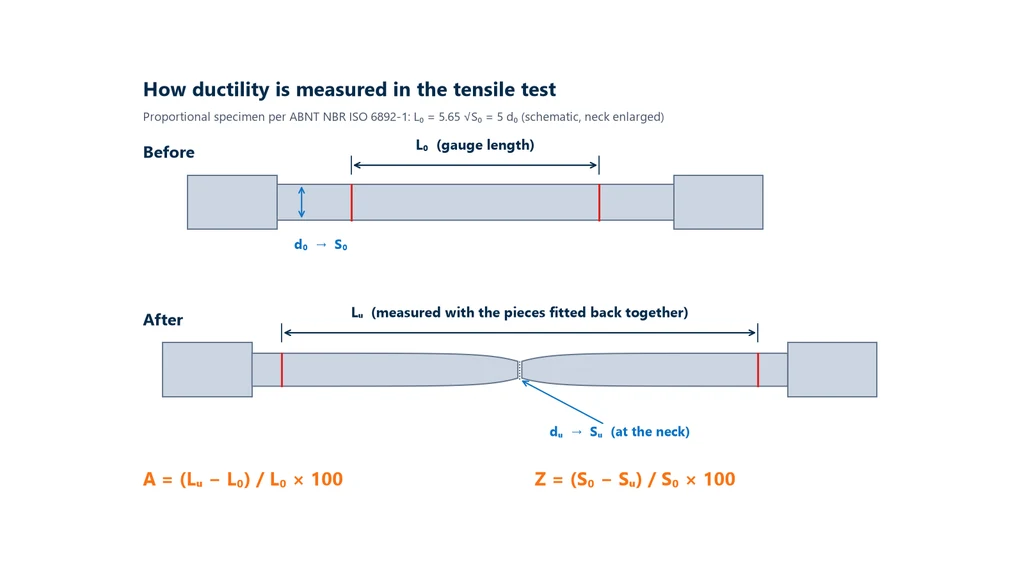
Elongation after fracture (A). Before the test, two gauge marks separated by the original gauge length L0 are made on the parallel length of the specimen. After fracture, the two pieces are fitted back together and the new distance between the marks, Lu, is measured. The elongation is how much this distance increased, as a percentage of the initial value: A = (Lu − L0) / L0 × 100. Because the measurement is taken with the pieces already separated, the elastic part of the deformation, which the material recovers when it fractures, is excluded: A measures only the permanent deformation.
Reduction of area or necking (Z). The original cross-sectional area, S0, is measured and, after fracture, the minimum area at the neck, Su. The reduction of area is how much the cross-section shrank: Z = (S0 − Su) / S0 × 100. For a round specimen, Z comes directly from the diameters: Z = [1 − (du / d0)²] × 100. Z is the more "local" measure of ductility, because it depends only on the neck and not on the gauge length. More details on the neck in necking.
The same areas give the true fracture strain, εf = ln(S0 / Su). It uses the actual cross-section at the fracture point, not the original length, and therefore shows how much the material really deformed where it fractured. The L0, in turn, is not arbitrary: the standard prefers the proportional gauge length, L0 = 5.65 √S0, which for a round specimen equals 5 times the diameter.
The diagram below shows the measurements on the specimen: before the test, the diameter d0 and the L0 gauge marks; after, the pieces fitted back together to measure Lu and the diameter du at the neck.
The table summarizes the formulas and the variables of each one:
| Quantity | Formula | Variables |
|---|---|---|
| Elongation after fracture (A) | A = (Lu − L0) / L0 × 100 | L0: original length between gauge marks; Lu: final length, with the pieces fitted back together |
| Reduction of area or necking (Z) | Z = (S0 − Su) / S0 × 100 | S0: original area; Su: minimum area at the neck after fracture |
| True fracture strain | εf = ln(S0 / Su) | Same areas; dimensionless result |
| Proportional gauge length | L0 = 5.65 √S0 | For a round specimen, equal to 5 times the diameter |
How to measure, step by step (ISO 6892-1)
In practice, the laboratory follows this sequence:
- Measure the original area S0 at a minimum of three cross-sections along the parallel length and use the average.
- Mark the original gauge length L0 with fine scribe lines, or use an extensometer.
- Pull the specimen to fracture in the universal testing machine (UTM), between 10 and 35 °C.
- Fit the two pieces back together, carefully aligned, and measure Lu between the marks.
- Measure the diameter at the thinnest point of the neck in two planes at 90° and calculate Su from the average.
- Report the elongation together with the gauge length used, indicated in the symbol: A for 5.65√S0, A11.3 for 11.3√S0 and A80mm for a fixed gauge length of 80 mm.
Two precautions. As a rule, the result is only valid if the fracture falls within the gauge length. And if the elongation is read from the extensometer during the test, rather than between the marks after fracture, the elastic part, which the specimen recovers when it fractures, must be subtracted.
Why elongation depends on the test specimen
Up to maximum force, deformation is distributed along the whole specimen. After that, it concentrates in the neck. So with a short L0 the neck weighs more in the total, and the elongation comes out higher. The same steel gives different numbers depending on the standard:
| Gauge length | Where it is used | Factor to convert to 5.65√S0 (ISO 2566-1) |
|---|---|---|
| 4D (50 mm on the 12.5 mm specimen) | ASTM E8/E8M | × 0.91 |
| 5.65√S0 = 5d | ISO 6892-1 / ABNT NBR ISO 6892-1 (preferred) | × 1 |
| 11.3√S0 = 10d (10φ) | ISO, and rebars under NBR 7480 (the Brazilian standard for steel reinforcing bars) | × 1.32 |
The factors come from the ISO 2566-1 formula, A = 2·Ar·(√S0 / L0)0.4, and apply only to carbon and low-alloy steels. The ISO 6892-1 rule is straightforward: elongations can only be compared when measured with the same gauge length. In the calculator below, change the gauge length and see the effect.
Interactive simulation
Try the test in your browser and watch the results being calculated.
Stress-strain curve of ductile and brittle materials
The stress-strain curve shows ductility visually. In a ductile material the curve rises in a straight line through the elastic region up to the yield strength, keeps rising with work hardening, the hardening of the metal by its own plastic deformation, up to the ultimate tensile strength (UTS), and from there necking begins: the cross-section thins at one point, the force drops and the specimen fractures.
The graph below marks these points on the curve of a ductile material and compares it with that of a brittle one. It also shows where ductility lies: uniform elongation goes up to maximum force, the deformation after that concentrates in the neck, and elongation A is the sum of the two, minus the elastic recovery (the dashed line).
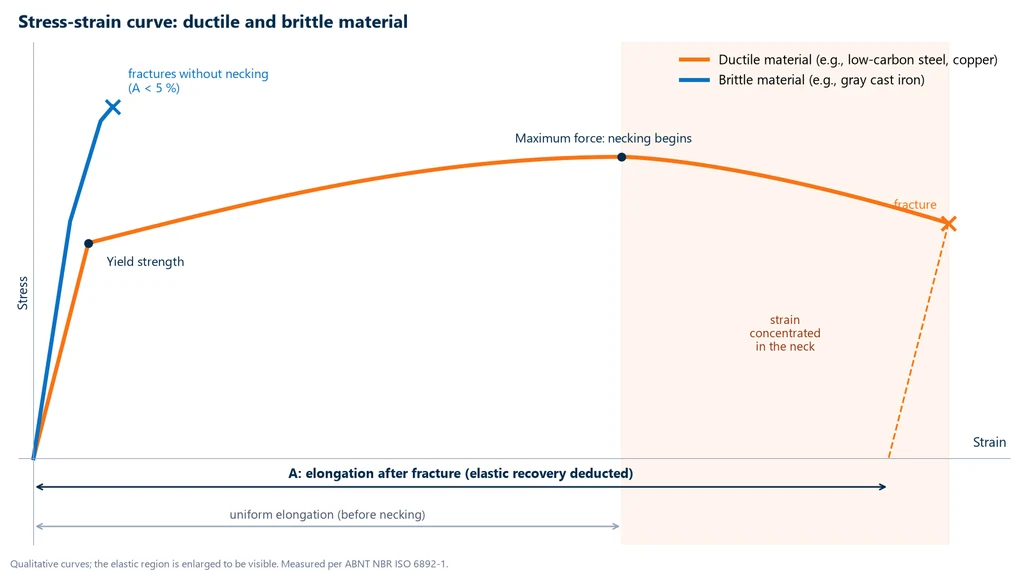
In a brittle material the curve is almost straight up to fracture: there is no visible yielding and no necking, and elongation stays below 5%. The area under the curve, which is the energy absorbed, is small. That is why ductility and toughness usually go together, although they are not the same thing.
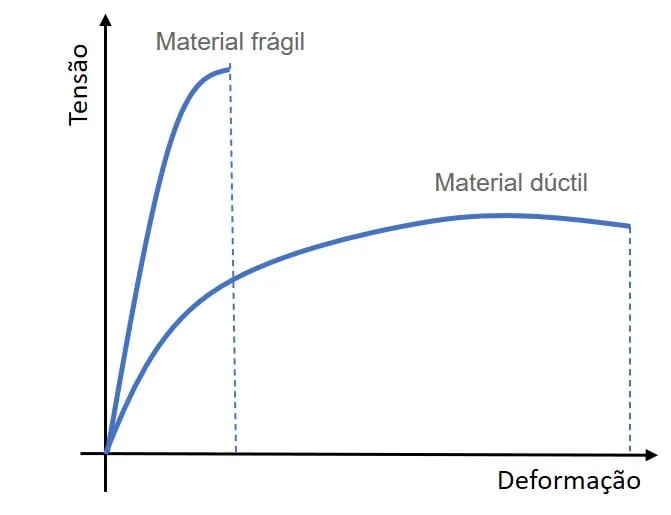
The diagram below repeats the comparison in simplified form. In it, the brittle material is shown with a higher fracture stress than the ductile one, which happens in many pairs of materials but is not a rule: what separates the two is the deformation up to fracture, not the strength.
Ductile and brittle materials: differences and examples
Ductility and brittleness are the two ends of the same scale. What decides which side a material falls on is how easily it deforms internally. In a metal, plastic deformation occurs by slip of atomic planes, driven by the movement of crystal lattice defects called dislocations; the metallic bond has no fixed direction, and atoms change neighbors without the material separating. In ceramics and glasses, ionic and covalent bonds are directional and hardly let planes slip: before deforming, the material cracks. The types of materials help predict behavior: metals tend to be ductile, ceramics and glasses tend to be brittle, and polymers vary widely.
What is a ductile material
A ductile material is one that elongates and forms a neck before fracturing. The fracture has a typical appearance, called cup and cone: in the center of the neck small voids open up, grow and coalesce into a crack, and the outer edge fractures last, inclined at about 45°. One half takes the shape of a cup and the other of a cone, with a dull, fibrous surface. Most metals are ductile at room temperature. Gold is the most ductile metal and also the most malleable. Among engineering metals, annealed copper and brass are among the most ductile; low-carbon steel is too, as the section on the ductility of steel further on shows.
It is this ability to deform without cracking that industry relies on in manufacturing. The photos show two typical uses: copper, drawn into fine wire, and steel sheets, which are bent and stamped cold.
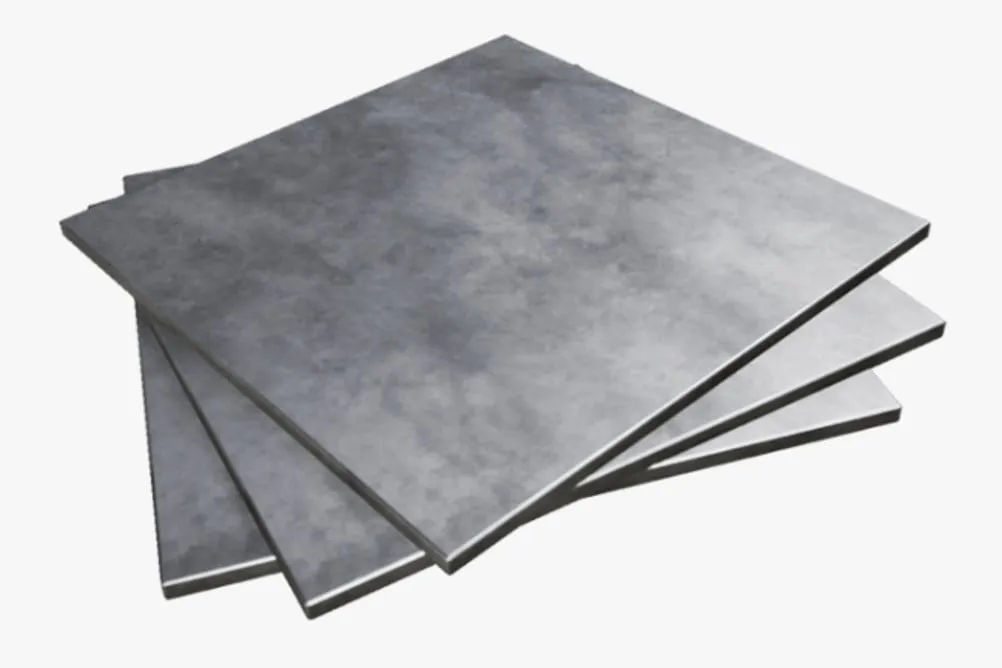
Steel sheets: a ductile material, cold formed without cracking
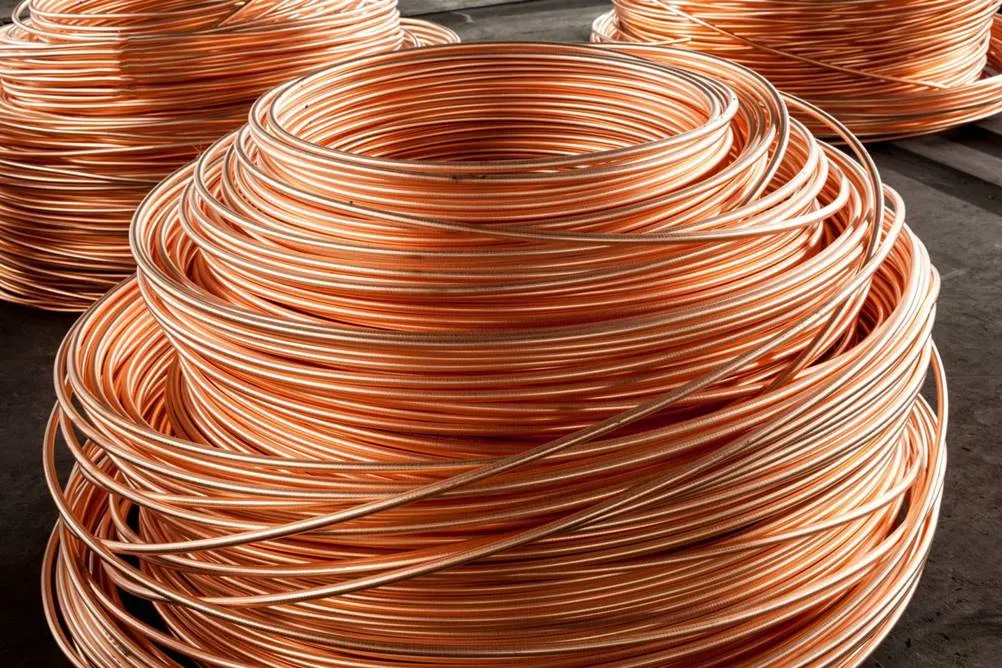
Copper is so ductile that it is drawn into fine wire
What is a brittle material
A brittle material is one that fractures suddenly, with little or no plastic deformation, generally with less than 5% elongation and no necking. The crack runs through the part very quickly, perpendicular to the load, and leaves a flat, shiny, granular fracture. The material gives no warning and absorbs little energy before breaking. A piece of glass breaks when bent; a copper wire bends and stays bent. Classic examples of brittle materials are glass, ceramics, gray cast iron (less than 1%), concrete under tension, polystyrene (about 1.6%) and acrylic. There is no absolute "most brittle material": brittleness also depends on temperature and on the presence of cracks and notches.
One caveat: brittle does not mean weak. Gray cast iron and ceramics are brittle and still perform well in compression, several times better than in tension. The 5% limit is a teaching convention from Callister, not a requirement of any standard.
Summary of the differences
The table brings together the criteria that separate the two behaviors, from the number measured in the test to the appearance of the fracture:
| Criterion | Ductile material | Brittle material |
|---|---|---|
| Elongation after fracture | typically above 5% | below about 5% |
| Reduction of area (Z) | high (40 to 66% in carbon steels) | practically zero |
| Stress-strain curve | yielding, work hardening and necking | almost linear up to fracture |
| Fracture appearance | cup and cone, dull and fibrous | flat, perpendicular to the load, shiny and granular |
| Warning before failure | deforms visibly | sudden fracture |
| Examples | 1020 steel, copper, brass, aluminum, gold, ductile (nodular) iron, polycarbonate, polyethylene | gray cast iron, glass, ceramics, concrete under tension, polystyrene, acrylic, as-quenched (untempered) steel |
Ductility table of materials
The values below are typical values or standard minimums, always given with the material condition. Metals are measured over L0 = 50 mm unless otherwise stated.
| Material | Condition | Elongation A (%) | Reduction of area Z (%) | Source |
|---|---|---|---|---|
| 1020 steel | annealed | 25 | n/a | Callister |
| AISI 1020 steel | typical datasheet | 36.5 | 66 | AZoM |
| AISI 1045 steel | hot-rolled | 16 | 40 | AZoM |
| AISI 4140 steel | annealed | 25.7 | n/a | AZoM |
| 304 stainless steel | minimum (EN standard) | ≥ 45 | n/a | AZoM |
| 6061-T6 aluminum | 1.6 mm sheet / 12.7 mm bar | 12 / 17 | n/a | Aluminum Association |
| Copper | annealed | 45 | n/a | Callister |
| 70/30 brass | annealed | 68 | n/a | Callister |
| 60-40-18 ductile iron | ASTM A536 minimum | 18 | n/a | ASTM A536 |
| 80-55-06 ductile iron | ASTM A536 minimum | 6 | n/a | ASTM A536 |
| Gray cast iron | as-cast | less than 1 | ≈ 0 | Metal Casting Institute |
| Polystyrene (PS) | typical | ≈ 1.6 | Professional Plastics | |
| Polycarbonate (PC) | typical | 100 to 150 | Professional Plastics | |
| Low-density polyethylene | typical | ≈ 400 | Professional Plastics |
Cast iron is the clearest example of how microstructure controls ductility: graphite flakes make gray iron brittle, while graphite nodules make ductile iron ductile, with up to 18%. Polymers follow other standards (ASTM D638 and ISO 527), and the result changes a lot with test speed and temperature.
The chart below puts these elongations side by side, with the 5% line that, by convention, separates brittle from ductile. The scale runs from less than 1% for gray cast iron to about 400% for low-density polyethylene.
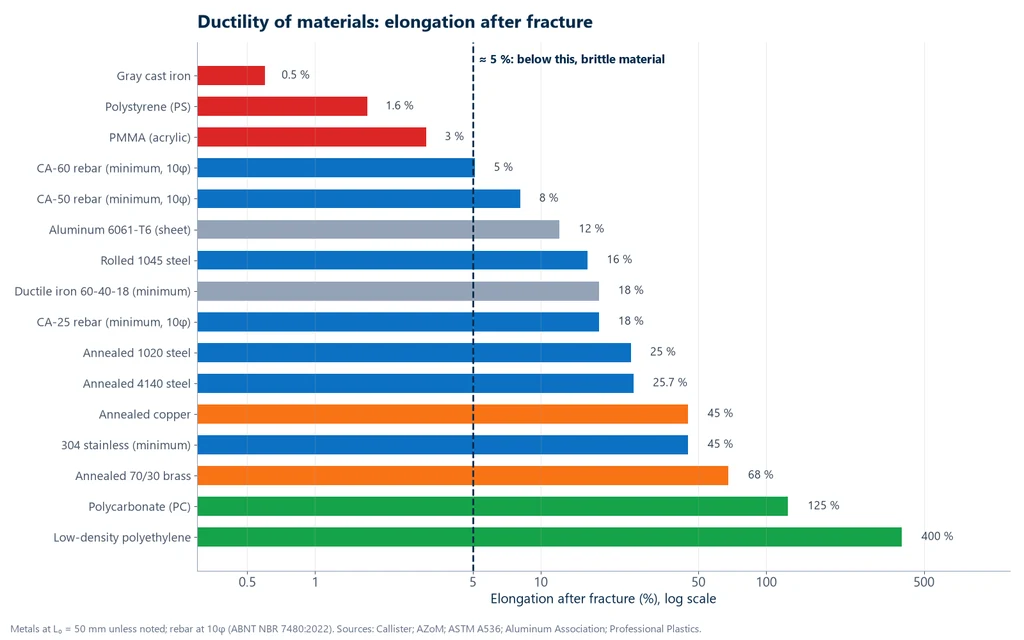
Ductility of steel
In steel, ductility depends on carbon content and heat treatment. More carbon raises strength and lowers elongation: hot-rolled 1045 elongates 16%, against 25 to 36.5% for 1020. That range for 1020 in the table above also shows why condition and source matter: 25% is the textbook value for the annealed steel, 36.5% the value from a commercial datasheet. This is why an elongation value only makes sense when it comes with the material condition.
Heat treatment changes ductility as much as composition does. Quenching forms hard, brittle martensite; tempering restores part of the ductility; annealing and normalizing leave the steel in its most ductile condition (annealed 4140 elongates 25.7%). Stiffness does not change with any of this: the modulus of elasticity of steel stays around 200 GPa.
Rebar ductility: CA-25, CA-50 and CA-60
In civil construction, steel ductility is a code requirement. ABNT NBR 7480:2024 (the Brazilian standard for steel reinforcing bars and wires) sets the minimum elongation of bars and wires for reinforced concrete in the Brazilian grades CA-25, CA-50 and CA-60, measured over 10 diameters (10φ):
| Grade | Minimum yield strength (fyk) | Minimum elongation after fracture (10φ) | Total elongation at maximum force (Agt) |
|---|---|---|---|
| CA-25 | 250 MPa | 18% | n/a |
| CA-50 | 500 MPa | 8% | 5% |
| CA-60 | 600 MPa | 5% | n/a |
For CA-50, elongation can be verified either by the elongation after fracture criterion (8%) or by the total elongation at maximum force (5%). The standard also requires a minimum ratio between tensile strength and yield strength, which is another ductility requirement: the steel must work harden before it fractures. Bend ductility is checked in the bend test, with a mandrel diameter defined by the grade.
Ductility, malleability, toughness and elasticity
Searches for ductility almost always come together with these words, and many texts on the internet confuse these properties. Each one answers a different question about the material.
Ductility and malleability: the first is being drawn into wire, under tension; the second is being flattened into sheet, by rolling or hammering, under compression. Both depend on the same ability of atoms to change position without the material separating, which is why they usually go together, as in gold. But they are not the same thing: a material can be very malleable and have little tensile strength, like lead. There is no standardized malleability index; it is assessed in forming tests.
Ductility and toughness: ductility tells how much the material deforms; toughness tells how much energy it absorbs up to fracture, which is the area under the stress-strain curve. A very ductile material with low strength has low toughness, and so does a very strong but brittle one. High toughness requires both. Toughness has nothing to do with "returning to the original dimensions" or with a high modulus of elasticity, as some texts claim.
Ductility, elasticity and resilience: as seen in the definition, elasticity is the deformation that is recovered when the load is removed, and the stiffness of that range is the modulus of elasticity. Resilience is the energy the material stores in that same elastic range and releases when unloaded. Both end where ductility begins: at yielding.
Ductility and hardness: hardness is the resistance to indentation and scratching, measured on scales such as Brinell, Vickers and Rockwell. In general, when a treatment raises the hardness of a steel, ductility drops, as in quenching.
The table summarizes what each property measures and how it is quantified:
| Property | What it measures | How it is quantified |
|---|---|---|
| Ductility | plastic deformation up to fracture, under tension | A and Z in the tensile test |
| Malleability | ability to be rolled or hammered into sheet without cracking, under compression | no standardized index; forming tests |
| Toughness | energy absorbed up to fracture (requires strength and ductility) | area under the curve (J/m³), Charpy energy (J), KIC |
| Elasticity | deformation recovered when the load is removed | modulus of elasticity (GPa) |
| Resilience | stored elastic energy | area up to yielding |
| Hardness | resistance to indentation and scratching | HB, HV, HRC |
What increases or reduces ductility
- Temperature. In general, ductility increases with temperature. Ferritic steels have a ductile-to-brittle transition temperature: below it, they fracture in a brittle manner. A 1020 steel absorbs 16.9 J in the Charpy test at −30 °C and 68 J at 150 °C (AZoM). Face-centered cubic metals, an atomic arrangement with many slip planes, such as copper, aluminum and 304 stainless steel, do not show a marked transition. The curve is obtained with the impact test.
- Strain rate. Loading faster tends to reduce ductility and raises the transition temperature.
- Work hardening. Cold working raises yield strength and tensile strength and reduces ductility; annealing restores it. See work hardening.
- Heat treatment and composition. These are the factors already covered under the ductility of steel and in the materials table: quenching without tempering, high carbon and, in cast iron, graphite flakes reduce ductility.
- Grain size. A refined grain raises strength and lowers the transition temperature.
- Hydrogen. Hydrogen embrittlement greatly reduces the ductility of high-strength steels, a well-known problem in pickled and galvanized bolts.
Structural ductility and concrete ductility
In structures, ductility is the ability of a member to deform beyond yielding without an abrupt loss of strength, measured by the ratio μ = Δu / Δy between the ultimate displacement and the yield displacement. It is not a property of the material but of the whole member. It is what dissipates energy in an earthquake and gives time to evacuate an overloaded building. Concrete alone is brittle in tension; the ductility of reinforced concrete beams and columns comes from the steel reinforcement, hence the minimum elongations for CA-50, and from detailing. The behavior of concrete is covered in modulus of elasticity of concrete.
Solved ductility exercises
1. ASTM specimen. A round specimen with d0 = 12.5 mm and L0 = 50 mm ended with Lu = 62.5 mm and a 7.5 mm diameter at the neck. Then A = (62.5 − 50) / 50 × 100 = 25.0%. From the diameters, Z = 1 − (7.5 / 12.5)² = 1 − 0.36 = 64%. The true strain at fracture is ln(1 / 0.36) = 1.02. These are typical values for annealed low-carbon steel.
2. ISO proportional specimen. For d0 = 10 mm, S0 = 78.54 mm² and √S0 = 8.862 mm, so L0 = 5.65 × 8.862 = 50.07 mm, in practice 50 mm = 5d. If Lu = 61.2 mm, A = (61.2 − 50) / 50 × 100 = 22.4%.
3. CA-50 rebar on the universal testing machine. A 12.5 mm bar, L0 = 10φ = 125 mm, nominal area of 122.7 mm². The test gave a yield force of 66.3 kN, a maximum force of 79.5 kN and Lu = 138.5 mm. Yield strength: 66,300 / 122.7 = 540 MPa (minimum 500). Tensile strength: 79,500 / 122.7 = 648 MPa, ratio 1.20. Elongation: (138.5 − 125) / 125 × 100 = 10.8% (minimum 8%). The bar meets NBR 7480 in tension. A bar like this breaks at around 80 kN, so it calls for a 100 to 200 kN machine.
4. Converting elongation between standards. A carbon steel gave A = 30% on an ASTM (4D) specimen. 4D is equivalent to 4.51√S0, and the ISO 2566-1 factor is (4.51 / 5.65)0.4 = 0.91. On the 5d ISO specimen, the expected value is 30 × 0.91 ≈ 27.4%. The same material, about 2.6 points less, only because of the gauge length.
5. Structural ductility. A column tested under lateral load yields at 12 mm of displacement and reaches 54 mm before losing strength. The displacement ductility is μ = 54 / 12 = 4.5: the member deformed 4.5 times its yield displacement before losing strength.
How to measure ductility on a universal testing machine
The universal testing machine pulls the specimen to fracture while the load cell measures force and the extensometer measures extension over the gauge length. The testing software plots the curve and calculates yield strength, tensile strength and elongation. Using crosshead displacement instead of the extensometer overestimates strain, because it includes slack and the deformation of the machine itself. Reduction of area always requires measuring the neck of the fractured specimen. The panel below shows the machine, the role of each part in this test and the accessories used to measure ductility.
The universal testing machine in the tensile test that measures ductility
The M2 line has single-column models, from 200 N to 10 kN, and dual-column models, from 5 kN to 1,000 kN. Each part of the machine has a role in the test:
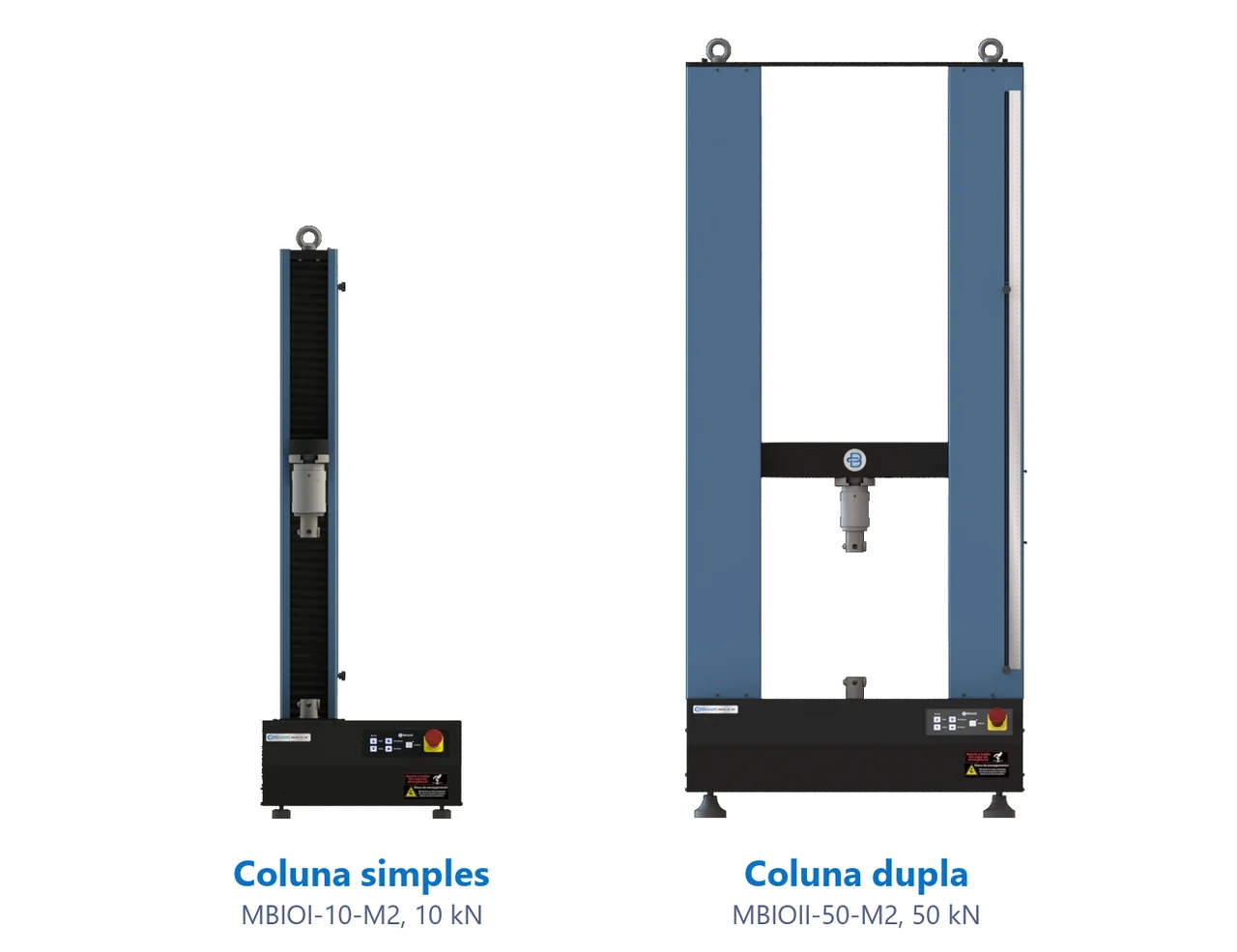
- Moving crosshead pulls to fracture
- Load cell measures force, class 1
- Wedge grips hold without slipping
- Extensometer measures the actual elongation
- BioLab software calculates elongation at fracture
- Panel and emergency stop position and stop the test
Accessories for the tensile test that measures ductility
The accessories below are mounted on the same machine, depending on the specimen and the standard:
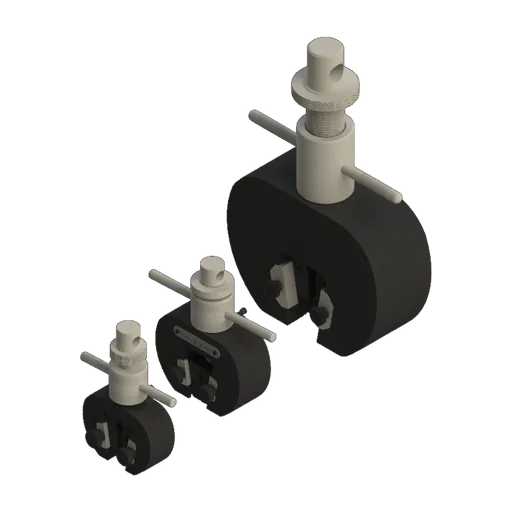
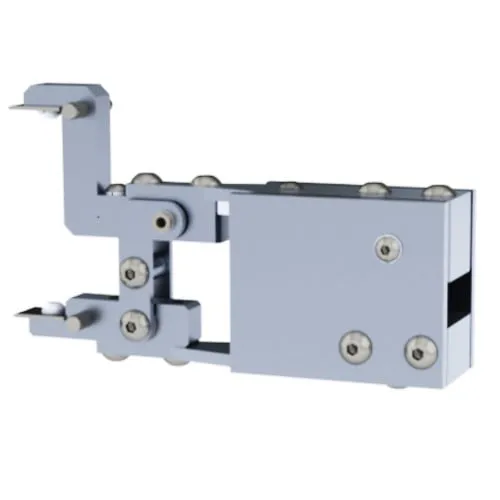
Machine capacity follows the material: films and fine wires, 200 N to 1 kN; polymers, elastomers and textiles, 2 to 10 kN, with an extended column for materials that elongate hundreds of percent; metals, sheet and fasteners, 5 to 50 kN; rebar, profiles and cables, 100 kN and up. Explore Biopdi's line of universal testing machines. For sheet ductility in forming, see also the cupping test.
Ductility standards
- ABNT NBR ISO 6892-1 / ISO 6892-1:2019: tensile testing of metallic materials at room temperature; defines A, Z, Agt and the 5.65√S0 gauge length.
- ASTM E8/E8M: tensile testing of metallic materials, with a 4D gauge length.
- ASTM A370: mechanical testing of steel products.
- ISO 2566-1: conversion of elongation values between gauge lengths for carbon and low-alloy steels.
- ABNT NBR 7480:2024: Brazilian standard for steel for concrete reinforcement; minimum elongations for CA-25, CA-50 and CA-60.
- ISO 15630-1: test methods for bars and wires for concrete reinforcement.
- ASTM D638 and ISO 527: tensile testing of plastics.
Other tests and technical references
Toughness of materials: what it is, how to calculate it and units
Toughness is the energy a material absorbs before fracturing. Learn how to calculate it, units, the Charpy test, fracture toughness and reference values.
Mechanical properties of materials: what they are, the main types, tests, standards and steel values
The mechanical properties of materials define how a material responds to forces: how much it deforms, whether it returns to its shape, how much load it carries, how much energy it absorbs and how it fractures. See each property with its unit, test and standard, the values for steel (NBR 8800, the Brazilian steel structures design standard; ASTM A36; CA-50, the Brazilian rebar grade), the pairs that are often confused and solved exercises.
Necking in the tensile test: what it is, when it starts, reduction of area Z and cup-and-cone fracture
Necking is the localized reduction in cross-section of the test specimen that begins at maximum force in a tensile test. See Considère's criterion, the reduction of area Z = (S0 − Su)/S0 × 100 per ISO 6892-1, values by material, cup-and-cone fracture, the Bridgman correction, cold drawing of polymers and worked examples.
Mechanical strength: what it is, types, formula and values
Mechanical strength is the maximum stress a material bears before yielding or breaking (MPa). Types, formulas, tests, standards and values by material.
Frequently asked questions
What is ductility?
Ductility is the mechanical property that indicates how much a material deforms plastically under tension before it fractures. It is measured in the tensile test by the elongation after fracture (A) and the reduction of area (Z), according to ISO 6892-1 (ABNT NBR ISO 6892-1 in Brazil).
How do you calculate ductility?
Use A = (Lu − L0) / L0 × 100 and Z = (S0 − Su) / S0 × 100. For example, a test specimen with a 50 mm gauge length that ends up at 62.5 mm has A = 25%. Always report the gauge length you used, because elongation depends on it.
What is a ductile material?
A ductile material elongates and necks before it fractures and shows a cup-and-cone fracture. It usually has more than 5% elongation. Examples: annealed copper (about 45%), 70/30 brass (about 68%) and 1020 steel (25 to 36.5%, depending on its condition).
What is a brittle material?
A brittle material fractures suddenly, with little or no plastic deformation. It usually has less than 5% elongation and a flat fracture. Examples: glass, ceramics, gray cast iron (less than 1%) and polystyrene (about 1.6%).
What is the difference between a ductile and a brittle material?
A ductile material deforms plastically and gives warning before it fractures, with necking and a cup-and-cone fracture. A brittle material fractures suddenly with almost no deformation, shows a flat, shiny fracture surface and absorbs little energy.
What is the difference between ductility and malleability?
Ductility is the ability to deform under tension, as when a metal is drawn into wire. Malleability is the ability to deform under compression, as when a metal is rolled or hammered into sheet. Gold is the most ductile metal and also the most malleable.
What is the difference between ductility and toughness?
Ductility measures how much a material deforms before it fractures. Toughness measures how much energy it absorbs before it fractures, which requires both strength and ductility. Toughness is measured by the area under the stress-strain curve or by the Charpy impact test.
In Portuguese, is the correct term "ductilidade" or "ductibilidade"?
The Priberam dictionary lists both forms with the same meaning, with "ductibilidade" as a variant of "ductilidade". In technical standards and in engineering, use "ductilidade" (ductility).
What is a synonym for ductility?
In engineering, the closest equivalent is the capacity for plastic deformation under tension. Flexibility is not a synonym, because a flexible material may be only elastic and return to its original shape.
What is the ductility of CA-50 steel?
ABNT NBR 7480:2024 (the Brazilian standard for steel reinforcing bars) requires CA-50 rebar to have a minimum elongation after fracture of 8% over 10 diameters, or a total elongation at maximum force of 5%. For CA-60 the minimum is 5%, and for CA-25 it is 18%.
Does temperature affect ductility?
Yes. In general, ductility increases with temperature. Ferritic steels, however, have a ductile-to-brittle transition temperature below which they fracture in a brittle manner, which is evaluated with the Charpy impact test.
Are metals always ductile?
No. Most metals are ductile at room temperature, but gray cast iron, quenched steel without tempering and steels below their transition temperature are brittle.