
Elastic deformation is the reversible deformation of a solid: under load, the bonds between atoms stretch without breaking, and once the force is removed the material returns to its original size. In metals it follows Hooke's law, ε = σ/E (strain equals stress divided by the modulus of elasticity), and it rarely exceeds 0.5%. Plastic deformation begins when the stress exceeds the elastic limit: from that point on, part of the deformation remains in the part after unloading.
The difference between the two is what separates a beam that deflects and springs back from a sheet that is bent on purpose. This article covers the elastic part, in this order: the definition and what happens to the atoms, the formula, the point where it ends, the comparison with plastic deformation, how much each material deforms, the stored energy, springback in metal forming, the case of polymers and the measurement in the tensile test, with solved exercises at the end.
What is elastic deformation
To deform is to change shape or size under a load. So that the result does not depend on the size of the part, deformation is measured in relative terms: in tension, engineering strain is ε = ΔL/L0, the elongation divided by the original length. It is dimensionless and is usually written in %, in mm/mm or in microstrain (1 µε = 10−6). The load, in turn, is expressed as stress, σ = F/A0, the force divided by the original cross-sectional area, in MPa (N/mm²).
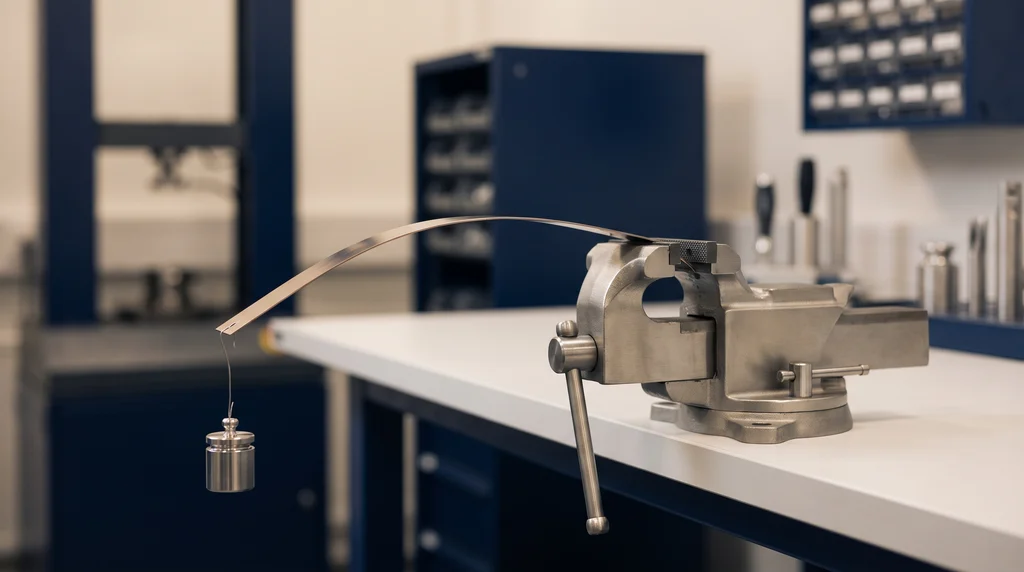
In the photo, a spring steel blade clamped in a vise is bent by a weight: as long as the stress stays below the yield point, the blade straightens again when the weight is removed. That is elastic deformation.
Deformation is elastic when it disappears completely once the load is removed. Callister and Rethwisch (Materials Science and Engineering: An Introduction, ch. 6) define elastic deformation as the deformation in which stress and strain are proportional, and note that it is not permanent. That definition covers the most common case, metals, but not all of them: gray cast iron, concrete, many polymers and rubber recover their shape along a stress-strain curve that is not straight. The more robust definition is therefore reversibility: elastic deformation is deformation that goes away. Proportionality, when it exists, is Hooke's law.
Three engineering examples make the idea concrete. A floor beam under service load deflects a few millimeters and returns to its position when the load is removed. A valve spring compresses and extends millions of times without changing its free length. A bolt tightened to a controlled torque elongates elastically, and it is that elongation that maintains the clamping force in the joint. In all three cases, the design only works if the part stays within the elastic range.
What happens to the atoms
In a solid, each atom occupies an equilibrium position where the attraction and repulsion of its neighbors cancel out. A tensile stress pulls the atoms slightly away from that position, and a compressive stress pushes them closer; in both cases a restoring force appears that tends to bring them back. In elastic deformation, each atom keeps the same neighbors: the bonds stretch or shorten, but they do not break. Once the load is removed, the restoring force returns the atoms to their original positions, and the part recovers its dimensions.
This mechanism explains where the modulus of elasticity E comes from. Callister shows that the modulus is proportional to the slope of the interatomic force versus separation curve, taken at the equilibrium position: stronger bonds give a higher modulus. That is why tungsten has about 407 GPa, steel about 200 GPa, aluminum 69 GPa, and polymers, with weak bonds between chains, a few GPa or less. For the same reason, the modulus barely changes with heat treatment or cold working: these processes change the microstructure, not the strength of the bonds.
Plastic deformation has a different mechanism. In it, planes of atoms slip over one another through the motion of dislocations, line defects in the crystal lattice, and the atoms acquire new neighbors. Slip of planes, dislocation motion and grain rotation are therefore not mechanisms of elastic deformation, as is sometimes stated: they are precisely what makes deformation permanent.
Elastic deformation formula: Hooke's law
In the linear portion, stress is proportional to strain, and the constant of proportionality is the modulus of elasticity: σ = E·ε. Solving for strain gives the elastic deformation formula:
ε = σ / E
With σ in MPa, E must also be in MPa: 200 GPa is 200,000 MPa. The most common mistake in this calculation is dividing MPa by GPa without converting and getting a strain a thousand times too large. The relationship was published by Robert Hooke in 1678, in Lectures de Potentia Restitutiva, after being announced in 1676 as a Latin anagram meaning "ut tensio, sic vis": as the extension, so the force. The form with stress and modulus came later; the history and the case of the spring are in the article on Hooke's law.
Combining the definitions of stress and strain with Hooke's law gives the elastic elongation of a bar under axial force, the form most used in design:
ΔL = F·L0 / (A0·E)
The formula shows the three ways to reduce the elongation of a part: increase the area, reduce the length or switch to a material with a higher modulus. Increasing the strength of the steel does not help, because a high-strength steel has practically the same E as an ordinary steel. The list summarizes the quantities and units:
- Normal stress: σ = F/A0, with F in N, A0 in mm² and σ in MPa.
- Normal strain: ε = ΔL/L0, dimensionless; 0.001 = 0.1% = 1,000 µε.
- Modulus of elasticity: E, in GPa or MPa. For steel, design uses 200 GPa according to ABNT NBR 8800:2008 (the Brazilian standard for the design of steel structures) and 210 GPa for reinforcing bars according to ABNT NBR 6118:2023 (the Brazilian standard for the design of concrete structures); the average measured value cited by Callister is 207 GPa. The difference is explained in the article on the modulus of elasticity of steel.
- Elastic elongation: ΔL = F·L0/(A0·E), in the unit of L0.
Where elastic deformation ends
Hooke's law and elastic deformation each have their own limits, and they do not necessarily coincide. On the stress-strain curve, the elastic portion is the beginning of the curve; the article on the curve marks the proportional limit with the letter A and the elastic limit with B, and this article follows the same notation. Three points, in order of increasing stress, bound elastic deformation:
- Proportional limit (A): the highest stress at which σ is still proportional to ε. Above it, Hooke's law no longer holds, but the material may still be elastic. The topic is covered in the article on the proportional limit.
- Elastic limit (B): the highest stress that leaves no permanent deformation after unloading (ASTM E6). It is the end of elastic deformation proper. Between A and B there may be a nonlinear elastic portion.
- Yield strength: the stress at which plastic deformation becomes measurable. In steel with a yield plateau, these are the ReH and ReL values; in other materials, Rp0.2, the stress that leaves 0.2% permanent strain. Because the elastic limit depends on the sensitivity of the instrument, product standards specify the yield strength. The topic is covered in the article on the elastic limit and yield strength.
In metals, the three are very close, in the order A ≤ B ≤ yield. In practice, the maximum elastic strain of a metal is estimated from the ratio of yield strength to modulus, a calculation made later, in the section on how much each material deforms.
Elastic and plastic deformation: the difference
Both types of deformation occur in the same material, in different stress ranges. Below the elastic limit, all deformation is elastic. Above it, the part has two components added together: the elastic one, which still exists and is recovered on unloading, and the plastic one, which remains. This sum is the idea most often missing from texts on the subject: a part that has deformed plastically has not lost its elasticity, it has simply accumulated a permanent deformation on top of it.
Plastic deformation also changes the material. It multiplies dislocations, which begin to block one another, and more stress is needed to keep deforming: this is work hardening, which raises the yield strength of a cold-drawn steel. The ability to deform plastically until fracture is ductility. Neither effect exists in elastic deformation, which leaves the material exactly as it was.
Another difference lies in volume. In elastic deformation, the volume changes slightly: a bar in tension elongates and gets thinner, but it thins less than would be needed to keep the volume constant, because Poisson's ratio ν, the ratio of lateral contraction to elongation, is below 0.5 in metals. The relative volume change in tension is ΔV/V = ε·(1 − 2ν); for a steel with ε = 0.001 and ν = 0.3, it is 0.0004, or 0.04%. Plastic deformation of metals occurs at constant volume, because slip of planes neither creates nor removes space between atoms. The table brings the differences together:
| Aspect | Elastic deformation | Plastic deformation |
|---|---|---|
| Reversibility | fully recovered on unloading | remains after unloading |
| Mechanism | bonds stretch or shorten; atoms keep their neighbors | dislocations move; atoms change neighbors |
| Stress-strain relationship | linear in metals (σ = E·ε) | nonlinear, with work hardening |
| Stress range | below the elastic limit | above the elastic limit |
| Order of magnitude in metals | up to about 0.5% | from a few % to tens of % up to fracture |
| Volume | changes slightly (ν < 0.5) | constant |
| Effect on modulus E | none | generally very small |
| Effect on yield strength | none | increases (work hardening) |
| Energy | stored and released on unloading | largely converted into heat |
| Related properties | modulus E and Poisson's ratio | yield strength, work hardening and ductility |
The mechanisms of plastic deformation, the factors that control it and the forming processes that use it, such as rolling, forging and stamping, are covered in the article on plastic deformation.
Elastic deformation in tension, compression, shear and volume
Elastic deformation is not just elongation. Each loading mode has its own strain and its own modulus, and all are elastic as long as the stress stays below the corresponding limit:
- Tension: axial elongation ε = σ/E, accompanied by lateral contraction εlateral = −ν·ε.
- Compression: axial shortening and lateral expansion; in metals, at low stresses, the modulus is the same as in tension. The corresponding test is the compression test.
- Shear and torsion: the part does not change length, but it distorts. The shear strain γ, in radians, is γ = τ/G, with τ the shear stress and G the shear modulus, 77 GPa for steel according to NBR 8800. It is measured in the torsion test and is related to the shear test.
- Bending: the fibers on one side of the beam are in tension and those on the other side in compression, with strain proportional to the distance from the neutral axis. The test is the flexural test.
- Volumetric: under a pressure p equal in all directions, the volume changes by ΔV/V = −p/K, with K the bulk modulus.
In an isotropic material, with the same properties in all directions, E, G and ν are not independent: E = 2G(1 + ν). With the NBR 8800 values for steel, 2 × 77 × 1.3 = 200.2 GPa, which agrees with E = 200 GPa. The relationship with K and the values of E, G and ν for several metals are in the article on the modulus of elasticity.
How much a material deforms elastically
Callister gives the order of magnitude: in most metals, the elastic range extends to strains of about 0.005, or 0.5%. The figure for each material comes from ε ≈ Re/E, with Re the yield strength, used instead of the elastic limit, which is very close to it and is what gets measured. The table applies the calculation to materials with a known source and condition; the yield values are those in the article on yield strength.
| Material and condition | Yield strength (MPa) | E (GPa) | Maximum elastic strain |
|---|---|---|---|
| 1020 steel, hot rolled | 205 (typical) | 200 | 0.10% |
| 304 stainless steel, annealed | ≥ 205 (minimum) | 193 | 0.11% |
| ASTM A36 steel | ≥ 250 (minimum) | 200 | 0.125% |
| CA-50 rebar (Brazilian grade) | fyk ≥ 500 | 210 (NBR 6118) | 0.24% |
| 6061-T6 aluminum | 276 (typical) | 69 | 0.40% |
| 4140 steel, quenched and tempered at 205 °C | about 1,600 | 200 | 0.80% |
Two conclusions follow from the table. The first is that the elastic strain of structural steels is small: from 0.1% to 0.25%, which means that a test specimen with a 50 mm gauge length elongates about 0.05 to 0.12 mm before yielding. The second is that Callister's 0.5% is an average: quenched 4140 reaches 0.8% because it has a much higher yield strength with the same modulus, and aluminum reaches 0.4% with a yield strength similar to that of A36 because its modulus is three times lower. In elastomers, elastic strain exceeds 100%, through a different mechanism, discussed in the section on polymers.
Elastic energy: resilience
Deforming a material requires work, and in elastic deformation that work is stored as energy in the stretched bonds, ready to be released on unloading. Per unit volume, this energy is the area under the elastic portion of the stress-strain curve, a triangle. The maximum energy the material can store without permanent deformation is the modulus of resilience (Callister):
Ur = σe² / (2E) = ½·σe·εe
With σe and E in MPa, Ur comes out in MJ/m³, because 1 MPa is equivalent to 1 MJ/m³. Since stress enters squared, resilience grows much more with the elastic limit than with a reduction in modulus. The chart below compares three materials from the previous table: A36 stores 0.156 MJ/m³; 6061-T6 aluminum, with a similar yield strength and a modulus three times lower, 0.552 MJ/m³; and quenched and tempered 4140, with a yield strength 6.4 times that of A36, 6.4 MJ/m³, about 41 times more.
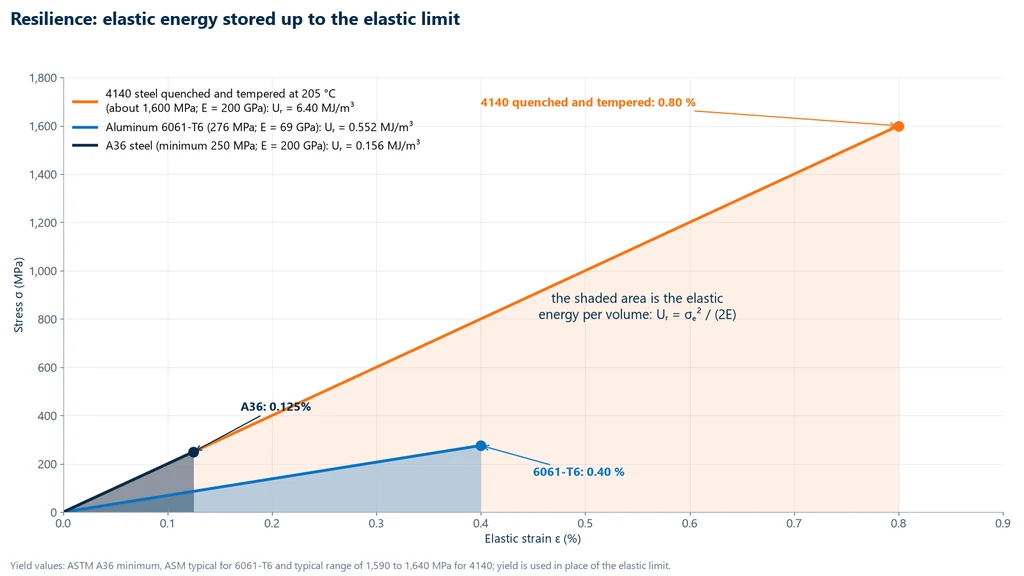
That is why springs are made from steels with a high elastic limit: a spring needs to store a lot of energy per unit volume without taking a permanent set. Resilience should not be confused with toughness, which is the area under the entire curve up to fracture and includes plastic deformation. Applications and the comparison between materials are in the article on the resilience of materials.
Elastic recovery on unloading and in forming
When a part is loaded beyond yield and then unloaded, the unloading curve does not retrace the loading path. It drops in a straight line, parallel to the initial elastic portion, with the same slope E. The strain that disappears along this line is the elastic part, σ/E. The strain that remains when the force reaches zero is the plastic part. The graph below shows this with the numbers from exercise 4. A steel bar is loaded to 636.6 MPa, with 1.32% total strain under load. It recovers 0.32% on unloading and keeps a permanent strain of 1.00%.
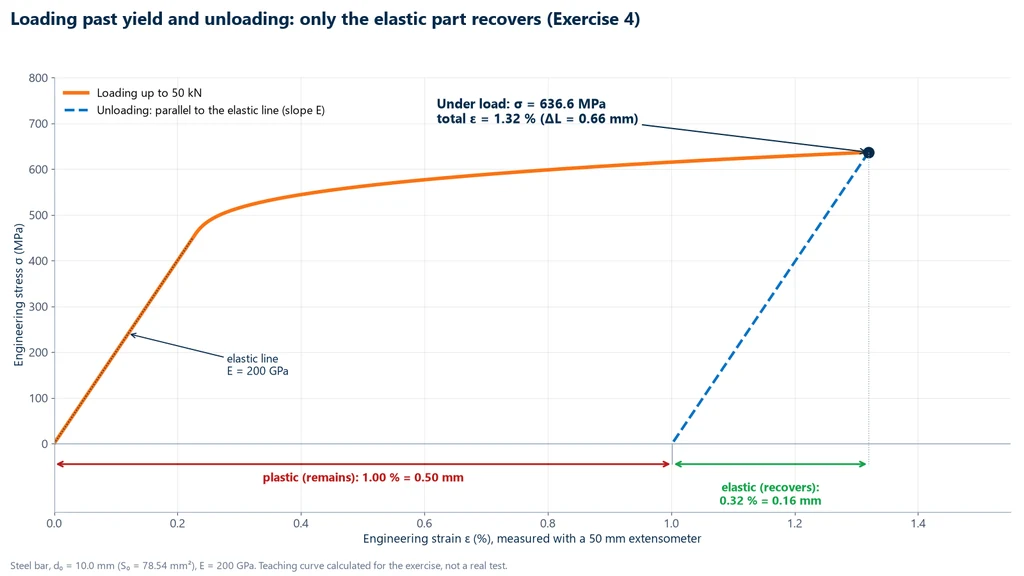
In sheet metal forming, this recovery has a name: springback. After bending or stamping, the part "opens" slightly as it leaves the tool, because the elastic part is recovered. Springback is proportional to σ/E at the start of unloading, which gives two practical rules. First, low-modulus materials spring back more. At the same stress of 200 MPa, aluminum (69 GPa) recovers 0.29% and steel (200 GPa) recovers 0.10%, almost three times less. Second, high-strength materials spring back more, because they reach unloading at a higher stress.
In the advanced high-strength steels (AHSS) used by the automotive industry, springback is identified as the main problem in mass production of structural parts, according to a dissertation from UFPR (Federal University of Paraná, Brazil) on computational prediction of the phenomenon. A study presented at CONEM 2012 (the Brazilian National Congress of Mechanical Engineering, organized by ABCM) tested six steels: high-strength low-alloy (HSLA 400/500), dual-phase (DP, up to DP 800/1000) and transformation-induced plasticity (TRIP 500/800). It measured moduli between 205 and 208 GPa and found a considerable reduction of the modulus with plastic strain. DP 800/1000, the strongest, showed the largest springback. This drop in apparent modulus on unloading is an exception to the rule that work hardening does not change E, and it is what makes prediction difficult in these steels. On the shop floor, springback is compensated in the tool design: overbending past the final angle, adjusting radius and clearance, and finite element simulation. The tests that characterize the sheet for this purpose are covered in the articles on the cupping test and the bend test.
Rubber, polymers and anelasticity
Hooke's law describes metals well, but it does not hold for every elastic material. Rubber is the best-known counterexample, and many texts get it wrong by listing it next to steel as an example of linear elastic deformation.
In elastomers, the polymer chains are coiled and linked to each other at a few points, the crosslinks. Under tension, the chains uncoil and align. When the load is removed, they return to the coiled state. The recoverable strain is huge, but the stress-strain curve is not straight, and there is no single E. Callister shows the scale of the contrast: the modulus of highly elastic polymers can be on the order of 7 MPa, and that of very stiff polymers reaches about 4 GPa, against 45 GPa for magnesium and 407 GPa for tungsten. Some elastomers elongate more than 1,000% before breaking.
Thermoplastics add another effect: the response depends on time and on rate. This is viscoelasticity, a behavior between that of a spring, which follows Hooke's law, and that of a dashpot, where stress depends on strain rate. A viscoelastic polymer under constant load keeps deforming over time (creep). Under constant strain, it loses stress over time (relaxation). It also gives different moduli in tests run at different speeds. This is why plastics standards such as ASTM D638 and ISO 527-1 fix the test speed, and why ISO 527-1 defines the modulus as a chord between two specified strains.
Callister calls time-dependent elastic deformation anelasticity: it is recoverable, but not instantaneous. In metals it is usually negligible; in polymers it is significant. A practical sign is hysteresis. In a loading and unloading cycle, the unloading curve does not match the loading curve, and the area between them is dissipated energy. Mützenberg, Veit and Silveira (Revista Brasileira de Ensino de Física, 2004) show loops of this kind in loading and unloading tests on copper and steel wires. Creep of metals at elevated temperature is a different phenomenon, with its own test: the creep test.
How to measure elastic deformation in a tensile test
Elastic deformation is measured on a universal testing machine (UTM) with three elements. The crosshead applies the force at a controlled speed. The load cell measures the force. The extensometer measures elongation directly on the test specimen, between two contact points a known distance apart, the gauge length. The software divides the force by the area and the elongation by the gauge length, and plots the stress-strain curve. The modulus E is the slope of the line fitted to the elastic portion, following ASTM E111. Poisson's ratio requires a second, transverse extensometer, following ASTM E132. That standard warns that, above the proportional limit, the ratio between lateral and axial strain should not be treated as Poisson's ratio.
The extensometer is not optional. Crosshead displacement includes grip seating and the elastic deformation of the machine itself, while the elastic elongation of a steel specimen is a few tens of micrometers, as exercise 1 shows. Measured from the crosshead, the curve comes out with a lower slope, and the calculated modulus is underestimated. Extensometer quality is defined by classes: ASTM E83-25 classifies extensometer systems by maximum error, and ISO 9513 does the same in the ISO series. For properties that depend on measured strain, such as Rp0.2, ISO 6892-1 requires at least a class 1 extensometer per ISO 9513.
Solved exercises
The four exercises follow the order of the article: strain in a specimen, elongation and contraction of a bar, shear, and elastic recovery on unloading. Resilience was already calculated in its own section.
Exercise 1: extensometer reading on a steel specimen
Cylindrical ASTM A36 steel specimen, d0 = 10 mm, with a 50 mm gauge length extensometer and E = 200 GPa. The machine applies 15 kN. What does the extensometer read?
- Area: A0 = π × 10² / 4 = 78.54 mm².
- Stress: σ = 15,000 / 78.54 = 191.0 MPa, below the minimum yield strength of 250 MPa; the behavior is elastic.
- Strain: ε = 191.0 / 200,000 = 9.55 × 10⁻⁴, or 955 µε (0.0955%).
- Elongation: ΔL = 9.55 × 10−4 × 50 = 0.048 mm, about 48 µm.
When the force is removed, the reading returns to zero. That is 48 µm, the same order as grip seating, which is why the modulus can only be measured with an extensometer.
Exercise 2: elongation and contraction of an aluminum bar
Aluminum bar with L0 = 2 m and d = 20 mm, under a tensile force of 10 kN, with E = 69 GPa and ν = 0.33 (Callister, Table 6.1).
- Area and stress: A = π × 20² / 4 = 314.16 mm²; σ = 10,000 / 314.16 = 31.83 MPa.
- Axial strain: ε = 31.83 / 69,000 = 4.61 × 10⁻⁴.
- Elongation: ΔL = 4.61 × 10−4 × 2,000 = 0.92 mm.
- Lateral strain: εlateral = −0.33 × 4.61 × 10−4 = −1.52 × 10⁻⁴.
- Change in diameter: Δd = −1.52 × 10−4 × 20 = −0.0030 mm, about 3 µm.
An identical steel bar, with E = 200 GPa, would elongate 0.32 mm: the same stress with a modulus three times higher gives one third of the elongation.
Exercise 3: shear strain of a steel pin
Steel pin under a shear stress τ = 50 MPa, with G = 77 GPa and ν = 0.3 (ABNT NBR 8800:2008, the Brazilian standard for design of steel structures).
- Shear strain: γ = τ/G = 50 / 77,000 = 6.49 × 10⁻⁴ rad, about 0.037°.
- Check: E = 2G(1 + ν) = 2 × 77 × 1.3 = 200.2 GPa, matching the E = 200 GPa given by the same standard.
Exercise 4: how much is recovered after passing yield
A steel bar with d0 = 10 mm, E = 200 GPa and a 50 mm gauge length extensometer is loaded to 50 kN, above yield. Under load, the extensometer reads ΔL = 0.66 mm. How much of the elongation is recovered on unloading, and how much remains?
- Maximum stress: σ = 50,000 / 78.54 = 636.6 MPa.
- Total strain under load: ε = 0.66 / 50 = 0.0132 (1.32%).
- Elastic part, which is recovered: εel = 636.6 / 200,000 = 3.18 × 10⁻³ (0.32%), or 0.16 mm.
- Plastic part, which remains: εpl = 0.0132 − 0.00318 = 0.0100 (1.00%), or 0.50 mm.
The graph in the section on elastic recovery shows this loading and unloading. The recovered part does not depend on the plastic curve, only on the stress at the start of unloading and on the modulus.
Standards for elastic deformation
Definitions come from terminology standards, measurement methods from test standards, and design values from structural standards. The table lists the standards cited in this article:
| Standard | Scope | Edition |
|---|---|---|
| ABNT NBR ISO 6892-1 | tensile testing of metals at room temperature (Brazilian adoption of ISO 6892-1) | 2024 |
| ISO 6892-1 | tensile testing of metals at room temperature | 2019 |
| ASTM E111 | Young's modulus, tangent modulus and chord modulus | E111-17(2025)e1 |
| ASTM E132 | Poisson's ratio at room temperature | E132-17(2025)e1 |
| ASTM E6 | terminology: elastic limit and proportional limit | E6-25 |
| ISO 9513 | calibration and classes of extensometers | 2012 |
| ASTM E83 | verification and classification of extensometer systems | E83-25 |
| ABNT NBR ISO 7500-1 | force verification of static testing machines (Brazilian adoption of ISO 7500-1) | 2023 |
| ASTM D638 | tensile testing of plastics | D638-22 |
| ISO 527-1 | tensile testing of plastics, general principles | 2019 |
| ABNT NBR 8800 | steel structures (Brazil): design values of E, G and ν | 2008 |
| ABNT NBR 6118 | concrete structures (Brazil): modulus of reinforcing steel | 2023 |
Machine for measuring elastic deformation
Measuring elastic deformation requires applying force at a controlled speed, measuring that force with a load cell sized for the test, and measuring elongations of a few tens of micrometers with an extensometer on the specimen itself. The Biopdi M2 universal testing machine is electromechanical and does all three. The line includes single-column models from 200 N to 10 kN and dual-column models from 5 kN to 1,000 kN. It uses class 1 load cells per ISO 7500-1:2023 (ABNT NBR ISO 7500-1 in Brazil), clip-on extensometers, and the BioLab software, which plots the stress-strain curve and calculates the modulus from the line of the elastic portion. The panel below shows the machine, the role of each part in the measurement, and the grips used.
The universal testing machine in the tensile test
The M2 line has single-column models from 200 N to 10 kN and dual-column models from 5 kN to 1,000 kN. Each part of the machine has a role in measuring elastic deformation:
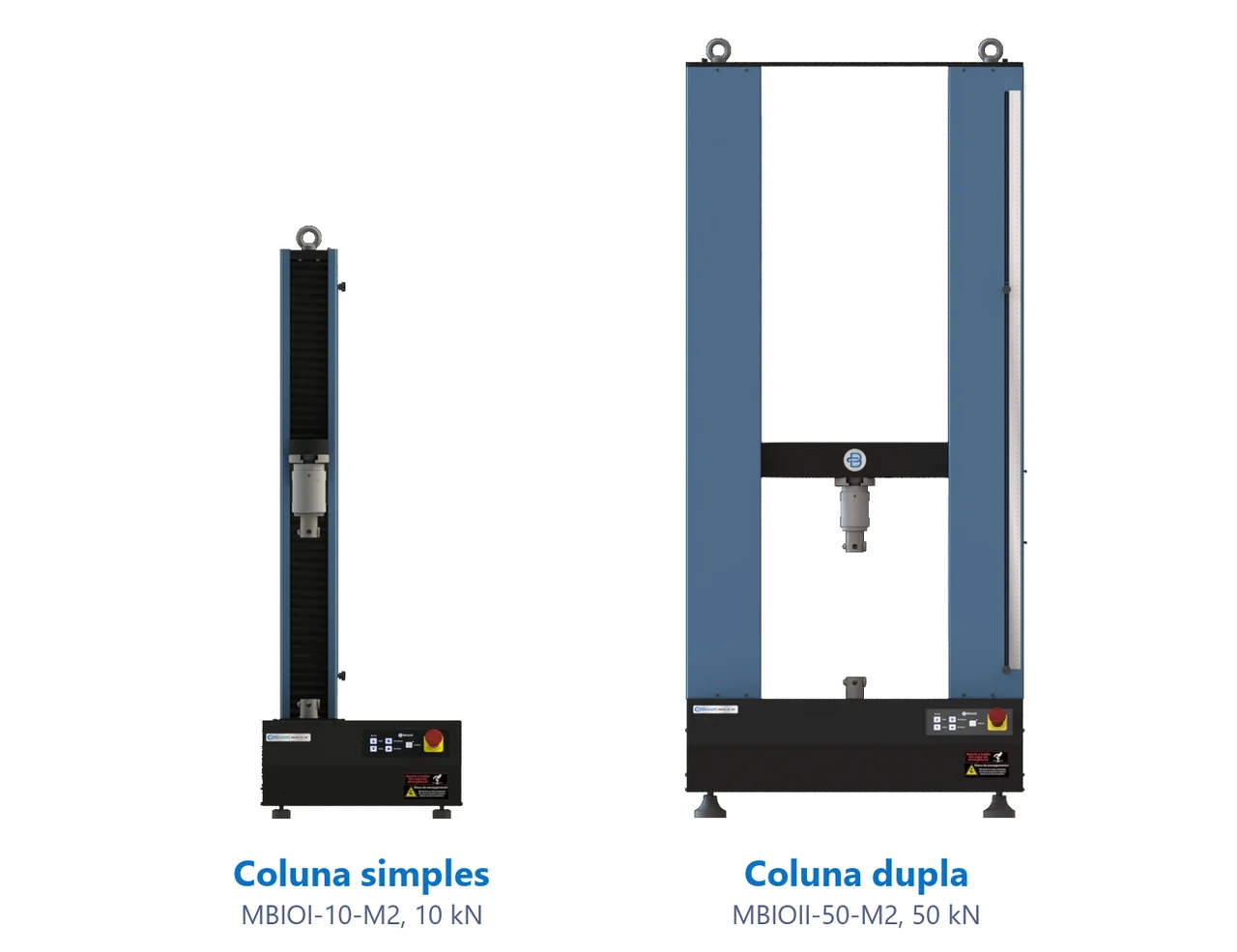
- Moving crosshead applies loading and unloading at the speed set by the standard
- Load cell measures force F, class 1
- Grips: wedge, pneumatic, for threaded specimens or for wires
- Extensometer measures the elastic ΔL, a few tens of micrometers, over gauge length L0
- BioLab software divides by S0 and L0, plots the curve and calculates E from the elastic line
- Control panel and emergency stop position and stop the test
Fixtures for the tensile test
The fixtures below mount on the same machine, depending on the specimen and the standard:
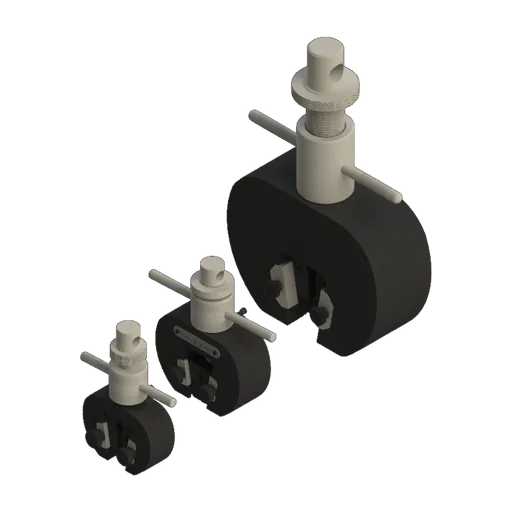 Wedge grip5, 20 and 200 kN
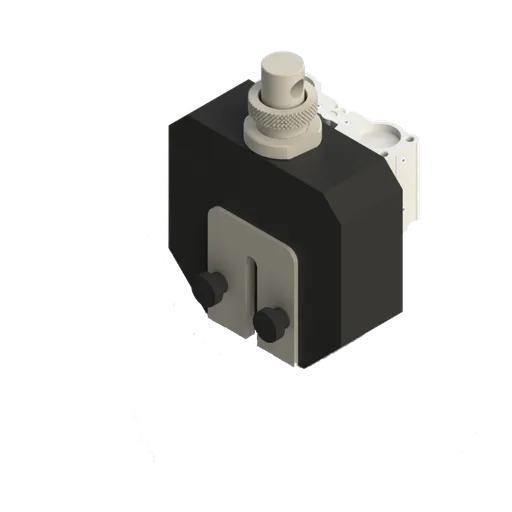 Pneumatic wedge grip50 and 200 kN
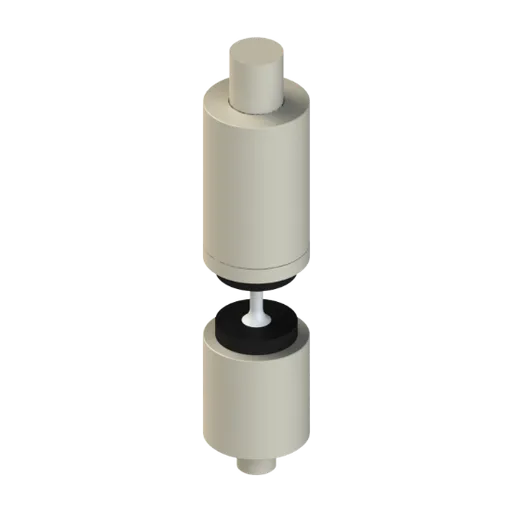 Grip for threaded specimensbolts and threaded specimens
For metal specimens like those in exercises 1 and 4, the recommended model is the 5 to 50 kN universal testing machine (MBIOII-50-M2), with 25 or 50 mm extensometers for small strains. For high-elongation rubbers and films, use the extended-column version, 2 to 10 kN, with 150 and 250 mm extensometers. The BioLab software runs on Windows and does not need an internet connection. The other capacities are listed on the universal testing machine page.
Other tests and technical references
Elastic limit and yield strength: what they are, the difference, formula, Rp0.2 and steel table
The elastic limit is the highest stress without permanent strain; yield strength is where plastic strain becomes measurable (ReH and ReL, or Rp0.2). See the formula, symbols, 0.2% offset, steel table, CA-50 and exercises.
Resilience of materials: modulus of resilience, formula Ur = σe²/2E, units and difference from toughness
Resilience is a material's ability to absorb energy when it deforms elastically and to release it on unloading. See the modulus of resilience (Ur = σe²/2E), its derivation, the J/m³ unit, calculated values by material and condition, the difference from toughness, spring materials, the resilient modulus of pavements and solved exercises.
Hardness of materials: what it is, scales and HRC, HB and HV conversion chart
Hardness is a material's resistance to localized plastic deformation. Types, scales, HRC × HB × HV chart, what 60 HRC means and steel hardness.
Ultimate tensile strength (Rm): what it is, formula, graph, steel table and how to measure it
Ultimate tensile strength (Rm) is the engineering stress at the maximum force of the tensile test: Rm = Fm/S0. See the symbols, where it sits on the graph, how it differs from yield strength and fracture stress, the steel table with material condition, CA-50 (Brazilian rebar grade), breaking load, the estimate from hardness, and exercises.
Frequently asked questions
What is the difference between elastic and plastic deformation?
Elastic deformation is temporary: the atomic bonds stretch and, once the load is removed, the material returns to its original size. Plastic deformation is permanent: dislocations move, atoms change neighbors and the shape is not recovered. Plastic deformation begins above the elastic limit, which in metals corresponds to strains of up to about 0.5%.
What is the formula for elastic deformation?
ε = σ/E, from Hooke's law, with σ and E in the same unit (MPa). For a bar under axial force, the elongation is ΔL = F·L0/(A0·E). In shear, the shear strain is γ = τ/G.
What is the difference between elasticity and plasticity?
Elasticity is the property of recovering the original shape after the load is removed. Plasticity is the ability to undergo permanent deformation without fracturing. Steel has both: it is elastic up to yielding and plastic beyond it.
What is plastic forming?
It is shaping a part by plastic deformation, as in rolling, forging, extrusion, stamping and bending. When the part leaves the tool, the elastic portion of the deformation recovers (elastic recovery, or springback), and the tool design must compensate for this recovery.
How much does a metal deform elastically?
Very little: typically up to about 0.5% (Callister). In structural steels, from 0.1% to 0.25%; on a test specimen with a 50 mm gauge length, that is less than 0.15 mm. Quenched high-strength steels reach about 0.8%.
Does rubber obey Hooke's law?
No. It recovers from large deformations, but with a nonlinear stress-strain curve and viscoelastic behavior, so it does not have a single modulus. Highly elastic polymers can have a modulus on the order of 7 MPa, compared with 200 GPa for steel.
What is resilience?
It is the elastic energy a material stores per unit volume up to the elastic limit, Ur = σe²/(2E). An A36 steel, with 250 MPa and E = 200 GPa, stores about 0.156 MJ/m³; a quenched and tempered 4140, with about 1,600 MPa, about 6.4 MJ/m³.
What is elastic recovery (springback)?
It is the recovery of the elastic portion when the load is removed from a plastically deformed part. Unloading follows a straight line parallel to the elastic region, and the recovered strain equals σ/E. In the stamping of structural parts made of advanced high-strength steels, it is cited as the main problem in mass production.
Does plastic deformation change the modulus of elasticity?
In general very little, because the modulus depends on the bonds between atoms and not on the microstructure. In advanced high-strength steels, however, the apparent modulus on unloading decreases with plastic deformation, which increases springback (CONEM 2012, the Brazilian National Congress of Mechanical Engineering).
How do you measure elastic deformation in a test?
On a universal testing machine, with a load cell and an extensometer attached to the test specimen, in accordance with ISO 6892-1 and ASTM E111. The software calculates the modulus from the slope of the straight line in the elastic region. Crosshead displacement is not suitable, because it includes grip seating and machine deflection.
Does elastic deformation change the volume?
Yes, slightly. Because Poisson's ratio of metals is below 0.5, a part under tension increases slightly in volume: ΔV/V = ε(1 − 2ν), about 0.04% in a steel with ε = 0.1%. Plastic deformation of metals occurs at constant volume.