
Tempering is the reheating of quenched steel to a temperature below the critical temperature, usually between 150 and 650 °C, followed by holding and cooling, to trade part of the hardness of martensite for toughness and to relieve the stresses left by quenching. The higher the temperature, the lower the hardness and the higher the ductility: oil-quenched 4140 steel has about 57 HRC, drops to 54.5 HRC when tempered at 200 °C and to 31 HRC when tempered at 650 °C (Lucefin datasheet for 42CrMo4, 10 mm bar).
This article follows the order of the process: what changes in the martensite, the temperature and time ranges, the hardness and impact energy curve of 4140, the Hollomon-Jaffe parameter, the two embrittlement ranges, temper colors and the tests that verify the result, with solved exercises at the end.
What is tempering
Tempering only exists after quenching. In quenching, the steel is heated until it becomes austenite, the high-temperature phase that dissolves carbon, and cooled so fast that the carbon has no time to leave the crystal lattice. The result is martensite, a phase supersaturated with carbon, with a lattice distorted into a tetragonal shape. It is the hardest phase steel can have, but it is brittle and comes out of quenching full of internal stresses, because it forms with an increase in volume. Part of the austenite may not transform and remains in the part as unstable retained austenite.
A part in this condition breaks easily and can crack on its own while sitting on the shelf. Tempering solves this by heating the part below the lower critical temperature, Ac1, at which austenite begins to form (about 745 °C for 4140, according to the Lucefin datasheet). In this range no new austenite forms: the carbon trapped in the martensite gains mobility, precipitates as carbides and relieves the stresses. Hardness drops and toughness rises, and the temperature chosen defines how far this trade goes.
That is why tempering cannot wait. Herring (Gear Solutions, "Getting back to basics with tempering") notes that parts usually go into the tempering furnace 60 to 90 minutes after quenching; when this is not possible, a short safety temper at 121 °C for 2 hours per inch of thickness is done before the final temper. In Portuguese the process is called "revenimento" in Brazil and "revenido" in Portugal, a term that in Brazil also designates the treated steel ("aço temperado e revenido"). In English, the process is tempering, and the steel is quenched and tempered.
Quenching followed by high-temperature tempering, around 500 to 650 °C, is called quenching and tempering (Q&T, "beneficiamento" in Brazil): it is the as-supplied condition of shafts, gears and bolts made of medium-carbon low-alloy steels such as 1045, 4140 and 4340. The complete cycle, with austenitizing, quenching media and the comparison between the two steps, is in the article on quenching of steel. An overview of the processes is in heat treatment of metals.
What happens to martensite during tempering
Tempering is not a single transformation: as the temperature rises, martensite goes through successive stages, which Krauss (Steels: Processing, Structure, and Performance, ASM) describes as follows. The ranges overlap and depend on carbon content and alloying elements.
| Stage | Approximate range | What happens |
|---|---|---|
| I | 100 to 250 °C | carbon clusters and precipitates as transition carbides (ε or η); martensite loses part of its tetragonal distortion |
| II | 200 to 300 °C | retained austenite decomposes into ferrite and cementite |
| III | 250 to 350 °C | cementite (Fe3C) replaces the transition carbides; martensite becomes ferrite with cementite |
| IV | above about 350 °C | cementite coarsens and spheroidizes; ferrite recovers and recrystallizes; in steels with Cr, Mo, V and W, alloy carbides form |
The practical reading is Herring's: up to about 200 °C hardness barely drops and the gain is stress relief; between 200 and 400 °C cementite precipitates and retained austenite transforms; above 400 °C cementite coarsens, hardness and strength drop quickly and toughness rises markedly.
The last stage has an important exception. In steels with high chromium, molybdenum, vanadium or tungsten, such as tool steels and high-speed steels, the alloy carbides that precipitate at high temperature, usually 500 °C or more, are fine and numerous, and hardness rises again over a temperature interval. This phenomenon is secondary hardening, and it is why these steels are tempered at high temperature without losing their working hardness.
What tempering temperature to use
The tempering temperature is chosen by the required final hardness, and in practice it is grouped into three ranges. The limits vary between authors (Metal Paulista uses 150 to 250, 300 to 450 and 500 to 700 °C; Wikipedia gives 150 to 600 °C as the general range), so they should be read as approximate. The table summarizes what each range delivers:
| Range | Temperature | Result | Typical applications |
|---|---|---|---|
| Low | 150 to 250 °C | hardness nearly retained, stress relief | cutting tools, bearings, carburized parts |
| Medium | 250 to 450 °C | compromise between hardness and toughness; requires attention to embrittlement | springs, some impact tools |
| High | 500 to 650 °C | low hardness, higher toughness (quenching and tempering) | shafts, gears, high-strength bolts |
Low-temperature tempering is used for parts that need maximum surface hardness. In carburizing, for example, 8620 steel carburized at 925 °C, oil quenched and tempered at 230 °C reaches 61 HRC at the surface (Açovisa table). High-temperature tempering is the one used in quenching and tempering, and the upper limit is Ac1: going above it forms austenite again, and the part would no longer be tempered.
Soaking time and cooling
Herring's rule of thumb is to hold the part 1 hour per 25 mm of thickness, counted after the core reaches temperature, with a minimum of 1 hour; Wikipedia gives 1 to 3 hours as the usual range. Time weighs much less than temperature, as the Hollomon-Jaffe parameter shows further on. Cooling is usually in air. In steels susceptible to temper embrittlement, explained below, cooling after high-temperature tempering should be fast, so the part does not linger in the dangerous range.
Double and triple tempering of tool steels
In high-alloy tool steels such as D2 and H13, quenching leaves a lot of retained austenite. During cooling from the first temper, this austenite turns into fresh martensite, which has not yet been tempered and is brittle. A second temper treats this martensite; in some steels a third is done. Herring recommends the second cycle, usually, about 10 °C below the first. Starting hardnesses are high: about 63 HRC for D2 and 54 HRC for H13 as quenched (thyssenkrupp datasheets). The temperature and number of cycles come from the manufacturer's datasheet, which also points out ranges to avoid: Villares Metals recommends not tempering H13 between 450 and 540 °C, due to excessive loss of toughness.
Hardness and toughness curve of tempered 4140 steel
The best way to choose the temperature is by the tempering curve of the steel itself, published by the manufacturer. For 4140 (42CrMo4 in the European designation), the Lucefin datasheet gives the properties of a 10 mm diameter bar oil quenched at 850 °C and tempered from 100 to 700 °C. The chart below shows two of these quantities: Rockwell C hardness and Charpy KV impact energy, which measures notch toughness. The colored bands are Herring's embrittlement ranges, covered in the next section.
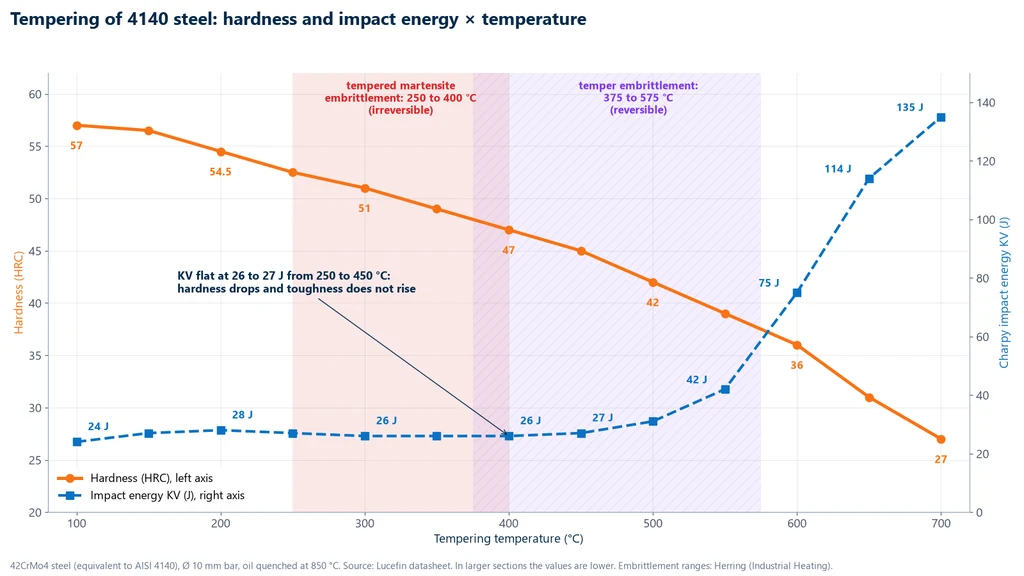
Hardness drops continuously, from 57 HRC at 100 °C to 27 HRC at 700 °C, with the fastest drop above 500 °C. Impact energy tells another story: it stays flat at 26 to 27 J between 250 and 450 °C and only rises from 500 °C, reaching 75 J at 600 °C and 135 J at 700 °C. Between 250 and 450 °C the steel loses hardness without gaining toughness, which is exactly the signature of the embrittlement ranges. The table lists the 13 points of the datasheet:
| Tempering (°C) | Hardness (HRC) | Rm (MPa) | KV (J) |
|---|---|---|---|
| 100 | 57 | 2,200 | 24 |
| 150 | 56.5 | 2,180 | 27 |
| 200 | 54.5 | 2,030 | 28 |
| 250 | 52.5 | 1,910 | 27 |
| 300 | 51 | 1,800 | 26 |
| 350 | 49 | 1,700 | 26 |
| 400 | 47 | 1,590 | 26 |
| 450 | 45 | 1,480 | 27 |
| 500 | 42 | 1,350 | 31 |
| 550 | 39 | 1,220 | 42 |
| 600 | 36 | 1,100 | 75 |
| 650 | 31 | 980 | 114 |
| 700 | 27 | 880 | 135 |
Mechanical strength follows hardness. The chart below, with the same Lucefin data, shows that tensile strength Rm drops from 2,200 to 880 MPa, yield strength Rp0.2 peaks at 1,620 MPa at 200 °C before dropping to 710 MPa at 700 °C, and elongation rises from 7% to 21.5%. This trade of strength for ductility is what defines tempering.
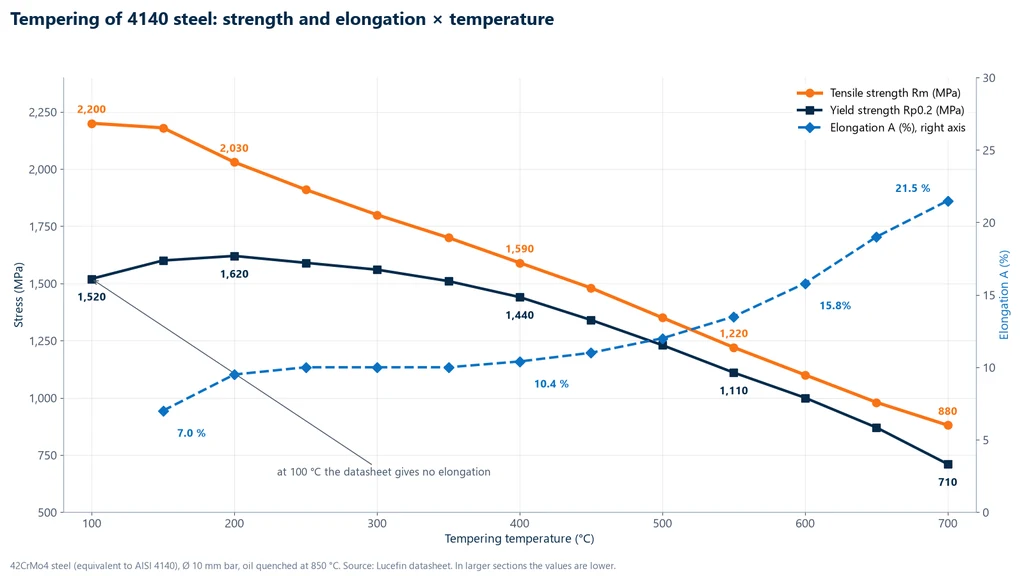
These numbers apply to the 10 mm bar. In a thick part the core does not become fully martensitic during quenching and, after tempering, hardness and strength fall below those in the table. That is why other compilations give different values for the same steel: the ASM Handbook, cited by UTEC and used in the article on hardness of materials, gives 52 to 54 HRC at 205 °C and 26 to 30 HRC at 650 °C. Callister's table (Appendix B), for 4140 oil quenched and tempered at 315 °C, gives 1,570 MPa yield strength and 1,720 MPa Rm, consistent with the Lucefin curve at that temperature. The curve is used to choose the temperature; the hardness of each batch is confirmed on the part.
Hollomon-Jaffe parameter: time and temperature
Temperature and time act together in tempering: a short temper at a higher temperature gives the same hardness as a long temper at a lower temperature. Hollomon and Jaffe (Transactions AIME, v. 162, 1945) combined the two into a single number:
- P = T · (C + log t), with T in kelvin, t in hours and log to base 10;
- C is a constant of the steel, which decreases with carbon content: about 19.5 for steels with 0.25 to 0.4% carbon and about 15 for tool steels with 0.9 to 1.2%; in practice C = 20 is often used;
- for a given steel, the same P gives approximately the same tempered hardness.
Because time enters as a logarithm, it weighs much less than temperature. An example with C = 20: a batch tempered at 540 °C for 2 h has P = 813.15 × (20 + 0.301) = 16,508. To repeat this P at 565 °C (838.15 K), 20 + log t = 16,508 / 838.15 = 19.696, log t = −0.304 and t = 0.50 h. Thirty minutes at 565 °C are equivalent to two hours at 540 °C: 25 °C more means four times less time. The parameter is an approximation: it does not hold without calibration for steels with secondary hardening, and the constant C must be the one for the steel in question.
Embrittlement in tempering
The 4140 curve showed that tempering at a higher temperature does not always give more toughness. There are two temperature ranges in which tempered steel becomes brittle, through different mechanisms. Many Portuguese-language texts call both "temper embrittlement" ("fragilidade do revenido"), but they have distinct causes, ranges and remedies.
Tempered martensite embrittlement
Tempered martensite embrittlement (TME), also called "350 °C embrittlement", occurs with tempering between about 250 and 400 °C (Herring, "Embrittlement of Steel", Industrial Heating). In this range, retained austenite decomposes and cementite precipitates as thin films at the boundaries of the martensite crystals and grains, paths along which a crack runs with little energy. The effect is irreversible: a part tempered in this range must be quenched again. The rule is not to temper parts subjected to impact in this range; for 4340, GGD Metals recommends not tempering between 230 and 370 °C.
Temper embrittlement
Temper embrittlement (TE) appears when the steel is held in or slowly cooled through the range of about 375 to 575 °C (Herring). The cause is the segregation of impurities, mainly phosphorus, antimony, tin and arsenic, to the prior austenite grain boundaries, which then fracture intergranularly. Chromium, nickel and manganese intensify the effect. Unlike the first, it is reversible: retempering above 575 °C and cooling quickly restores toughness. Total Materia also notes that 0.2 to 0.3% molybdenum mitigates temper embrittlement, and that higher contents make it worse again. The table compares the two:
| Characteristic | Tempered martensite embrittlement (TME) | Temper embrittlement (TE) |
|---|---|---|
| Range (Herring) | about 250 to 400 °C | about 375 to 575 °C |
| Cause | cementite films at the boundaries | P, Sb, Sn and As segregated at the boundaries |
| Reversible? | no | yes: retemper above 575 °C and cool quickly |
| Prevention | do not temper parts under impact in this range | clean steel, fast cooling, 0.2 to 0.3% Mo |
| How it shows in testing | drop in Charpy energy at room temperature | increase in the ductile-to-brittle transition temperature |
Neither shows up on the hardness tester: hardness is within specification and the part is brittle. What reveals them is the Charpy impact test. Tempered martensite embrittlement shows up as low energy at room temperature, like the 26 J of 4140 between 300 and 400 °C. Temper embrittlement is best seen in the curve of energy versus test temperature, which shifts to the right: the ductile-to-brittle transition temperature rises. The concept of absorbed energy is covered in the article on toughness.
Temper colors
When a clean, sanded steel surface is heated in air, it becomes covered with a very thin oxide film whose thickness grows with temperature. Light reflected from the two faces of the film produces interference colors, and blacksmiths and toolmakers used these colors to know when to stop heating. The photo shows six hardened steel cold chisels tempered at different temperatures. The film goes from light straw, near 205 °C, to light blue, near 340 °C, passing through brown and purple. This is why the colors served as a thermometer in the workshop.
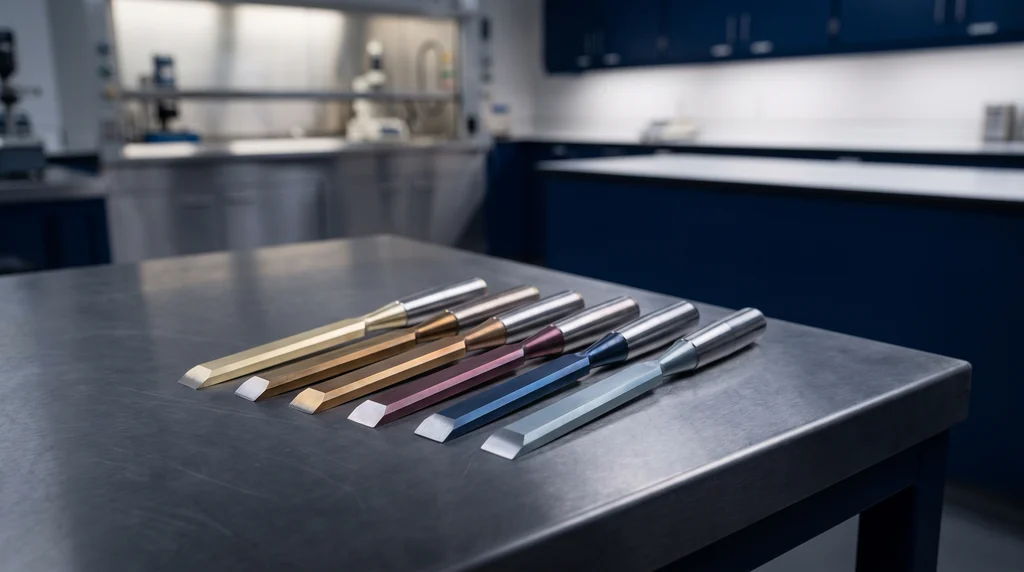
The traditional table, reproduced by the English Wikipedia ("Tempering (metallurgy)"), links each color to a temperature and a workshop use:
| Color | Temperature | Traditional use |
|---|---|---|
| Light yellow | 176 °C | gravers, razors, scrapers |
| Light straw | 205 °C | rock drills, reamers, metal-cutting saws |
| Dark straw | 226 °C | scribers, planer blades |
| Brown | 260 °C | taps, dies, drill bits, hammers, cold chisels |
| Purple | 282 °C | surgical instruments, punches |
| Dark blue | 310 °C | screwdrivers and wrenches |
| Light blue | 337 °C | springs, wood-cutting saws |
| Grey-blue | 371 °C or higher | structural steel |
Color is only a rough indicator. It also depends on heating time, surface finish and atmosphere, and a protective-atmosphere or vacuum furnace produces no color at all. It works at the forge and when sharpening tools. In production, control relies on a thermocouple in the furnace and a hardness test on the part.
Tempering vs. annealing: the difference
Both reheat the steel, but at opposite points in the process. Tempering always comes after quenching and stays below Ac1, adjusting the hardness of the martensite. Full annealing heats the steel above the critical temperature, forms austenite and cools it slowly inside the furnace to soften the material before machining or forming. Normalizing also austenitizes but cools in air. The comparison of annealing, normalizing and quenching is in the normalizing article.
How to verify tempering: hardness, impact, tensile and metallography
Tempering is specified by its result, for example "4140 quenched and tempered, 28 to 32 HRC", and accepted by testing. There are four checks, from the quickest to the most complete.
- Hardness: this is the check for every batch. Rockwell C (ISO 6508-1 or ASTM E18) is measured on the part, or on a witness specimen that went through the furnace with it, and compared with the specified range. The procedure is in the hardness testing article, which also covers the microhardness profile used on carburized parts.
- Charpy impact: this is the only one of the four that reveals both types of embrittlement, because hardness can be right while the part is brittle. For parts subject to shock loading, the specification gives the minimum energy and the test temperature.
- Tensile: gives Rm, Rp0.2 and elongation, the design values. A specimen machined from the part or from the witness coupon is tested on a universal testing machine with an extensometer, according to ISO 6892-1 or ASTM E8/E8M, and the result is compared with the steel's curve, as in exercise 4.
- Metallography: shows tempered martensite, carbides, any retained austenite and surface decarburization. The sample goes through the metallographic cutting machine, the grinding and polishing machine and the metallurgical microscope.
In the tensile test, machine capacity is chosen by the expected maximum force, and steel tempered at low temperature calls for high force. A 10 mm diameter specimen of 4140 tempered at 200 °C, with an Rm of 2,030 MPa, breaks at about 160 kN. The Biopdi M2 line universal testing machine is electromechanical, ranges from 200 N to 1,000 kN and comes with class 1 load cells and extensometers. For quenched and tempered steels, the dual-column 100 to 200 kN model (MBIOII-200-M2) covers most specimens, and the BioLab software plots the stress-strain curve and reports Rp0.2, Rm and elongation. The machine complies with NR-10 and NR-12 (the Brazilian electrical safety and machinery safety regulations), with an emergency stop button on the panel and automatic stop on loss of communication.
Solved exercises
The exercises use Lucefin data for 4140 and the rules presented in the previous sections.
Exercise 1: temperature for 40 HRC on a 4140 shaft
A 4140 shaft, oil-quenched, needs 40 HRC. What tempering temperature should be used, and what precaution should be taken?
- In the table, 500 °C gives 42 HRC and 550 °C gives 39 HRC; 40 HRC lies between the two.
- Interpolating: T = 500 + (42 − 40) / (42 − 39) × 50 = 500 + 33 = about 530 °C.
- Risk: 530 °C is above the tempered martensite embrittlement range but inside the temper embrittlement range (375 to 575 °C). Cooling after the soak should be fast, and impact energy should be checked if the shaft is subject to shock. According to the data sheet, at 550 °C the energy is already 42 J, against 26 J at 400 °C.
- The data are for a 10 mm bar. On a thicker shaft, hardness comes out lower at the same temperature, so the final temperature is adjusted using the hardness measured on the first batch.
Exercise 2: soak time
What is the soak time for a 4140 shaft with a 75 mm diameter?
- Herring's rule: 1 h per 25 mm of thickness.
- t = 75 / 25 × 1 h = 3 h, counted after the core reaches the tempering temperature.
Exercise 3: Hollomon-Jaffe with C = 19.5
A temper at 480 °C for 1 h must be redone in a furnace that only accepts 4 h cycles. What temperature gives the same P, with C = 19.5?
- T1 = 480 + 273.15 = 753.15 K; P = 753.15 × (19.5 + log 1) = 753.15 × 19.5 = 14,686.
- For 4 h: 19.5 + log 4 = 19.5 + 0.602 = 20.102.
- T2 = 14,686 / 20.102 = 730.6 K = about 457 °C.
- Quadrupling the time is equivalent to lowering the temperature by only 23 °C.
Exercise 4: tensile test of 4140 tempered at 550 °C
A 4140 specimen tempered at 550 °C, with d0 = 8 mm and L0 = 40 mm (5 d0), records Fp0.2 = 55.8 kN and Fmax = 61.3 kN on the machine; after fracture, Lf = 45.4 mm. Was the tempering done correctly?
- S0 = π × 4² = 50.27 mm².
- Rp0.2 = 55,800 / 50.27 = 1,110 MPa; Rm = 61,300 / 50.27 = 1,219 MPa.
- Elongation A = (45.4 − 40) / 40 × 100 = 13.5%.
- The Lucefin data sheet gives 1,110 MPa, 1,220 MPa and 13.5% at 550 °C: the result matches. With about 61 kN of maximum force, a 50 kN machine cannot break the specimen, and the yield strength requires an extensometer, using the 0.2% offset method.
Standards related to tempering
No standard sets the tempering temperature for each steel: it comes from the manufacturer's data sheet and the design specification. The standards cover steel supplied for quenching and tempering and the tests that verify the result. The table lists those cited in this article:
| Standard | What it covers | Edition |
|---|---|---|
| ISO 683-2 | alloy steels for quenching and tempering, including 42CrMo4 (equivalent to 4140) | 2016 |
| ISO 6508-1 | Rockwell hardness, test method | 2023 |
| ASTM E18 | Rockwell and superficial Rockwell hardness | E18-25 |
| ISO 148-1 | Charpy impact test of metals | 2016 |
| ABNT NBR ISO 148-1 | Charpy impact test of metals (Brazilian adoption of ISO 148-1) | 2021 |
| ASTM E23 | notched bar impact testing (Charpy and Izod) | not stated |
| ISO 6892-1 | tensile testing of metals at room temperature | 2019 |
| ABNT NBR ISO 6892-1 | tensile testing of metals at room temperature (Brazilian adoption of ISO 6892-1) | 2024 |
| ASTM E8/E8M | tensile testing of metals | E8/E8M-25 |
| ASTM A255 | Jominy hardenability: used to select the steel, does not cover tempering | not stated |
Other tests and technical references
Annealing of steel: what it is, types, temperatures and effects on properties
Annealing is the heat treatment that heats the metal, holds it at temperature and cools it slowly, usually inside the furnace, to reduce hardness and internal stresses and restore ductility and machinability. In steel, full annealing austenitizes about 30 to 50 °C above Ac3, and the subcritical types stay below Ac1 (stress relief annealing at 550 to 650 °C, spheroidizing at 700 to 720 °C). See the types, temperatures, microstructure, effects with numbers and how to check the result.
Quenching steel: what it is, temperatures, quenching media, types and the quench and temper cycle
Quenching steel means heating the part until austenite forms, usually 30 to 50 °C above Ac3, then cooling it rapidly in water, oil, polymer or gas to form martensite. Carbon sets the maximum hardness and alloying sets the hardened depth. See temperatures by steel (1045 at 820 to 850 °C), the Grossmann H severity, martensite and Ms, the Jominy test, types of quenching, stainless steel, cracking and the quench and temper cycle.
Carburizing of steel: what it is, types, temperature, case depth and control
Carburizing is the thermochemical treatment that enriches the surface of a low-carbon steel with carbon, usually between 900 and 930 °C, before quenching and tempering. The part ends up with a 58 to 62 HRC surface and a tough core. See the types (gas, pack, liquid and vacuum), Harris's formula for time (about 0.63·√t mm at 925 °C), the steels used, the effective case depth at 550 HV per ISO 18203:2026, defects and solved exercises.
Normalizing steel (heat treatment): temperature, air cooling and how it differs from annealing and quenching
Normalizing steel is the heat treatment in which steel is heated above the upper critical temperature (Ac3, or Acm in hypereutectoid steel), held until it becomes austenite and cooled in still air. The result is a refined grain and fine pearlite, with more strength than in the annealed condition and much less hardness than in the quenched condition. 1045 steel is normalized at about 850 to 880 °C.
Frequently asked questions
What is tempering?
It is the heat treatment carried out right after quenching: the steel is reheated below the critical temperature, usually between 150 and 650 °C, held for about 1 hour per 25 mm of thickness and cooled, usually in air. The brittle martensite becomes tempered martensite, quenching stresses are relieved and part of the hardness is traded for toughness.
What temperature is used for tempering?
It depends on the required hardness. Roughly: 150 to 250 °C to keep hardness and relieve stresses (tools, carburized parts), 250 to 450 °C for the compromise needed in springs, and 500 to 650 °C for quenched and tempered shafts and bolts. For 4140, 200 °C gives 54.5 HRC and 600 °C gives 36 HRC (Lucefin, 10 mm bar).
Why is tempering done after quenching?
Because as-quenched martensite is hard, brittle and full of internal stresses, and the part can crack even while sitting idle. Tempering precipitates the carbon as carbides and relieves the stresses. This is why the part should go into the tempering furnace within 60 to 90 minutes of quenching (Herring).
How long does tempering take?
The rule of thumb is 1 hour per 25 mm of thickness, with a minimum of 1 hour, counted after the core reaches temperature. A 75 mm shaft is held for 3 hours. High-alloy tool steels receive two or three cycles.
What is the difference between tempering and annealing?
Tempering comes after quenching and stays below the critical temperature, to adjust the hardness of the martensite. Annealing heats the steel above the critical temperature and cools it slowly in the furnace, to soften it before machining or forming.
Does tempering reduce the strength of steel?
Yes. For 10 mm 4140, tensile strength drops from 2,030 MPa when tempered at 200 °C to 1,100 MPa at 600 °C, while elongation rises from 9.5% to 15.8% and impact energy from 28 J to 75 J (Lucefin). Trading strength for toughness is the purpose of the process.
What is temper embrittlement?
It is the loss of toughness in steel held at or slowly cooled through about 375 to 575 °C, caused by phosphorus, antimony, tin and arsenic segregated at the grain boundaries. It is reversible: temper above 575 °C and cool quickly. Unlike it, tempered martensite embrittlement, between about 250 and 400 °C, is irreversible (Herring).
What is double tempering?
It is repeating the temper to treat the fresh martensite that forms from retained austenite during cooling after the first cycle. It is used on high-alloy tool steels such as D2, H13 and high-speed steels. The second cycle is usually about 10 °C below the first.
What are temper colors used for?
They are thin oxide films that give a rough indication of temperature: light straw near 205 °C, brown near 260 °C and dark blue near 310 °C. They are useful at the forge and when sharpening tools, but they do not replace a thermocouple and a hardness test, because they also depend on time and atmosphere.
How do you know if tempering was done correctly?
By measuring the Rockwell C hardness of the part or of a witness specimen and comparing it with the specification. For critical parts, add the Charpy impact test, which reveals embrittlement that hardness does not show, the tensile test, which gives the design values, and metallography of the microstructure.