
ABNT NBR 15270-2:2023, currently in force, is the Brazilian standard for test methods for ceramic masonry blocks and bricks. Under it, compressive strength is the maximum force divided by the gross area of the bed face, fb = F / Ab, so a 14 × 29 cm block that fails at 243.6 kN has a strength of 6.0 MPa. The standard also covers measurement of geometry, dry mass, water absorption and the initial rate of absorption (AAI). It does not say what strength the block must reach: the requirements and classes are in Part 1, ABNT NBR 15270-1:2023.
In this guide we explain, in our own words, what Part 2 measures, how the compression test is prepared and run, how the characteristic strength of a lot is calculated and how much force the testing machine needs. We checked the current edition of both parts on October 1, 2026, in the catalog of Target, an ABNT reseller. The full text of the 2023 edition is sold by ABNT and is not reproduced here. What changed in 2023 comes from the summary published by Revista da Anicer, the magazine of Anicer, the Brazilian ceramic industry association. Procedure parameters that we could not confirm in the 2023 edition are given with the edition they come from. To apply the standard in a laboratory, you need the purchased standard.
What is the current edition of NBR 15270-2
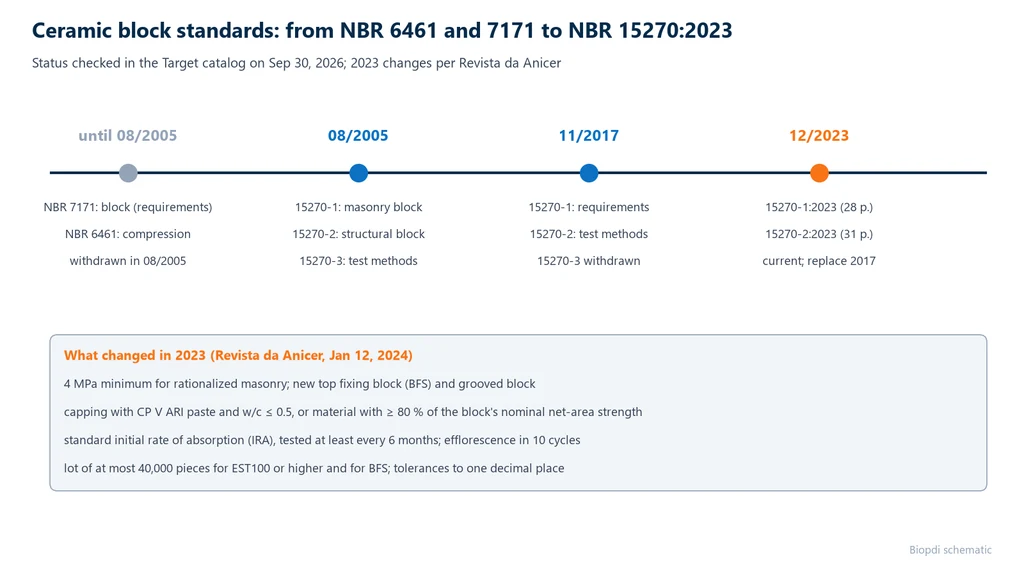
The current edition of ABNT NBR 15270-2, Ceramic components: Blocks and bricks for masonry, Part 2: Test methods, is the December 2023 edition, with 31 pages. In the Target catalog, checked on October 1, 2026, it is listed with the date 12/2023 and status in force. Part 1, on requirements, was published on the same date, with 28 pages, and is also in force. According to Revista da Anicer, ABNT published both on December 14, 2023, after a revision that began in 2021, and they automatically canceled the 2017 editions.
The numbering of the parts has a trap. In the first edition of the series, from August 2005, Part 1 covered non-load-bearing blocks, Part 2 covered structural blocks (terminology and requirements) and Part 3 contained the test methods. In the November 2017 edition, Part 1 took over all the requirements, Part 2 became the test methods part and Part 3 was canceled. If you read "NBR 15270-2" in a document written before 2017, you are reading requirements for structural blocks, not the test method.
Before the 15270 series, ceramic blocks were covered by two standards that still show up in searches: NBR 7171, for requirements, and NBR 6461, for verifying compressive strength. Both were canceled in August 2005 and replaced by the 15270 series. The timeline below summarizes the sequence and lists the 2023 changes that Anicer highlighted. Each change is explained in the following sections, at the point of the test where it applies:
Part 1 and Part 2: what each one says
In the NBR 15270 series, Part 2 says how to measure, and Part 1 says what the block must achieve and how the lot is accepted or rejected. The most common mistake with this standard is looking in Part 2 for the minimum strength of the block. A ceramic block test report therefore cites both: Part 2 for the method, Part 1 for the acceptance criterion.
Both parts cover two components, the block and the brick. A ceramic block has holes or cells that take up a large part of the cross section. A brick is solid or has few holes. Under the criterion used in the structural masonry course material of UFRGS (Federal University of Rio Grande do Sul, Brazil), a unit with a net area of 75% or more of the gross area is treated as solid. In common structural blocks, this ratio is close to 50%. The tests in Part 2 are the same for both, and the difference shows up in the class and the acceptance criterion.
In Part 1, components are sold by class, according to their use. The 2023 edition has three groups:
- VED, components with no structural function, used in non-load-bearing (infill) masonry, which closes the openings of a concrete frame and carries only its own weight and service loads;
- EST, structural components and components for rationalized masonry (masonry built from a specific production design, with modular coordination and integration with building services);
- BFS, the top fixing block, new in 2023: laid with the cells horizontal in the top course of the wall, just below the beam or slab.
The number after the abbreviation is the minimum strength in kgf/cm², using the approximation 1 kgf/cm² ≈ 0.1 MPa: EST100 is the 10 MPa class. According to Anicer's summary, the 2023 edition raised the minimum strength of blocks for rationalized masonry to 4 MPa and now requires grooves on the inner walls of EST solid-wall blocks with fbk of 10 MPa or more, in accordance with ABNT NBR 16868-1, the Brazilian structural masonry design standard.
The other values in the Part 1:2023 class table, and the water absorption ranges for each class, were not confirmed in a reliable source and are not reproduced here. As a historical reference, the 2005 edition required fb ≥ 1.5 MPa for non-load-bearing blocks used with horizontal holes, 3.0 MPa with vertical holes, fbk ≥ 3.0 MPa for structural blocks and water absorption between 8% and 22%. These numbers are not the current requirements: the structural minimum, for example, is no longer 3 MPa. In the 2017 edition, according to an article in Revista da Anicer, the minimums were 1.5 MPa for non-load-bearing blocks and 3.0 MPa for rationalized non-load-bearing blocks, and structural fbk started at 4.0 MPa. The "3.0 MPa for rationalized non-load-bearing masonry" that still appears in automated search engine answers comes from that edition. On the market, the same magazine reports qualified structural blocks from 4 MPa up to above 20 MPa, which allows buildings of up to 20 stories.
Part 1 also keeps a difference in criterion between the classes. For non-load-bearing blocks, the mechanical property is the individual strength fb of each block, judged by the number of blocks below the minimum. For structural blocks, it is the characteristic strength fbk of the lot, calculated statistically. Both appear in the calculation sections further on. Where these tests fit within materials testing as a whole is covered in our guide to materials testing.
What NBR 15270-2 tests
NBR 15270-2 tests three groups of properties of the ceramic block or brick: geometric, physical and mechanical, the last being compressive strength. All of them are measured on the whole block itself, not on a molded or machined test specimen. This differs from concrete: there, you test a cylinder that represents the material; here, you test the unit that goes into the wall, with its cells, face shells and webs.
- Geometric properties. Actual dimensions of width (L), height (H) and length (C), thickness of the face shells and of the webs (the internal walls that separate the cells), out-of-squareness, planeness of the faces (bow) and gross and net areas. In 2023, the minimum sum of face shells and webs began to be measured along a straight horizontal line, perpendicular to the faces of the section, looking for the line with the smallest sum. As a historical reference, the 2005 text allowed, according to the UFRGS material, ± 5 mm individual tolerance and ± 3 mm on the average for L, H and C, and 3 mm for out-of-squareness and bow. In 2023, according to Anicer, tolerances are now expressed to one decimal place.
- Physical properties. Dry mass, water absorption (AA) and initial rate of absorption (AAI), which measures the suction of the bed face in the first minute of contact with water. In 2023, AAI became normative.
- Mechanical property. Compressive strength of components with and without structural function.
In the 2023 edition, each group takes up an annex of the standard, and that is how laboratories accredited by Inmetro (Brazil's national metrology and accreditation body) to ABNT NBR ISO/IEC 17025 list them in their scope of accreditation. The scope of laboratory CRL 1739, issued on February 6, 2026, cites NBR 15270-2:2023 Annex A for geometric properties, Annex B for physical properties and Annex C for compressive strength. The table summarizes what each annex delivers:
| Annex (2023) | Test | Result | Unit |
|---|---|---|---|
| A | geometric properties | L, H, C, face shells, webs, squareness, bow, gross and net areas | mm and mm² |
| B | physical properties | dry mass, water absorption (AA) and AAI | g, % and (g/193.55 cm²)/min |
| C | compressive strength | fb = Fmáx / Ab | MPa |
Efflorescence, the whitish stain of soluble salts that migrate to the surface, also has a method, which is informative. It changed in 2023: instead of evaluating the block after 7 days of partial immersion, the block now goes through ten consecutive cycles of 24 h of partial immersion and 24 h of oven drying.
The order of the tests matters because the compression test destroys the block. Geometry and masses come first, and compression closes the sequence. Compression testing in general, with the stress-strain curve and the difference between ductile and brittle materials, is covered in our guide to compression testing. Here the focus is on what the ceramic block standard requires. Because it destroys the unit, it is a destructive test, and that is why it is done by sampling.
Sample: how many blocks are tested
A ceramic block sample is the set of blocks taken from a lot to represent it in the tests, and its size is defined in Part 1. The number in the 2023 edition was not confirmed in an open source. In the 2005 and 2017 editions, the sample for geometry and compression was 13 blocks, and the sample for water absorption was 6 blocks, taken from the lot before any test. For non-load-bearing blocks, the 2005 text accepted the lot with up to 2 of the 13 blocks below the minimum strength and rejected it with 3 or more. For absorption, it accepted up to 1 of the 6 blocks outside the range.
One 2023 change affects the lot. According to Anicer, for EST100 or higher blocks and bricks and for the BFS, the production lot is now limited to 40,000 units. A smaller lot means more tests per thousand units produced, and more control over the high-strength classes, where a weak block matters more in the wall.
The same test serves two separate controls. Production control is done by the brick plant, which tests what it manufactures. Acceptance control is done by a laboratory hired by the builder, on the sample from the delivered lot. In an article in Revista da Anicer, Emil Sanchez, a retired professor at UFF (Fluminense Federal University, Brazil), describes a structural masonry project without acceptance control of block compressive strength as unacceptable.
Preparing the faces: capping and leveling
Capping a ceramic block means applying a thin layer of paste or mortar that makes the two loaded faces, called the bearing faces, flat and parallel. These faces come out of the kiln with undulations, burrs and lack of parallelism. If the block were placed directly between steel platens, the force would enter through the high points, and the block walls would fail from stress concentration before the whole material was loaded. That is why the faces are leveled before the test.
This was one of the points changed in 2023. According to Anicer, capping is now done with CP V ARI cement paste with a maximum water/cement ratio of 0.5, or with a paste or mortar that reaches at least 80% of the nominal strength of the block calculated on the net area, with that strength proven. CP V ARI is the Brazilian high early strength cement: it hardens quickly, and the paste is ready for testing in a short time. The low water/cement ratio gives a strong, low-deformation paste.
The 2005 text required a layer that left the face flat and uniform, without patches, with a maximum thickness of 3 mm, made with a paste or mortar stronger than the block on the gross area. It also accepted grinding of the faces as an alternative to capping. Only the purchased standard can confirm whether the 2023 edition keeps the maximum thickness and the grinding option. Sulfur, cited in automated search engine answers as a capping material for blocks, does not appear among the options Anicer describes for 2023.
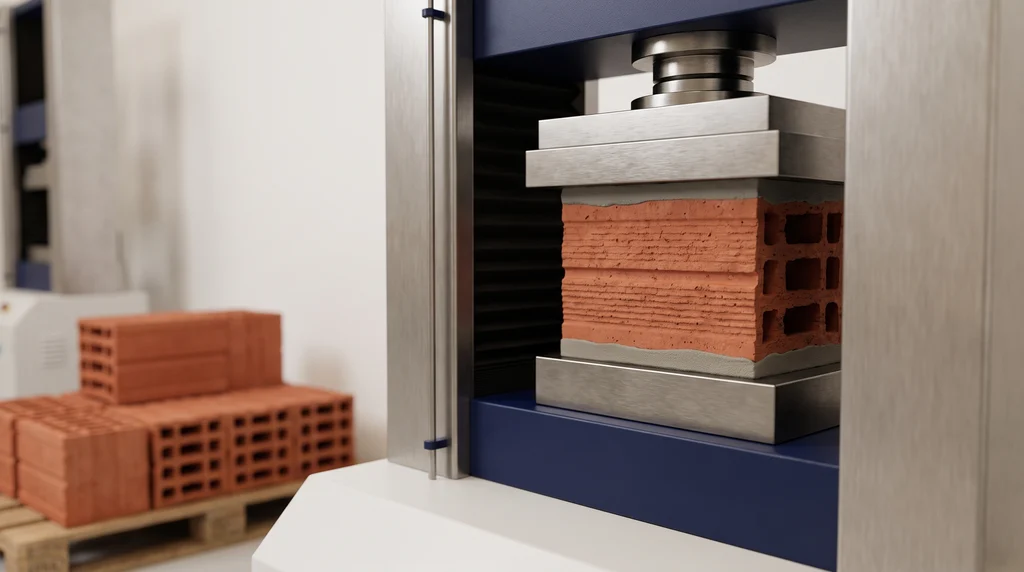
The photo shows a ceramic block with both bearing faces capped, between the platens of the testing machine: the capping levels the faces so that the force is distributed over the whole block, and not only over the high points.
Running the compression test
The ceramic block compression test breaks the capped, saturated block in a compression testing machine, applying increasing force on the bed face until failure. With the faces leveled, the sequence in the 2005 text, which is the historical reference for the method, has four steps. The time and rate values below come from that edition; each of them must be checked against the 2023 edition.
- Saturation. After the capping has hardened, the block is immersed in water for at least 6 h and tested saturated. Laboratory procedures found online mention 24 h of immersion, which is above this minimum.
- Orientation. The load is applied in the direction of the load the block carries in the wall: perpendicular to its length and on the bed face. For a non-load-bearing block with horizontal holes, this means the block lying as it sits in the wall, with the holes parallel to the platens.
- Centering. The block's center of gravity is placed on the load axis of the platens. Off-axis, the wall on one side takes more force than the other, and the block fails early.
- Loading. The stress, calculated on the gross area, increases progressively and without shocks. In 2005 the rate was (0.05 ± 0.01) MPa/s.
The rate is given as stress so that it applies to any block size, but the machine controls force. The conversion is the same as in any compression test: the rate in N/s is the rate in MPa/s multiplied by the gross area in mm². For a 140 × 290 mm block, 0.05 MPa/s becomes 2.03 kN/s, and a 6 MPa block fails in about 120 s. The rate is nine times lower than the rate for concrete under NBR 5739 (the Brazilian standard for concrete compression testing), which is 0.45 MPa/s: ceramic blocks fail at much lower stresses, and the slow rate gives the operator and the software time to record the peak.
In 2005 the machine had to comply with the standard for verification of testing machines, today ABNT NBR ISO 7500-1:2023, and read the load with an error of no more than ± 2% of the failure load. When the platens do not cover the whole block, a rigid steel plate is placed between platen and block; the 2005 text required a thickness of at least 50 mm. A block 29 cm long does not fit on a small platen, and a thin plate would bend and load the ends of the block less than the center. The force is measured by the machine's load cell.
Strength calculation: fb on the gross area
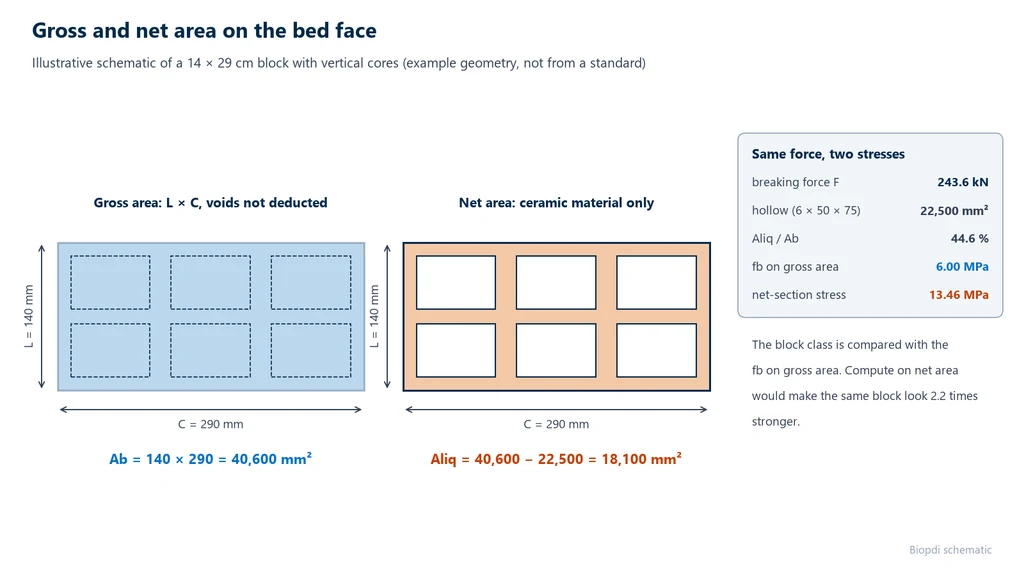
The individual compressive strength is the maximum force divided by the gross area. The gross area Ab is the area of the bed face bounded by the edges of the block, without deducting the cells: L × C. The net area Aliq is only the area of ceramic material, that is, the gross area minus the area of the cells. The 2005 text calculated fb using the mean of the gross areas of the two bearing faces, in MPa, rounded to one decimal place:
fb = Fmáx / Ab, with Fmáx in newtons and Ab in mm², which gives MPa.
The choice of area changes the result more than any other detail of the test. The diagram below uses a 140 × 290 mm block with six cells, with illustrative geometry: the gross area is 40,600 mm² and the net area is 18,100 mm², 44.6% of the gross area. The same failure load, 243.6 kN, gives 6.00 MPa on the gross area and 13.46 MPa on the net area. The first is the number compared with the strength class; the second is the stress that actually acted on the ceramic.
Rearranging the formula, F = fb × Ab gives the force each strength level requires, and that is the number that decides the capacity of the testing machine. The table shows the 14 × 19 × 29 cm block, loaded on the 140 × 290 mm face:
| fb or fbk | Force on the 14 × 29 cm block |
|---|---|
| 3.0 MPa | 121.8 kN |
| 4.0 MPa | 162.4 kN |
| 6.0 MPa | 243.6 kN |
| 8.0 MPa | 324.8 kN |
| 10.0 MPa | 406.0 kN |
| 14.0 MPa | 568.4 kN |
Characteristic strength fbk: how a structural lot is evaluated
For a structural block, a single result is not enough: the designer sizes the wall using the characteristic strength, fbk, the value that the vast majority of blocks in the lot exceed. Because 13 blocks are too few to estimate a distribution, the ABNT NBR 15270 series (the Brazilian standards for ceramic masonry units) uses its own estimator, which looks at the weaker half of the sample. The 2005 text, whose procedure was described in 2022 by Revista da Anicer (the magazine of Anicer, Brazil's National Association of the Ceramic Industry), works as follows:
- sort the n results of fb in ascending order, with fb(1) the lowest;
- take i = n/2 if n is even, or i = (n − 1)/2 if n is odd;
- calculate fbk,est = 2 × [fb(1) + fb(2) + … + fb(i−1)] / (i − 1) − fb(i);
- if fbk,est is greater than or equal to the mean fbm, adopt fbk = fbm;
- if fbk,est is lower than ψ × fb(1), adopt fbk = ψ × fb(1), with ψ depending on the number of blocks: 0.89 for 6, 0.96 for 10, 0.99 for 13, 1.00 for 14 and 1.04 for 18 or more;
- in all other cases, adopt fbk = fbk,est.
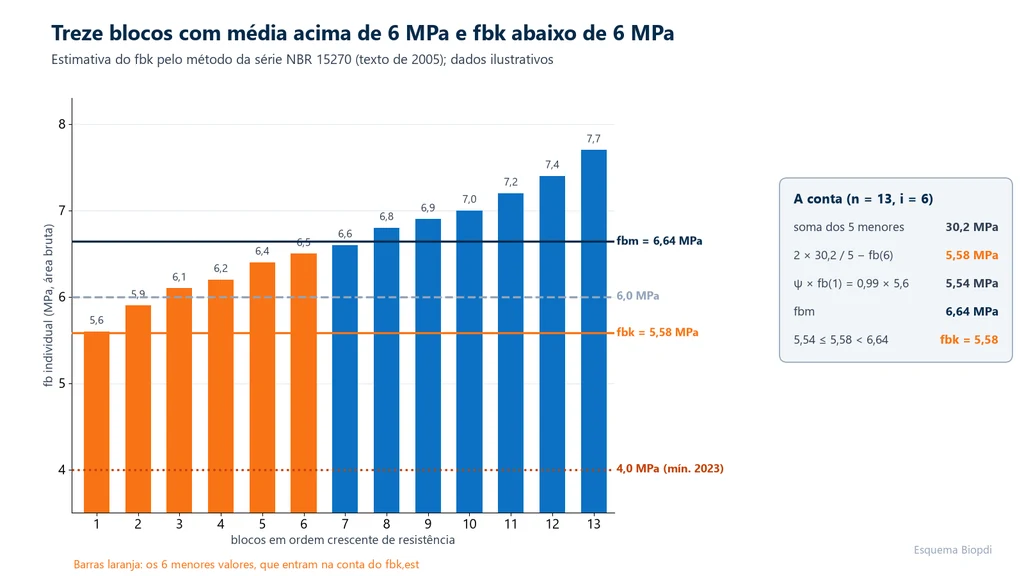
The text recommended n ≥ 13, and the structural lot is accepted when fbk reaches the class value. Whether the 2023 edition of Part 1 kept this formulation should be confirmed in the purchased standard; it is the same family of estimator used in other Brazilian product standards, such as the one for reinforcing bars. The chart below shows an illustrative lot of 13 blocks, with the six lowest values in orange, which are the ones that enter the calculation: the mean is 6.64 MPa, but fbk is 5.58 MPa, below 6 MPa. The full calculation is in exercise 2.
Water absorption and initial rate of absorption (AAI)
The two physical tests measure different things. The water absorption (AA) measures how much water the block holds when saturated, as a percentage of its dry mass: an indicator of porosity and, indirectly, of firing. The initial rate of absorption (AAI) measures how fast the bed face draws in water during the first minute: an indicator of what the block will do to the mortar.
Water absorption. In the 2005 text, the block was oven-dried at (105 ± 5) °C to constant mass, weighed, saturated by immersion in boiling water for 2 h or in water at room temperature for 24 h, and weighed again. The index is:
AA = (mu − ms) / ms × 100, in %, where ms is the dry mass and mu the wet, saturated mass.
The range has both a lower and an upper limit. High absorption indicates a porous, underfired block, more susceptible to moisture and deterioration. Absorption that is too low is also a problem: the mortar does not bond to the closed surface. In 2005 the range was 8% to 22%; the ranges by class in the 2023 edition have not been confirmed in a reliable source.
Initial rate of absorption. The dry block is placed with its bed face in a shallow layer of water, about 3 mm above the supports in the 2005 text, for 60 s; it is then wiped and weighed. The AAI is the mass of water absorbed, normalized to an area of 193.55 cm²:
AAI = Δm × 193.55 / A, in (g/193.55 cm²)/min, with Δm in grams and A the area of the face in contact with the water, in cm².
For a block with vertical cells, the area A is the net area of the face, because only the ceramic material touches the water: the cells absorb nothing. Using the gross area in this case divides the water by a larger area than the real one and underestimates the suction, as exercise 3 shows.
The AAI decides whether the block must be wetted before laying. A very thirsty block pulls water out of the mortar right after contact, the mortar loses the water it needs to harden next to the face, and bond strength drops. The informative annex of 2005 recommended wetting the blocks when the AAI exceeded 30 (g/193.55 cm²)/min. In 2023 the test became normative: according to Anicer, the manufacturer must disclose the AAI of its product to the customer, in a technical manual, sales material or delivery document, repeat the test at least every six months and redo it whenever the process changes, such as the clay deposit, the formulation or the firing. The numerical criterion of 2023 has not been confirmed. The tests on the mortar that will receive this block are covered in the guide to NBR 13279 (the Brazilian standard for mortar flexural and compressive strength).
How to interpret the standard
The standard says what to do without saying why. The points below are the ones most often misread in the laboratory, at the brickworks and on the job site, with the reason behind each one.
Why is the strength calculated on the gross area and not on the net area?
Because the number exists for the design of the wall, and the wall is designed on its full cross-section. Masonry strength and design stresses refer to the gross area, as Anicer notes: in the evaluation of fbk, the gross area of the block section is used. Calculating on the gross area also avoids measuring the area of each cell in each block, which reduces scatter between laboratories. The practical consequence shows up in the area diagram: two blocks of the same clay, one with more cells, give different fb values, because the one with more cells has less material under the same gross area. The class measures the unit, not the ceramic. Comparing an fb calculated on the net area with the class makes a 6 MPa block look like a 13 MPa one.
Why is the block tested saturated?
Because wet ceramic is weaker than dry ceramic, and a block in a wall spends its life exposed to moisture. Testing it dry would give an optimistic number that the wall would not have on a rainy day. Saturation also standardizes the condition: a block fresh out of the kiln and another that sat in the yard for weeks reach the test in the same state. The 2005 text required immersion for at least 6 h after the capping had hardened; the duration in the 2023 edition should be checked in the standard.
Why is the mean of 13 blocks not enough to classify a structural lot?
Because the wall fails at the weak block, not the average one. The mean tells where the center of the distribution is, and fbk tells where the lower tail is. The estimator of the 15270 series uses only the weaker half of the sample, and two lots with the same mean can have very different fbk values: the more scattered one has the lower tail. That is why the lot in exercise 2, with a mean of 6.64 MPa, does not reach an fbk of 6 MPa. The coefficient ψ is the floor: with few blocks, the estimator can fall below what the lowest result justifies, and the standard limits the drop to ψ times that lowest value.
What changes with the 2023 capping requirement?
Previously, a paste or mortar stronger than the block on the gross area was enough. Because the block has many cells, the real stress in the webs and shells, which is the net-area stress, is much higher than the gross-area stress: 2.2 times in the diagram in this guide. A paste that only exceeds the strength on the gross area can crush under the block walls before the block fails, and the test then measures the capping. The 2023 edition closes this gap in two ways: either a fixed recipe, CP V ARI (Brazilian high-early-strength Portland cement) with w/c ≤ 0.5, which gives a paste of high and known strength, or a material with at least 80% of the nominal strength of the block on the net area, with the strength verified.
Where does the number 193.55 cm² come from?
It is 30 square inches: 30 × 6.4516 cm² = 193.55 cm². The index originated in the North American practice of measuring brick suction, where the unit is the mass of water absorbed by 30 in² of face in one minute. Normalizing by area makes it possible to compare blocks of different sizes: what matters to the mortar is how much water each square centimeter of face draws in, not the total for the block.
Is the strength of the block the strength of the wall?
No. The fbk of NBR 15270 is the strength of the individual unit; the wall is block plus mortar, and the mortar joint, more deformable than the ceramic, makes the masonry weaker than the block. That is why structural masonry design under ABNT NBR 16868-1 (the Brazilian structural masonry standard) works with the strength of prisms, small walls or walls, tested under ABNT NBR 16868-3:2020, the standard of test methods for ceramic and concrete block masonry elements in axial compression, shear, flexure and combined flexure and compression. The block test under NBR 15270-2 comes first: it qualifies the unit that will form the prism.
Do ceramic blocks and concrete blocks follow the same standard?
No. The hollow concrete block has its own standard, ABNT NBR 6136 (the Brazilian standard for hollow concrete masonry units), published in 2026 in two parts: 6136-1, with requirements, and 6136-2, with test methods, which replaced NBR 12118. The history and status of these standards are covered in the guide to NBR 5739. The two tests look alike, with a whole block, leveled faces and strength on the gross area, but the preparation, loading rate and acceptance values belong to each standard and are not interchangeable.
Worked examples
The examples use illustrative data. Where a procedure parameter not confirmed in the 2023 edition is used, the edition it comes from is indicated.
1. Force, loading rate and machine capacity. A laboratory is going to test 14 × 19 × 29 cm structural blocks, loaded on the 140 × 290 mm face.
- Gross area: Ab = 140 × 290 = 40,600 mm².
- For 3 MPa: F = 3 × 40,600 = 121,800 N = 121.8 kN. For 6 MPa: F = 6 × 40,600 = 243.6 kN.
- With 300 kN platens, the highest measurable fb is 300,000 / 40,600 = 7.39 MPa. An 8 MPa block already requires 324.8 kN, and a 10 MPa block, 406.0 kN.
- Loading rate of 0.05 MPa/s (2005 text): 0.05 × 40,600 = 2,030 N/s = 2.03 kN/s, with the 0.04 to 0.06 MPa/s range going from 1.62 to 2.44 kN/s. A 6 MPa block fails in 6 / 0.05 = 120 s.
Conclusion: 300 kN platens serve this block up to about 7 MPa, with margin for the 4 and 6 MPa classes. Blocks of the 8 MPa class and above call for a higher-capacity machine. Good practice is for the expected failure load to fall within the range over which the machine has been verified, not right at full scale.
2. fbk of a lot of 13 blocks. Results in ascending order, in MPa: 5.6; 5.9; 6.1; 6.2; 6.4; 6.5; 6.6; 6.8; 6.9; 7.0; 7.2; 7.4; 7.7. Estimator from the 2005 text:
- n = 13, odd, so i = (13 − 1) / 2 = 6.
- Sum of the i − 1 = 5 lowest: 5.6 + 5.9 + 6.1 + 6.2 + 6.4 = 30.2 MPa; mean 30.2 / 5 = 6.04 MPa.
- fbk,est = 2 × 6.04 − fb(6) = 12.08 − 6.5 = 5.58 MPa.
- Mean: fbm = 86.3 / 13 = 6.64 MPa. Since 5.58 < 6.64, the mean is not adopted.
- Floor: ψ × fb(1) = 0.99 × 5.6 = 5.54 MPa. Since 5.58 ≥ 5.54, fbk = 5.58 MPa is adopted.
The lot does not reach a characteristic strength of 6 MPa, despite a mean of 6.64 MPa and 11 of the 13 blocks exceeding 6 MPa. It does reach the 4 MPa minimum that the 2023 edition set for rationalized masonry.
3. AAI of a block with vertical cells. The block in the area diagram has a 140 × 290 mm face, a gross area of 406 cm² and a net area of 181 cm². In the test, it gained 52 g of water in 1 min.
- With the net area, which is correct for vertical cells: AAI = 52 × 193.55 / 181 = 10,064.6 / 181 = 55.6 (g/193.55 cm²)/min.
- With the gross area, by mistake: AAI = 10,064.6 / 406 = 24.8 (g/193.55 cm²)/min.
By the 2005 informative reference of 30 (g/193.55 cm²)/min, the correct value calls for wetting the blocks before laying, and the wrong value would say it is not needed. The area error reverses the decision on site.
4. Water absorption. Oven-dry mass: ms = 6,250 g. Saturated mass: mu = 7,125 g. AA = (7,125 − 6,250) / 6,250 × 100 = 875 / 6,250 × 100 = 14.0%. The result is compared with the class range in the current Part 1.
5. Non-load-bearing block with horizontal cells. A 9 × 19 × 29 cm block, laid with the cells horizontal. The bed face is width × length: Ab = 90 × 290 = 26,100 mm². For the 1.5 MPa minimum that the 2005 edition set for this block, F = 1.5 × 26,100 = 39,150 N = 39.2 kN per block. Since the non-load-bearing criterion is individual, each of the 13 blocks is compared with the minimum, and the lot depends on how many fall below it.
Common mistakes when applying NBR 15270-2
Almost all mistakes in applying NBR 15270-2 (the Brazilian standard of test methods for ceramic blocks and bricks) come from three sources: a canceled standard or the wrong edition, the wrong area in the calculation, and the wrong acceptance criterion. The list collects the ones we see in test reports, in-house procedures and purchasing discussions:
- Using NBR 6461 or NBR 7171. Both were canceled in August 2005, and they still show up at the top of search results for "ceramic block compression test".
- Reading NBR 15270-2:2005 as a test standard. In 2005, Part 2 covered the requirements for structural blocks. The methods were in Part 3, which was canceled in 2017.
- Looking for the minimum strength in Part 2. The requirements and the classes are in Part 1.
- Citing the 2017 edition as current. The two 2023 parts replaced the 2017 ones.
- Calculating fb on the net area. The class is compared with the gross area. On the net area, the block looks twice as strong.
- Testing the block dry. Dry ceramic is stronger, so the result comes out above what the wall will actually have.
- Capping with any paste. In 2023 the paste is CP V ARI cement (Brazilian high-early-strength Portland cement) with w/c ≤ 0.5, or a material with a proven strength of at least 80% of the block's nominal strength on the net area. A thick, soft or out-of-square cap concentrates stress and makes the block fail early.
- Loading the block in the wrong direction. The load goes on the bed face, in the direction the block works in the wall.
- Classifying a structural lot by the mean. The criterion is fbk. For non-load-bearing blocks, it is the number of individual blocks below the minimum.
- Calculating the AAI of a block with vertical cores using the gross area. The cores do not absorb water, so the index comes out too low.
- Using the 2005 absorption ranges and minimums as if they still applied. The structural minimum, for example, went up to 4 MPa.
- Taking the block fbk as the strength of the wall. Masonry is weaker than the block. The design strength comes from the prism, tested to NBR 16868-3 (the Brazilian standard of test methods for structural masonry).
- Choosing the testing machine based on the block mean. The capacity has to cover the strongest blocks in the lot, with a margin.
- Using a copy of the standard downloaded from a file-sharing site. Many are old editions, and none of them gives the right to use it. A laboratory's reference is the standard purchased from the ABNT catalog.
Equipment for testing ceramic blocks
The block compression test needs a machine that applies compression at a controlled rate, records the maximum force and has platens, or steel plates, that cover the entire face of the block. The Biopdi electric and hydraulic compression testing machine is dedicated to compression and handles routine specimen breaking. The dual-column universal testing machine runs the same test with the 300 kN compression platens, such as the 300 kN machine, and handles other tests on the same frame.
The capacity follows exercise 1: for a 14 × 29 cm block, the 300 kN platens cover up to about 7.4 MPa on the gross area, which includes the 4 and 6 MPa classes. Blocks in the higher classes call for the larger capacities of the M2 line, the 600 kN machine or the 1,000 kN one, with the compression fixture defined in the quote. The M2 line load cell is class 1 per ABNT NBR ISO 7500-1:2023, and the BioLab software converts the rate from MPa/s to kN/s based on the gross area, records the maximum force, calculates fb and generates the report. The panel below shows the machine, the role of each part in this test and the accessory used.
The universal testing machine in the compression test
The dual-column M2 line ranges from 5 kN to 1,000 kN. In the test of ceramic blocks and bricks to NBR 15270-2, each part of the machine has a role:
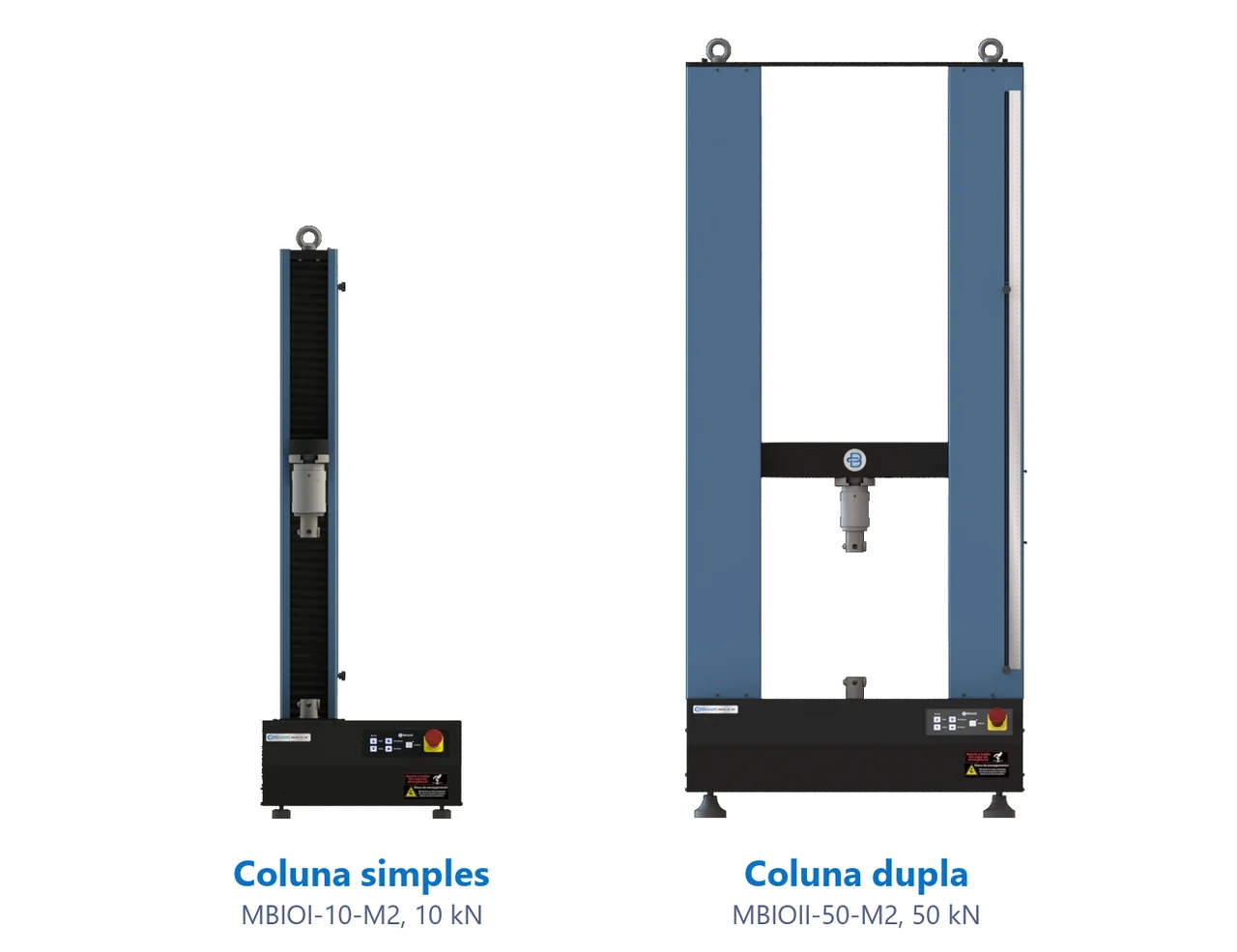
- Moving crosshead applies the load at the rate set by the standard, without shocks
- Load cell measures the force, class 1
- Compression platens capped block on the bed face
- BioLab software rate in kN/s, fb on the gross area and report
- Control panel and emergency stop positions and stops the test
Fixtures for the compression test
The fixture below is mounted on the same machine, in place of the grips:
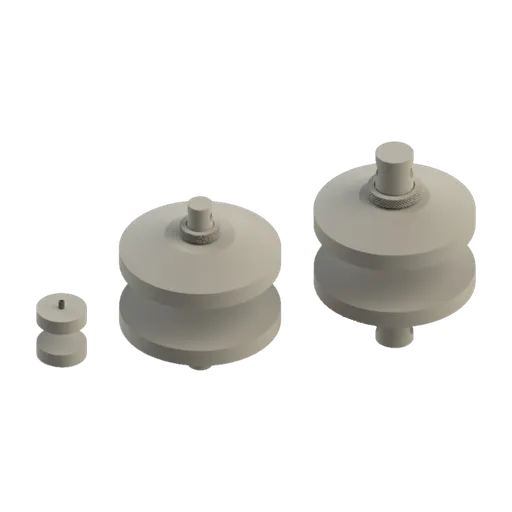
To compare the models, see the universal testing machine guide. The configuration for each standard is defined in the quote.
Standards cited: edition and status
The standards in this guide are the NBR 15270 series (the Brazilian standards for ceramic blocks and bricks), the ones it replaced and the ones around it in masonry design and testing. The table gives the edition and status of each one: NBR 15270-1, 15270-2, 16868-1 and 16868-3 were checked on October 1, 2026 in the Target catalog; the other ABNT standards on September 30, 2026 in the same catalog; and the ASTM standard on September 30, 2026 on the official ASTM page. The US standard for clay bricks and tiles, ASTM C67/C67M, is cited only as a reference: its methods and criteria are not interchangeable with those of NBR 15270.
| Standard | Subject | Edition and status |
|---|---|---|
| ABNT NBR 15270-2 | ceramic blocks and bricks, test methods | 12/2023, current (31 pp.); replaces 2017 |
| ABNT NBR 15270-1 | ceramic blocks and bricks, requirements | 12/2023, current (28 pp.); replaces 2017 |
| ABNT NBR 15270-3 | test methods (2005 series) | 2005, canceled in 11/2017 |
| ABNT NBR 6461 | compression of ceramic blocks | canceled in 08/2005 |
| ABNT NBR 7171 | ceramic blocks for masonry | canceled in 08/2005 |
| ABNT NBR 16868-1 | structural masonry, design | 08/2020, confirmed in 01/2025, current |
| ABNT NBR 16868-3 | structural masonry, test methods (prism, small wall, wall) | 08/2020, confirmed in 01/2025, current |
| ABNT NBR 6136-1 and 6136-2 | hollow concrete blocks | 2026, current |
| ABNT NBR ISO 7500-1 | verification and class of the machine | 2023, current |
| ASTM C67/C67M | sampling and testing of clay bricks and tiles (USA) | C67/C67M-26, active |
Other tests and technical references
Tests performed on the Biopdi universal testing machine









Related technical references
NBR 6136-2: compression test of concrete blocks, fbk, strength classes and what changed from NBR 12118
NBR 6136-2:2026 replaced NBR 12118 in Brazil: hollow concrete block tests, fb = F/Ab on gross area, fbk calculation, classes A, B and C, and what changed.
NBR 13818: canceled standard, what replaced it (NBR ISO 13006 and NBR ISO 10545) and the flexural test of ceramic tiles
ABNT NBR 13818:1997 (the former Brazilian standard for ceramic tiles) was canceled in December 2020 and replaced by ABNT NBR ISO 13006:2020 (specification, the Brazilian adoption of ISO 13006) and the ABNT NBR ISO 10545 series (test methods, the Brazilian adoption of ISO 10545). See the water absorption groups, the current definition of porcelain tile, the 16 parts of NBR ISO 10545 and the flexural test of NBR ISO 10545-4 with worked examples.
NBR 5739 concrete compression test: fc calculation and the NBR 7222, NBR 12142 and NBR 6136-2 standards
ABNT NBR 5739:2018 (the Brazilian standard for concrete compression testing), reaffirmed in 2023, covers compression testing of cylindrical concrete specimens: continuous loading at 0.45 ± 0.15 MPa/s until failure and fc = 4F/(πD²), in MPa, to three significant figures. See what it requires of the machine and the specimen, the h/d correction, failure types A to G and the related standards: NBR 7222 (splitting tensile test), NBR 12142 (flexural tensile strength) and NBR 12118, withdrawn in February 2026 and replaced by NBR 6136-2:2026.
Frequently asked questions
What is the ABNT standard for ceramic bricks and blocks?
It is ABNT NBR 15270, in two parts published in December 2023 and currently in force: 15270-1, requirements, and 15270-2, test methods. They apply to ceramic blocks and bricks with and without a structural function and replaced the 2017 editions.
What is the standard for non-load-bearing masonry with ceramic blocks?
For the unit, NBR 15270-1:2023 defines the VED class, with no structural function, and NBR 15270-2:2023 defines the tests. For concrete blocks, the standard is NBR 6136, from 2026.
What is the minimum strength of a ceramic block or brick?
It depends on the class, defined in Part 1:2023. According to Anicer (the Brazilian ceramic industry association), the 2023 edition set 4 MPa as the minimum for blocks for rationalized masonry. As a historical reference, the 2005 edition required 1.5 MPa for non-load-bearing blocks with horizontal holes. In all cases, the strength is calculated on the gross area.
What is the strength of a ceramic brick?
It depends on the class in which the brick is sold, defined in NBR 15270-1:2023, and on whether it has a structural function. For structural use, the minimum characteristic strength has been 4 MPa since 2023, according to Anicer, and the market offers products from 4 MPa to over 20 MPa. The value is always calculated on the gross area and measured to NBR 15270-2.
What is the difference between a ceramic block and a ceramic brick?
A block has holes or cores that take up a large part of the cross section, while a brick is solid or has few holes. Under the criterion in the teaching material of UFRGS (Federal University of Rio Grande do Sul), a unit with a net area of 75% or more of the gross area is treated as solid. Both are tested to NBR 15270-2.
How is the compression test of a ceramic block performed?
The block is measured, its two working faces are leveled by capping, it is saturated in water and compressed on the bed face, in the direction it works in the wall, with the stress increasing slowly and without shocks until failure. The strength is the maximum force divided by the gross area.
Why is block strength calculated on the gross area?
Because masonry design uses the strength referred to the full cross section, so there is no need to measure the cores of each block. A block with more cores has a lower fb on the gross area, even with the same ceramic.
How many blocks are tested in compression?
In the 2005 and 2017 editions, 13 blocks in the geometry and compression sample and 6 in the water absorption sample. Sampling is in Part 1, and the number in the 2023 edition should be checked there.
How are the block faces prepared for the test?
By capping, which levels the working faces. Since 2023, the paste is CP V ARI cement (Brazilian high-early-strength Portland cement) with a water/cement ratio of no more than 0.5, or a paste or mortar with at least 80% of the block's nominal strength on the net area, with the strength proven.
Is the ceramic block tested dry or saturated?
Saturated. In the 2005 text, after the capping hardened, the block was immersed in water for at least 6 h and tested right after, because wet ceramic is weaker and the wall spends its whole life exposed to moisture. The duration in the 2023 edition should be checked in the standard.
Can a ceramic block be capped with sulfur?
The 2023 edition gives no basis for it. According to Anicer, it allows CP V ARI cement paste with w/c ≤ 0.5, or a paste or mortar with a proven strength of at least 80% of the block's nominal strength on the net area. Sulfur is not among the options.
What changed in NBR 15270 in 2023?
According to Anicer: a 4 MPa minimum for rationalized masonry, the addition of the top fixing block (BFS) and the grooved block, capping with CP V ARI, a normative AAI repeated every six months, efflorescence over ten cycles, a new way of measuring shells and webs, tolerances with one decimal place, and lots of up to 40,000 units for EST100 or higher and for the BFS.
What is the initial rate of absorption (AAI)?
It is the mass of water that the bed face of the block absorbs in 1 min, normalized to 193.55 cm² (30 in²). It indicates whether the block should be wetted before laying. Since 2023 it is a normative test, repeated at least every six months, and the manufacturer must state the value.
Is NBR 6461 still valid?
No. It was canceled in August 2005 and replaced by NBR 15270-3, which in turn was canceled in 2017, when the methods moved to NBR 15270-2.
What testing machine do I need to break ceramic blocks?
Calculate F = fb × L × C. A 14 × 29 cm block at 6 MPa requires 243.6 kN, and at 8 MPa, 324.8 kN. The 300 kN platens cover this block up to about 7.4 MPa; higher classes call for a 600 kN machine or larger.
What does ABNT NBR 16868-3 specify?
NBR 16868-3:2020 specifies the test methods for structural masonry elements made of ceramic and concrete blocks and bricks: prism, small wall and wall, under axial compression, shear, bending and combined bending and compression. It measures the masonry; the individual block is tested to NBR 15270-2.
What is the MPa rating of a concrete block?
It depends on the class defined in ABNT NBR 6136-1:2026, the Brazilian standard for hollow concrete blocks, not on NBR 15270. The standard divides blocks into characteristic strength (fbk) classes according to use, structural or non-load-bearing, and the A, B and C classes, the fbk and the test methods are explained in the guide to NBR 6136-2 for concrete blocks.
Do ceramic blocks sold in Brazil usually comply with the standard?
Not always. In Itabira (Minas Gerais, Brazil), Santos et al. (2023, Research, Society and Development) evaluated blocks from six brands against the 2017 edition, and none met all the requirements. That is why acceptance control, with testing of a sample from the lot, is part of good construction site practice.