
ABNT NBR 13818:1997 (the former Brazilian standard for ceramic tiles) was canceled in December 2020 and replaced by ABNT NBR ISO 13006:2020, which specifies ceramic tiles, and by the ABNT NBR ISO 10545 series, which contains the test methods; the flexural test, for example, is now ABNT NBR ISO 10545-4:2020. The same publication canceled NBR 13816 (terminology), NBR 13817 (classification) and NBR 15463 (porcelain tile). Anyone who buys, manufactures or tests ceramic tiles in Brazil should specify and accept them under the pair NBR ISO 13006 and NBR ISO 10545, even if the product catalog still cites 13818.
In short:
- Status: NBR 13818, published in April 1997, 78 pages, canceled and replaced in December 2020 (ABNT catalog distributed by Target, checked on September 30, 2026).
- Current specification: ABNT NBR ISO 13006:2020, the Brazilian adoption of ISO 13006:2018. It classifies tiles by forming method and water absorption and sets the requirements for each group.
- Current methods: the 16 parts of ABNT NBR ISO 10545 (ISO 10545), one per property.
- Porcelain tile: a fully vitrified tile with water absorption of up to 0.5% (groups AIa and BIa). The 0.1% cutoff for "technical porcelain tile" came from NBR 15463, which was also canceled.
- Mechanical test: three-point flexural test per NBR ISO 10545-4, performed on a universal testing machine with a flexural fixture.
What NBR 13818 was and when it was canceled
NBR 13818, "Ceramic tiles for wall and floor covering: specification and test methods", gathered in a single document everything required of a tile: manufacturing characteristics, marking, catalog information, acceptance, sampling and the test methods, which were given in annexes. That is why older technical data sheets cite "NBR 13818, Annex C" for the flexural test or "Annex B" for water absorption: the annex was the method. It came with two sister Brazilian standards from 1997, NBR 13816 (terminology) and NBR 13817 (classification), and, from 2007, with NBR 15463, dedicated to porcelain tile.
The history in the ABNT catalog, distributed by Target and checked on September 30, 2026, records the first edition in April 1997, corrigenda and new editions still in 1997, reaffirmations in August 2013 and October 2018 and, in December 2020, cancellation with replacement. The "Situação" (status) field of the record reads "Substituída" (replaced) and lists NBR ISO 13006 and the parts of NBR ISO 10545 as replacements. NBR 15463 met the same fate on the same date: published in February 2007, with a new edition in 2013, canceled in December 2020 with NBR ISO 13006 as its replacement. The forewords of the method parts also record the change: NBR ISO 10545-3 (water absorption) and NBR ISO 10545-4 (flexure), both from July 2020, state that they cancel and replace NBR 13818.
There is no "updated NBR 13818". The update of 13818 is a change of system: Brazil dropped its own national standard and adopted the ISO standards for ceramic tiles, which aligns Brazilian test reports with those used for export.
What replaced NBR 13818: NBR ISO 13006 and NBR ISO 10545
The change separated what 13818 had combined. ABNT NBR ISO 13006:2020, "Ceramic tiles: definitions, classification, characteristics and marking", is an adoption of ISO 13006:2018. It defines the terms, divides tiles into groups, states which characteristics are required for floors and walls, indoors and outdoors, and sets the limits for each group in annexes. It applies to first-quality tiles formed by extrusion or by dry pressing; other processes are outside its scope, as are trim pieces (skirtings, corners, edge trims) and mosaics, which the standard defines as any piece that fits within a square with sides smaller than 7 cm.
13006 does not describe any test. Each requirement points to a part of the ABNT NBR ISO 10545 series, and that is where the laboratory finds the procedure: dimensions in Part 2, water absorption in Part 3, flexure in Part 4, and so on. The table below shows the correspondence between the old system and the current one:
| Before (canceled in December 2020) | What it covered | Now |
|---|---|---|
| NBR 13816:1997 | terminology | NBR ISO 13006:2020, definitions |
| NBR 13817:1997 | classification | NBR ISO 13006:2020, groups by absorption and forming method |
| NBR 13818:1997, main body | requirements, marking, acceptance | NBR ISO 13006:2020, requirements and marking; NBR ISO 10545-1, sampling and acceptance |
| NBR 13818:1997, annexes | test methods | NBR ISO 10545, Parts 2 to 16 |
| NBR 15463:2013 | porcelain tile | NBR ISO 13006:2020, groups AIa and BIa |
A technical change comes with the switch and affects every absorption report. The current edition of the method, NBR ISO 10545-3:2020 (adoption of ISO 10545-3:2018), removed the boiling method: water now enters the test specimen only by vacuum, with the chamber at about 10 kPa for 30 minutes, followed by 15 minutes of immersion. This is the absorption value that NBR ISO 13006 uses to classify the tile. An old result obtained by boiling is not the same measurement that the current standard requires.
Why catalogs and tender documents still cite NBR 13818
13818 still appears in technical data sheets, packaging and project specifications for practical reasons, and none of them makes it current:
- Material printed before 2020. Catalogs and data sheets stating "complies with NBR 13818:1997 / 15463:2013" are still in circulation and on manufacturers' websites.
- Old test reports. A report issued under 13818 before December 2020 is a valid record of that date, but it does not demonstrate conformity with the current standard.
- Copied specifications. Public tender documents in Brazil and project specifications reuse text from earlier projects; a search for the standard returns public works specifications that still require it.
- Installation standards that predate the change. NBR 13755 (the Brazilian standard for ceramic tile cladding on facades) dates from 2017 and refers to the tile standards of that time.
- Similar numbers. The core limits, such as the absorption of up to 0.5% for porcelain tile, changed little, and the old name seems to remain correct.
- PDF copies. Full copies of 13818, with no cancellation notice, are among the top search results. Besides being outdated, they reproduce a copyrighted text without authorization.
In practice, whoever specifies should order the tile by its NBR ISO 13006 group (for example, "BIa, per NBR ISO 13006:2020") and request the report under the parts of NBR ISO 10545. Whoever receives a report citing only 13818 should ask for the test date and, if it is after 2020, request that it be issued under the current standard.
Classification by water absorption: groups Ia to III
NBR ISO 13006 classifies tiles by two criteria. The first is the forming method: A for extruded tiles, in which the plastic body comes out of an extruder and is cut, and B for dry-pressed tiles, in which a fine powder is compacted in a mold under high pressure. The second is water absorption, Ev: the mass of water the tile absorbs, as a percentage of its dry mass, measured by the vacuum method of NBR ISO 10545-3.
Absorption is an indirect measure of how much the piece vitrified during firing. During sintering, the glassy phase closes the pores; the fewer open pores, the lower the absorption and, in general, the higher the mechanical strength and frost resistance. That is why absorption is the backbone of the classification: it ranks tiles from porcelain tile, almost free of pores, to the highly porous monoporosa wall tile. The diagram below shows the five ranges, the codes by forming method and where porcelain tile sits:
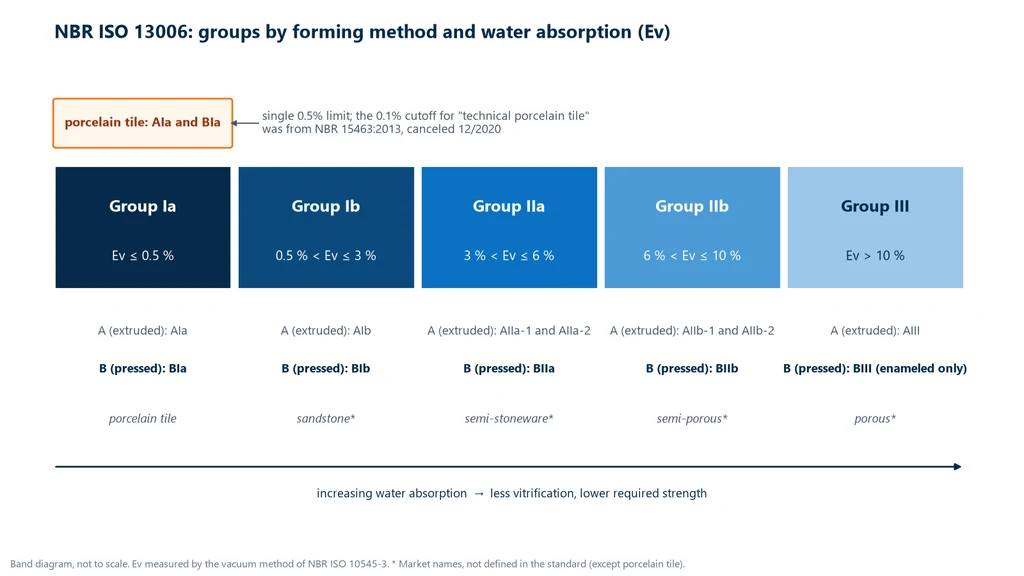
Three details of the standard's table are often overlooked. Groups AIIa and AIIb, for extruded tiles, are divided into subgroups 1 and 2, with different requirements in separate annexes. Group BIII covers only glazed tiles; unglazed dry-pressed tiles with absorption above 10% do not fall into any group. And the group does not indicate the use: 13006 states which characteristics are required for each application, but it does not prohibit, for example, a BIIa tile on an indoor floor. In that table of characteristics, breaking strength and modulus of rupture are required for all four applications (floors and walls, indoor and outdoor); abrasion resistance, only for floors; frost resistance, only for outdoor areas exposed to freezing; and dovetail keys (the ribs on the back of the tile that anchor it in the mortar), only for exterior walls installed with cement-based mortar. Brazilian market names (grés, semigrés, semiporoso, poroso or monoporosa) are not defined by the standard; the only commercial name it defines is porcelain tile (porcelanato). The table summarizes the ranges:
| Group | Water absorption Ev | Extruded (A) | Dry-pressed (B) |
|---|---|---|---|
| Ia | Ev ≤ 0.5% | AIa | BIa |
| Ib | 0.5% < Ev ≤ 3% | AIb | BIb |
| IIa | 3% < Ev ≤ 6% | AIIa-1 and AIIa-2 | BIIa |
| IIb | 6% < Ev ≤ 10% | AIIb-1 and AIIb-2 | BIIb |
| III | Ev > 10% | AIII | BIII (glazed only) |
Example 1: classifying a tile by absorption
A dry-pressed tile has a dry mass m1 = 2,000.0 g and, after vacuum impregnation, a saturated mass m2 = 2,008.0 g. The absorption is:
- Ev = (m2 − m1) / m1 × 100 = (2,008.0 − 2,000.0) / 2,000.0 × 100 = 0.40%.
- Since 0.40% ≤ 0.5% and the tile is dry-pressed, it belongs to group BIa: it is porcelain tile under the current standard.
- Under NBR 15463:2013, now canceled, it would not be "technical porcelain tile", because it exceeds 0.1%. That cutoff no longer exists in the standard.
Porcelain tile: definition in NBR ISO 13006 and the end of NBR 15463
NBR ISO 13006 defines porcelain tile as a fully vitrified tile with water absorption of up to 0.5%, in groups AIa or BIa. The definition has two parts: low absorption and complete vitrification. A porcelain tile may be glazed or unglazed; the standard deals with the body of the piece, not the finish. In the Annex G table, the 0.5% limit applies to the lot average, and each individual tile may reach 0.6%. A Brazilian national note in the standard also states that terms such as "porcelânico" and "grés porcelânico" are not used in Brazil, to avoid confusing consumers.
NBR 15463 (the former Brazilian porcelain tile standard), canceled in December 2020, divided the product in two: technical porcelain tile ("porcelanato técnico"), with absorption of up to 0.1%, and glazed porcelain tile ("porcelanato esmaltado"), with up to 0.5%. 13006 does not include this 0.1% cutoff. The term "technical" remains in catalogs as a commercial name, but anyone who needs very low absorption, for example in outdoor areas exposed to freezing or staining, should write the numerical limit into the specification, because the current standard does not guarantee it by name.
The mechanical strength that 13006 requires of porcelain tile is measured by the flexural test of NBR ISO 10545-4, explained below, after the parts of the series.
The 16 parts of NBR ISO 10545 and what each one measures
The NBR ISO 10545 series has one part per property, and NBR ISO 13006 indicates which of them apply to floors or walls, indoors or outdoors. The parts adopted by ABNT and what each one determines are listed in the table, with the edition checked on September 30, 2026 in the catalog distributed by Target; where the year was not confirmed, the cell has no year:
| Part | What it determines | ABNT edition |
|---|---|---|
| 1 | sampling and basis for lot acceptance | October 2017 |
| 2 | dimensions and surface quality (length, width, thickness, straightness of sides, rectangularity, flatness) | July 2020 |
| 3 | water absorption, apparent porosity, apparent relative density and bulk density | July 2020 |
| 4 | breaking strength and modulus of rupture (three-point flexure) | July 2020 |
| 5 | impact resistance, by coefficient of restitution | November 2017 |
| 6 | resistance to deep abrasion of unglazed tiles | year not confirmed |
| 7 | resistance to surface abrasion of glazed tiles (the class known in the market as PEI) | November 2017 |
| 8 | linear thermal expansion | November 2017 |
| 9 | resistance to thermal shock | November 2017 |
| 10 | moisture expansion | November 2017 |
| 11 | crazing resistance of glazed tiles | November 2017 |
| 12 | frost resistance | November 2017 |
| 13 | chemical resistance | July 2020 |
| 14 | resistance to stains | November 2017 |
| 15 | lead and cadmium release | year not confirmed |
| 16 | small color differences | year not confirmed |
Of the 16 parts, only Part 4 is a mechanical force test performed on a testing machine. Part 5 is also mechanical, but it measures how much a steel ball rebounds off the tile, and Parts 6 and 7 use dedicated abrasion testers.
The flexural test in NBR ISO 10545-4
NBR ISO 10545-4:2020 is the Brazilian adoption of ISO 10545-4:2019, the fourth edition of the method. The principle is three-point bending: the tile rests on two rollers and receives, at the center, the force of a third roller until it breaks. The general theory of bending, the difference between three-point and four-point bending, and flexural testing of other materials are covered in the article on the flexural test. Here the focus is on what the tile standard requires that is different.
Breaking strength and modulus of rupture
The test gives two results from the same breaking load F, read at the peak of the curve:
- Breaking strength (S), in N: S = F · l2 / b, where l2 is the span between the support rollers and b is the width of the test specimen, both in mm. It is the force the tile, as a product, withstands, corrected only for the geometry of the span and the width.
- Modulus of rupture (R), in N/mm², which is the same as MPa: R = 3 · F · l2 / (2 · b · h²), where h is the minimum thickness measured along the edge of the fracture, after the test. It is the tensile stress on the bottom face at the instant of fracture: a property of the material, independent of thickness.
NBR ISO 13006 (the Brazilian adoption of ISO 13006, the ceramic tile specification) requires both results. Why the specification is not satisfied with just one, and what changes for tiles with a relief surface, is covered in the section "How to interpret the standard", after the requirements.
Apparatus: rollers, rubber and overhang
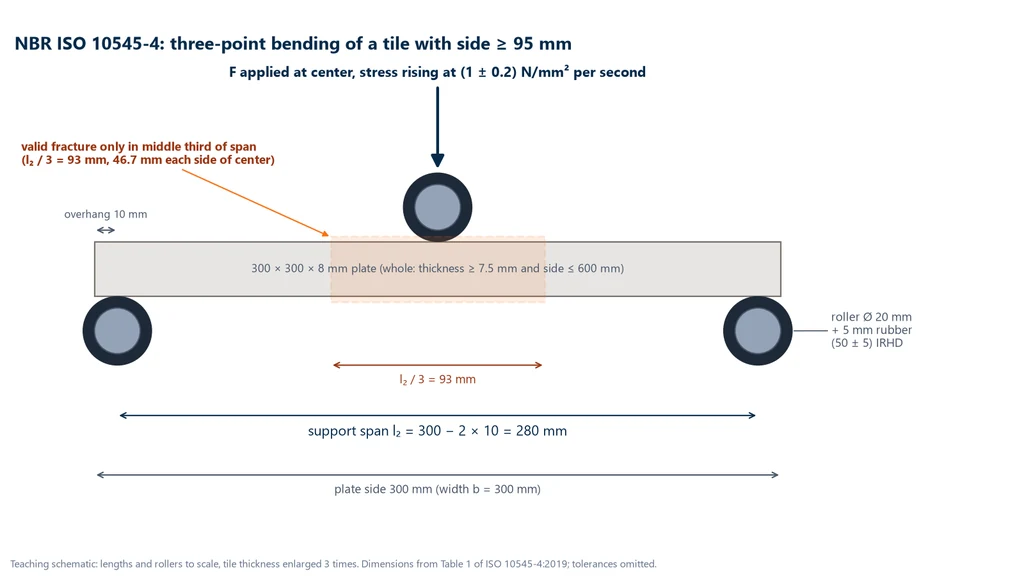
The two support rollers are metal cylinders covered, in the contact region, with rubber of hardness (50 ± 5) IRHD. One of them can tilt slightly and the other rotates about its own axis, so that the tile, which is never perfectly flat, settles without parasitic stresses. The central roller, which applies the force, has the same diameter and the same rubber and can also tilt. The roller diameter, the rubber thickness and the overhang, which is how far the tile extends beyond each support, depend on the longest side of the tile, L:
| Longest side of the tile | Roller diameter | Rubber | Overhang beyond the support |
|---|---|---|---|
| 18 mm ≤ L < 48 mm | (5 ± 1) mm | (1 ± 0.2) mm | (2 ± 1) mm |
| 48 mm ≤ L < 95 mm | (10 ± 1) mm | (2.5 ± 0.5) mm | (5 ± 3) mm |
| L ≥ 95 mm | (20 ± 1) mm | (5 ± 1) mm | (10 ± 5) mm |
The values and tolerances are those of Table 1 of NBR ISO 10545-4:2020, identical to ISO 10545-4:2019. For large tiles, the overhang can range from 5 to 15 mm, so the actual span must be measured and reported, not deduced from the nominal overhang. The force measuring system must have an accuracy of 2%. A class 1 load cell according to ISO 7500-1 (ABNT NBR ISO 7500-1:2023 in Brazil), whose relative error of indication is up to 1%, meets this comfortably within the verified range. The diagram below shows the setup for a 300 × 300 × 8 mm tile, with the span that results from the 10 mm overhang and the central band where the fracture must occur:
Test specimens: whole or cut tile
The 2019 edition changed the test specimen rule, and the work thickness, which is the thickness specified by the manufacturer, now decides:
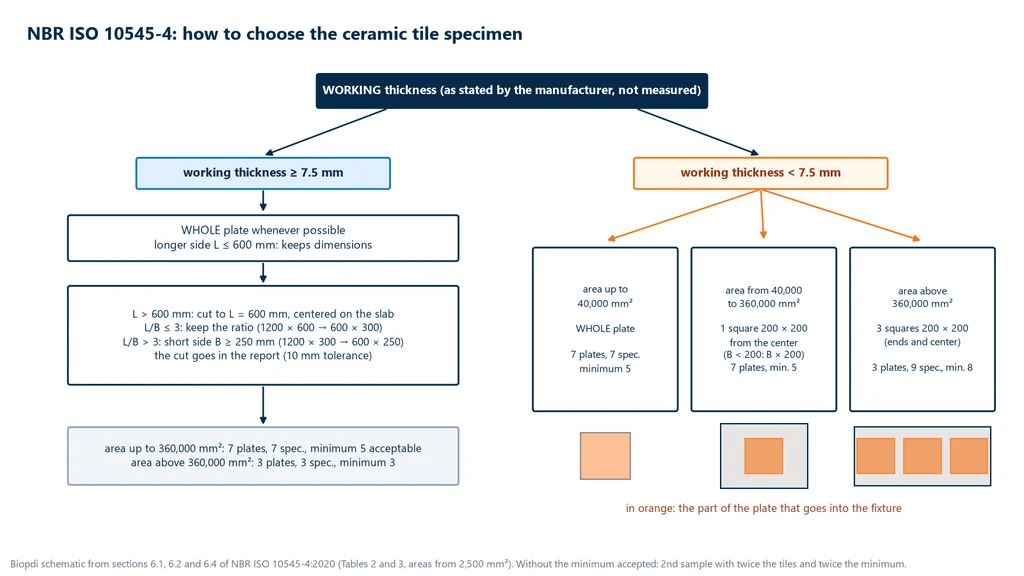
- Thickness of 7.5 mm or more: the whole tile is tested whenever possible. Tiles with a longest side above 600 mm are cut down to 600 mm, with the center of the specimen at the center of the tile. If the longest side is up to three times the shortest, the proportion is kept: 1200 × 600 mm becomes 600 × 300 mm. For more elongated tiles, the shortest side is not less than 250 mm: 1200 × 300 mm becomes 600 × 250 mm. The cut is recorded in the report and, in case of doubt, the result of the whole tile prevails.
- Thickness below 7.5 mm: tiles with an area of up to 40,000 mm² are tested whole; above that, a 200 × 200 mm square is cut from the center of the tile (or the shortest side by 200 mm, when the shortest side is less than 200 mm). Tiles above 360,000 mm² yield three squares of 200 × 200 mm each.
- Quantity: for most formats, 7 tiles, with at least 5 acceptable results. For tiles above 360,000 mm², 3 tiles: for those of 7.5 mm or more, all 3 results must be acceptable; for thin tiles, the 3 tiles give 9 test specimens, with at least 8 acceptable.
- Condition: free of cracks and visible damage, never tested before, cleaned of loose particles on the back with a brush and dried in an oven at (105 ± 5) °C for at least 24 h. After cooling to room temperature, they must be tested within 3 h at most.
The flowchart below brings the decision together in three steps: the work thickness chooses the branch, the longest side or the area chooses the test specimen, and the tile area defines how many tiles to test and the minimum number of acceptable results:
The cut is not a detail. Demarch, Waterkemper, Pasini, Zanelatto and Ruzza (Cerâmica Industrial, 2019) compared whole and cut tiles of monoporosa (single-fired wall tile), single-fired floor tile and glazed porcelain tile and, using Student's t-test, found a significant difference, at 95% confidence, between the old and the new procedure, in both breaking strength and modulus of rupture. An old test report, with a whole tile, and a new one, with a cut tile, are not directly comparable.
Procedure and validity of the result
The tile is positioned with the wearing surface facing up, in contact with the central roller, and with the overhang from the table beyond each support. The orientation is also fixed: a rectangular tile is placed with its longest side perpendicular to the rollers, so that the span runs along it; an extruded tile is placed with the ribs on the back perpendicular to the supports; and only an unglazed reversible tile can be supported on either side. When the wearing surface has a relief, a second layer of rubber on the central roller accommodates the relief. The force increases so that the stress rises by (1 ± 0.2) N/mm² per second, and the breaking load is recorded. Since the rate is given in stress, the machine must convert it into force per second, a calculation shown in Example 4.
Only test specimens that break in the central third of the span are valid, a band of length equal to l2 / 3 centered under the loading roller. On a 280 mm span, that is 93 mm, or 46.7 mm on each side of the center: a crack 40 mm from the center is valid, one at 60 mm is discarded. All individual values go into the report, but the mean of S and R is calculated only from the acceptable results. If the minimum number of acceptable results in the table is not reached, a second sample with twice as many tiles is tested, and the minimum number of acceptable results also doubles.
In addition to F, S and R, individual and mean, the report records the description of the tile (including the relief, if any), the number of test specimens, the cut dimensions, when the tile was cut, and the fixture geometry: the roller diameter (d), the rubber thickness (t), the overhang beyond each support (l1) and the span (l2). With these four values, another laboratory can reproduce the setup.
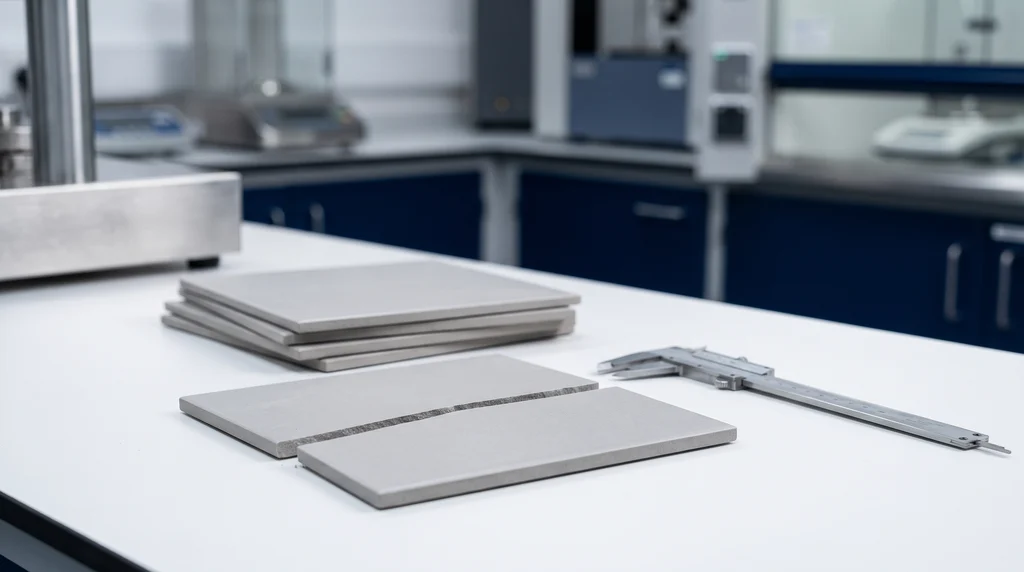
In the photo, porcelain tiles and a tile already tested in bending: the straight fracture at mid-span is where the tensile stress is highest, and the caliper measures the thickness used to calculate the modulus of rupture.
The force × displacement curve of a ceramic is practically straight up to fracture, which is sudden and without a plateau: the material does not yield, and only the peak goes into the formulas. Brittle behavior and sensitivity to defects are covered in the article on toughness.
What NBR ISO 13006 requires of porcelain tile in bending
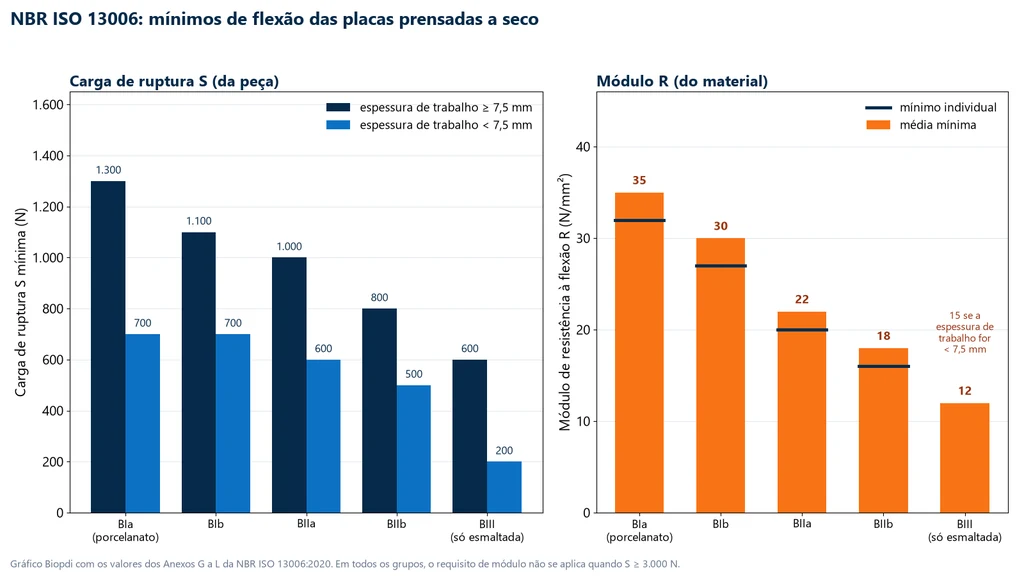
For group BIa, Annex G of NBR ISO 13006:2020 requires a breaking strength of at least 1,300 N for tiles with a thickness of 7.5 mm or more and at least 700 N below that, and a mean modulus of rupture of at least 35 N/mm², with no individual value below 32 N/mm². In the groups with higher water absorption, the requirements drop. The table summarizes the flexural minimums of the dry-pressed tile groups, checked against Annexes G to L of NBR ISO 13006:2020:
| Group (annex) | Water absorption Ev | Breaking strength S, thickness ≥ 7.5 mm | Breaking strength S, thickness < 7.5 mm | Mean modulus R (individual minimum) |
|---|---|---|---|---|
| BIa, porcelain tile (G) | up to 0.5% | 1,300 N | 700 N | 35 N/mm² (32) |
| BIb (H) | 0.5 to 3% | 1,100 N | 700 N | 30 N/mm² (27) |
| BIIa (J) | 3 to 6% | 1,000 N | 600 N | 22 N/mm² (20) |
| BIIb (K) | 6 to 10% | 800 N | 500 N | 18 N/mm² (16) |
| BIII, glazed only (L) | above 10% | 600 N | 200 N | 12 N/mm² (≥ 7.5 mm) or 15 N/mm² (< 7.5 mm) |
One detail of the annexes changes how test reports for thick tiles are read: in all groups, the modulus requirement does not apply when the breaking strength is 3,000 N or more. In that case the tile already passes in bending on the basis of strength, even if the calculated modulus falls below the minimum. The annexes are the reference for accepting or rejecting a lot.
The chart below puts the same minimums side by side and shows that the two requirements drop at different rates: from BIa to BIII, the breaking strength required of thick tiles falls to less than half (from 1,300 to 600 N), and the mean modulus falls to about one third (from 35 to 12 N/mm²):
The two formulas combine into a useful relationship. Substituting S = F · l2 / b into R = 3 · F · l2 / (2 · b · h²) gives S = (2/3) · R · h²: the breaking strength depends only on the modulus and the square of the thickness, not on the span or the width. With the minimum modulus of 35 N/mm², the strength of 1,300 N is reached at h = √(3 × 1,300 / (2 × 35)) = 7.46 mm, practically the 7.5 mm limit of the standard. The chart below shows this curve, the BIa minimums and the two worked examples that follow:
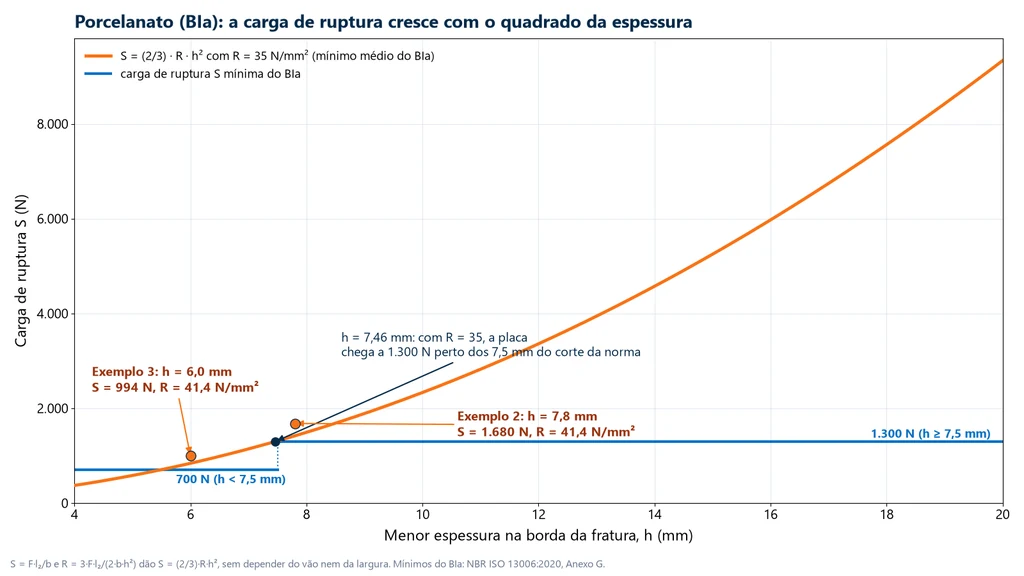
The practical reading: below 7.5 mm the standard accepts a lower strength because a thin tile could not reach 1,300 N without a modulus well above the minimum. A 6 mm tile would need R = 3 × 1,300 / (2 × 36) = 54 N/mm² to do so.
How to interpret the standard
Many of the discrepancies between laboratories and the disputes over batch acceptance come from points that ISO 10545-4 (ABNT NBR ISO 10545-4 in Brazil) and ISO 13006 (ABNT NBR ISO 13006 in Brazil) set without explaining them. The most frequent ones are listed below, each with its technical reason.
What does "work thickness" mean, and why does it decide the 7.5 mm rule?
NBR ISO 10545-4 defines the work thickness as the thickness specified by the manufacturer. That value, not the caliper reading, decides between testing the whole tile and testing a cut specimen. The rule has to apply the same way to the entire batch. If it depended on the measured value, a tile declared at 7.5 mm that measured 7.4 mm would switch branch, switch test specimen and, under 13006, switch minimum breaking strength (from 1,300 to 700 N for BIa). The measured thickness is used only later, in the modulus calculation, as the minimum thickness at the fracture edge.
Why does NBR ISO 13006 require both breaking strength and modulus of rupture, and drop the modulus above 3,000 N?
The two numbers answer different questions. The breaking strength S tells how much load the tile, at its actual thickness, can carry. That matters when the tile sits over a void in the mortar and takes a concentrated load. The modulus of rupture R tells how strong the material is, regardless of thickness, and reflects the quality of firing. Since S = (2/3) · R · h², either criterion alone could be gamed. If only S were required, a poorly sintered body could pass by being thick. If only R were required, an excellent material could be sold at a thickness too thin for its use. The annexes of 13006 drop the modulus requirement when S reaches 3,000 N, more than twice the highest minimum breaking strength (1,300 N, for BIa). The reasoning is that, with that much spare load capacity in the tile, the modulus is no longer the criterion that protects the user.
Why is only a fracture in the middle third of the span valid, and why does the standard accept the approximation?
In three-point bending, the bending moment rises linearly from zero at the supports to F · l2 / 4 under the central roller, and the formulas for S and R use that maximum. A ceramic, however, breaks at the most critical flaw that sees enough stress, and that flaw is not always exactly under the roller. At the edge of the middle third, l2 / 6 from the center, the moment is 2/3 of the maximum. The standard accepts this difference because requiring the fracture exactly at the center would reject almost every specimen, and the calculated value is still the stress the central region withstood. Outside the middle third the difference becomes too large. At 60 mm from the center on a 280 mm span, the moment is (140 − 60) / 140 = 57% of the maximum, and the fracture points to a gross flaw or to a setup with uneven contact, not to the typical strength of the material.
What changes when the tile has a relief surface?
On a proper side with relief, the central roller would touch only the high points and concentrate the force on them. That is why the standard requires a second rubber layer, of the same thickness given in the table, between the roller and the relief, to spread the contact. The calculation still assumes a rectangular cross-section with the minimum thickness at the fracture edge, and the real cross-section is not rectangular. The standard itself warns that the result is approximate and becomes more accurate the shallower the relief.
Why is the tile dried and tested soon after cooling?
Moisture adsorbed in the pores and at the tips of microcracks promotes slow growth of these cracks under stress, so a damp tile breaks at a lower force. Drying for at least 24 h at (105 ± 5) °C and the 3 h limit between cooling and testing standardize this condition.
Does the "PEI" class indicate mechanical strength?
No. What the market calls PEI is the surface abrasion class of glazed floor tiles, measured by NBR ISO 10545-7 and described in Annex N of NBR ISO 13006, which is informative and uses the term "abrasion class". The classes range from 0, not recommended for floors, to 5, for heavy traffic such as shopping malls and airports. The class describes glaze wear and says nothing about the force that breaks the tile: a class 5 BIIa tile still has the flexural minimums of BIIa.
How do you read the designation on the packaging?
13006 requires the packaging to be marked with, among other items, the brand and country of origin, "first quality", the group and annex, the nominal and work dimensions, GL or UGL, the batch and the shade. Glazed floor tiles must also state the abrasion class or the place of use. A designation such as "dry-pressed tile, NBR ISO 13006:2020, Annex G, BIa, GL, rectified, 90 × 90 cm, work size 898 × 898 × 9 mm" reads as follows:
- Annex G and BIa: pressed porcelain tile; the acceptance requirements are those of Annex G.
- GL: glazed. An engobed tile counts as unglazed (UGL).
- Rectified: edges machined after firing. For BIa, the length and width tolerance drops from ±0.6% (limited to ±2.0 mm) to ±0.3% (limited to ±1.0 mm).
- 9 mm work thickness: 7.5 mm or more, so S ≥ 1,300 N and mean R ≥ 35 N/mm². With an 898 mm side, the test specimen is cut to 600 × 600 mm.
Worked examples of the flexural test
The examples use data from a BIa porcelain tile. The force values are illustrative; the criteria are those of NBR ISO 13006 and NBR ISO 10545-4.
Example 2: breaking strength and modulus of rupture of a 300 × 300 × 8 mm tile
The tile has a nominal thickness of 8 mm (7.5 mm or more) and a 300 mm side (up to 600 mm), so it is tested whole. With a side above 95 mm, the rollers are 20 mm and the overhang is 10 mm on each side. Fracture occurs in the central band at F = 1,800 N, and the caliper reads 7.8 mm as the minimum thickness at the fracture edge.
- Span: l2 = 300 − 2 × 10 = 280 mm; width b = 300 mm.
- Breaking strength: S = 1,800 × 280 / 300 = 1,680 N ≥ 1,300 N: passes.
- Modulus of rupture: R = 3 × 1,800 × 280 / (2 × 300 × 7.8²) = 1,512,000 / 36,504 = 41.4 N/mm² ≥ 35 N/mm²: passes.
- Check: S = (2/3) × 41.4 × 7.8² = 1,680 N, the same value.
If the laboratory used the nominal thickness of 8 mm, the modulus would come out at 1,512,000 / 38,400 = 39.4 N/mm², 5% lower. Here the error is on the safe side, but on a tile thicker than nominal it would go the other way. The batch result is the mean of the acceptable results of the 7 tiles, not a single specimen.
Example 3: the same material at 6 mm thickness
The same porcelain tile (R = 41.4 N/mm²) is made at 300 × 300 × 6 mm. The thickness is less than 7.5 mm and the area is 90,000 mm², between 40,000 and 360,000 mm², so the standard requires a 200 × 200 mm specimen cut from the center of the tile.
- Span: the 200 mm side is still above 95 mm, so 20 mm rollers and a 10 mm overhang: l2 = 200 − 2 × 10 = 180 mm; b = 200 mm.
- Expected breaking force: F = 2 · b · h² · R / (3 · l2) = 2 × 200 × 36 × 41.4 / (3 × 180) = 596,160 / 540 = 1,104 N.
- Breaking strength: S = 1,104 × 180 / 200 = 994 N ≥ 700 N: passes, because the minimum below 7.5 mm is 700 N.
The lesson: the modulus belongs to the material and does not change with thickness; the breaking strength falls with the square of the thickness. Going from 7.8 to 6.0 mm reduced S from 1,680 to 994 N, 41% less, with the same material.
Example 4: setting the force rate on the machine
The standard requires the stress to increase at (1 ± 0.2) N/mm² per second, while the machine controls force per second. Differentiating the modulus formula with respect to time, the force rate is dF/dt = (2 · b · h² / (3 · l2)) × dR/dt. Before the test the actual thickness at the fracture is unknown, so the nominal thickness is used:
- Tile from Example 2 (b = 300 mm, h = 8 mm, l2 = 280 mm): dF/dt = 2 × 300 × 64 / (3 × 280) × 1 = 38,400 / 840 = 45.7 N/s, with an acceptable range of 36.6 to 54.9 N/s. Fracture at 1,800 N is reached in about 39 s.
- Specimen from Example 3 (b = 200 mm, h = 6 mm, l2 = 180 mm): dF/dt = 2 × 200 × 36 / 540 = 26.7 N/s. Fracture at 1,104 N is reached in about 41 s.
Each format has its own rate. Setting the same force rate for different tiles is one of the most common errors in this test.
Example 5: choosing the machine capacity
Test forces range from hundreds of newtons to a few kilonewtons, but thick tiles change the calculation. Consider a porcelain tile with R = 45 N/mm² in two 600 × 600 mm formats, both tested whole (side up to 600 mm and thickness above 7.5 mm), with l2 = 600 − 20 = 580 mm and b = 600 mm:
- 10 mm: F = 2 × 600 × 100 × 45 / (3 × 580) = 5,400,000 / 1,740 = 3,103 N, about 31% of a 10 kN machine.
- 20 mm (thickness used in outdoor areas): F = 2 × 600 × 400 × 45 / 1,740 = 21,600,000 / 1,740 = 12,414 N. This exceeds 10 kN.
With the rule of working up to about 80% of capacity, a 10 kN machine handles this porcelain tile up to h = √(8,000 × 1,740 / (2 × 600 × 45)) ≈ 16 mm. For 20 mm tiles, the choice moves to a 50 kN dual-column machine. Besides the force, the fixture has to accept the tile: rollers long enough for a 600 mm width and span adjustment for each format.
Installation and roof tiles: the neighboring standards
Installation of ceramic tiles with adhesive mortar follows three standards of its own, all current according to the ABNT (Brazilian standards body) catalog checked on September 30, 2026. NBR 13753 covers interior and exterior floors and NBR 13754 covers interior walls. Both date from 1996 and were last confirmed in January 2025, which means the 1996 text remains valid. NBR 13755:2017, for facades and exterior walls, covers design, execution, inspection and acceptance. It was confirmed in January 2022 and predates the cancellation of 13818, so it still refers to the tile standards of that time; in the specification, the tile should be ordered to NBR ISO 13006. None of these is a tile test: they govern the construction work.
Ceramic roof tiles do not follow 13006. Their standard was NBR 15310:2009, "Ceramic components: roof tiles, terminology, requirements and test methods", cancelled and replaced in September 2025 and split into two parts: NBR 15310-1:2025 (terminology and requirements) and NBR 15310-2 (test methods). The 2009 edition already included the flexural breaking load of the roof tile, also performed on a testing machine; the current requirements and method should be checked in the new parts, which supersede the figures of the 2009 edition.
Common errors in applying NBR 13818 and the standards that replaced it
- Treating 13818 as current. It has been cancelled since December 2020, together with 13816, 13817 and 15463.
- Looking for the test method in 13006. 13006 is a specification; the methods are in the parts of NBR ISO 10545.
- Requiring "technical porcelain ≤ 0.1%" as if it were in the standard. The current limit is 0.5%; a lower value must be written into the specification.
- Measuring water absorption by boiling. The 13006 classification uses the vacuum method of NBR ISO 10545-3.
- Confusing breaking strength with modulus of rupture. S, in N, belongs to the tile; R, in N/mm², belongs to the material.
- Using the nominal thickness in the modulus. The standard requires the minimum thickness measured at the fracture edge, after the test.
- Testing a thin tile whole. Below 7.5 mm and above 40,000 mm², the 2019 edition requires a 200 × 200 mm cut specimen.
- Accepting a fracture outside the middle third of the span. The calculated stress is not the stress at the point where the crack started, and the specimen must be discarded.
- Deciding the 7.5 mm rule by the measured thickness. The deciding value is the work thickness declared by the manufacturer; the measured value only enters the modulus.
- Comparing a new test report with an old one. A whole tile and a cut specimen give different results.
- Reading the PEI class as resistance to breaking. It measures glaze abrasion (Part 7), not flexural strength.
- Applying 13006 to roof tiles or blocks. Roof tiles follow NBR 15310-1 and NBR 15310-2; blocks and bricks, the NBR 15270 series.
Testing machine for the NBR ISO 10545-4 test
The NBR ISO 10545-4 flexural test is performed on a universal testing machine, with a flexural fixture of two supports and a central loading roller in place of the grips. The load cell measures the breaking force, the crosshead lowers the central roller and the software controls the force rate and calculates S and R from the span, width and thickness entered. The panel below shows the machine, the role of each part in testing ceramic tiles and the fixtures used.
The universal testing machine in the flexural test
The M2 line has single-column models, from 200 N to 10 kN, and dual-column models, from 5 kN to 1,000 kN. In ceramic tile testing, each part of the machine has a function:
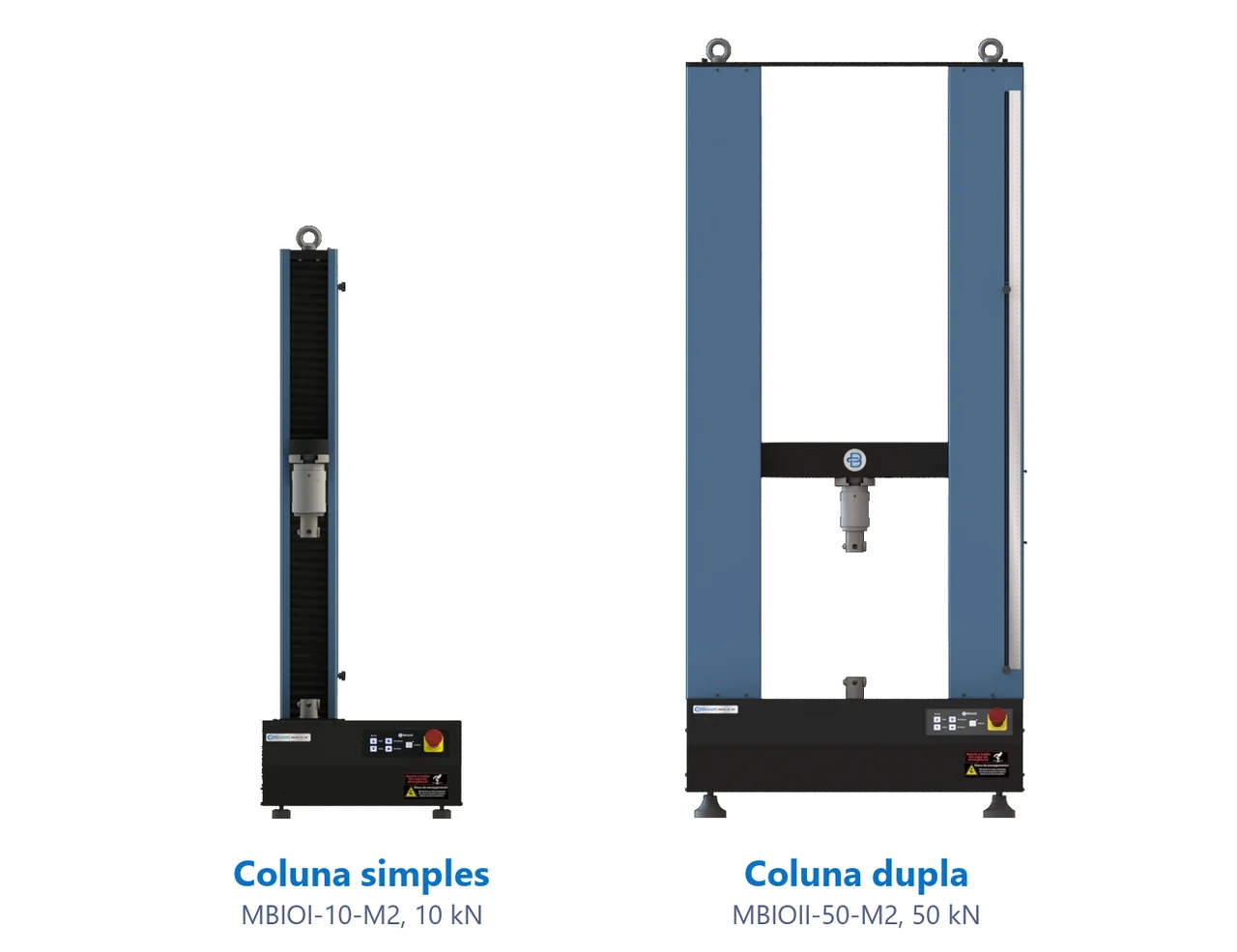
- Moving crosshead lowers the central roller onto the tile
- Load cell measures the breaking force F, class 1
- Flexural fixture for 3-point bending, with span adjustable to the format
- Force control holds the calculated rate in N/s
- BioLab software calculates the breaking strength S and the modulus of rupture R
- Control panel and emergency stop position and stop the test
Fixtures for the flexural test
The flexural fixture is the one NBR ISO 10545-4 uses; the deflectometer is needed only when the tile deflection is also wanted:
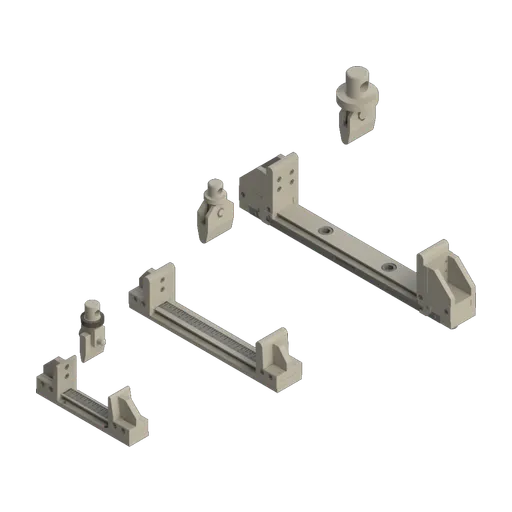
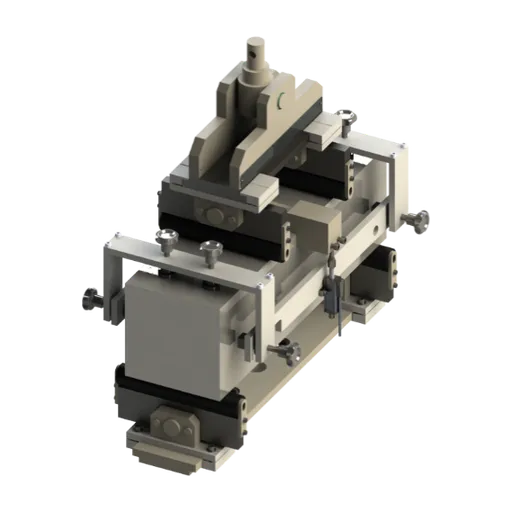
For most floor and wall tiles, with forces from a few hundred newtons to a few kilonewtons, the suitable range is that of the single-column machine from 2 to 10 kN (MBIOI-10-M2). Thick outdoor tiles, as in Example 5, call for the dual-column machine from 5 to 50 kN (MBIOII-50-M2). When configuring, confirm that the fixture rollers have the diameter, rubber covering, articulation and length that NBR ISO 10545-4 and your formats require. To put together the configuration for your laboratory, request a quote.
Standards cited
The table lists the standards cited in this guide, with the edition and status checked on September 30, 2026 in the ABNT (Brazilian Association of Technical Standards) catalog distributed by Target and on iso.org:
| Standard | Subject | Edition and status |
|---|---|---|
| ABNT NBR 13818 | ceramic tiles: specification and test methods | 1997; withdrawn in 12/2020 |
| ABNT NBR 13816 and NBR 13817 | terminology and classification of tiles | 1997; withdrawn in 12/2020 |
| ABNT NBR 15463 | porcelain tile | 2013; withdrawn in 12/2020 |
| ABNT NBR ISO 13006 | definitions, classification, characteristics and marking | 12/2020, current |
| ISO 13006 | international basis of the specification | 2018, current; revision under way at ISO |
| ABNT NBR ISO 10545 (Parts 1 to 16) | test methods for ceramic tiles | 2017 and 2020, depending on the part |
| ABNT NBR ISO 10545-4 | breaking strength and modulus of rupture | 07/2020, current |
| ISO 10545-4 | international basis of the flexural test method | 2019, confirmed in 2024 |
| ABNT NBR 13753 and NBR 13754 | installation on floors and on interior walls | 1996, confirmed in 01/2025 |
| ABNT NBR 13755 | ceramic cladding of building facades | 2017, confirmed in 01/2022 |
| ABNT NBR 15310 | ceramic roof tiles | 2009; withdrawn in 09/2025 |
| ABNT NBR 15310-1 and NBR 15310-2 | roof tiles: requirements and test methods | Part 1 from 09/2025, current |
| ABNT NBR ISO 7500-1 | verification of the machine's load cell | 2023 |
Other tests and technical references
Tests performed on the Biopdi universal testing machine









Related technical references
NBR 15270-2: ceramic block and brick compression test, gross area, fbk, water absorption and IRA
NBR 15270-2:2023 tests for ceramic blocks and bricks: gross-area compression (fb = F/Ab), lot fbk, water absorption, IRA and the 2023 changes.
Weld test specimen: tensile and bend tests per ASME IX, AWS and ISO
Weld test specimen: how to cut, machine and run tensile and bend tests per ASME IX and ISO 15614-1, with the 3 mm and 95% criteria and examples.
NBR 5739 concrete compression test: fc calculation and the NBR 7222, NBR 12142 and NBR 6136-2 standards
ABNT NBR 5739:2018 (the Brazilian standard for concrete compression testing), reaffirmed in 2023, covers compression testing of cylindrical concrete specimens: continuous loading at 0.45 ± 0.15 MPa/s until failure and fc = 4F/(πD²), in MPa, to three significant figures. See what it requires of the machine and the specimen, the h/d correction, failure types A to G and the related standards: NBR 7222 (splitting tensile test), NBR 12142 (flexural tensile strength) and NBR 12118, withdrawn in February 2026 and replaced by NBR 6136-2:2026.
Frequently asked questions
Is NBR 13818 still in force?
No. ABNT NBR 13818:1997 was withdrawn and replaced in December 2020. A test report or a specification that cites it as a current reference follows a document with no normative validity.
Which standard replaced NBR 13818?
ABNT NBR ISO 13006:2020, for definitions, classification, requirements and marking, and the ABNT NBR ISO 10545 series, for the test methods. NBR ISO 13006 simultaneously withdrew NBR 13816, 13817 and 13818, from 1997, and NBR 15463:2013.
Which standard covers ceramic tiles today?
For the product, NBR ISO 13006:2020; for the tests, the parts of NBR ISO 10545; for installation with adhesive mortar, NBR 13753 (floors), NBR 13754 (interior walls) and NBR 13755:2017 (facades).
Was NBR 15463 for porcelain tile withdrawn?
Yes, in December 2020, by NBR ISO 13006. Today porcelain tile is the fully vitrified tile with water absorption of up to 0.5%, groups AIa and BIa, without the old split between technical (unglazed) and glazed porcelain tile.
What do BIa, BIb, BIIa, BIIb and BIII mean?
B indicates a dry-pressed tile (A would be extruded). The rest indicates the water absorption range: Ia up to 0.5%, Ib from 0.5 to 3%, IIa from 3 to 6%, IIb from 6 to 10% and III above 10%.
What is the water absorption of porcelain tile?
At most 0.5% under NBR ISO 13006:2020, measured by the vacuum method of NBR ISO 10545-3. The 0.1% limit for "technical porcelain tile" came from NBR 15463, which has been withdrawn.
How is the modulus of rupture of a tile calculated?
Per NBR ISO 10545-4: R = 3·F·l2/(2·b·h²), in N/mm², where F is the breaking load, l2 the span between supports, b the width of the test specimen and h the minimum thickness measured at the edge of the fracture. The breaking strength is S = F·l2/b, in N.
What is the minimum flexural strength of porcelain tile?
For group BIa, NBR ISO 13006:2020 requires a mean modulus of rupture of at least 35 N/mm², with no individual value below 32 N/mm², and a breaking strength of at least 1,300 N for tiles 7.5 mm thick or more, or 700 N for thinner ones.
Why does the manufacturer still cite NBR 13818 in its catalog?
Because catalogs, data sheets and test reports from before 2020 are still in circulation, and construction specifications copy old texts. Specify the product by its NBR ISO 13006 group and request the test report under the parts of NBR ISO 10545.
What is the ABNT standard for ceramic roof tiles?
NBR 15310:2009 was withdrawn in September 2025 and replaced by NBR 15310-1:2025, covering terminology and requirements, and by NBR 15310-2, covering test methods.
Where can I find the NBR 13818 PDF?
The PDF copies in circulation are unauthorized reproductions of a withdrawn standard. The current standard, NBR ISO 13006:2020, and the parts of NBR ISO 10545 are sold by ABNT and by authorized distributors.
What machine performs the flexural test on ceramic tiles?
A universal testing machine (UTM) with a three-point bending fixture, a load cell with accuracy better than 2% and control of the loading rate. For most tiles, a 10 kN machine is enough; thick outdoor tiles can exceed 10 kN.