
ABNT NBR 13279:2005 is the Brazilian standard for determining the flexural tensile strength and the compressive strength of hardened masonry mortars and wall and ceiling rendering mortars. The 2005 edition is current and was last confirmed by ABNT (the Brazilian standards body) in November 2023. It requires 4 × 4 × 16 cm prisms, air-cured and normally tested at 28 days. Each prism is first broken in 3-point bending, over a 100 mm span with the load increasing at (50 ± 10) N/s. The two halves left over are then broken in compression over a 40 × 40 mm area, at (500 ± 50) N/s. The results are Rf = 1.5·Ff·L / 40³ and Rc = Fc / 1,600, in MPa.
This guide explains, in our own words, what NBR 13279 requires for the test specimen, the equipment, the procedure, the calculations and the report. It works through a complete test with three prisms and shows how much force the machine needs. We checked the status of the standards on September 30, 2026 in the catalog of Target (an ABNT reseller in Brazil) and on the ASTM and ISO websites. The text quotes only the essential figures and does not replace a purchased copy of the standard.
What NBR 13279 measures and where it applies
NBR 13279 belongs to ABNT's committee for cement, concrete and aggregates (CB-018). The 2005 edition replaced the 1995 edition, which covered compression only, and it has since been confirmed in 2010, 2014, 2018 and 2023 with no change to the text. Its scope covers inorganic mortars for laying masonry and for rendering walls and ceilings, whether mixed on site or factory-made. Tile adhesive mortar for ceramic tiles, which has its own standard, and concrete are outside the scope.
The standard measures two properties of the hardened material. The flexural tensile strength (Rf) is the tensile stress on the bottom face of the prism at the instant it cracks, calculated with beam theory. The compressive strength (Rc) is the maximum force that one half of the prism withstands divided by the loaded area. Both are used to control production, compare mix proportions and classify the mortar. Neither of them is the strength of the finished wall, which also depends on the block, the joint and the workmanship.
The general principles of both tests are covered in our guides to flexural testing, which explains 3-point and 4-point bending and where the stress formula comes from, and to compression testing, which covers the compression curve and the behavior of brittle materials. Here the focus is on what NBR 13279 requires. Mortar and concrete have different standards and different specimens: concrete is broken as 10 × 20 or 15 × 30 cm cylinders under NBR 5739 (the Brazilian standard for concrete compression testing), with the loading rate in MPa/s and forces of hundreds of kilonewtons, as shown in the guide to NBR 5739. A mortar result cannot be compared directly with a concrete result, and the procedure for one does not apply to the other.
The mortar standards: which one defines what
NBR 13279 is one link in a chain. The strength test is only reproducible if the mortar was prepared and proportioned the same way, and the number only becomes meaningful when it is compared with a requirement. Each step has its own standard:
- NBR 16541:2016 (mix preparation). Defines how to mix the mortar in the laboratory, in a mortar mixer, before any test. Current, confirmed in December 2025.
- NBR 13276:2016 (consistency index). Measures the spread of fresh mortar on the flow table. Current, confirmed in December 2025. In research it is common to fix the water content to reach a reference spread, such as 260 ± 5 mm; this is laboratory practice, not a requirement of NBR 13279.
- NBR 13279:2005 (strength). The method covered in this guide.
- NBR 13281-1:2023 and NBR 13281-2:2023 (requirements). State which values each type of mortar must reach. The two parts replaced NBR 13281:2005 in February 2023 and list NBR 13279 among their normative references.
The most frequent mix-up is with NBR 7215, which even shows up in search summaries as if it were the mortar standard. ABNT NBR 7215:2019 (with an amendment from March 2025, current) measures the compressive strength of Portland cement: it uses a standard mortar of cement and standard sand, molded into 50 × 100 mm cylinders, cured under water, and tested in compression only. NBR 13279 evaluates job mortar as it is produced, in prisms, air-cured, and measures both flexure and compression. The table summarizes the split:
| Standard | Role | Edition and status |
|---|---|---|
| ABNT NBR 16541 | laboratory mix preparation | 2016, current |
| ABNT NBR 13276 | consistency index (fresh state) | 2016, current |
| ABNT NBR 13279 | flexural tensile and compressive strength (hardened) | 2005, current |
| ABNT NBR 13281-1 and -2 | requirements and classification | 2023, current |
| ABNT NBR 7215 | cement compressive strength, on cylinders | 2019 with 2025 amendment, current |
Test specimen: molding, demolding and curing
The test specimen is a 40 × 40 × 160 mm prism, cast in a three-gang steel mold. Annex A, which is normative, sets the internal dimensions with a tolerance of ± 0.4 mm on the cross section and ± 0.8 mm on the length, walls at least 8 mm thick and a watertight assembly, with the parts marked so they are not swapped between molds. One mold produces the three prisms for one test age, always with freshly prepared mortar.
The mold, clamped to the compaction table, is given a thin coat of mineral oil. The mortar is placed in two layers, each spread with the spreader and compacted with 30 drops of the table, and the excess is removed with a beveled metal straightedge. This top face, the struck-off face, is more irregular than the other three, which were cast against steel, and this will matter during the test.
The prisms stay in the mold for (48 ± 24) h and, once demolded, remain in the laboratory environment until they are broken, at (23 ± 2) °C and (60 ± 5)% relative humidity. This is air curing, not the water curing used for cement under NBR 7215: rendering mortar works exposed to air, and that is the condition in which it is evaluated. The reference age is 28 days. Other ages can be requested to follow the strength development and are recorded in the report. Each age has a timing tolerance, summarized in the table:
| Test age | Tolerance | Relative tolerance |
|---|---|---|
| 24 h | ± 1 h | 4.2% |
| 3 days | ± 2 h | 2.8% |
| 7 days | ± 4 h | 2.4% |
| 14 days | ± 6 h | 1.8% |
| 28 days | ± 8 h | 1.2% |
| 91 days | ± 24 h | 1.1% |
The test sequence: one prism, two results
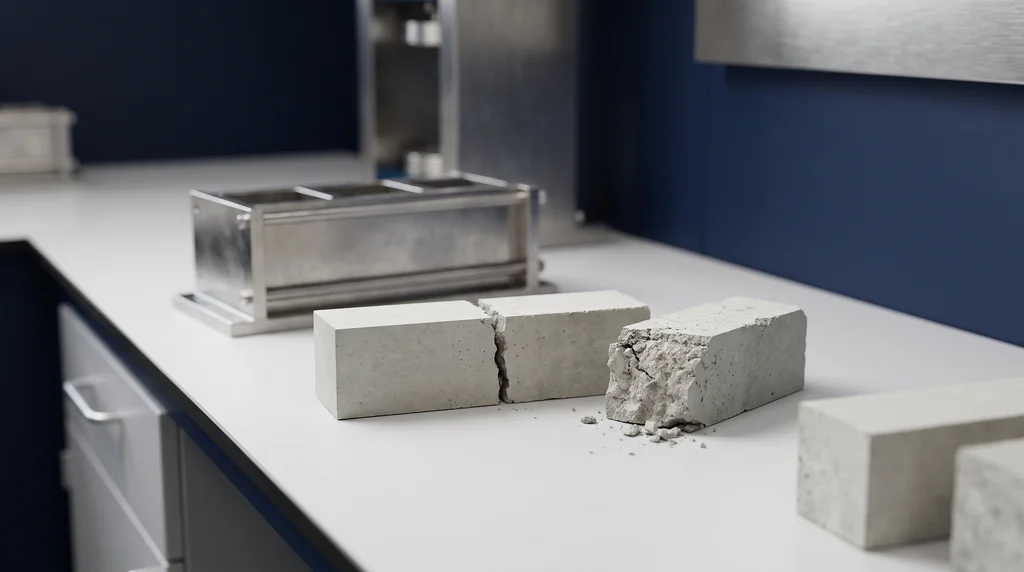
The test uses the same specimen twice. First the whole prism is broken in flexure; the crack opens at midspan and splits the prism into two halves of about 80 mm, which remain intact enough to go on to compression. That is why three prisms per age give three Rf results and six Rc results. The photo shows 4 x 4 x 16 cm mortar prisms: one split in half by the flexural test and one of the halves already crushed in compression, with the three-gang mold in the background.
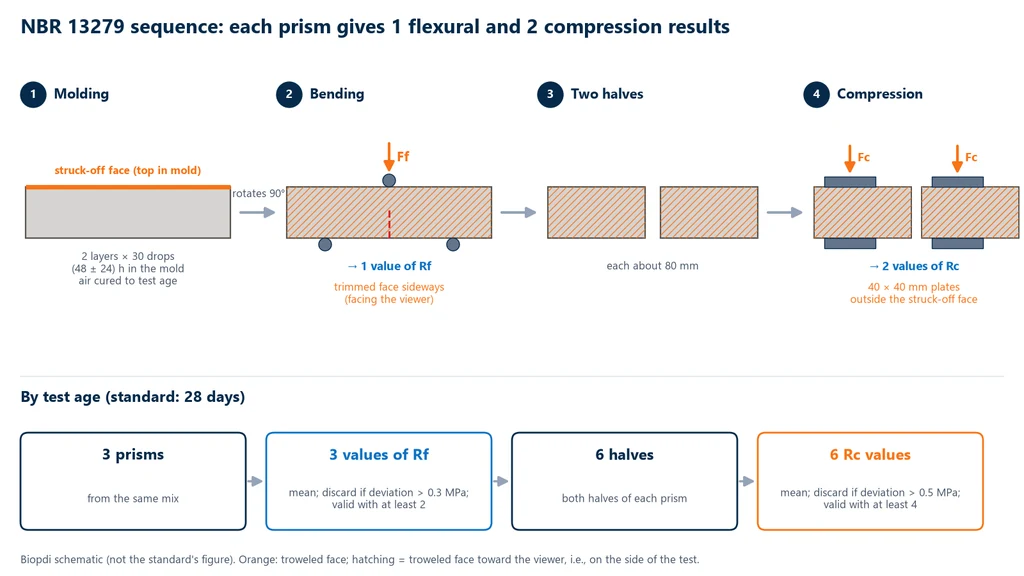
In neither step may the struck-off face touch the support rollers, the loading roller or the compression platens: the prism comes out of the mold with that face up and is rotated 90° about its own axis, so that the loaded faces are the ones cast against steel. The diagram below, drawn for this guide, follows a prism from the mold to the last result. Its bottom row shows that the two groups of results for one age go to statistical treatment separately, each with its own rejection limit and its own minimum number of values.
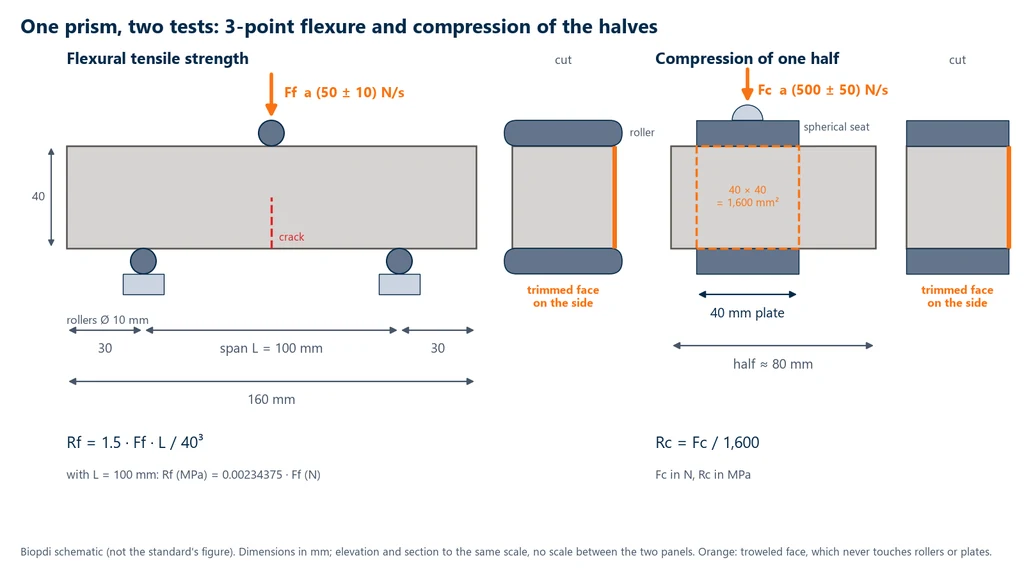
The second diagram gives the dimensions of each setup, in elevation and in section, with no common scale between the two panels. On the left, the prism rests on two rollers 100 mm apart, with a 30 mm overhang on each side, the load Ff at the center and the crack starting at the bottom face, which is the face in tension. On the right, a half lies between two 40 × 40 mm steel platens, the upper one on a spherical seat: only the portion between the platens is compressed, and it is the platen area, not the area of the whole half, that goes into the calculation. The sections show the struck-off face, in orange, on the side in both tests.
Flexural tensile strength: setup, loading rate and calculation
The machine must be at least class 1 under ISO 7500-1 (ABNT NBR ISO 7500-1 in Brazil), that is, with an indication error of no more than 1% over the verified range. The flexure fixture has two support rollers and one loading roller, made of steel, (10.0 ± 0.5) mm in diameter and 45 to 50 mm long. The supports are (100.0 ± 0.5) mm apart, and the loading roller comes down at midspan, with the three axes parallel to each other and perpendicular to the prism. One support and the loading roller can tilt slightly, so the load is distributed across the full width without twisting the prism. The prism is centered on the supports, with a 30 mm overhang on each side, and loaded continuously and without shock at (50 ± 10) N/s until it breaks. The machine records the maximum force, Ff, in newtons.
The formula comes from a simply supported beam with a central load. The maximum bending moment, under the load, is M = Ff·L / 4. The square section with side b = h = 40 mm has a section modulus W = b·h² / 6. The maximum stress at the bottom face is M / W = 3·Ff·L / (2·b·h²), which, with b = h = 40 mm, becomes the expression in the standard:
Rf = 1.5·Ff·L / 40³, with Ff in N, L = 100 mm and the result in MPa (N/mm²).
Since L and the cross section are fixed, the calculation comes down to a single factor: 1.5 × 100 / 64,000 = 0.00234375. In practice, Rf (MPa) = 0.00234375 × Ff (N): a prism that breaks at 1,000 N has 2.34 MPa. The factor only holds if the span really is 100 mm. A fixture set up with the supports 120 mm apart, with the calculation done for 100 mm, underestimates Rf by 1 − 100/120 = 16.7% for the same measured force.
The 50 N/s rate is deliberately low: an ordinary mortar breaks between 0.5 and 2 kN, and the test lasts 10 to 40 s. Loading faster tends to raise the breaking force; the 40 to 60 N/s range is what makes results from different laboratories comparable.
Compression of the halves: 40 × 40 mm platens
Each half goes into the compression fixture, which has two steel platens (40.0 ± 0.1) mm square, one above the other, at least 10 mm thick and flat to within 0.01 mm. The upper platen sits on a spherical seat, which aligns with the half at first contact and then locks, and the indicator holds the breaking force after the load drops. The half is laid between the platens, with one molded side face resting on the lower platen and the struck-off face to the side, and positioned so that the contact area is the full 40 × 40 mm square. The load increases at (500 ± 50) N/s, ten times faster than in flexure, because the breaking force is also about ten times higher.
Rc = Fc / 1,600, with Fc in N and 1,600 mm² = 40 × 40 mm, which gives MPa. As a factor, Rc (MPa) = 0.000625 × Fc (N): a half that breaks at 6,400 N has 4.0 MPa. The formula assumes the half covers the platens completely. If it is off-center, part of the platen bears on empty space, the real area is smaller than 1,600 mm² and the calculated value comes out low.
Treatment of results and report
NBR 13279 specifies how to round and when to reject. Each individual result is rounded to the nearest 0.01 MPa. The mean and the maximum absolute deviation are rounded to the nearest 0.1. The maximum absolute deviation is the largest difference, in absolute value, between an individual result and the group mean.
- Flexure: if the maximum absolute deviation exceeds 0.3 MPa, a new mean is calculated without the outlier, which stays in the report marked with an asterisk. The result is only valid with at least 2 of the 3 prisms.
- Compression: the limit is 0.5 MPa, with the same rule, and the result is only valid with at least 4 of the 6 halves.
If rejection leaves fewer values than the minimum, there is no valid result for that age and the test is repeated. The report identifies the mortar (type, color, batch or manufacturing date, trade name and manufacturer) and the ratio of water to dry mortar, by mass. For each age, it gives the individual results, the mean and the maximum absolute deviation, for both flexure and compression.
What the result means: P and R classes and the 2023 NBR 13281
NBR 13279 (the Brazilian standard for flexural and compressive strength of mortar) only measures. Whether the value is good enough is decided by the requirements standard, and that standard changed in 2023. Until February of that year, the standard in force was NBR 13281:2005 (the Brazilian specification for masonry and rendering mortars). It classified every masonry and rendering mortar by property ranges, regardless of its use. These were the strength ranges for the two properties measured under NBR 13279:
| Class | Compressive (MPa) | Class | Flexural tensile (MPa) |
|---|---|---|---|
| P1 | ≤ 2.0 | R1 | ≤ 1.5 |
| P2 | 1.5 to 3.0 | R2 | 1.0 to 2.0 |
| P3 | 2.5 to 4.5 | R3 | 1.5 to 2.7 |
| P4 | 4.0 to 6.5 | R4 | 2.0 to 3.5 |
| P5 | 5.5 to 9.0 | R5 | 2.7 to 4.5 |
| P6 | > 8.0 | R6 | > 3.5 |
The ranges overlap on purpose, because the test itself has scatter. The 2005 standard required the test deviation to be taken into account and, when the value fell in the overlap of two ranges, the higher class was adopted. This nomenclature still shows up in older technical data sheets and in many academic papers.
In February 2023, NBR 13281:2005 was withdrawn and replaced by two parts, in force since August 2023, that classify mortar by its use:
- NBR 13281-1:2023, rendering for walls and ceilings. Classes ARV-I, ARV-II and ARV-III are all suitable for interior use and differ in exterior use: up to 10 m in height, up to 60 m and above 60 m, respectively. There is also AET, a technical base coat mortar, the first layer of layered decorative systems. The classifying requirements are potential bond strength, surface strength, dynamic modulus of elasticity and dimensional change. Flexural tensile strength, measured under NBR 13279, became informative: the manufacturer declares the class on the bag or on the technical data sheet. Compressive strength does not appear in Part 1, not even as information.
- NBR 13281-2:2023, masonry laying and fixing. It separates non-structural masonry mortar (AAV), structural masonry mortar (AAE) and horizontal fixing mortar for masonry (AAF), used for top-of-wall wedging (known in Brazil as encunhamento). Here the compressive strength measured under NBR 13279 is a classification requirement for all three types, and flexural tensile strength is not required. Water retention, air content, shrinkage and potential bond strength complete the requirements.
In Part 2, the compressive strength limits are as follows, always based on the mean of the NBR 13279 specimens, with a coefficient of variation below 20% for structural mortar:
| Mortar (NBR 13281-2:2023) | Compressive strength fa | Recommended block (fbk) |
|---|---|---|
| AAV, non-structural masonry | 2.0 to 5.0 MPa | non-structural |
| AAF, fixing (top-of-wall wedging) | 1.5 to 5.0 MPa | non-structural |
| AAE5 | 5.0 to 8.0 MPa | 3 to 6 MPa |
| AAE8 | 8.0 to 12.0 MPa | 8 to 10 MPa |
| AAE12 | 12.0 to 16.0 MPa | 12 to 16 MPa |
| AAE16 | 16.0 to 20.0 MPa | 18 to 20 MPa |
| AAE20 | 20.0 to 24.0 MPa | 22 to 24 MPa |
| AAEE, special | 24.0 MPa or more | specified case by case |
Note that AAV and AAF have a ceiling of 5.0 MPa, not just a floor. The AAE classes apply to rendered walls; for exposed masonry, retaining walls or water tanks, the standard recommends going up one compressive strength class.
Part 1 introduced its own informative flexural tensile classes, with the same names R1, R2, R3 and R4 as the 2005 edition but different ranges:
| Class in NBR 13281-1:2023 | Flexural tensile strength Rf (NBR 13279) |
|---|---|
| R1 | below 0.5 MPa |
| R2 | 0.5 to 1.5 MPa |
| R3 | 1.5 to 3.0 MPa |
| R4 | above 3.0 MPa |
How to interpret the standard
The text of NBR 13279 is short, and some points tend to be read only halfway or applied without knowing why they exist. This section explains each of them, including where the numbers come from.
Where does the 40³ in the Rf formula come from, and what does it assume?
Rf = 1.5·Ff·L / 40³ is the maximum stress in a simply supported beam with a midspan load, derived in the flexural section: the moment Ff·L / 4 divided by the section modulus b·h² / 6. The 40³ is the product b·h² using the nominal prism dimensions. The standard uses the nominal cross-section, not the measured one: a prism at the limit of the mold tolerance, at 40.4 × 40.4 mm, would have an actual stress about 3% lower than the calculated value, because (40 / 40.4)³ = 0.97. That is why Annex A controls the mold to tenths of a millimeter. The formula also assumes linear elastic behavior up to fracture, which is reasonable for a brittle material such as mortar, but Rf is still a conventional strength: it serves to compare mortars in the same test and is not the direct tensile strength.
Why does the struck-off face never touch the rollers or the platens?
The three faces molded against steel are flat and square; the struck-off face, finished with the straightedge, has ripples and dragged grains. In flexure, supporting or loading on that face would concentrate the force at a few points, with local stresses that bring the crack forward. In compression the effect is greater: the platens have a flatness of 0.01 mm so that the stress is uniform over the 1,600 mm², and an irregular face would only bear on its high points, giving an Rc below the true value and more scatter between halves. Rotating the prism 90° keeps that face out of all contact.
In what order should rounding and rejection be applied?
The standard uses two roundings, to the hundredth for individual results and to the tenth for the mean and the deviation, and the order changes the decision. The sequence consistent with the text is:
- calculate each result and round it to the hundredth;
- calculate the mean from those values, without rounding it;
- take the largest deviation from that mean;
- if it exceeds 0.3 MPa (flexure) or 0.5 MPa (compression), remove the outlier, mark it with an asterisk and recalculate;
- check the minimum of 2 prisms or 4 halves and only then round the mean and the deviation to the tenth.
The text does not address a borderline case: a deviation of 0.33 MPa in flexure becomes 0.3 when rounded and, read that way, does not exceed the limit. The laboratory should fix this reading in its internal procedure and always apply it the same way.
What does the age tolerance mean?
Table 1 of the standard gives a time window that grows with age, from 1 h at 24 h to 24 h at 91 days, but shrinks in relative terms, from about 4% to about 1% of the age. The reason is the rate of strength gain: in the first hours the cement hydrates quickly and one extra hour affects the result; at 28 days the curve is almost flat. A prism broken outside the window does not correspond to the declared age, so casting is planned so that testing does not fall on a non-working day.
Why is the 2005 edition still the current one?
ABNT (the Brazilian standards body) reviews standards periodically and can confirm them without changing the text, as it did with NBR 13279 in 2010, 2014, 2018 and 2023. The correct citation is still ABNT NBR 13279:2005. What has aged are the references: NBR 13276:2005, which covered both preparation and consistency, had the preparation part transferred in 2016 to NBR 16541, already cited by NBR 13281-1:2023; and NBR NM ISO 7500-1:2004, for the machine class, was withdrawn in 2016 and replaced by ABNT NBR ISO 7500-1:2023 (the Brazilian adoption of ISO 7500-1). It is good practice to state in the report the editions of the supporting standards used.
How do NBR 13281-1 and 13281-2 use each result?
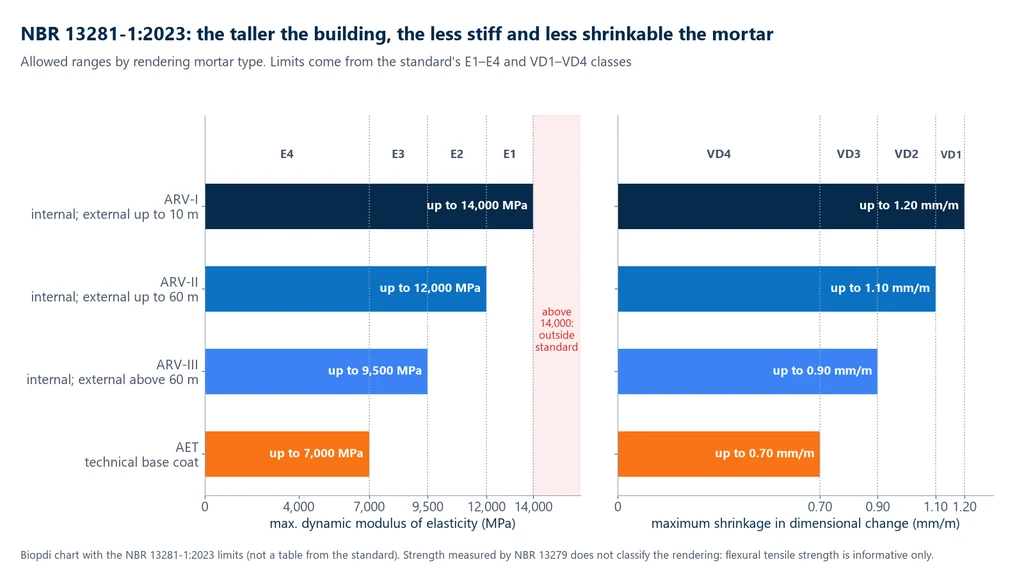
As shown in the section on NBR 13281, each part uses only one of the two quantities from NBR 13279. In rendering, which replaces strength with tensile bond strength, modulus and shrinkage, the reason is physical: rendering fails by cracking and debonding, and higher strength usually comes with higher stiffness and more shrinkage, which make the layer follow the substrate poorly. That is why the limits tighten as the permitted height for exterior use increases. The chart below shows the maximum dynamic modulus and shrinkage for each type, according to classes E1 to E4 and VD1 to VD4: ARV-I goes up to 14,000 MPa and 1.20 mm/m; AET, only up to 7,000 MPa and 0.70 mm/m.
In masonry laying, where only compressive strength classifies, the ceiling for AAV and AAF follows the same logic: a non-structural joint must be more deformable than the block, otherwise it transmits the deformations of the structure to the wall and the crack runs through the block instead of staying in the joint. For structural mortar, the coefficient of variation below 20% also gives weight to the scatter between halves.
Is R3 from 2005 the same as R3 from 2023?
No. The two editions use the same labels with different ranges: R3 was 1.5 to 2.7 MPa and became 1.5 to 3.0 MPa; R2 was 1.0 to 2.0 MPa and is now 0.5 to 1.5 MPa; and classes R5 and R6 no longer exist. A test report that says only "R3" is ambiguous. The safe reading is by the value in MPa, with the edition of the standard next to the class.
Worked example with 3 prisms
A laboratory tested three prisms of a rendering mortar at 28 days. The forces below are for teaching purposes, but of the same order of magnitude as a real cement, lime and sand mortar. The calculations follow the standard's rounding rules, in the order explained in the previous section.
Step 1: flexural tensile strength
Breaking forces: Ff1 = 1,020 N, Ff2 = 1,080 N and Ff3 = 950 N, with L = 100 mm.
- Factor: 1.5 × 100 / 40³ = 150 / 64,000 = 0.00234375 MPa/N.
- Individual results: Rf1 = 1,020 × 0.00234375 = 2.3906, or 2.39 MPa. Rf2 = 1,080 × 0.00234375 = 2.5313, or 2.53 MPa. Rf3 = 950 × 0.00234375 = 2.2266, or 2.23 MPa.
- Mean: (2.39 + 2.53 + 2.23) / 3 = 7.15 / 3 = 2.383 MPa.
- Deviations: |2.39 − 2.383| = 0.01; |2.53 − 2.383| = 0.15; |2.23 − 2.383| = 0.15. The maximum absolute deviation is 0.15, which rounds to 0.2 MPa, below the 0.3 MPa limit. No value is rejected.
- Result: Rf = 2.4 MPa, with a maximum absolute deviation of 0.2 MPa.
Step 2: compression of the 6 halves
Breaking forces of the halves: 6,200, 6,450, 5,900, 6,600, 6,300 and 5,000 N.
- Individual results, from Rc = Fc / 1,600: 3.88; 4.03; 3.69; 4.13; 3.94 and 3.13 MPa.
- Mean of the 6: 22.80 / 6 = 3.80 MPa.
- Deviations: 0.08; 0.23; 0.11; 0.33; 0.14 and 0.67. The maximum, 0.67 MPa, exceeds 0.5 MPa. The most distant value, 3.13 MPa, is rejected.
- New mean, with 5 values: 19.67 / 5 = 3.934 MPa.
- New deviations: 0.05; 0.10; 0.24; 0.20 and 0.01. The maximum is 0.24, or 0.2 MPa rounded, within the limit, and 5 values remain, above the minimum of 4.
- Result: Rc = 3.9 MPa, with a maximum absolute deviation of 0.2 MPa.
The chart below shows both steps. On the left, the three Rf values all fall within the ± 0.3 MPa band around the mean. On the right, the ± 0.5 MPa band around the mean of the six halves leaves out the 3.13 MPa value; after rejection, the mean rises from 3.80 to 3.93 MPa, and the five remaining halves are less than 0.25 MPa from it.
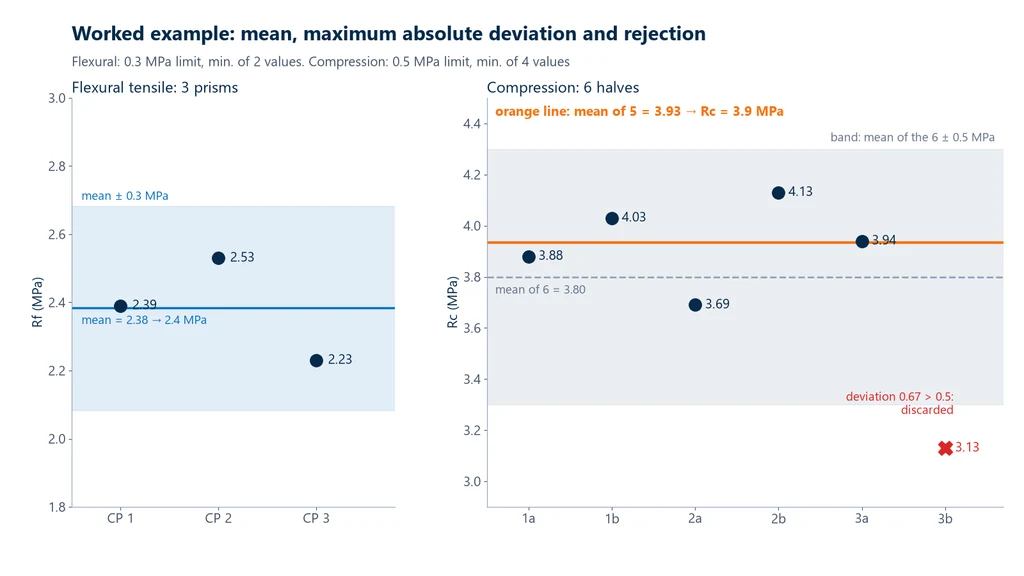
A half that breaks far below the others usually has a defect: an air void, poor compaction or a crack from the flexural test that propagated into the half. The rejection criterion exists so that this defect does not pull the mean down, and the minimum of 4 values prevents rejection from becoming a way of picking results.
Step 3: test duration and rate check
At a constant rate, the time to fracture is the force divided by the loading rate, and it is a quick check that the machine is programmed correctly. For prism 2, the flexural test takes 1,080 / 50 = 21.6 s. For the 6,600 N half, the compression test takes 6,600 / 500 = 13.2 s. A flexural test that ends in 3 s or a compression test that lasts a minute indicates the wrong rate, not a different mortar.
Step 4: how the result reads under the requirements standards
With Rf = 2.4 MPa, the mortar would be R3 under NBR 13281-1:2023, whose range goes from 1.5 to 3.0 MPa. Under the 2005 table, the same value falls in the overlap of R3 and R4 and, by the higher-class rule, would be R4. As a rendering mortar, this number is only informative, and the ARV class depends on tests that NBR 13279 does not cover. If it were a masonry mortar, Rc = 3.9 MPa would fall within the AAV range of 2.0 to 5.0 MPa, and below AAE5; under the 2005 table, it would fall only in the P3 range. The coefficient of variation of the five valid halves is 4.2% (standard deviation of 0.166 MPa over the mean of 3.934 MPa), well below the 20% that Part 2 allows for structural mortar.
Expected force and how to choose the fixture and load cell
Inverting the formulas gives the expected breaking force for each strength: Ff = Rf / 0.00234375 and Fc = Rc × 1,600. These forces, not the strength in MPa, set the capacity of the fixture, the load cell and the machine. The chart below compares the forces calculated for weak, medium and strong mortars with the capacity of a 10 kN flexural fixture and 50 kN compression platens.
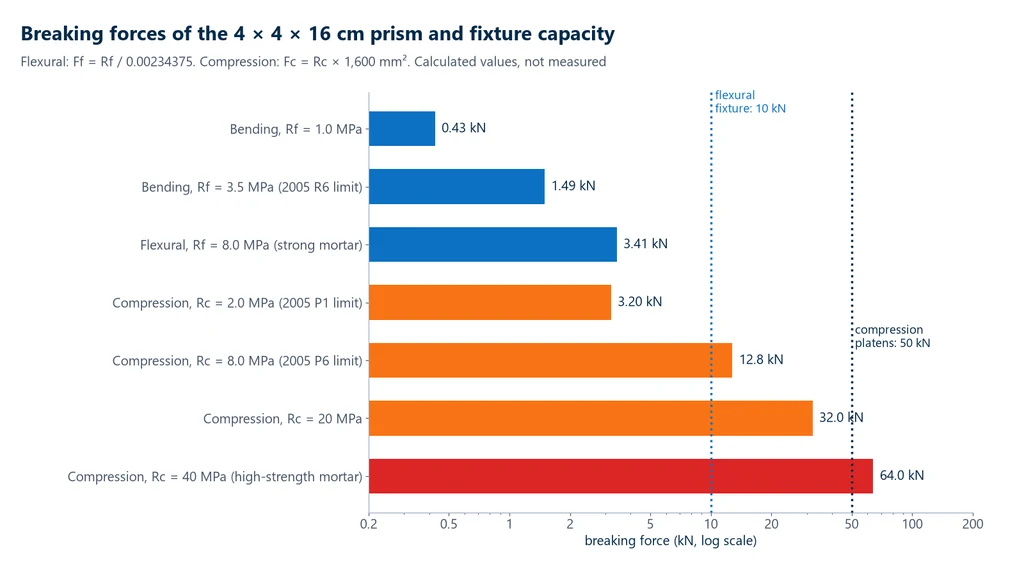
The table gives the same values and the test duration at the nominal loading rates:
| Case | Strength | Breaking force | Time to failure |
|---|---|---|---|
| Flexure, weak mortar | Rf = 1.0 MPa | 427 N | 8.5 s |
| Flexure, medium mortar | Rf = 3.0 MPa | 1,280 N | 25.6 s |
| Flexure, strong mortar | Rf = 8.0 MPa | 3,413 N | 68 s |
| Compression, weak mortar | Rc = 2.0 MPa | 3.2 kN | 6.4 s |
| Compression, medium mortar | Rc = 8.0 MPa | 12.8 kN | 25.6 s |
| Compression, strong mortar | Rc = 20 MPa | 32 kN | 64 s |
| Compression, high strength | Rc = 40 MPa | 64 kN | 128 s |
Exercise: choosing the equipment. A manufacturer of factory-made mortar wants to test masonry and rendering products with Rc up to about 20 MPa and Rf up to 5 MPa.
- Flexure: maximum Ff = 5 / 0.00234375 = 2,133 N, or 2.1 kN. A 10 kN flexural fixture handles this with ample margin.
- Compression: maximum Fc = 20 × 1,600 = 32,000 N, or 32 kN, 64% of 50 kN platens. This works, with margin for a batch stronger than expected.
- Machine: a 50 kN machine covers both stages. The same mortar at 40 MPa would give 64 kN, above 50 kN: in that case the machine and the platens must be from the next capacity range.
- Load cell: this is where sizing usually goes wrong. Flexure of a medium mortar, 1.28 kN, is only 2.6% of a 50 kN load cell. A class 1 load cell under ISO 7500-1 (ABNT NBR ISO 7500-1 in Brazil) holds that class only over a verified range, stated in the calibration certificate, and the test force must fall within it. The safe approach is to use a smaller 5 kN load cell for flexure and the 50 kN cell for compression, changing the load cell between stages.
The same reasoning shows why cement testing calls for a different range. The standard mortar of ISO 679, made of cement and standard sand, breaks at 28 days at around 30 to 60 MPa, depending on the cement class, in the same 40 × 40 × 160 mm prisms, that is, 48 to 96 kN per half, well above what a rendering mortar requires.
NBR 13279 and foreign standards
The 40 × 40 × 160 mm prism broken in flexure and then in compression on its halves is an international format, but each standard has its own reference material and parameters. In Europe, EN 1015-11:2019 (which replaced the 1999 edition) is the equivalent method for masonry mortars. ISO 679:2009, confirmed in 2025, uses the same prism for cement, with a standard mortar of one part cement, three parts standard sand and half a part water. In the United States, ASTM C348-21 measures the flexural strength of hydraulic cement mortars in prisms, and ASTM C349-24 measures compressive strength on the portions of the prism broken in flexure. Loading rates, curing and acceptance criteria differ among them, and a test report must cite the standard actually applied.
Common mistakes when applying NBR 13279
The mistakes that distort the result most are in the execution, not the calculation. Each of them has been explained in the previous sections:
- Confusing it with NBR 7215 (the Brazilian standard for Portland cement compressive strength), which tests cement in cylinders and in compression only.
- Supporting or loading the struck-off face, which is irregular, instead of the side faces cast against the mold.
- A span other than 100 mm with the 0.00234375 factor: 120 mm gives an Rf 16.7% lower.
- A loading rate from another standard, or a machine programmed in mm/min without conversion to 50 and 500 N/s.
- Half off-center on the plates: the area is no longer 1,600 mm² and Rc comes out low.
- Rounding in the wrong order: individual results to 0.1 instead of 0.01, or the mean to 0.1 before calculating the deviations.
- Ignoring the discard rule, or discarding below the minimum of 2 values in flexure and 4 in compression.
- Water curing, as for cement, instead of air curing.
- Testing outside the age window, for example at 28 days with a 12 h delay, when the tolerance is 8 h.
- A load cell too large for flexure, with the force below the verified range.
- Classifying by the 2005 table as if it were the rule in force since August 2023, or reading an "R3" without knowing the edition.
Equipment for NBR 13279
The test requires a machine with load control in N/s, a 3-point flexural fixture set to a 100 mm span with 10 mm rollers, and compression platens with the 40 × 40 mm plates specified by the standard. The universal testing machine performs both stages on the same frame by changing the accessory: the 10 kN flexural fixture for the prisms and the 50 kN compression platens for the halves. According to the calculations in the section on expected force, this combination covers the usual masonry and rendering mortars.
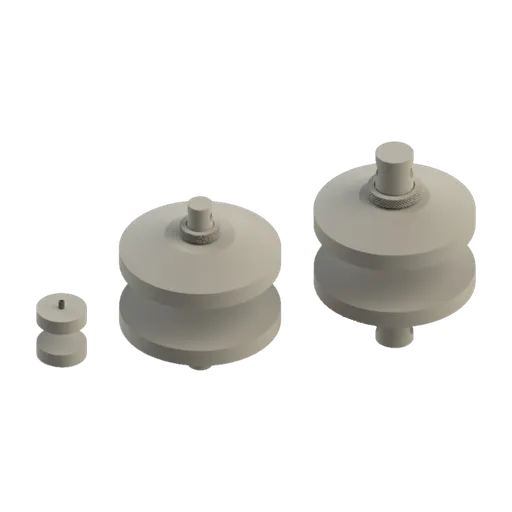
The recommended frame is the 50 kN dual-column machine, which works with interchangeable load cells from 0.5 to 50 kN: a 5 kN load cell for flexure and the 50 kN cell for compression keep both measurements within the verified range, with a class 1 load cell under ISO 7500-1:2023 (ABNT NBR ISO 7500-1 in Brazil). For high-strength mortars, above about 30 MPa, the force on the halves exceeds 50 kN and the recommended choice is the 100 to 200 kN machine. Laboratories that only run compression tests can also use the electric and hydraulic compression testing machine. The BioLab software applies the loading rate in N/s, records the maximum force and calculates Rf and Rc in the report. The panel below shows the machine, the role of each part in the NBR 13279 test and the two accessories used.
The universal testing machine in the compression test
The M2 line ranges from 200 N to 1,000 kN; for mortar, the 50 kN dual-column machine covers both flexure and compression. In the NBR 13279 test, each part of the machine has a function:
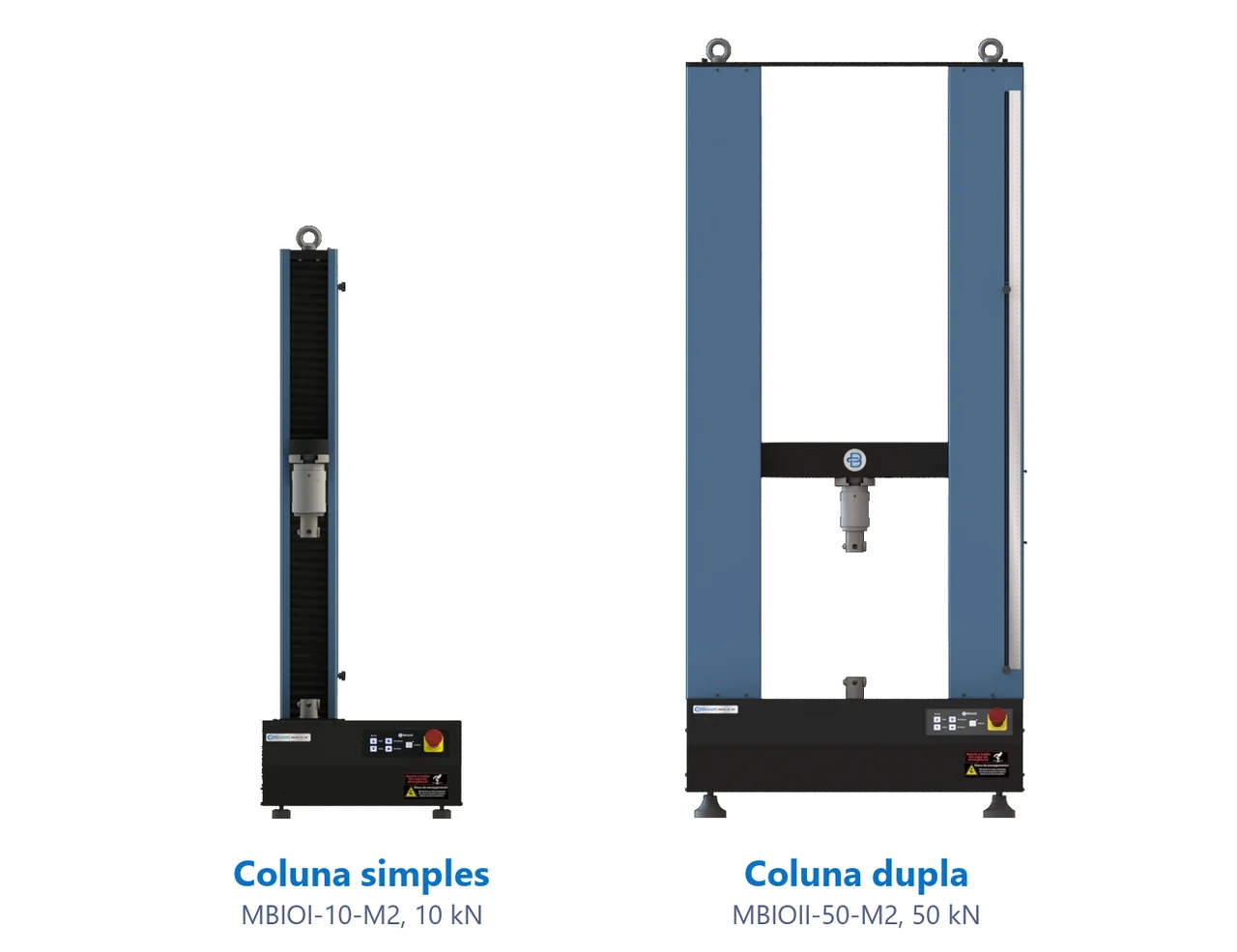
- Moving crosshead applies 50 N/s in flexure and 500 N/s in compression
- Load cell interchangeable, class 1: smaller for flexure, larger for compression
- Flexural fixture 3-point, 100 mm span
- Compression platens half prism on 40 × 40 mm
- BioLab software Rf, Rc, mean and report
- Control panel and emergency stop positions and stops the test
Fixtures for the compression test
The fixtures below are mounted on the same machine, first the flexural fixture and then the platens:
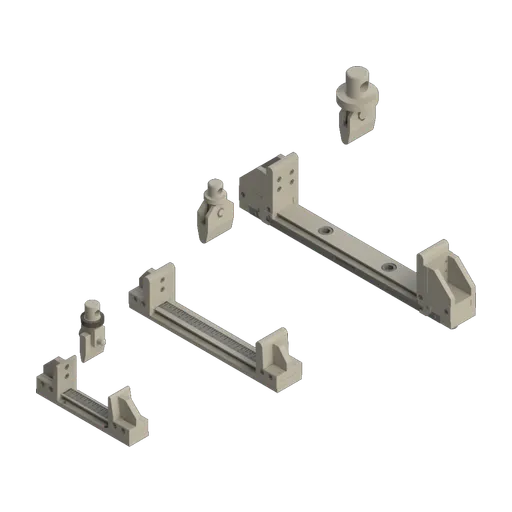
To compare the models, see the universal testing machine guide; the configuration for each standard is defined in the quote.
Standards cited: edition and status as of September 30, 2026
The table lists the standards in this guide, with the edition and status checked on September 30, 2026 in the Target catalog for ABNT standards, and on the official ISO and ASTM pages. EN 1015-11 was checked in catalogs of European standards bodies.
| Standard | Subject | Edition and status |
|---|---|---|
| ABNT NBR 13279 | mortar, flexural tensile and compressive strength | 2005, in force (confirmed November 2023) |
| ABNT NBR 13281-1 | rendering mortar, requirements | 2023, in force |
| ABNT NBR 13281-2 | laying and fixing mortar, requirements | 2023, in force |
| ABNT NBR 13281 | requirements (P and R classes) | 2005, withdrawn in February 2023, replaced by parts 1 and 2 |
| ABNT NBR 13276 | consistency index | 2016, in force (confirmed December 2025) |
| ABNT NBR 16541 | mixture preparation | 2016, in force (confirmed December 2025) |
| ABNT NBR 7215 | compressive strength of Portland cement | 2019, with amendment March 2025, in force |
| ABNT NBR ISO 7500-1 | machine verification and class | 2023, in force |
| EN 1015-11 | masonry mortar, flexure and compression | 2019, in force |
| ISO 679 | cement, strength on prisms | 2009, confirmed in 2025 |
| ASTM C348 | flexural strength of cement mortar | C348-21, active |
| ASTM C349 | compression on prism portions | C349-24, active |
Other tests and technical references
Tests performed on the Biopdi universal testing machine









Related technical references
NBR 12142: flexural tensile strength of concrete prism specimens, calculation and examples
NBR 12142:2010 (in force): flexural tensile strength of concrete prisms under third-point loading. Formula, 5% rule, rate in kN/min and examples.
NBR 7222: splitting tensile test, fct,sp calculation, bearing strips and loading rate in kN/s
NBR 7222:2011 measures the tensile strength of concrete and mortar by diametral compression: fct,sp = 2F/(π·d·L) at 0.05 MPa/s. Strips, calculation, examples and machine.
ASTM D695: compression testing of rigid plastics (test specimen, 1.3 mm/min and calculations)
ASTM D695-26 measures compressive strength, yield and modulus of rigid plastics: a 12.7 × 12.7 × 25.4 mm prism at 1.3 mm/min. Calculations and ISO 604.
Frequently asked questions
What is NBR 13279?
It is the ABNT (Brazilian) standard that defines how to measure the flexural tensile strength and compressive strength of hardened masonry and rendering mortars. It uses 4 × 4 × 16 cm prisms broken in 3-point flexure, with the halves then broken in compression. The 2005 edition is in force, confirmed in November 2023.
Which ABNT standard applies to mortar?
It depends on what you need. Requirements and classification are in NBR 13281-1:2023 (rendering) and NBR 13281-2:2023 (laying and fixing). Test methods have their own standards: NBR 13279 for strength, NBR 13276 for consistency and NBR 16541 for mixture preparation.
What is the specimen size in NBR 13279?
A 40 × 40 × 160 mm prism, cast in a three-compartment metal mold. Each test age uses three prisms, which yield six halves for compression.
What is the loading rate in NBR 13279?
(50 ± 10) N/s for flexural tensile strength and (500 ± 50) N/s for compression, applied continuously until failure.
How do you calculate the flexural tensile strength of mortar?
Rf = 1.5·Ff·L / 40³, with Ff in newtons and L = 100 mm, which gives Rf (MPa) = 0.00234375 × Ff (N). A prism that breaks at 1,000 N has 2.34 MPa.
How do you calculate the compressive strength of mortar?
Rc = Fc / 1,600, because the load is applied through 40 × 40 mm plates, or 1,600 mm². A half that breaks at 6,400 N has 4.0 MPa.
At what age is the test performed and how is curing done?
The reference age is 28 days. The prisms stay (48 ± 24) h in the mold and are then air-cured at (23 ± 2) °C and (60 ± 5)% relative humidity until testing.
When should a result be discarded?
When the maximum absolute deviation exceeds 0.3 MPa in flexure or 0.5 MPa in compression: the value farthest from the mean is eliminated and the mean is recalculated. The result is only valid with at least 2 values in flexure and 4 in compression.
What do P1 to P6 and R1 to R6 mean?
They are the compressive and flexural tensile strength classes of NBR 13281:2005, from P1 (up to 2.0 MPa) to P6 (above 8.0 MPa) and from R1 (up to 1.5 MPa) to R6 (above 3.5 MPa). That standard was withdrawn in 2023; NBR 13281-1 and -2 classify mortar by use (ARV, AAV, AAE, AAF).
What is the difference between NBR 13279 and NBR 7215?
NBR 7215 measures the compressive strength of Portland cement in 50 × 100 mm cylinders, with standard mortar and water curing. NBR 13279 measures the flexural and compressive strength of masonry and rendering mortar in 40 × 40 × 160 mm prisms, with air curing.
What is the international equivalent of NBR 13279?
For masonry mortar, EN 1015-11:2019. For cement, ISO 679:2009 and the ASTM C348-21 (flexure) and C349-24 (compression on prism portions) pair. All of them use prisms and break the halves in compression, but with their own parameters.
What machine do I need for NBR 13279?
A machine with load control in N/s, a 3-point flexural fixture with a 100 mm span and compression platens with 40 × 40 mm plates. For usual mortars, flexure breaks below 5 kN and compression below about 35 kN, so a 50 kN machine, with a smaller load cell for flexure, covers both stages.