
ABNT NBR 6136-2:2026 is the Brazilian standard for test methods for hollow concrete blocks for masonry. Published on February 27, 2026, it canceled NBR 12118 and defines compressive strength as the maximum force divided by the gross area, fb = F / Ab, with the whole block tested at a loading rate of 0.05 or 0.15 MPa/s. A 14 × 19 × 39 cm block that fails at 425 kN has 7.8 MPa on the nominal area of 54,600 mm². The same standard covers visual inspection, dimensional analysis, water absorption, initial rate of absorption, net volume, relative moisture content and drying shrinkage.
Part 2 does not say what strength the block has to reach. The classes, limits and lot acceptance are in Part 1, ABNT NBR 6136-1:2026, which replaced NBR 6136:2016 on the same date. In this guide we explain, in our own words, what changed from the canceled standards, each test in Part 2, what the testing machine and platens must have, how the characteristic strength of a lot is calculated and how the lot is classified. We read the full text of both parts and checked the current edition on October 2, 2026. The text of the standard is not reproduced here, and a laboratory that applies it needs a purchased copy.
What changed: from NBR 12118 and NBR 6136:2016 to NBR 6136-1 and 6136-2
The 2026 revision brought together in a single series what used to be split between two standards with different numbers. Until February 2026, hollow concrete blocks were covered by NBR 6136:2016, for requirements, and NBR 12118, for test methods, whose last edition was from 2013, with a corrected version in 2014. On February 27, 2026, ABNT (the Brazilian national standards body) published the first edition of both parts of NBR 6136, under the general title Hollow concrete blocks for masonry: Part 1, requirements, cancels and replaces NBR 6136:2016, and Part 2, test methods, cancels and replaces NBR 12118:2014. Both came from the Brazilian Committee for Cement, Concrete and Aggregates (ABNT/CB-018) and went through the same National Consultation, from September 18 to October 20, 2025.
Anyone who searches for "NBR 12118" today finds manufacturer blogs and automated search engine answers that still treat it as current. It is not. A test report issued after February 2026 cites NBR 6136-2 for the method and NBR 6136-1 for the acceptance criteria. Part 2 also changed in scope compared with the old 12118, and the comparison below summarizes what stayed the same and what was added. The NBR 12118 values come from the 2014 text cited in our research file; the 2026 values come from the full text:
| Item | NBR 12118:2014 (canceled) | NBR 6136-2:2026 |
|---|---|---|
| Tests | dimensional, absorption, net area, compression, shrinkage | the same, plus visual inspection, initial rate of absorption, net volume and relative moisture content |
| Loading rate | 0.15 or 0.05 MPa/s on the gross area | unchanged: (0.15 ± 0.03) MPa/s if the specified fbk ≥ 8 MPa; (0.05 ± 0.01) MPa/s below that |
| Bearing surface preparation | capping up to 3 mm average thickness, or grinding | unchanged; grinding is now wet grinding, with the option of conditioning in an oven at 40 °C |
| Machine class | 0.5 or 1 in the laboratory; 2 on site and at the plant | unchanged |
| Test validity | not checked in the 2014 text | validation by the relative moisture content of companion blocks |
Part 1 changed more than Part 2. Classes A, B and C remain, but class B now has two nominal ranges, water absorption no longer has a limit per class and became an optional test, sampling is now fixed per lot, with a test sample and a retest sample, and mandatory fillets, manufacturer qualification and environmental indicators were added. The table compares the points that affect the laboratory and the buyer. The 2016 values come from the text of that edition as reproduced in secondary sources, and the 2026 values from the full text:
| Item | NBR 6136:2016 (canceled) | NBR 6136-1:2026 |
|---|---|---|
| Class B | 4.0 ≤ fbk < 8.0 MPa | two ranges: 4 MPa (fbk from 4 to 5.9) and 6 MPa (from 6 to 7.9) |
| Water absorption | limit per class (A ≤ 9%, B ≤ 10%, C ≤ 11%, individual, normal-weight aggregate) | a single limit: ≤ 11% individual and ≤ 10% average (normal-weight aggregate); optional test |
| Sample for compression | 6, 8 or 10 blocks depending on lot size, or fewer with a known standard deviation | 6 test blocks and 6 retest blocks per lot |
| Lot | up to one day of production | up to one day of production and 40,000 blocks |
| fbk with the plant's standard deviation | fbm − 1.65 Sd | no longer exists |
| Fillets | recommendation | minimum radius of 40 mm (A and B) and 20 mm (C) |
A news article on the revision published by Cimento Itambé on August 12, 2026, with an interview with Cláudio Oliveira Silva of the Brazilian Portland Cement Association (ABCP), summarizes class B as "between 4.0 MPa and 6.0 MPa", which led some readers to see a gap between 6 and 8 MPa. There is no gap: class B has ranges in multiples of 2 MPa, and a lot with an fbk of 7.5 MPa is class B 6 MPa. The details are in the section on classes, just below.
Classes A, B and C: what NBR 6136-1 requires of the block
The class of a concrete block combines the permitted use and the characteristic compressive strength, fbk: the value that the vast majority of blocks in the lot exceed, estimated from a sample with the formula in Annex C of Part 2, explained further on. Part 1 defines three classes, with strength verified at 28 days of age:
| Class | fbk (MPa) | Use | Below ground level |
|---|---|---|---|
| A | ≥ 8.0, in 2 MPa steps (8, 10, 12…) | structural masonry | permitted |
| B | 4 (from 4 to 5.9) or 6 (from 6 to 7.9) | structural masonry | not permitted |
| C | ≥ 3.0, in 1 MPa steps | structural or non-load-bearing | not permitted |
Class C has one more limit, based on block width. With a nominal width of 190 or 140 mm, it can be used in structural masonry up to five stories, with the strength specified by the designer; with 115 mm, up to two stories; with 90 mm, up to one; with 65 mm, only without a structural function. In classes A and B, use follows the design. The likely reasoning is wall stability: a thin, low-strength wall carries little force before it buckles, and the standard limits the building height instead of leaving the decision to calculation alone.
Geometry is also a requirement. Nominal dimensions follow the modular coordination of ABNT NBR 15873 (the Brazilian standard for modular coordination in buildings), with a module M of 100 mm: the most common full block, from the 15 × 40 family, measures 140 × 190 × 390 mm (width × height × length), and the one from the 20 × 40 family, 190 × 190 × 390 mm. The 10 mm missing from the module is the mortar joint. Individual tolerances apply to all classes: ± 2.0 mm in width, ± 3.0 mm in height and length, and − 1.0 mm in wall thickness, which may only be smaller than nominal up to that limit. The minimum wall thickness depends on the class: in the 140 × 390 mm block, 25 mm in classes A and B and 18 mm in class C. The height of blocks used where the wall meets the slab can be agreed between supplier and buyer, according to the design.
Part 1 also requires fillets, the rounding where the face shells meet the central cross web, with a minimum radius of 40 mm in classes A and B and 20 mm in class C. The fillet reinforces the point where the wall changes direction and where stress concentrates under compression. Water absorption has a single limit: up to 11.0% for an individual block and 10.0% on average with normal-weight aggregate, and up to 16.0% and 13.0% with lightweight aggregate. Drying shrinkage has a limit of 0.065% at 28 days for all classes. The initial rate of absorption has no acceptance criterion.
Gross area, net area and net volume
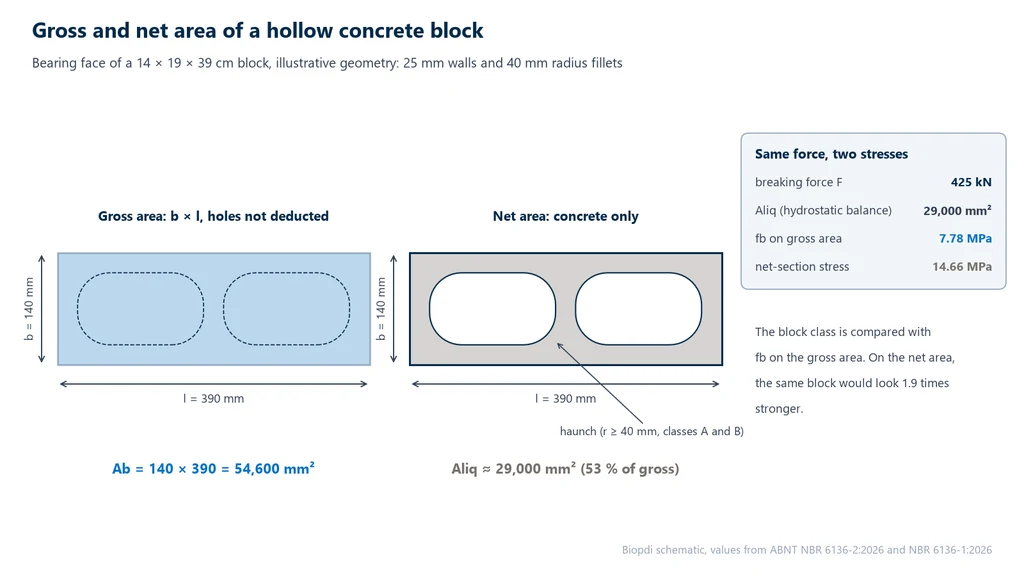
The gross area of a hollow block is the area of the section perpendicular to the axis of the cores without deducting the voids: length × width, Ab = l × b. The net area is the same section with the voids deducted, in other words, only the concrete. The net volume is the volume of concrete in the block, also without the voids. All three appear in Part 2 and play different roles: the gross area is the basis for calculating strength and loading rate; the net area goes into the initial rate of absorption; the net volume gives the equivalent thickness, used in assessing the fire resistance of the wall.
The gross area comes from the dimensional assessment, using the measured average width and length. The net area, in a block with tapered walls and rounded fillets, would be hard to measure with a caliper, so the standard calculates it with a hydrostatic balance: the difference between the saturated mass of the block and its apparent mass immersed in water is the volume of concrete, and that volume divided by the block height gives the average net area. The diagram below shows both areas in a 14 × 19 × 39 cm block with illustrative geometry, 25 mm walls and 40 mm fillets: the gross area is 54,600 mm², and the net area about 29,000 mm², 53% of the gross area. With the same 425 kN force and the nominal area, the stress is 7.78 MPa on the gross area and 14.66 MPa on the net area.
The 2026 Part 1 defines a hollow block as a masonry unit with voids open on the top and bottom faces. The numerical criterion that the net area must not exceed 75% of the gross area, which was part of the 2016 definition and still appears in automated search engine answers, is not in the 2026 definition; what distinguishes blocks now are the wall thicknesses and the minimum equivalent thickness for each class and width.
The NBR 6136-2 tests, one by one
NBR 6136-2 organizes the tests into annexes: three normative ones, which every lot must meet, and three informative ones, which describe methods for optional tests. All are performed on the block itself, whole, and not on a molded test specimen: the block is the specimen. This is the difference from structural concrete, where a molded cylinder that represents the material is tested, as in our guide to NBR 5739.
Visual inspection (Annex A, normative)
Six blocks taken at random from the lot sample are examined under normal lighting. The inspector looks for non-uniform appearance, irregular edges, cracks, fractures and any defect that impairs laying, strength or durability. The result is acceptance or rejection of the sample. Under Part 1, the lot passes if no more than 2% of the blocks have a nonconformity, and in exposed (architectural) blocks, efflorescence, the whitish stain of salts that migrate to the surface, is treated as an aesthetic issue and not a durability one.
Dimensional assessment (Annex B, normative)
Six blocks are measured with a metal caliper with 0.05 mm resolution, or with a digital instrument of proven accuracy. Width, height and length are each measured three times, at different points, with individual and average results rounded to the millimeter. Walls are measured on the face with the smallest thickness, which is the bottom face when laid, at the narrowest point: two measurements per face shell and one per web. Cores are measured at the center, on the face with the greatest wall thickness, the top face. The reason lies in manufacturing: the block is vibro-compacted in a mold with tapered cores so it can be stripped, and the walls come out thicker on one side. Measuring the wall on the thin side and the core on the narrow side captures the worst case of each. The assessment yields the gross area of each block and the equivalent thickness, the net volume divided by the area of the side face.
Initial rate of absorption (Annex D, informative)
The initial rate of absorption (AAI) measures how much water the face of the block draws in during the first minute. The oven-dried block is placed with the test face in a film of water (3.0 ± 0.2) mm above the supports for (60 ± 1) s, wiped and weighed again. The rate is AAI = 194 × (M2 − M1) / A, with masses in grams and area in cm². The constant 194 is the area of 30 square inches, rounded, inherited from the US standard for clay bricks, ASTM C67/C67M, cited in the bibliography. On the bearing face, A is the net area; on the side face, which receives the rendering, it is length × height. The result helps the designer assess the bond of a rendering and has no acceptance criterion. The same rate exists for clay blocks, with a different constant, in our guide to NBR 15270-2.
Absorption, net volume, net area and relative moisture content (Annex E, informative)
Three blocks are dried in an oven at (110 ± 5) °C until two weighings 2 h apart differ by no more than 0.5%, which gives the dry mass m1. After 24 h immersed in water at (23 ± 5) °C and drained for 60 s on a screen, with the surface wiped, they give the saturated mass m2. On the hydrostatic balance, the apparent immersed mass is m3. The expressions are:
- absorption: a = (m2 − m1) / m1 × 100, in %;
- net volume: Vn = (m2 − m3) / γ × 1,000, in mm³, with masses in grams and γ, the density of water, in g/cm³;
- net area: Aliq = (m2 − m3) / (h × γ) × 1,000, in mm², with height h in mm;
- relative moisture content: Ur = (m − m1) / (m2 − m1) × 100, in %, with m the mass of the block in the condition in which it would be compression tested.
The relative moisture content tells what fraction of the water the block can absorb it already contains. It is measured on three companion blocks prepared together with the compression blocks and is the value that validates, or invalidates, the compression test, as shown in the calculation section.
Linear drying shrinkage (Annex F, informative)
Drying shrinkage is the shortening of the block as it loses water. Three blocks, or prisms dry-cut from the face shells, receive gauge studs about 300 mm apart, are kept in water for 48 h and have their length read when saturated. They then go into an oven at (50 ± 5) °C with humidity of about 17%, maintained by calcium chloride, and are measured in 48 h cycles until equilibrium: a length change of no more than 0.002% and a mass loss of no more than 0.2% over six days. Shrinkage is S = L / G × 100, in %, with L the average length change and G the gauge length; the length reference is the same as in the Brazilian mortar standard NBR 15261. The Part 1 limit is 0.065%: in a 6 m wall, that means 3.9 mm of shortening, which explains the control joints in concrete block masonry.
Concrete block compression test, step by step
The concrete block compression test loads the whole block, with both bed faces leveled, in a press that applies an increasing force in the direction the block works in the wall, until failure. It is a destructive test, done on a sample basis, and it measures only the maximum force: there is no extensometer, no stress-strain curve and no modulus, unlike the materials compression test explained in the compression test guide. Annex C of Part 2 of ABNT NBR 6136 (the Brazilian standard for hollow concrete blocks for masonry) sets out the sequence.
- Sample. Six blocks taken at random from the lot sample. They can be the same blocks used for the visual inspection and the dimensional check, since those do not destroy the block. Three control blocks are also set aside for the relative humidity.
- Gross area. Calculated block by block, from the averages measured in the dimensional check.
- Leveling the faces. The two faces that touch the platens are capped or ground, as described below.
- Conditioning. Blocks and control blocks stay at least 72 h in the laboratory at (40 ± 20) % air relative humidity and (24 ± 4) °C. For ground blocks, the alternative is a forced-air oven at (40 ± 2) °C for (24 ± 0.5) h, with the test done within 1 h of removal.
- Position. The block goes in with the thicker face shells up and with its center of gravity on the load axis of the platens.
- Loading. The stress on the gross area increases progressively and without shock, at (0.15 ± 0.03) MPa/s when the specified fbk is 8 MPa or more and at (0.05 ± 0.01) MPa/s below that. The maximum force is recorded.
Capping with paste or mortar. The layer is made with cement paste or mortar of strength equal to or greater than that of the block, on a mold or a flat, rigid surface that does not depart from a plane by more than 0.08 mm per 400 mm, with release agent or damp paper. The side faces of the block must be perpendicular to the cap, within ± 5°, and the cap must come out flat, without patches, with an average thickness of up to 3 mm. The control blocks are not capped, because the fresh paste would wet the block and distort the moisture reading.
Grinding. This is the alternative to capping: both faces are wet-ground to a flat, uniform surface without breaking the edges. In this case the control blocks are also ground, so they go through the same water treatment.
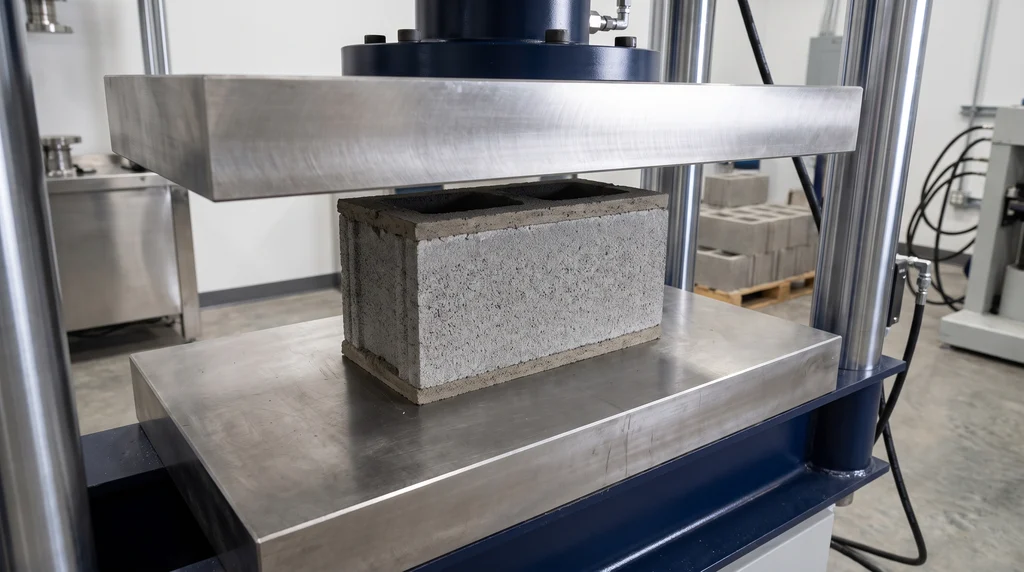
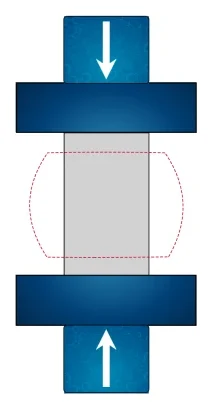
In the photo, a hollow concrete block between the platens of the press, in the same position it works in the wall: cells vertical and bed faces leveled, so the force is distributed over the area of the block.
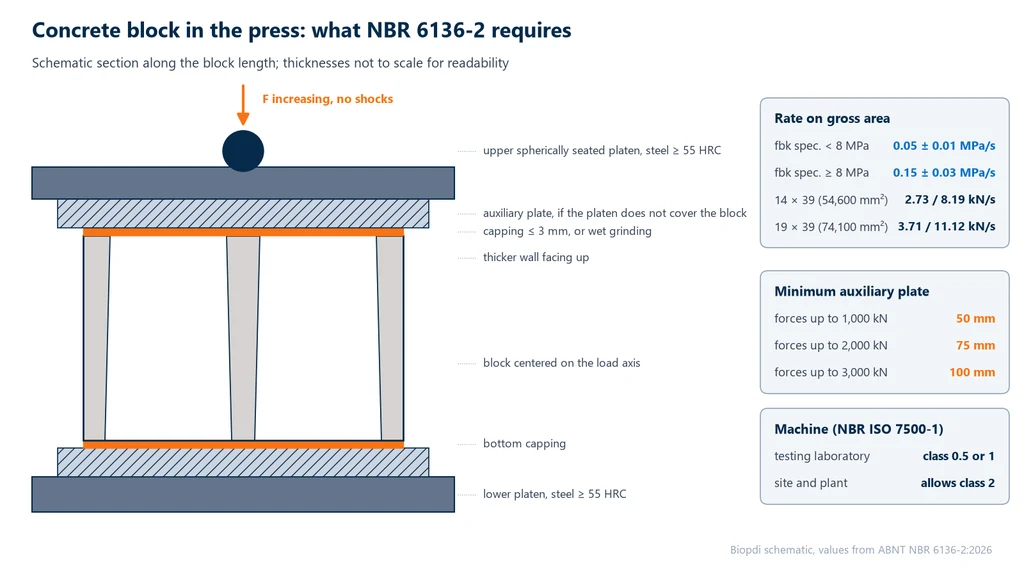
The rate is given in stress so that it applies to any block size, but the press controls force. The conversion multiplies the rate in MPa/s by the gross area in mm², which gives N/s. For the 140 × 390 mm block, 0.05 MPa/s becomes 2.73 kN/s and 0.15 MPa/s becomes 8.19 kN/s; for the 190 × 390 mm block, 3.71 and 11.12 kN/s. A 7.5 MPa block loaded at 0.05 MPa/s fails in about 150 s. The rate is much lower than the 0.45 MPa/s used for concrete cylinders under NBR 5739 (the Brazilian standard for compression testing of concrete cylinders) because the block fails at much lower stresses on the gross area, and because the thin face shells are sensitive to load shocks.
Press and platens: what NBR 6136-2 requires of the machine
The press for testing concrete blocks under NBR 6136-2 is a compression testing machine verified under the calibration standard for static testing machines, ABNT NBR ISO 7500-1, equivalent to ISO 7500-1. Testing laboratories use a class 0.5 or 1 machine; site and plant laboratories may use class 2. The maximum force must be measured and read to within ± 2 %. Force is measured by the machine's load cell, and the class applies to the verified system as a whole, not to the load cell alone.
The bearing platens are steel with a surface hardness of at least 55 HRC, so they do not dent or deform under the concentrated load of the block's face shells. One of the platens is spherically seated, and it is the one on the top face of the block: the seat lets the platen follow a slight lack of parallelism in the block, so the force enters over the whole face and not through one edge. The machine must also apply the force progressively and without shock.
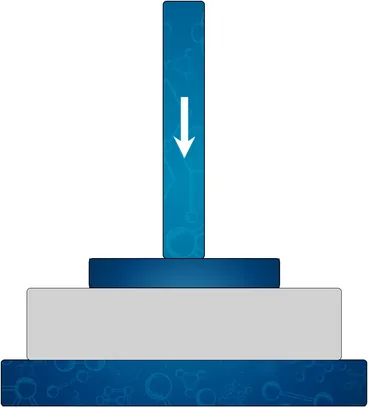
The 39 cm block is larger than many platens. When the platens do not cover the test area, the standard requires a monolithic steel plate between platen and block, with a minimum thickness of 50 mm for forces up to 1,000 kN, 75 mm up to 2,000 kN and 100 mm up to 3,000 kN. The thickness increases with force because a thin plate would bend: the ends of the block, outside the platen, would receive less force than the center, and the block would fail early, through the middle. The diagram below summarizes the setup and the figures Part 2 requires of the press:
The capacity comes from the strength equation in reverse, F = fb × Ab. Because it is large, a concrete block requires much more force than a cylinder: a 14 × 19 × 39 at 8 MPa already needs 437 kN, more than a 10 × 20 cm concrete cylinder at 50 MPa. The table shows the failure force over the nominal area; since the blocks in a lot exceed the fbk, the press has to cover the strongest ones, with margin.
| Block fb | 14 × 39 cm (54,600 mm²) | 19 × 39 cm (74,100 mm²) |
|---|---|---|
| 4 MPa | 218 kN | 296 kN |
| 6 MPa | 328 kN | 445 kN |
| 8 MPa | 437 kN | 593 kN |
| 12 MPa | 655 kN | 889 kN |
| 16 MPa | 874 kN | 1,186 kN |
| 20 MPa | 1,092 kN | 1,482 kN |
Strength calculation: fb, estimated fbk and test validation
The individual compressive strength of the concrete block is the maximum force divided by the gross area of that block, fb = F / Ab, with F in newtons and Ab in mm², which gives MPa, rounded to 0.1 MPa. The lot, however, is judged by its characteristic strength, and Part 2 provides the estimator to calculate it from the six results:
- sort the fb values in ascending order, fb1 being the lowest;
- take i = n/2 if n is even, or i = (n − 1)/2 if n is odd; with 6 blocks, i = 3;
- calculate fbk,est = 2 × [(fb1 + … + fb(i−1)) / (i − 1)] − fbi;
- check the floor: fbk,est cannot be less than ψ × fb1, with ψ = 0.89 for 6 blocks (the coefficient increases with the number of blocks, up to 1.04 for 18).
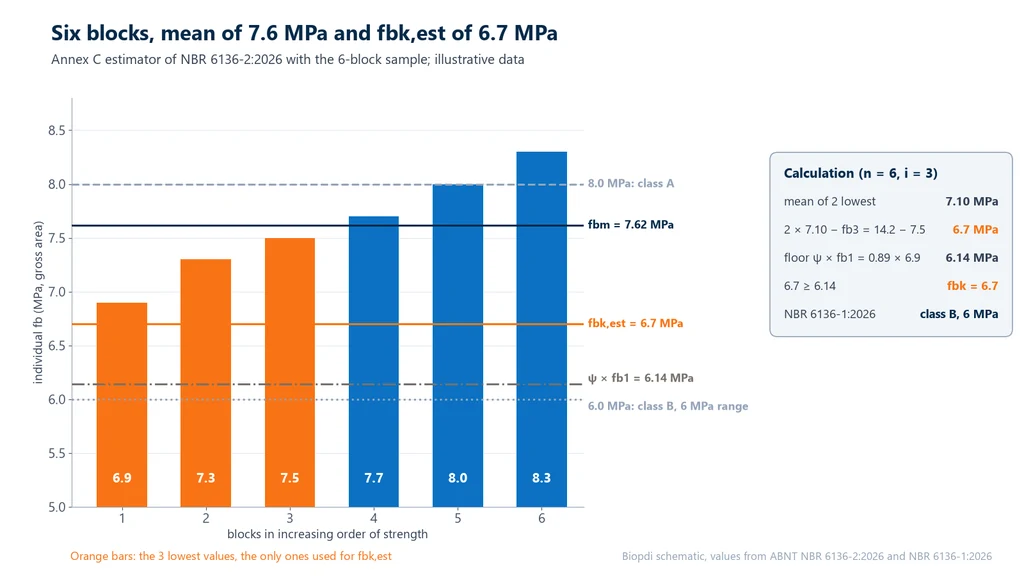
The estimator uses only the weaker half of the sample. With six blocks, the two lowest go into the average and the third is subtracted: the distance between them measures the scatter of the lower tail, and fbk,est falls below it in the same proportion. The chart below shows an illustrative lot of six blocks, with the three lowest values in orange: the mean is 7.62 MPa, but fbk,est is 6.7 MPa, and the lot is class B at 6 MPa, not class A. The full calculation is in the worked example.
Validation by relative humidity. The result is valid only if the blocks were at the right moisture. The average relative humidity of the three control blocks, at the time of the test, must be within (40 ± 20) % when fbk is 8 MPa or more, and within (25 ± 15) % when it is lower. If the humidity was above the range and fbk,est meets the requirement, the test is valid: the wetter block is weaker, and the result is on the safe side. If it was below the range, the test is invalid and the retest is carried out, because an overly dry block fails at an optimistic value. When the laboratory conditions the blocks in the oven at 40 °C for 24 h, proof of relative humidity is optional.
The report gives the date, lot, age, class and strength range, nominal dimensions, type of leveling, gross area and maximum force of each block, individual fb, fbk,est to 0.1 MPa, the relative humidity of the control blocks and the validation. An editorial note: the calculation clause of the 2026 text says to round "to the nearest tenth of a millimeter", but the result is a stress, and the report clause itself asks for 0.1 MPa.
Lot acceptance: sampling, retest and control age
A production lot, under NBR 6136-1 (Part 1 of the Brazilian concrete block standard, with the requirements), is the set of blocks of the same product, made under the same conditions, with the same materials and equipment, limited to one day of production and 40,000 blocks. Each pallet carries the identification of the product, class, nominal dimensions in centimeters, lot or date, and manufacturer. The buyer collects at random, from the same lot, the test and retest blocks, all marked indelibly. The table summarizes the sampling in Part 1:
| Test | Type | Test + retest | Frequency |
|---|---|---|---|
| Visual inspection, dimensional check and compression | mandatory | 6 + 6 (the same blocks serve all three) | every lot |
| Absorption, initial rate of absorption and shrinkage | optional | 3 + 3 each | every 12 months of production |
| Environmental performance | optional | environmental product declaration | every 24 months |
The lot is accepted when, at the same time, no more than 2 % of the blocks fail the visual inspection, the dimensions meet Part 1 and fbk meets the class. If any of these requirements fails, the retest blocks are tested; a satisfactory retest accepts the lot, and a failed retest rejects it, with the supplier required to deliver another lot for new tests. The control age is agreed in advance: the delivery date at the site (condition 1) or 28 days from production, or more (condition 2). Under condition 1, the manufacturer guarantees that the block already arrives at the site with the contracted strength.
Part 1 also establishes manufacturer qualification. A manufacturer with third-party product certification is prequalified, subject to the buyer's acceptance; one without it must show approval of three different consecutive lots, tested by a third-party laboratory. In either case, the manufacturer gives the buyer the in-house control reports for the requirements. The block is classified as noncombustible, without testing, and fire safety, when the design requires it, is assessed on the wall under ABNT NBR 15575-4 (the Brazilian building performance standard, wall systems part). For environmental performance, the standard recommends that the manufacturer declare, by family and strength range, at least the CO2 emissions and primary energy per block, using the methodology of ABNT NBR ISO 14025 (the Brazilian adoption of ISO 14025).
How to interpret the standard
NBR 6136-2 says what to do, but rarely says why. The points below are the ones most often misread in the laboratory, at the block plant and on site.
Why is strength calculated on the gross area and not the net area?
Because the number exists for wall design, and structural masonry is designed on the gross section. The gross area is also measured with less error: only width and length are needed, without depending on the tapered face shells and webs of each block. The consequence is that two blocks of the same concrete, one with thinner face shells, give different fb values, because the more hollow one has less material under the same gross area. The class measures the component, not the concrete. Calculating on the net area makes the block in the diagram look 1.9 times stronger.
Why does the thicker face shell go up?
Because that is how the block is laid: the face with the wider shells faces up, to receive the mortar of the next course. Testing in the same position makes the force enter from the side it enters on site, and the spherically seated platen, which is on top, bears on the wider face, which is the more stable one. Inverted, the block would put the seat on the face with thinner shells, and failure would start at the narrow edge.
Why does relative humidity decide whether the test is valid?
Because dry concrete is stronger than wet concrete, and a block that spent days in an oven or in the sun would give an fbk the wall does not have. The humidity range standardizes the condition of the block at the time of the test, and the rule is asymmetric on purpose: humidity above the range can only lower the result, so a lot approved under those conditions is approved; humidity below the range can inflate the result, so the test is repeated.
Does the class come from the test or from the order?
From both, at different times. The order defines the specified class and range, and that is where the loading rate comes from, 0.15 MPa/s for a specified fbk of 8 MPa or more. The test gives the lot's fbk,est, which is compared with the range: a lot ordered as class A that gives 6.7 MPa does not automatically become class B, it fails in the class ordered and goes to the retest.
Why is fbk below the mean?
Because the wall fails through the weak block, not the average one. The mean tells where the center of the distribution is, and fbk tells where the lower tail is. Two lots with the same mean can have different fbk values: the more scattered one has a lower tail and is penalized. Santiago and Beck (2018, Revista IBRACON de Estruturas e Materiais) analyzed more than 6,000 blocks from three Brazilian regions and found class A lots with estimated strength below the specified value, which shows why the criterion looks at the tail.
Is block strength the strength of the wall?
No. The wall is block plus mortar, and the joint, more deformable than the block concrete, makes the masonry weaker than the block alone. According to the design parameters of ABCP (the Brazilian Portland Cement Association, 2021), a prism of 14 × 19 × 39 blocks has 60 % to 80 % of the block's fbk, with the ratio falling at higher strengths. That is why structural masonry design uses the strength of prisms, tested under ABNT NBR 16868-3 (the Brazilian structural masonry standard, test methods part); the test under NBR 6136-2 comes first and qualifies the component.
Worked example: from the lot to the report
This example follows a lot of 14 × 19 × 39 cm blocks ordered as class B, 6 MPa, using illustrative data. All procedure parameters come from the full text of Parts 1 and 2 of ABNT NBR 6136 (2026), the Brazilian standard for hollow concrete masonry blocks.
1. Absorption, net volume, net area and equivalent thickness. One block has a dry mass m1 = 11,200 g, a saturated mass m2 = 12,050 g, an immersed mass m3 = 6,540 g and a measured height h = 190 mm; γ = 1.00 g/cm³.
- Absorption: a = (12,050 − 11,200) / 11,200 × 100 = 850 / 11,200 × 100 = 7.6%, below the 11.0% individual limit in Part 1.
- Net volume: Vn = (12,050 − 6,540) / 1.00 × 1,000 = 5,510 × 1,000 = 5,510,000 mm³ (5.51 liters of concrete).
- Net area: Aliq = 5,510,000 / 190 = 29,000 mm², 53% of the nominal gross area of 54,600 mm².
- Equivalent thickness: Te = 5,510,000 / (390 × 190) = 5,510,000 / 74,100 = 74.4 mm, above the 65 mm that Part 1 sets for the 140 × 390 mm block in classes A and B.
2. Individual strength on the gross area. Six blocks, with the measured average width and length:
- 140.2 × 391.0 = 54,818 mm²; 380 kN → 380,000 / 54,818 = 6.93 → 6.9 MPa;
- 140.4 × 390.2 = 54,784 mm²; 400 kN → 7.3 MPa;
- 140.5 × 390.5 = 54,865 mm²; 410 kN → 7.47 → 7.5 MPa;
- 140.6 × 390.4 = 54,890 mm²; 425 kN → 7.74 → 7.7 MPa;
- 140.8 × 390.8 = 55,025 mm²; 440 kN → 8.00 → 8.0 MPa;
- 141.0 × 390.6 = 55,075 mm²; 455 kN → 8.26 → 8.3 MPa.
If the fourth block were calculated on the net area from step 1, the result would be 425,000 / 29,000 = 14.7 MPa, almost double: this is the error the standard avoids by specifying the gross area.
3. Characteristic strength and class. With n = 6, i = 3.
- Mean of the two lowest values: (6.9 + 7.3) / 2 = 7.10 MPa.
- fbk,est = 2 × 7.10 − 7.5 = 14.2 − 7.5 = 6.7 MPa.
- Lower bound: ψ × fb1 = 0.89 × 6.9 = 6.14 MPa. Since 6.7 ≥ 6.14, fbk = 6.7 MPa applies.
- Mean: 45.7 / 6 = 7.62 MPa. The fbk is 12% below it.
- Class according to Part 1: 6.7 MPa lies between 6 and 7.9 MPa, so the lot is class B, 6 MPa, and meets the order. It would not be class A, even though two blocks reached 8 MPa or more.
4. Validation. The three witness blocks, weighed at the time of testing, gave an average relative moisture of 24%. Since the fbk is below 8 MPa, the allowed range is (25 ± 15)%, from 10% to 40%, and the test is valid. Had the average been 8%, the test would be invalid and the retest set would be tested.
5. Loading rate and time. The specified fbk, 6 MPa, is below 8 MPa, so the rate is (0.05 ± 0.01) MPa/s. With the average gross area of 54,910 mm²: 0.05 × 54,910 = 2,746 N/s = 2.75 kN/s, within a range of 2.20 to 3.29 kN/s. A 7.6 MPa block fails in 7.6 / 0.05 = 152 s.
6. Machine capacity for another product. The same plant wants to test 19 × 19 × 39 cm blocks of class A, 12 MPa.
- Rate: specified fbk ≥ 8 MPa, so 0.15 × 74,100 = 11.1 kN/s, from 8.9 to 13.3 kN/s.
- Force at 12 MPa: 12 × 74,100 = 889 kN. The strongest blocks in a lot with fbk 12 exceed 14 MPa: 14 × 74,100 = 1,037 kN.
- Auxiliary bearing plate, if the platen does not cover 190 × 390 mm: with forces above 1,000 kN, the minimum thickness goes from 50 to 75 mm.
- A 1,000 kN machine measures this block up to 1,000,000 / 74,100 = 13.5 MPa on the gross area.
Conclusion: for the 19 cm block, the 1,000 kN machine covers classes up to about 10 MPa with margin and is at its limit from 12 MPa upward. The 14 cm block, with 54,600 mm², goes up to 18.3 MPa on the same machine.
Common mistakes when applying NBR 6136-2
Mistakes in applying NBR 6136-2 (the Brazilian standard for test methods for hollow concrete masonry blocks) almost all come from three sources: a withdrawn standard, the wrong calculation area and block preparation outside the conditions of the standard. The list gathers those that show up in test reports, procedures and purchase orders:
- Citing NBR 12118 or NBR 6136:2016 as current. Both were canceled on February 27, 2026.
- Using the 2016 sampling plan. The sample no longer depends on lot size: it is 6 test blocks and 6 retest blocks, and the lot can be up to 40,000 blocks.
- Applying absorption limits by class. In 2026 there is a single limit, 11% individual and 10% average with normal-weight aggregate, and the test is optional.
- Calculating fb on the net area. The class is compared on the gross area; on the net area, the block looks almost twice as strong.
- Classifying the lot by the mean. The criterion is fbk,est, which is below the mean.
- Using fbm − 1.65 Sd. This route, based on the plant's standard deviation, does not exist in the 2026 parts.
- Testing without witness blocks. Without the relative moisture, there is no way to validate the test, except with conditioning in an oven at 40 °C.
- Capping the witness blocks. Fresh paste wets the block and distorts the moisture.
- Capping with sulfur. The options in NBR 6136-2:2026 are cement paste, mortar or grinding; sulfur, mentioned in AI-generated answers from search engines, is not among them.
- Thick or out-of-square capping. Above 3 mm on average, or with faces outside ± 5°, the capping concentrates stress and lowers the result.
- Using the concrete cylinder loading rate. The 0.45 MPa/s rate of NBR 5739 (the Brazilian standard for compression testing of concrete cylinders) is three to nine times that of the block.
- Placing the block upside down. The thicker wall goes on top, and the spherically seated platen rests on it.
- Platen smaller than the block, without a plate. The ends receive less force, and the block fails early; the auxiliary bearing plate must be 50, 75 or 100 mm thick, depending on the force.
- Choosing the testing machine by the class rather than by the strongest blocks. A lot with fbk 12 in 19 cm blocks exceeds 1,000 kN.
- Referring to class D. NBR 6136-1:2026 has only classes A, B and C; the non-loadbearing block is class C, which may also have limited structural use depending on its width.
- Confusing masonry blocks with paving units. Pavers follow the ABNT NBR 9781 series (the Brazilian standard for concrete paving units), also revised in 2026, with different tests and different strengths.
Equipment for testing concrete blocks
Testing concrete blocks requires a compression testing machine with capacity above the failure force of the strongest blocks, loading rate control, peak force recording and platens, or an auxiliary bearing plate, that cover the entire face of the block. Biopdi manufactures the electric and hydraulic compression testing machine, dedicated to compression tests, and the M2 line universal testing machine, whose floor-standing versions of 300 kN, 600 kN and 1,000 kN perform block compression and other tests on the same frame.
Capacity follows the worked example: the 600 kN machine covers the 14 cm block up to 11.0 MPa on the gross area, which includes classes C and B; the 1,000 kN machine reaches 18.3 MPa on the 14 cm block and 13.5 MPa on the 19 cm block. The M2 line load cell is class 1 according to ABNT NBR ISO 7500-1:2023 (the Brazilian adoption of ISO 7500-1), the class that NBR 6136-2 requires for testing laboratories; the class of the assembled machine comes from verification by the calibration laboratory. The line's compression platens go up to 300 kN; for the 39 cm block at higher capacities, the area of the platens or auxiliary plate is defined in the quote or as a special project. The BioLab software converts the rate from MPa/s to kN/s based on the gross area, records the peak force and issues the report. The panel below shows the machine, the role of each part in this test and the accessory used.
The universal testing machine in the compression test
The dual-column M2 line ranges from 5 kN to 1,000 kN. In testing hollow concrete blocks to NBR 6136-2, each part of the machine has a function:
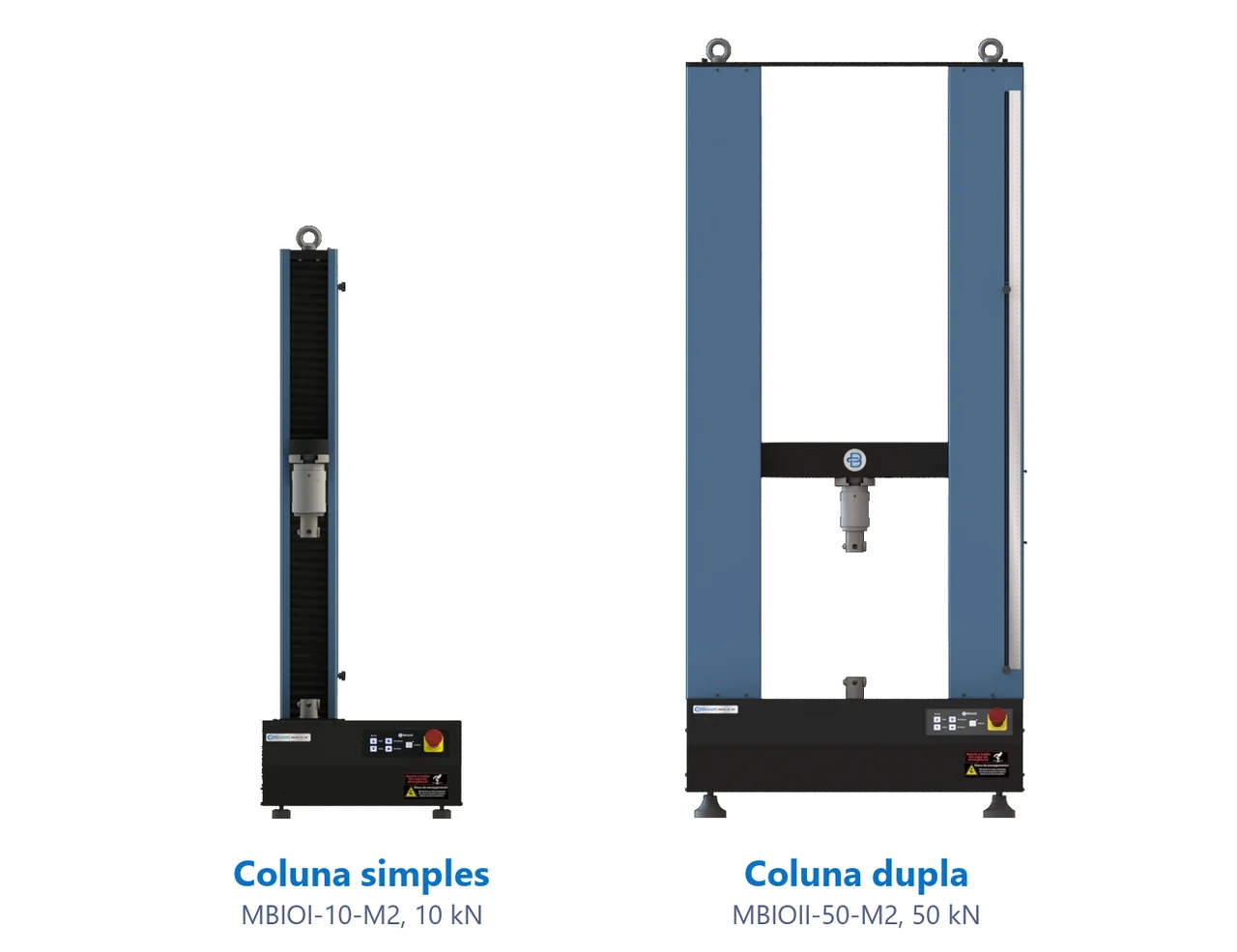
- Moving crosshead applies the load at 0.05 or 0.15 MPa/s, without shocks
- Load cell measures the peak force, class 1
- Compression platens capped block, thicker wall on top
- BioLab software rate in kN/s, fb on the gross area and report
- Control panel and emergency stop positions and stops the test
Fixtures for the compression test
The fixture below is mounted on the same machine, in place of the grips:
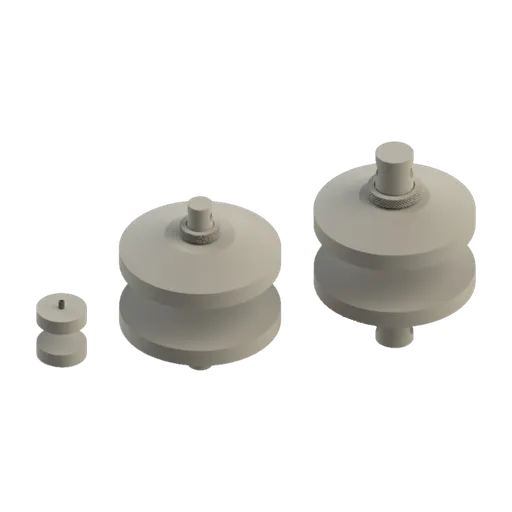
To compare models, see the universal testing machine guide; the configuration for each standard is defined in the quote.
Standards cited: edition and status
The standards in this guide are the two parts of NBR 6136, the ones they replaced and those that surround them in testing and in masonry design. NBR 6136-1 and 6136-2 were read in full text and checked on October 2, 2026; the other ABNT standards follow the Target catalog checked on September 30 and October 1, 2026, and the ASTM standard, the official ASTM page on October 2, 2026. The US standard for concrete blocks, ASTM C140/C140M, is cited for reference only: its methods and criteria are not interchangeable with those of NBR 6136.
| Standard | Subject | Edition and status |
|---|---|---|
| ABNT NBR 6136-2 | hollow concrete blocks, test methods | 1st edition, February 27, 2026, current; replaces NBR 12118:2014 |
| ABNT NBR 6136-1 | hollow concrete blocks, requirements | 1st edition, February 27, 2026, current; replaces NBR 6136:2016 |
| ABNT NBR 12118 | test methods (former) | 2013, corrected version 2014, canceled in February 2026 |
| ABNT NBR 6136 | requirements (former) | 2016, canceled in February 2026 |
| ABNT NBR ISO 7500-1 | verification and class of the testing machine | 2023, current (ISO 7500-1:2018) |
| ABNT NBR 15261 | dimensional change of mortar, reference for shrinkage | cited without date in NBR 6136-2 |
| ABNT NBR 16868-3 | structural masonry, testing of prisms and walls | August 2020, reaffirmed January 2025, current |
| ABNT NBR 15270-2 | ceramic blocks and bricks, test methods | December 2023, current |
| ASTM C140/C140M | sampling and testing of concrete masonry units (USA) | C140/C140M-26a, active |
Other tests and technical references
Tests performed on the Biopdi universal testing machine









Related technical references
NBR 5739 concrete compression test: fc calculation and the NBR 7222, NBR 12142 and NBR 6136-2 standards
ABNT NBR 5739:2018 (the Brazilian standard for concrete compression testing), reaffirmed in 2023, covers compression testing of cylindrical concrete specimens: continuous loading at 0.45 ± 0.15 MPa/s until failure and fc = 4F/(πD²), in MPa, to three significant figures. See what it requires of the machine and the specimen, the h/d correction, failure types A to G and the related standards: NBR 7222 (splitting tensile test), NBR 12142 (flexural tensile strength) and NBR 12118, withdrawn in February 2026 and replaced by NBR 6136-2:2026.
NBR 15270-2: ceramic block and brick compression test, gross area, fbk, water absorption and IRA
NBR 15270-2:2023 tests for ceramic blocks and bricks: gross-area compression (fb = F/Ab), lot fbk, water absorption, IRA and the 2023 changes.
Compression test: what it is, how to calculate it, concrete (NBR 5739 and fck) and standards
A compression test shortens a specimen until it fractures or yields. Learn to calculate compressive strength, plus NBR 5739, concrete fck and standards.
Frequently asked questions
Has NBR 12118 been canceled?
Yes. ABNT NBR 12118, covering test methods for hollow concrete blocks, was canceled on February 27, 2026 and replaced by ABNT NBR 6136-2:2026. Its last edition was from 2013, with a corrected version in 2014. The requirements, which were in NBR 6136:2016, moved to NBR 6136-1:2026.
What is the ABNT standard for concrete blocks?
For hollow concrete masonry blocks, it is ABNT NBR 6136 (the Brazilian standard), in two parts from 2026: 6136-1, covering requirements and classes, and 6136-2, covering test methods. Concrete paving units for interlocking pavements follow a different series, NBR 9781.
Which tests does NBR 6136-2 specify?
Visual inspection, dimensional assessment and compressive strength, which are normative and performed on every lot, plus initial rate of absorption, water absorption, net volume, net area, relative moisture and linear drying shrinkage, described in informative annexes.
How is the compressive strength of a concrete block calculated?
The peak force is divided by the gross area of the block, length × width without deducting the cores: fb = F / Ab, in MPa. A 140 × 390 mm block that fails at 425 kN has 7.8 MPa on the nominal area. The lot is judged by the fbk estimated from the six results.
What is the MPa rating of a concrete block?
It depends on the class in NBR 6136-1:2026: class C from 3 MPa, in 1 MPa steps; class B at 4 or 6 MPa; class A from 8 MPa, in 2 MPa steps. The value is the characteristic strength at 28 days, calculated on the gross area.
What is the loading rate in the concrete block test?
According to NBR 6136-2, the stress on the gross area increases at (0.15 ± 0.03) MPa/s when the specified fbk is 8 MPa or more, and at (0.05 ± 0.01) MPa/s below that. For a 140 × 390 mm block, this equals 8.19 and 2.73 kN/s.
Does the block need capping for the compression test?
Yes, the two faces in contact with the platens are leveled: by capping with cement paste or mortar as strong as the block, with an average thickness of up to 3 mm, or by wet grinding. The blocks are then kept for at least 72 h in a controlled environment.
How many blocks are tested per lot?
Six test blocks and six retest blocks per lot, according to NBR 6136-1:2026; the same six are used for visual inspection, dimensional assessment and compression. A lot is at most one day of production and 40,000 blocks.
What is the difference between a hollow block and a closed-bottom block?
A hollow block, according to NBR 6136-1:2026, has its cores open on the top and bottom faces. "Closed-bottom block" is not a term in the standard: a block closed on one face does not fit the definition of a hollow block, and the standard's block family provides the U-shaped (channel) block for lintels and bond beams.
What are the dimensions of the 15 cm hollow block?
In the 15 × 40 family of NBR 6136-1:2026, the full block is 140 mm wide, 190 mm high and 390 mm long, and the half block is 140 × 190 × 190 mm. The difference from 15 × 20 × 40 cm is the mortar joint.
How many 14 × 19 × 39 concrete blocks are needed per m²?
About 12.5 blocks per m² of wall, without waste: with a 1 cm joint, each block occupies 40 × 20 cm, or 0.08 m², and 1 / 0.08 = 12.5.
What is the standard for concrete test specimens?
In Brazil, concrete cylinders are molded and cured according to ABNT NBR 5738 and tested according to ABNT NBR 5739, covered in the NBR 5739 guide; preparation is covered in the concrete test specimen guide. Blocks have no molded specimen: the block itself is tested.