
Resilience is the ability of a material to absorb energy when it deforms elastically and to release it when the load is removed, without any permanent deformation. It is measured by the modulus of resilience, Ur = σe² / (2E): the energy per unit volume stored up to the yield strength, in J/m³, a unit equivalent to the pascal.
Two numbers give the order of magnitude. A hot-rolled AISI 1020 steel stores about 0.1 MJ/m³ before it yields. A quenched and tempered SAE 5160 spring steel stores about 5 MJ/m³, roughly fifty times more, with practically the same modulus of elasticity. The whole difference comes from the yield strength, which enters the formula squared. This article covers mechanical resilience, calculated from the tensile test. The "resilient modulus" of soils and pavements, MR = σd/εr in MPa, is a different quantity and has its own article: resilient modulus in pavement engineering (DNIT 134 and 135, Brazilian pavement testing standards).
What is resilience of materials
When a part is loaded within the elastic range, the bonds between atoms stretch without breaking or changing position. The work done by the force is stored as elastic strain energy and is returned when the load is removed. Callister and Rethwisch (Materials Science and Engineering: An Introduction, ch. 6) call this ability resilience. It is the "spring effect": the suspension spring that absorbs a pothole and gives the energy back on rebound, the bow that stores energy when drawn and delivers it to the arrow, the stretched rubber band.
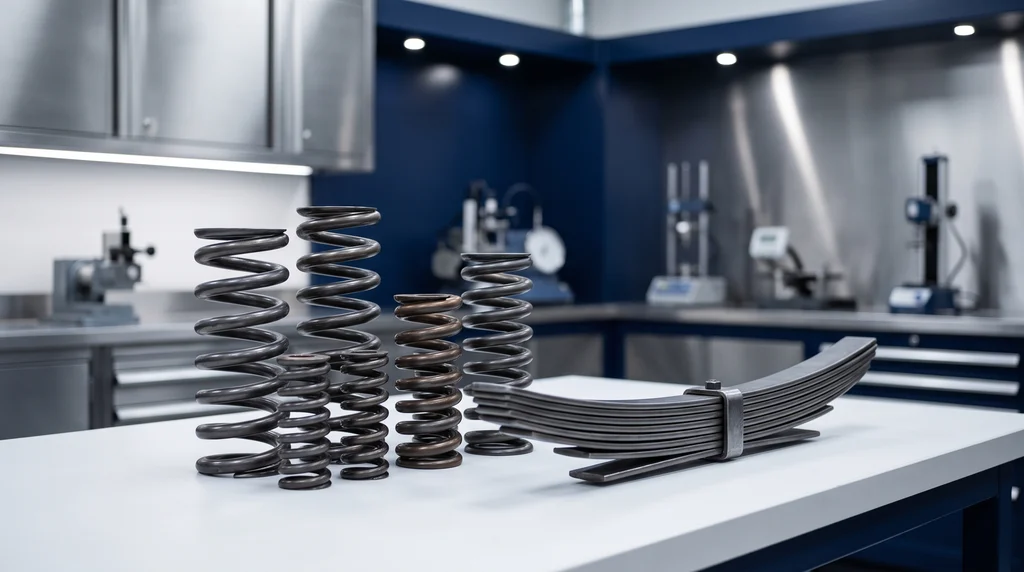
The photo shows coil springs and a leaf spring made of steel: these are the parts in which resilience is the main requirement, because they store elastic energy and release it in every cycle.
The term comes from 19th-century engineering. Thomas Tredgold introduced it in 1818 in the Philosophical Magazine (vol. 51, pp. 276 to 279) to explain why some timbers withstood sudden loads better than others of the same strength. Robert Mallet later developed the modulus of resilience, the per-unit-volume quantity still used today.
Two terms should be kept apart. Resilience is the property; the modulus of resilience, Ur, is its measure per unit volume and does not depend on the size of the part. The total energy a real part stores, sometimes called proof resilience, is the modulus multiplied by the stressed volume, and it is calculated further on. Resilience is part of elastic deformation and is one of the mechanical properties of materials obtained from the same tensile test curve.
Modulus of resilience formula: Ur = σe² / 2E
The strain energy per unit volume is the area under the stress-strain curve. A force F that elongates a bar by dΔL does the work F·dΔL; dividing by the volume A0·L0, the work per volume becomes σ·dε. Summing from zero up to the strain at yield, εe, gives Ur = ∫σ dε, a form that also applies to nonlinear curves such as that of rubber.
In metals, the portion up to yield is straight and obeys Hooke's law, σ = E·ε, where E is the modulus of elasticity. The area under a straight line starting at the origin is a triangle with base εe and height σe, so Ur = σe·εe / 2. Substituting εe = σe / E gives the form found in textbooks (Callister, ch. 6):
Ur = σe² / (2E)
The formula shows the two routes to a resilient material: a high yield strength, which enters squared, or a low modulus of elasticity, which sits in the denominator. Doubling σe quadruples the energy; an E three times lower, like that of aluminum compared with steel, triples the energy for the same σe. The table gathers the quantities and units used in the calculation:
| Quantity | Expression | SI unit |
|---|---|---|
| Modulus of resilience, general form | Ur = ∫σ dε, from 0 to εe | J/m³ |
| Modulus of resilience, linear range | Ur = σe·εe / 2 = σe² / (2E) | J/m³ |
| Strain at yield | εe = σe / E | dimensionless |
| Energy in a part under uniform stress | U = Ur·V = F·δ / 2 | J |
Energy released beyond yield
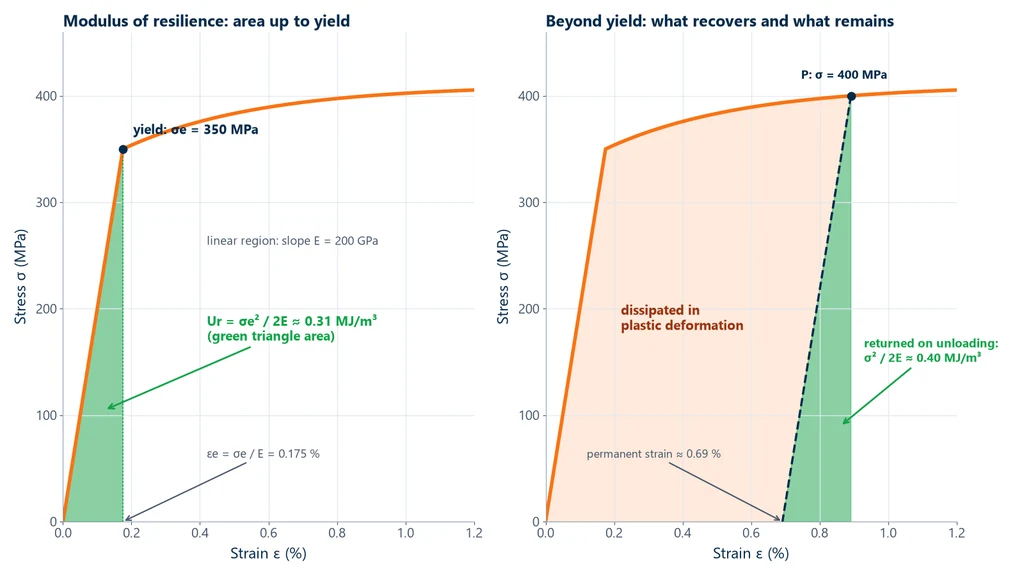
The formula has a more general reading. If the material is loaded beyond yield up to a stress σ and then unloaded, unloading follows a straight line of slope E, parallel to the initial elastic portion. The area under this unloading line, σ² / (2E), is the energy the material gives back; the rest of the area under the curve was spent on plastic deformation and remains in the material as permanent deformation and heat. At any point on the curve, therefore, the recoverable part of the energy is σ² / (2E), a result that follows from Hooke's law applied to unloading.
The chart below shows both situations on a teaching curve with E = 200 GPa and a yield strength of 350 MPa, a typical value for cold-drawn AISI 1020 steel. On the left, the green triangle is the modulus of resilience: base of 0.175%, height of 350 MPa and area of 0.31 MJ/m³. On the right, the specimen was taken to 400 MPa and unloaded: the green triangle under the unloading line is the energy released, 0.40 MJ/m³, and the light area to its left, as shown in the figure, is the energy dissipated, which leaves 0.69% permanent strain.
Energy stored in a part
The modulus of resilience is energy per volume. In a real part, it is multiplied by the stressed volume: U = Ur·V. In a bar under tension with area A0 and length L0, V = A0·L0. The same value comes from the force-elongation curve recorded by the machine: in the linear portion, the area under the F × ΔL curve up to yield is the triangle F·δ / 2, in joules. Multiplying by volume only applies under uniform stress, as in tension; bending and torsion are covered in the section on springs. Exercise 3 checks both calculations.
Unit of resilience
The modulus of resilience is energy per volume: joule per cubic meter, J/m³. Since 1 J = 1 N·m, 1 J/m³ = 1 N·m/m³ = 1 N/m² = 1 Pa. The dimension is the same as stress, which gives a useful shortcut: with σe and E in MPa, the calculation σe² / (2E) comes out in MPa, which is the same as MJ/m³. The most common conversions are:
- 1 kJ/m³ = 1 kPa;
- 1 MJ/m³ = 1 MPa = 1 J/cm³ = 1 N·mm/mm³;
- in US customary units, in·lbf/in³ = psi, and 1 psi ≈ 6.895 kJ/m³.
When writing the result, prefer MJ/m³ or kJ/m³ to MPa, because "0.31 MPa" is easily mistaken for a stress. Two errors appear in popular sources. The Portuguese Wikipedia describes resilience as energy "per surface", when the correct basis is per volume. And some tables on the internet give "0.16 kJ/m³" for mild steel, when the value is 0.16 MJ/m³: an error by a factor of one thousand.
Resilience on the stress-strain curve: why yield is used
On the stress-strain curve, point A is the proportional limit, the end of the straight portion, and point B is the elastic limit, the highest stress without permanent deformation. By definition, resilience would go up to B, the end of reversible behavior. In practice, it is calculated up to the yield strength, ReH for steel with a yield point plateau or Rp0.2 for other materials, and textbooks differ on the end point:
- Callister defines Ur up to yield, σy, which in practice is Rp0.2.
- Hibbeler (Mechanics of Materials) uses the proportional limit: ur = σlp² / (2E).
- Shigley refers to the area up to the elastic limit, "often approximated by the yield point".
- Dieter (Mechanical Metallurgy) explains why the elastic limit is not used: determining it is laborious, it is not part of routine testing and its value depends on the sensitivity of the instrument measuring strain.
The disagreement matters little for metals, because the three limits are very close. And, given the recoverable energy σ² / (2E) seen in the formula section, a calculation made with Rp0.2, which already includes 0.2% plastic strain, still gives the energy the material releases at that stress level. In addition, yield is the only one of the three measured by standard, under ISO 6892-1 and ASTM E8/E8M. The difference between elastic limit, ReH, ReL and Rp0.2 is detailed in the article on elastic limit and yield strength. In this article, σe always denotes the yield strength.
Resilience values by material
None of the standards consulted defines a dedicated modulus of resilience test for metals: it is calculated from E and σe. That is why a table of Ur only makes sense with the material condition alongside, since yield strength changes greatly with heat treatment and work hardening. In the calculations below, E for steels is 200 GPa, the value in ABNT NBR 8800:2008 (the Brazilian standard for the design of steel structures) used in the other articles on this site; E for aluminum and titanium comes from the data sheets of the materials themselves. Each value is the calculation σe² / (2E), with both quantities in MPa:
| Material and condition | σe (MPa) and E (GPa) | Ur (MJ/m³) | Data source |
|---|---|---|---|
| AISI 1020 steel, hot rolled | 205; 200 | 0.105 | typical (ASM); E from NBR 8800 |
| AISI 1020 steel, cold drawn | 350; 200 | 0.306 | typical (ASM); E from NBR 8800 |
| SAE 5160 spring steel, quenched and tempered at 540 °C | 1,041; 200 | 2.71 | typical (eFunda); E from NBR 8800 |
| SAE 5160 spring steel, quenched and tempered at 425 °C | 1,462; 200 | 5.34 | typical (eFunda); E from NBR 8800 |
| Aluminum 6061-T6 | 276; 68.9 | 0.553 | typical (ASM/MatWeb) |
| Titanium Ti-6Al-4V, annealed | 880; 113.8 | 3.40 | typical (Aerospace Metals data sheet) |
| Rubber (teaching value) | ≈ 2; ≈ 0.001 | ≈ 2 (nominal) | Dieter |
Two calculations show the procedure. For hot-rolled 1020, 205² / (2 × 200,000) = 42,025 / 400,000 = 0.105 MJ/m³. For 6061-T6, 276² / (2 × 68,900) = 76,176 / 137,800 = 0.553 MJ/m³. The rubber row is only an order of magnitude, because its curve is not linear: it shows that a very low E compensates for a low yield strength.
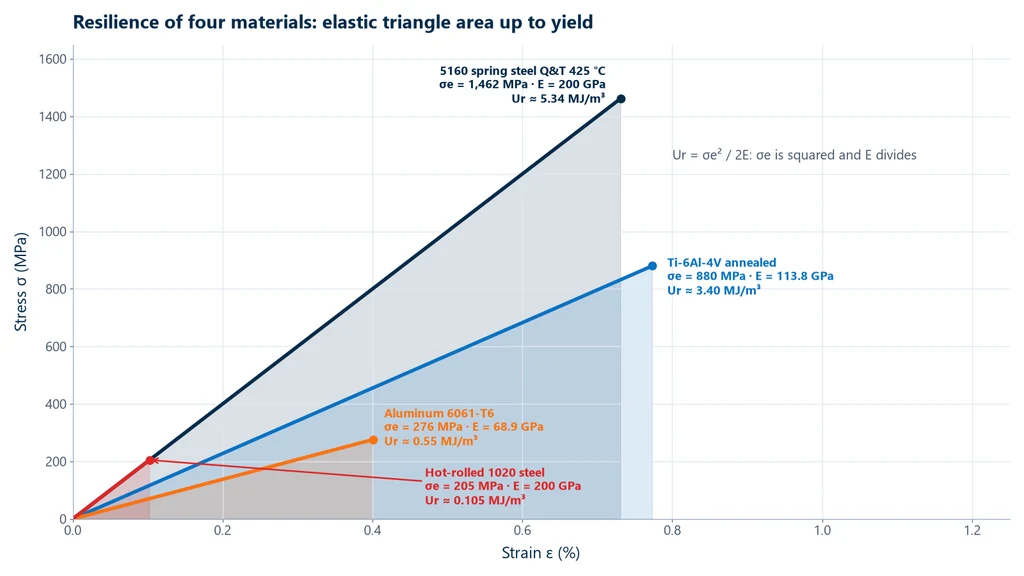
The chart below draws the triangles of four rows of the table on the same scale. 1020 steel and spring steel have the same E and therefore the same line; what changes is how far it goes. Aluminum has a flatter line and, with a yield strength only one third higher than that of 1020, stores about five times more energy. Ti-6Al-4V has 60% of the yield strength of spring steel and an E just above half, and stores almost two thirds of its energy.
What changes the resilience of a material
Since the E of an alloy hardly changes with processing (see modulus of elasticity of steel), the resilience of a given material follows its yield strength. Anything that raises yield strength raises resilience by its square: work hardening, which takes 1020 from 0.105 to 0.306 MJ/m³; quenching followed by tempering, which gives 5160 values of 2.7 to 5.3 MJ/m³ depending on the tempering temperature; grain refinement. Annealing does the opposite. Temperature and strain rate also change yield strength; the values in the table are at room temperature.
This leads to a counterintuitive conclusion: a stiffer material is not more resilient. For the same σe, a higher E gives a lower Ur, because the material reaches yield at a smaller strain and the triangle is narrower.
Resilience vs. toughness: the difference
Toughness is the energy a material absorbs up to fracture, that is, the total area under the curve, including the plastic portion. Resilience is only the initial triangle, and it is the only part of the energy that comes back. In a structural steel with σe = 250 MPa, Rm = 400 MPa, strain at fracture of 0.25 and E = 200 GPa, the modulus of resilience is 250² / 400,000 = 0.156 MJ/m³, and the estimated toughness is (250 + 400) / 2 × 0.25 ≈ 81 MJ/m³, about 520 times more. Almost all the energy a ductile metal absorbs comes from its ductility. The table summarizes the comparison:
| Resilience (Ur) | Toughness (UT) | |
|---|---|---|
| Range | elastic only | elastic and plastic, up to fracture |
| Area on the curve | triangle up to yield | total area up to fracture |
| Is the energy returned? | yes, on unloading | no, almost all is dissipated |
| What favors it | high σe and low E | strength and ductility together |
The two properties are independent: a spring steel has high resilience and limited ductility, and an annealed copper the opposite. The spring has to give the energy back; the tough part has to absorb an impact without breaking.
Materials for springs: why σe²/E decides
A spring exists to store elastic energy and give it back. Ashby (Materials Selection in Mechanical Design) shows that, for a spring of minimum volume, the best material is the one with the highest index σf² / E, where σf is the yield strength, whatever the shape of the spring. The index is twice Ur and ranks materials in the same order. The values of σf² / E reproduced from Ashby's table, in MJ/m³, are:
- rubber: 20 to 50;
- titanium alloys: 4 to 12;
- carbon fiber reinforced polymer (CFRP): 6 to 10;
- spring steel: 3 to 7;
- nylon: 1.5 to 2.5.
By volume, rubber beats spring steel by a wide margin, and by mass, with the index σf² / (E·ρ), it is about twenty times ahead. It does not replace steel in every spring because it has high internal damping: part of the energy of each cycle turns into heat instead of coming back, which is hysteresis. That is why it suits mounts and bumpers, while steel remains in suspension springs.
In steel, the resilience of a spring is built by heat treatment. Ashby and Jones (Engineering Materials 1) point out that springs are heavily hardened, and that annealing a spring removes that hardening, drops the yield strength and makes the material useless as a spring. In the previous table, the same 5160 loses half of its resilience just by being tempered at 540 °C instead of 425 °C.
Resilience in bending and in torsion
In bending and in torsion, only the most highly stressed fiber reaches yield; the rest of the cross-section works at lower stress and stores less energy. The result is a fraction of Ur·V. For a solid shaft in torsion, the energy is τmax²·V / (4G), half of what it would store if the whole section were at the maximum stress, with G the shear modulus, 77 GPa for steel. For a rectangular cantilever beam with a load at the tip, it is σmax²·V / (18E), one ninth of the value under uniform stress (Beer and Johnston, Mechanics of Materials). That is why helical springs (torsion) and leaf springs (bending) are designed by maximum stress. The corresponding tests are covered in the articles on the torsion test and the flexural test.
Do not confuse: three uses of the word resilience
The same word designates different quantities depending on the field and the country. Three uses deserve attention.
Resilient modulus of soils and pavements (MR)
In pavement engineering, the resilient modulus, MR, is the ratio between the applied deviator stress and the resilient strain, the recoverable part, in a repeated-load triaxial test: MR = σd / εr. The result is given in MPa and is a stiffness under cyclic loading, not an energy. In Brazil the test follows DNIT 134/2018-ME (the Brazilian highway agency standard for the resilient modulus of soils), and the MR feeds the MeDiNa design method (Brazil's mechanistic-empirical pavement design method). The triaxial test is covered in the article on the triaxial test, and the equipment for it is the Biopdi static and dynamic triaxial testing system, which meets DNIT 134/2018-ME. The test, the 18 stress pairs and the use in MeDiNa are covered in the article on the resilient modulus (MR).
"Resilience" in the Charpy test
In technical French, résilience is the impact fracture energy divided by the cross-sectional area under the notch, in J/cm², written KCU or KCV. The term entered Portuguese with this meaning in older texts. This energy includes plastic deformation and fracture, and it measures notch toughness, not elastic energy. The test is covered in the article on the impact test.
"Fracture resilience" does not exist
The expression appears in texts on the internet, including the previous version of this article, as if it were the ability to resist the propagation of a crack. That concept exists, but it is called fracture toughness, KIC, in MPa√m, and it is measured on a precracked test specimen. Resilience ends at yield and does not involve fracture; for the same reason, it is not measured in an impact test.
How to obtain resilience from a tensile test
The modulus of resilience comes from two quantities measured in the tensile test: the modulus of elasticity and the yield strength. The procedure has four steps:
- Measure strain with an extensometer, of at least class 1 per ISO 9513. In steel, the strain at yield is a few tenths of a percent, of the same order as the slack in the grips and the deformation of the machine itself; measured from crosshead displacement, it comes out inflated, E comes out underestimated and Ur comes out overestimated.
- Determine E by fitting a straight line to the linear portion, as described in ASTM E111.
- Determine yield, ReH or Rp0.2, per ISO 6892-1 or ASTM E8/E8M.
- Calculate Ur = σe² / (2E) or numerically integrate the curve up to yield.
For polymers and elastomers, whose initial portion is not straight, the curve measured per ASTM D638 or ISO 527-1 is integrated up to the stress of interest.
Solved exercises
The five exercises follow the order of the article. The steels use E = 200 GPa.
Exercise 1: modulus of resilience of spring steel
SAE 5160 steel, quenched and tempered at 425 °C, with σe = 1,462 MPa and E = 200 GPa. Calculate εe and Ur.
- εe = σe / E = 1,462 / 200,000 = 0.00731 (0.73%).
- Ur = 1,462² / (2 × 200,000) = 2,137,444 / 400,000 = 5.34 MJ/m³.
- Check: σe·εe / 2 = 1,462 × 0.00731 / 2 = 5.34 MJ/m³.
Exercise 2: 1020 steel versus 6061-T6 aluminum
Compare hot-rolled 1020 steel (205 MPa; 200 GPa; density 7.87 g/cm³) with 6061-T6 (276 MPa; 68.9 GPa; density 2.70 g/cm³).
- Ur of the steel = 205² / 400,000 = 0.105 MJ/m³; of the aluminum = 276² / 137,800 = 0.553 MJ/m³.
- By volume, the aluminum stores 0.553 / 0.105 ≈ 5.3 times more.
- By mass: steel 105,000 / 7,870 = 13.3 J/kg; aluminum 552,800 / 2,700 = 205 J/kg, about 15 times more.
Exercise 3: energy stored in a bar
A 6061-T6 bar with a diameter of 10 mm and a length of 500 mm, loaded in tension up to σe = 276 MPa.
- A = π × 10² / 4 = 78.54 mm²; V = 78.54 × 500 = 39,270 mm³ = 3.927 × 10⁻⁵ m³.
- U = Ur·V = 552,800 J/m³ × 3.927 × 10⁻⁵ m³ = 21.7 J.
- Check using the force-elongation curve: F = 276 × 78.54 = 21,677 N; δ = (276 / 68,900) × 500 = 2.00 mm; U = F·δ / 2 = 21,677 × 0.002003 / 2 = 21.7 J.
Exercise 4: resilience from a tensile test
Illustrative data. Cylindrical steel test specimen with d0 = 10.0 mm and an extensometer with L0 = 50 mm. In the linear portion, F = 15.0 kN corresponds to ΔL = 0.0463 mm; yield appears at F = 25.1 kN.
- A0 = 78.54 mm²; σ = 15,000 / 78.54 = 191.0 MPa; ε = 0.0463 / 50 = 9.26 × 10⁻⁴.
- E = 191.0 / 9.26 × 10⁻⁴ = 206,300 MPa ≈ 206 GPa.
- σe = 25,100 / 78.54 = 319.6 MPa.
- Ur = 319.6² / (2 × 206,300) = 102,144 / 412,600 = 0.248 MJ/m³ (248 kJ/m³).
- In the volume between the extensometer knife edges, 78.54 × 50 = 3,927 mm³, the energy is 0.248 × 10⁶ × 3.927 × 10⁻⁶ ≈ 0.97 J.
The elongation at yield is only 0.077 mm: that is why the extensometer is indispensable.
Exercise 5: minimum yield strength for a spring
A spring steel needs Ur ≥ 2.07 MJ/m³ (300 psi, the requirement of a Callister problem), with E = 200 GPa. What is the minimum yield strength, and which materials in the table meet it?
- σe = √(2·E·Ur) = √(2 × 200,000 × 2.07) = √828,000 = 910 MPa.
- The 5160 tempered at 540 °C (1,041 MPa, 2.71 MJ/m³) meets it; cold-drawn 1020 (350 MPa, 0.306 MJ/m³) does not.
- Annealed Ti-6Al-4V has a yield strength of 880 MPa, below 910, and still meets it (3.40 MJ/m³), because its E is 113.8 GPa. The right criterion is Ur, not σe alone.
Standards cited
The standards below define the quantities that go into the calculation of the modulus of resilience, or the concepts it is confused with:
| Standard | Scope | Edition |
|---|---|---|
| ABNT NBR ISO 6892-1 | tensile testing of metals at room temperature (Brazilian adoption of ISO 6892-1): ReH, ReL, Rp0.2 | 2024 |
| ISO 6892-1 | tensile testing of metals at room temperature | 2019 |
| ASTM E8/E8M | tensile testing of metals, offset yield strength | E8/E8M-25 |
| ASTM E111 | determination of the modulus of elasticity | E111-17(2025)e1 |
| ISO 9513 | calibration and classes of extensometers | 2012 |
| ASTM D638 | tensile testing of plastics | D638-22 |
| ISO 527-1 | tensile testing of plastics, general principles | 2019 |
| ABNT NBR 8800 | design of steel structures, Brazilian standard (E = 200 GPa) | 2008 |
| ISO 148-1 | Charpy impact test (the French résilience) | 2016 |
| ASTM E23 | notched bar impact testing of metals | E23-25 |
| DNIT 134-ME | resilient modulus of soils (MR), repeated-load triaxial test, Brazilian standard | 2018 |
Machine for calculating resilience
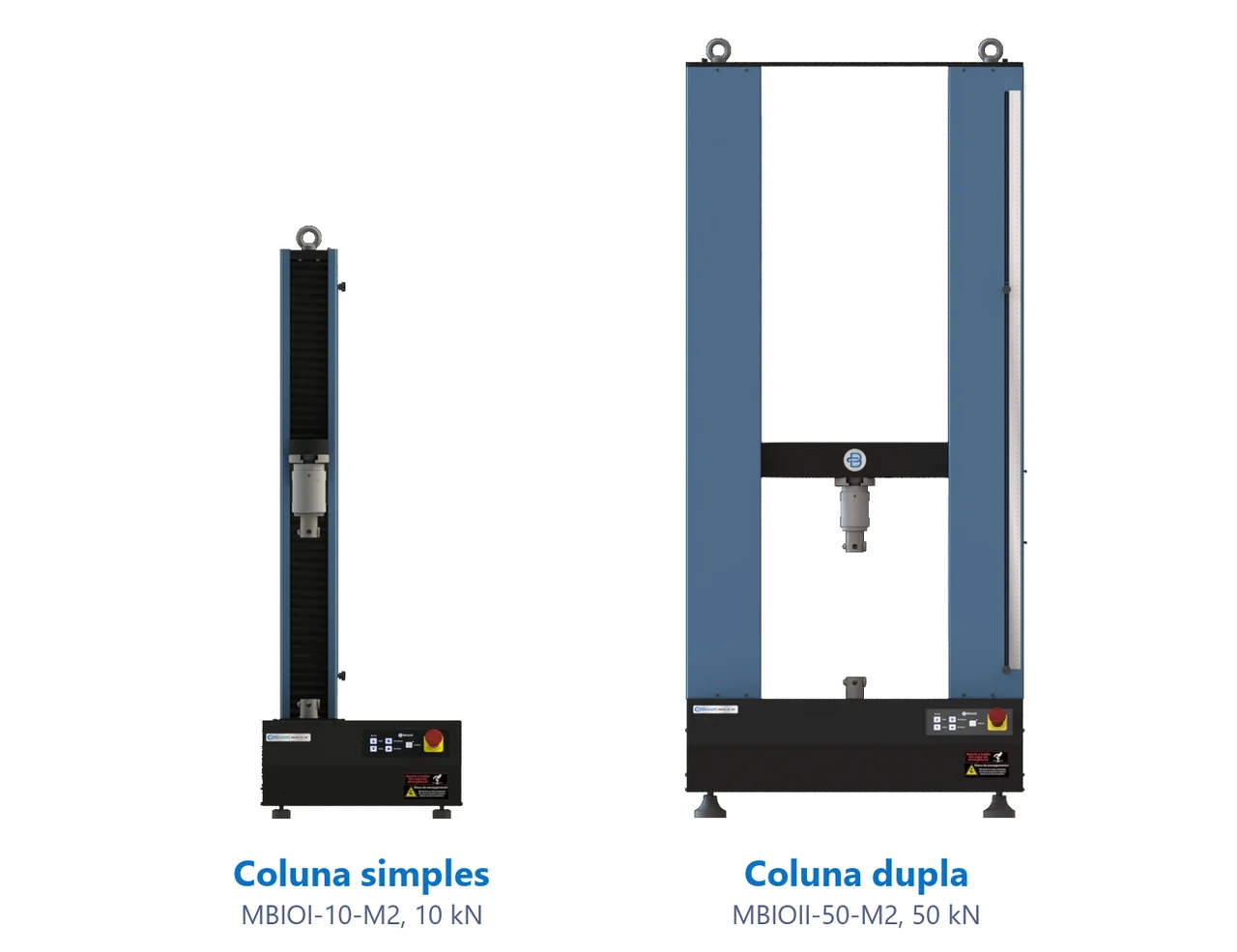
Since the modulus of resilience is calculated from E and the yield strength, the equipment is the same as for the tensile test: a universal testing machine with a class 1 load cell and an extensometer on the test specimen. The Biopdi M2 universal testing machine is electromechanical, has clip-on extensometers and the BioLab software, which plots the curve and calculates E and yield strength. The panel below shows the machine, the role of each part in the resilience calculation and the grips used.
The universal testing machine in the tensile test
The M2 line has single-column models, from 200 N to 10 kN, and dual-column models, from 5 kN to 1,000 kN. Each part of the machine has a function in obtaining the modulus of resilience:
- Moving crosshead pulls the test specimen at the speed set by the standard
- Load cell measures force, class 1, for the yield strength
- Grips: wedge, pneumatic, for threaded specimens or wires
- Extensometer measures strain over the gauge length, indispensable for E and Rp0.2
- BioLab software plots the curve, calculates E and yield strength and builds the report
- Control panel and emergency stop position and stop the test
Fixtures for the tensile test
The fixtures below are mounted on the same machine, depending on the test specimen and the standard:
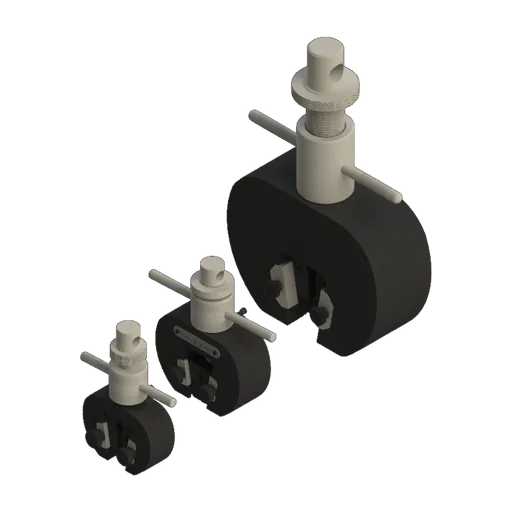 Wedge grip5, 20 and 200 kN
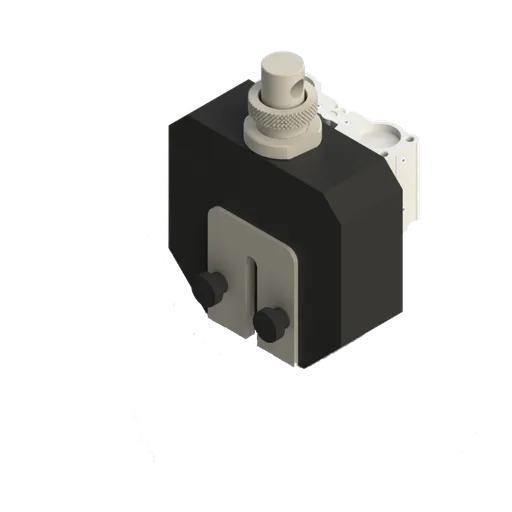 Pneumatic wedge grip50 and 200 kN
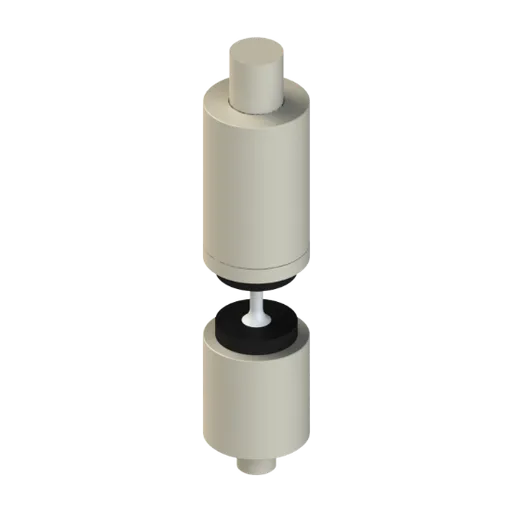 Grip for threaded specimensbolts and threaded test specimens
For spring steel, fasteners and metallic test specimens such as the one in exercise 4, the recommended model is the 5 to 50 kN universal testing machine (MBIOII-50-M2). For rubbers and elastomers, whose resilience requires integrating the whole curve and whose elongation is large, the extended-column version, 2 to 10 kN, provides the necessary stroke. In the BioLab software, custom calculation formulas let you create your own quantities from force, position and extensometer data. The other capacities are on the universal testing machine page.
Other tests and technical references
Toughness of materials: what it is, how to calculate it and units
Toughness is the energy a material absorbs before fracturing. Learn how to calculate it, units, the Charpy test, fracture toughness and reference values.
Hooke's law: formula, graph and solved problems
Hooke's law: F = k·x for a spring, σ = E·ε for materials and the generalized 3D form. Formula, graph, experiment, 7 solved problems and a simulator.
Elastic and plastic deformation: what elastic deformation is, formula, difference and examples
Elastic deformation is the reversible deformation of a solid: the bonds between atoms stretch without breaking, and the part returns to its original size when the load is removed. See the formula ε = σ/E, where elastic deformation ends, how it differs from plastic deformation, how much each material deforms, resilience, elastic recovery, rubber and solved exercises.
Mechanical properties of materials: what they are, the main types, tests, standards and steel values
The mechanical properties of materials define how a material responds to forces: how much it deforms, whether it returns to its shape, how much load it carries, how much energy it absorbs and how it fractures. See each property with its unit, test and standard, the values for steel (NBR 8800, the Brazilian steel structures design standard; ASTM A36; CA-50, the Brazilian rebar grade), the pairs that are often confused and solved exercises.
Frequently asked questions
What is the resilience of materials?
It is the ability of a material to absorb energy when it deforms elastically and to release it when the load is removed, with no permanent deformation. It is the "spring effect" of springs, bows and rubber bands.
What is the modulus of resilience of materials (Ur)?
It is the elastic energy per unit volume that the material absorbs up to yielding: the area of the triangle under the stress-strain curve up to σe (Callister). For 6061-T6 aluminum, it is about 0.55 MJ/m³. In pavement engineering, the same name refers to MR (resilient modulus), a stiffness under repeated loading, in MPa.
What is the formula for the modulus of resilience?
Ur = σe²/(2E), which is the same as σe·εe/2 in the linear range. With σe and E in MPa, the result comes out directly in MJ/m³. In pavement engineering, "resilient modulus" is a different quantity, MR = σd/εr, in MPa.
What is the unit of resilience?
Joule per cubic meter (J/m³), which is dimensionally equal to the pascal. In practice, kJ/m³ or MJ/m³ are used, with 1 MJ/m³ = 1 MPa = 1 J/cm³. In US customary units, in·lbf/in³ = psi.
What is the difference between resilience and toughness?
Resilience is only the elastic energy, which is recovered on unloading: the area up to yielding. Toughness is all the energy absorbed up to fracture, including the plastic part. In a typical structural steel, toughness is about 520 times the resilience (81 versus 0.156 MJ/m³).
What are examples of resilience?
A car suspension spring, the bow of a bow and arrow and a rubber band: all of them store elastic energy and give it back. Spring steel, titanium alloys, carbon fiber composites and elastomers are the best spring materials.
Why is the yield strength used instead of the elastic limit?
Because the elastic limit is difficult to determine and depends on the sensitivity of the extensometer, while yielding (ReH or Rp0.2) is measured according to standards. In metals the difference is small, and the calculation with the yield strength gives the recoverable energy at that point.
What is the resilience of steel?
It depends on the condition, because the yield strength varies a lot: about 0.105 MJ/m³ for hot-rolled 1020, 0.306 MJ/m³ for cold-drawn 1020 and 5.34 MJ/m³ for 5160 spring steel quenched and tempered at 425 °C, all with E = 200 GPa.
Is a stiffer material more resilient?
No. For the same yield strength, a higher E gives a lower Ur, because E is in the denominator. That is why 6061-T6 stores about five times more elastic energy per unit volume than hot-rolled 1020 steel.
Is resilience the result of the Charpy test?
No. In French, "résilience" (KCU or KCV, in J/cm²) refers to the impact fracture energy, a measure of notch toughness. The modulus of resilience is elastic energy, with no fracture, and is calculated from the tensile test.
What is the resilient modulus of soils?
It is the ratio between the deviator stress and the resilient strain in a repeated-load triaxial test, in MPa, used in pavement design. It follows DNIT 134/2018-ME (the Brazilian standard for this test) and is a stiffness, not an energy. The test and the calculation are covered in the article on the resilient modulus (MR).
Who introduced the concept of resilience in engineering?
Thomas Tredgold, in 1818, in the paper "On the resilience of materials; with experiments", published in the Philosophical Magazine. Robert Mallet later developed the modulus of resilience, the quantity per unit volume.