
Engineering materials fall into four classes: metals, ceramics, polymers and composites. The first three differ in the type of chemical bond between atoms (metallic; ionic or covalent; and covalent with secondary forces between chains), and that is what explains the stiffness, ductility and service temperature of each one. Composites combine two or more classes to get what none of them has on its own.
This is the classification used by Callister and Rethwisch (Materials Science and Engineering: An Introduction, ch. 1). The same authors treat advanced materials separately, such as semiconductors and biomaterials, which are defined by their application and can belong to any class. Below: what sets each class apart, typical properties with sources, the Ashby chart, how to select a material and how to test each one.
What are the types of materials in engineering
In engineering, classifying materials means grouping them by chemical bonding and internal structure, because that is where their properties come from. Metals have metallic bonding, ceramics have ionic bonding, covalent bonding or a mix of the two, and polymers are long chains of atoms held together by covalent bonds. A composite is not a fourth type of bond: it is the combination of two or more of these classes, with a continuous phase, the matrix, and a reinforcing phase. Studying, developing and testing these classes is the work of materials engineering.
Ten common examples, already classified:
- Steel: ferrous metal.
- Aluminum: nonferrous metal.
- Copper: nonferrous metal.
- Glass: noncrystalline ceramic.
- Alumina (aluminum oxide): technical ceramic.
- Porcelain: traditional ceramic.
- Polypropylene (PP): thermoplastic polymer.
- PVC: thermoplastic polymer.
- Vulcanized rubber: elastomer.
- Concrete and carbon fiber with epoxy: composites.
Two other classifications should not be confused with this one: the split between natural and synthetic materials, which is a teaching device and says nothing about mechanical behavior, and the "materials classification" used in supply management, which organizes inventory items.
The table below summarizes the four classes; each row is explained in the following sections.
| Class | Bonding | Examples | Typical behavior |
|---|---|---|---|
| Metals | metallic | steel, aluminum, copper, titanium | conductive, deform plastically before fracture |
| Ceramics | ionic and covalent | alumina, silicon carbide, glass, porcelain | stiff, refractory, insulating and brittle |
| Polymers | covalent along the chain, secondary between chains | PP, PVC, epoxy, rubber | light, low stiffness, soften with heat |
| Composites | those of the phases that form them | CFRP, fiberglass, concrete, wood | designed properties, direction-dependent |
Chemical bonding: why each class behaves differently
In metallic bonding, the valence electrons do not belong to any one atom: they form a shared cloud surrounding the positive ions. Because this bond has no preferred direction, planes of atoms can slide over one another without breaking the solid apart. This slip occurs through the motion of dislocations, linear defects in the crystal lattice, and it is the origin of the plastic deformation and ductility of metals. The free electrons also explain their good thermal and electrical conductivity.
In ceramics, ionic or covalent bonding is strong and directional. Shifting a plane of atoms requires bringing like-charged ions together or breaking oriented bonds, so dislocations barely move. The result is high stiffness, high melting temperature, electrical insulation and brittleness: instead of yielding, the ceramic lets a small crack grow until fracture.
In polymers, the atoms within each chain are held by covalent bonds, but the chains are bonded to each other by secondary forces, van der Waals forces or hydrogen bonds, tens of times weaker. Under load, it is these interchain bonds that give way. That is why polymers have a low modulus, low density and low service temperature. The table shows the relationship between bonding energy and melting temperature:
| Bond | Substance | Bonding energy (kJ/mol) | Melting point (°C) |
|---|---|---|---|
| Ionic | NaCl | 640 | 801 |
| Ionic | MgO | 1,000 | 2,800 |
| Covalent | Si | 450 | 1,410 |
| Covalent | C (diamond) | 713 | > 3,550 |
| Metallic | Hg | 68 | −39 |
| Metallic | Al | 324 | 660 |
| Metallic | Fe | 406 | 1,538 |
| Metallic | W | 849 | 3,410 |
| Van der Waals | Ar | 7.7 | −189 |
| Hydrogen bond | H2O | 51 | 0 |
Source: Callister and Rethwisch, Table 2.3. The rule that follows from it holds for all classes: the higher the bonding energy, the higher the melting temperature and the modulus of elasticity tend to be.
Metals: ferrous and nonferrous
Metals are divided into ferrous, iron-based, and nonferrous. Ferrous metals dominate thanks to their cost and their combination of strength, toughness and formability; nonferrous metals come in when the design calls for low weight, conductivity or corrosion resistance.
Ferrous: steel and cast iron
Steel is an iron-carbon alloy with up to about 2.14% carbon by weight; above that, the alloy is cast iron (Callister, ch. 11). Cast iron melts at a lower temperature and fills the mold well, which suits engine blocks and housings; gray cast iron is brittle in tension. Steel can be rolled, forged, stamped and drawn.
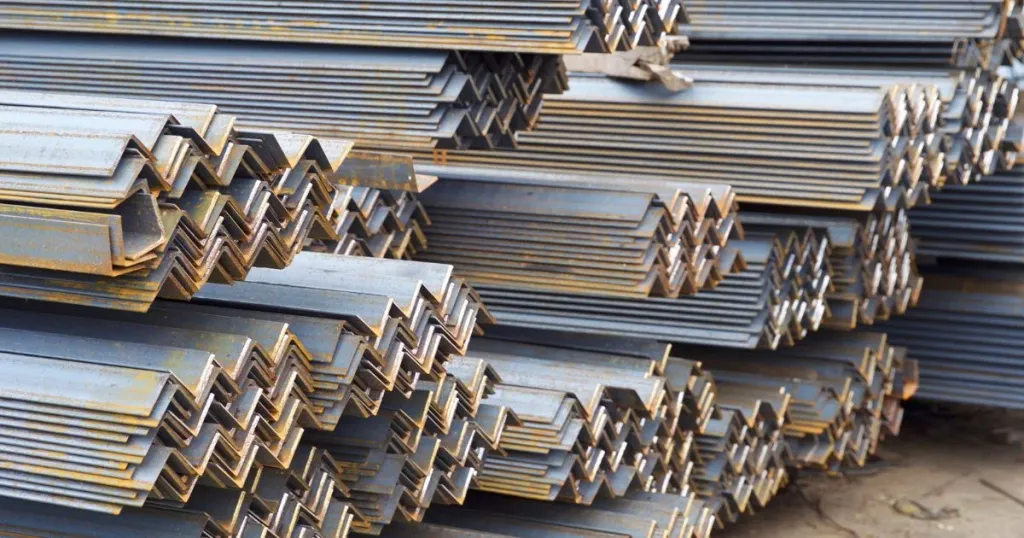
Plain carbon steel rusts. Corrosion resistance comes from three routes: alloying, coating or painting. Stainless steel contains at least about 11% chromium, which forms a thin protective oxide layer on the surface (Callister). A food can is made of tinplate, low-carbon steel coated with tin: the tin protects the steel but is not part of the alloy. The photo shows stacks of hot-rolled steel angles, the type of section used in steel structures and tensile tested to check the mill certificate.
The properties of the same steel change with processing. Hot-rolled 1020 steel yields at about 205 MPa; cold-drawn, at about 350 MPa. Quenching, tempering and annealing change the microstructure and, with it, hardness and strength, the subject of the article on heat treatment of metals. The modulus of elasticity, by contrast, barely changes: the design value is 200 GPa under ABNT NBR 8800 (the Brazilian standard for steel structures), and 210 GPa for reinforcement under NBR 6118 (the Brazilian standard for concrete structures); the difference from the roughly 207 GPa found in textbooks is explained in the article on the modulus of elasticity of steel.
Nonferrous: aluminum, copper, titanium and magnesium
Aluminum has a density of 2.70 g/cm³, about one third that of steel, and a modulus of 69 GPa. It conducts heat well, which takes it into heat sinks, and its low weight takes it into aircraft and vehicle bodies. Copper is the standard electrical conductor for wires and busbars, with a modulus of 110 to 117 GPa; alloyed with zinc it forms brass, and with tin, bronze. Titanium and the Ti-6Al-4V alloy combine high strength, a density of about 4.4 g/cm³ and excellent corrosion resistance, which takes them into aerospace and implants. Magnesium, at 1.74 g/cm³, is the lightest structural metal.
Metals can be recycled by remelting, but not without limits: residual elements build up in scrap, such as copper and tin in steel, and mixing alloys forces scrap to be diluted with primary metal to keep the specified composition.
Ceramics: traditional, technical and glasses
Ceramics are compounds of metallic and nonmetallic elements, usually oxides, nitrides and carbides. They are divided by raw material and application.
Traditional and technical ceramics
Traditional ceramics start from natural raw materials: clay, which gives the body plasticity for shaping; feldspar, which acts as a flux; and silica, which forms the skeleton of the piece. They include bricks, roof tiles, sanitaryware, porcelain and wall and floor tiles. The rule that every ceramic contains clay and feldspar applies only to them.
Technical, or advanced, ceramics use high-purity synthetic powders, with no clay: alumina (Al2O3), zirconia, silicon carbide and silicon nitride. The powder is compacted and consolidated by sintering, below the melting temperature. They appear in cutting tools, insulators, seals, implants, armor and in the piezoelectric ceramics of ultrasonic transducers, which convert pressure into an electrical signal.
Brittleness defines how a ceramic is designed and tested. In the Accuratus data sheet for 99.5% alumina, compressive strength is 2,600 MPa and flexural strength is 379 MPa: compression is about 7 times higher, because cracks close in compression and open in tension. That is why technical ceramics work well under compression and are characterized in flexure, not in tension. The fracture toughness of the same alumina is 4 MPa·√m, against 110 MPa·√m for an AISI 4130 steel (Dowling, via the article on toughness).
Glasses
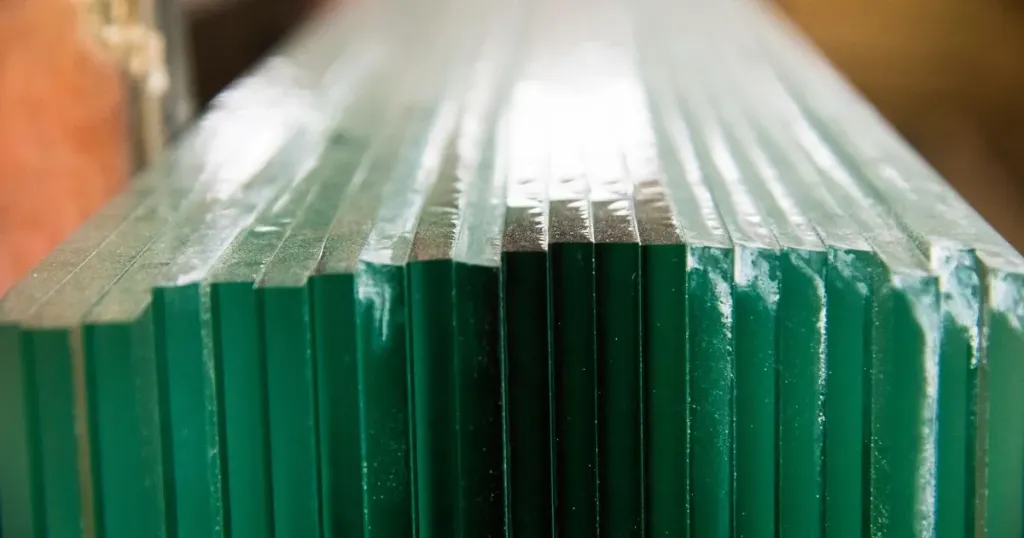
Glass is a noncrystalline ceramic: the atoms do not form an ordered lattice, because the material cools too fast to crystallize. Ordinary window glass is soda-lime glass, silica-based, with a modulus of about 69 GPa, practically the same as aluminum, and a fracture toughness of about 0.76 MPa·√m. The strength of a sheet depends more on surface scratches than on composition, which is why glass tempering, which leaves the surface in compression, raises strength so much. The photo shows stacked glass sheets: the green color of the edges comes from the iron oxide present in the raw material.
Polymers: thermoplastics, thermosets and elastomers
Polymers are materials made of macromolecules, long chains of repeating units called mers. The engineering classification is not by use (plastic, rubber, fiber) but by chain structure, which defines how the material responds to heat.
- Thermoplastics have independent chains, held only by secondary forces. They soften when heated and can be remelted and reshaped: polyethylene (PE), polypropylene (PP), PVC, PET, polystyrene (PS) and polycarbonate (PC).
- Thermosets have chains linked to one another by covalent bonds, the crosslinks, formed during curing. They do not remelt: when overheated, they degrade. Examples: epoxy, phenolic resins and unsaturated polyester, typical matrices for composites.
- Elastomers accept large elastic deformation and return to their shape. Vulcanized rubber is lightly crosslinked and does not melt, which is why old tires are ground up and reused, for example as rubber added to asphalt. Thermoplastic elastomers (TPE) melt and can be injection molded.
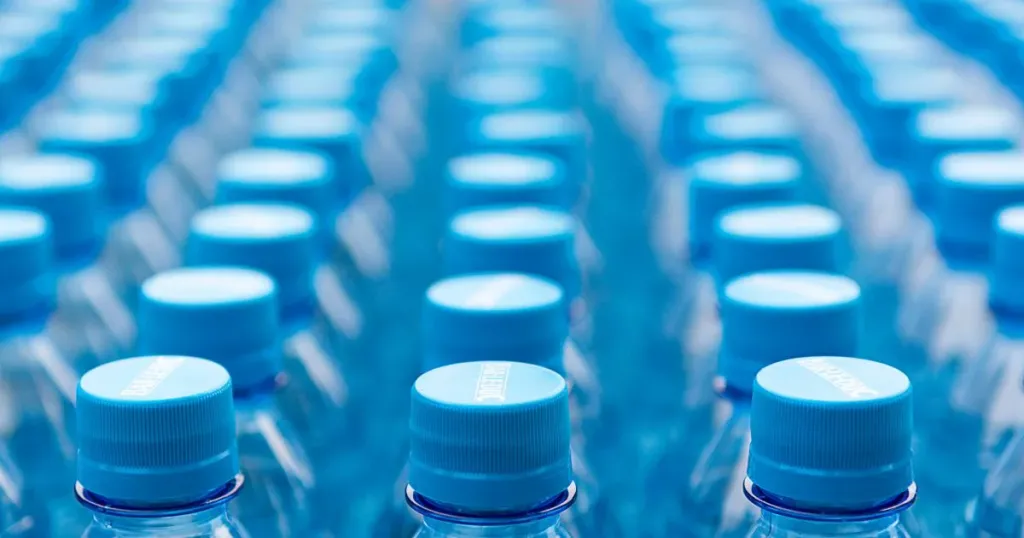
"Fiber" is not a class: it is the form in which a polymer is used. PET and nylon become textile fibers; aramid (Kevlar) is a high-strength polymer fiber; cotton is a natural cellulose fiber, another polymer. The photo shows water bottles: the body is PET and the caps are usually polypropylene or high-density polyethylene, two different thermoplastics in the same package, which must be separated for recycling.
The mechanical behavior of polymers depends on temperature and loading rate much more than that of metals. Below the glass transition temperature, an amorphous polymer is stiff and brittle; above it, it becomes rubbery. That is why plastics testing standards specify the test speed and the conditioning of the test specimen. The origin of the raw material is another axis: biodegradable polymers, such as PLA, are thermoplastics that break down through the action of microorganisms under controlled conditions.
Composites: matrix, reinforcement and direction
A composite is a material with two or more phases from different classes, designed to combine their qualities: the matrix holds the whole together and transfers the load, and the reinforcement, in particles or fibers, provides stiffness and strength. The mud brick with straw, used since antiquity, was already a composite: the straw fibers hold the mud together and reduce drying cracks. By matrix, composites are divided into three groups:
- Polymer matrix (PMC): carbon fiber with epoxy (CFRP), glass fiber with polyester (GFRP) and aramid with epoxy. Kevlar on its own is a fiber; the composite is the fiber in the matrix.
- Metal matrix (MMC): for example, aluminum reinforced with silicon carbide particles.
- Ceramic matrix (CMC): for example, silicon carbide reinforced with silicon carbide fibers, for hot turbine parts.
With aligned fibers, properties depend on direction, which is called anisotropy. In the data sheet for Toray T700S carbon fiber, the unidirectional laminate with epoxy and 60% fiber by volume has a modulus of 134 GPa and a tensile strength of 2,860 MPa in the fiber direction (0°), but only 81 MPa at 90°, when the load falls entirely on the matrix; that is why parts stack plies in several directions. The density estimated by the rule of mixtures, ρc = Vf·ρf + (1 − Vf)·ρm, is 0.6 × 1.80 + 0.4 × 1.2 = 1.56 g/cm³, taking the fiber at 1.80 g/cm³ (Toray) and the resin at 1.2 g/cm³ (range of 1.11 to 1.4 g/cm³).
Composites in civil construction
Concrete is a particulate composite: coarse and fine aggregates in a cement paste matrix. Reinforced concrete adds a second reinforcement, the steel bars, which carry the tension that concrete cannot withstand; the behavior of concrete as a material is covered in the article on the modulus of elasticity of concrete. Steel on its own is not a composite: it is a metal alloy. Wood and bone are natural composites, with cellulose and collagen fibers reinforcing a matrix.
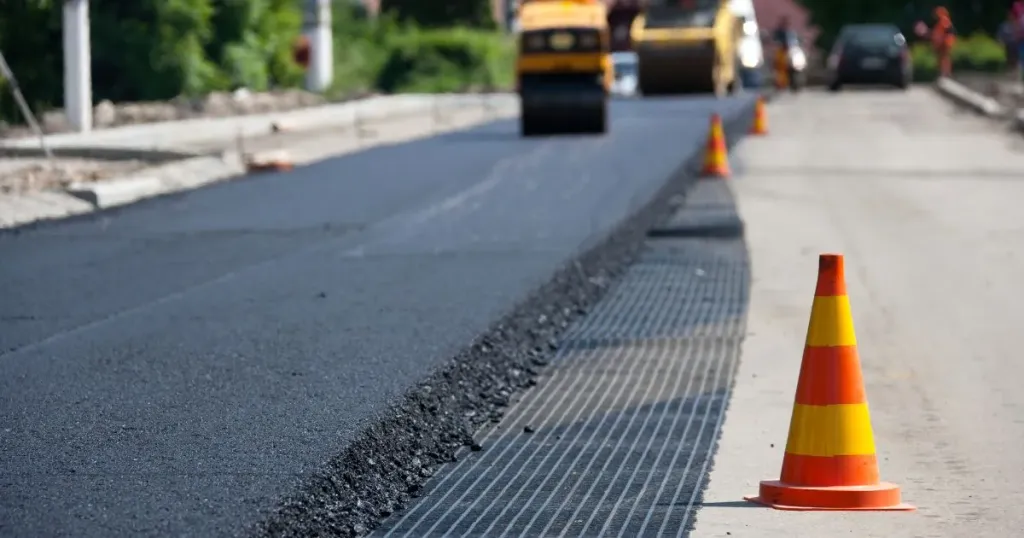
Asphalt mix is also a particulate composite, made of mineral aggregate and asphalt binder. In the photo, the roller compacts the freshly laid mix; beside it, a reinforcement grid is laid over the base, adding a second reinforcing phase to the pavement.
The design of this mix is controlled in the laboratory by the Marshall test (DNER-ME 043, the Brazilian Marshall test method), which compresses cylindrical specimens of the mix to measure stability and flow. The following video presents the Biopdi CBR/Marshall test press, which performs the Marshall test as well as the CBR test on soils.
Semiconductors and biomaterials
Semiconductors and biomaterials are not new chemical classes. They are advanced materials, defined by their function, and each one fits into one of the four classes.
Semiconductors have an electrical conductivity between that of conductors and that of insulators. It is controlled by adding impurities in very small concentrations, a process called doping (Callister, ch. 1). Silicon, the most important of them, has covalent bonding (450 kJ/mol, melting point 1,410 °C) and behaves mechanically like a brittle ceramic. Its modulus ranges from 130 to 185 GPa depending on the crystal direction (Engineering ToolBox).
Biomaterials, as defined by Williams (Biomaterials, 2009), are substances engineered to direct a therapeutic or diagnostic procedure through interactions with living systems. There are metallic biomaterials (Ti-6Al-4V in implants), ceramic biomaterials (zirconia in prostheses; hydroxyapatite, the mineral in bone, in grafts), polymeric biomaterials (PMMA in bone cement) and composites (dental resins with ceramic filler). Implant design runs into a stiffness problem. Titanium alloy has a modulus of 105 to 120 GPa and cortical bone has 10 to 20 GPa. An implant that is too stiff carries the load the bone should be carrying, and the surrounding bone loses mass. In dentistry, the durability of restorations and implants is evaluated under repeated loading through mechanical cycling.
Typical properties by class
The differences between the classes become clear when you compare the density, modulus of elasticity and strength of representative materials side by side. Every value below is either a typical value or a specification minimum, and the material condition is given for each one. The same designation changes with heat treatment, direction and batch, so only a test on the actual batch can replace the table. The article on mechanical properties of materials explains what each property means.
| Material and condition | ρ (g/cm³) | E (GPa) | Strength (MPa) |
|---|---|---|---|
| ASTM A36 steel, minimums | 7.85 | 200 | yield ≥ 250; Rm 400 to 550 |
| 1020 steel, hot rolled, typical | 7.85 | 200 | yield 205; Rm 380 |
| Aluminum 6061-T6, typical | 2.70 | 69 | Rp0.2 276; Rm 310 |
| Ti-6Al-4V, annealed | 4.43 | 105 to 120 | yield 925 |
| Alumina 99.5% | 3.89 | 375 | flexural 379; compressive 2,600 |
| Soda-lime glass | 2.4 to 2.8 | 69 | governed by surface flaws |
| Concrete | 2.0 to 2.4 | 25.4 to 36.6 | compressive: fck of the strength class |
| Polypropylene | 0.90 | 1.14 to 1.55 | tensile 27 |
| Rigid PVC | 1.33 | 2.41 to 4.14 | tensile 48 |
| PTFE | 2.1 | 0.4 | tensile 13 |
| Rubber, small strain | 1.1 | 0.01 to 0.1 | large elongation at break |
| CFRP T700S/epoxy, Vf 60% | 1.56 (estimated) | 134 at 0° | 2,860 at 0°; 81 at 90° |
| Oak, parallel to the grain | 0.72 | 11 | depends on moisture content |
Sources: steel, ABNT NBR 8800:2008 (the Brazilian standard for the design of steel structures; design values of E and ρ), ASTM A36 and MatWeb (1020); aluminum, Callister and MatWeb/ASM; Ti-6Al-4V, Engineering ToolBox (E of titanium alloys), Wikipedia (ρ) and Dowling (yield strength); alumina, Accuratus data sheet; glass and concrete, Sonelastic/ASM (E) and Engineering ToolBox (ρ); polymers, Callister, Table B.2 (E of PP and PVC) and Engineering ToolBox (the rest); CFRP, Toray T700S data sheet, with ρ calculated by the rule of mixtures; oak, Engineering ToolBox.
Fracture toughness separates the classes even more than the modulus does. The values below are at room temperature and match those in the article on toughness:
| Material | KIc (MPa·√m) | Source |
|---|---|---|
| AISI 4130 steel | 110 | Dowling, Table 8.1 |
| Ti-6Al-4V, annealed | 66 | Dowling, Table 8.1 |
| Aluminum 7075-T651 | 29 | Dowling, Table 8.1 |
| Alumina 99.5% | 4 | Accuratus |
| ABS | 3.0 | Dowling, Table 8.2 |
| Polycarbonate | 2.2 | Dowling, Table 8.2 |
| Soda-lime glass | 0.76 | Dowling, Table 8.2 |
| Concrete | 0.2 to 1.4 | Dowling, Table 8.2 |
Technical ceramics are stiffer and lighter than steel, but their tolerance to cracks is dozens of times lower. Hard does not mean tough, a difference covered in the article on hardness. Fiber composites reach the stiffness of metals with a density close to that of polymers, but only in the fiber direction.
Ashby chart and how to select a material
An Ashby chart plots two properties on logarithmic axes, usually the modulus of elasticity E against the density ρ, and shows each family of materials as a region of the chart (Ashby, Acta Metallurgica, 1989). On a log-log scale, each ratio between the properties becomes a straight line.
The chart below uses the materials cited in this article, not the full regions from Ashby's databases. Each material appears as a point when the source gives a single value and as a rectangle or bar when it gives a range. The data come from ABNT NBR 8800 (steel), Callister, Engineering ToolBox, the Accuratus (alumina) and Toray (CFRP, with estimated density) data sheets, and Sonelastic/ASM. The dashed lines pass through steel.
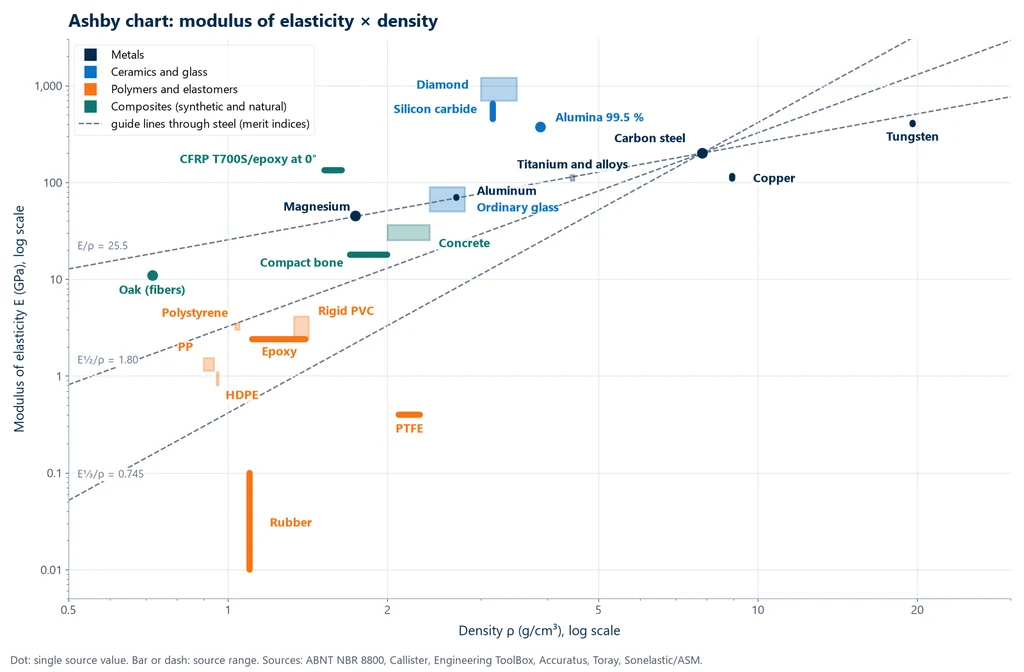
The lines correspond to three Ashby material indices (Materials Selection in Mechanical Design, 4th ed., 2011), each for a lightweight, stiff component with a different function: E/ρ for a tie, with slope 1 on the chart; E1/2/ρ for a beam in bending, with slope 2; and E1/3/ρ for a plate in bending, with slope 3. Any material above a line outperforms steel on that criterion, and any material below it falls short. Aluminum lies almost on the E/ρ line of steel but well above the beam and plate lines. CFRP and technical ceramics lie above all three.
The index is a screening tool within a four-step method: define the function of the part (tie, beam, plate); list the constraints (temperature, corrosion, cost, manufacturing process); choose the objective (minimum mass, cost or volume); and, using the index and the chart, eliminate candidates and confirm the remaining ones by testing the actual batch.
Example: a light, stiff beam in steel, aluminum or CFRP
A beam with a square cross-section, fixed length and fixed stiffness, with a free cross-section size, must have the lowest possible mass. The index is M = E1/2/ρ, and the mass of the beam is inversely proportional to it.
- Steel: √200 / 7.85 = 14.14 / 7.85 = 1.80.
- Aluminum 6061-T6: √69 / 2.70 = 8.31 / 2.70 = 3.08.
- CFRP T700S/epoxy at 0°: √134 / 1.56 = 11.58 / 1.56 = 7.42.
For the same stiffness, the aluminum beam weighs 1.80 / 3.08 = 58% of the steel beam, and the CFRP beam 1.80 / 7.42 = 24%, provided the fibers are aligned with the beam axis. For a tie, the result changes: E/ρ gives 200 / 7.85 = 25.5 for steel and 69 / 2.70 = 25.6 for aluminum, a tie, so the decision moves to cost, corrosion and strength. Alumina would score 4.98 as a beam, but its brittleness eliminates it at the constraints step for almost any structural part.
How to test each type of material
The material class defines the test, the specimen and the force range. The article on the main mechanical tests describes each test; this section covers what changes from one class to another.
- Metals: the tensile test gives the yield strength, Rm, elongation and, with an extensometer, the modulus. The curve shows the elastic region, yielding, work hardening and necking, as in the stress-strain curve.
- Polymers: tensile testing on dog-bone (dumbbell) specimens, with test speed and conditioning set by the standard, and flexural testing for the flexural modulus reported in data sheets.
- Elastomers: tensile testing with long crosshead travel, because elongation at break is far greater than that of any metal.
- Technical ceramics: flexural test on small bars, because tensile testing requires almost perfect alignment and grip pressure tends to initiate cracks. The curve is linear up to fracture, with no plastic plateau.
- Composites: in-plane tensile testing of the laminate, with the specimen cut in the direction of interest and that direction recorded in the test report; the curve of CFRP at 0° is nearly linear up to fracture.
- Concrete and mortar: compression test on cylindrical specimens.
The table summarizes the main standard for each class; the editions are listed in the standards section.
| Class | Main test | Standards | Typical force |
|---|---|---|---|
| Metals | tensile | ABNT NBR ISO 6892-1, ASTM E8/E8M | from a few kN (wires) to hundreds of kN (bars) |
| Plastics | tensile and flexural | ASTM D638, ISO 527-1; ASTM D790, ISO 178 | up to a few kN |
| Elastomers | tensile with high elongation | ASTM D412 | hundreds of N |
| Technical ceramics | flexural | ASTM C1161 | hundreds of N |
| Polymer matrix composites | in-plane tensile | ASTM D3039/D3039M | tens of kN |
| Concrete | compression | ABNT NBR 5739 (Brazilian standard) | hundreds of kN |
Example: tensile test of polypropylene
An ASTM D638 Type I PP specimen, with a gauge section of 13 mm × 3.2 mm, breaks at a maximum force of 1.12 kN. The area is S0 = 13 × 3.2 = 41.6 mm², and Rm = 1,120 / 41.6 = 26.9 MPa, consistent with the typical 27 MPa for PP. A force of about 1 kN calls for a low-capacity load cell, such as the one on the single-column universal testing machine from 2 to 10 kN (MBIOI-10-M2). For rubbers and films, the version with extended travel of 1,290 mm is the high-elongation machine.
Example: flexural test of alumina
A 99.5% alumina bar with width b = 4 mm and depth d = 3 mm is tested in three-point bending with a span L = 40 mm. With the flexural stress σ = 3FL / (2bd²) and the data sheet strength of 379 MPa, the fracture force is F = 2bd²σ / (3L) = (2 × 4 × 9 × 379) / (3 × 40) = 27,288 / 120 = 227 N. ASTM C1161 uses bars of this size range and recommends four-point bending, which subjects a longer length of the bar to the maximum stress.
Machine capacity, metallography and software
The maximum test force determines the machine. A round A36 steel specimen 12.5 mm in diameter (S0 = 122.7 mm²) reaches 550 × 122.7 = 67.5 kN and calls for the 100 to 200 kN machine (MBIOII-200-M2); thin sheets and composites fit the dual-column 5 to 50 kN machine (MBIOII-50-M2). Choosing the capacity and the grips is covered in the article on the universal testing machine, and the models are on the universal testing machine page. The BioLab software converts force and displacement into stress and strain and generates the report according to the selected standard. Compression testing of concrete specimens is done on the electric and hydraulic concrete compression testing machines.
In metals, metallography shows why the material performs the way it does: grain size, phases, inclusions and surface treatment layers. The sample is cut on the metallographic cutting machine, polished on the grinding and polishing machine and examined under the metallurgical microscope.
Standards cited
The table lists the testing standards cited in the article, with the current edition checked on September 30, 2026 where indicated:
| Standard | Scope | Edition |
|---|---|---|
| ABNT NBR ISO 6892-1 | tensile testing of metals at room temperature (Brazilian adoption of ISO 6892-1) | 2024 |
| ISO 6892-1 | tensile testing of metals at room temperature | 2019 |
| ASTM E8/E8M | tensile testing of metals | E8/E8M-25 |
| ASTM D638 | tensile testing of plastics | D638-22 |
| ISO 527-1 | tensile testing of plastics, general principles | 2019 |
| ASTM D790 | flexural testing of plastics | D790-25 |
| ISO 178 | flexural testing of plastics | 2019 |
| ASTM D412 | tensile testing of vulcanized rubber and thermoplastic elastomers | D412-16(2021) |
| ASTM C1161 | flexural strength of advanced ceramics | C1161-18(2023) |
| ASTM D3039/D3039M | tensile testing of polymer matrix composites | D3039/D3039M-17(2025) |
| ABNT NBR 5739 | compression testing of cylindrical concrete specimens (Brazilian standard) | 2018 |
| ABNT NBR 8800 | design of steel structures (design values; Brazilian standard) | 2008 |
| DNER-ME 043 | Marshall test of asphalt mixtures (Brazilian highway test method) | current |
Other tests and technical references
Materials engineering: what it is, what materials engineers do, degree, legal duties and salary
Materials engineering relates processing, structure, properties and performance of metals, polymers, ceramics and composites to select, develop, manufacture and test the right material for each use. See what a materials engineer does, the professional duties defined by Confea (Brazil's Federal Council of Engineering and Agronomy), the degree curriculum, where to study in Brazil, salaries reported in Caged (Brazil's formal employment registry) and the Brazilian minimum engineering salary set by Law 4.950-A/66.
Heat treatment of metals: what it is, types, iron-carbon diagram and TTT curves
Heat treatment is the controlled heating and cooling of a solid metal to change its microstructure and, with it, hardness, strength and toughness, without changing the shape of the part. See the three stages, the iron-carbon diagram (eutectoid at 727 °C and 0.77% C), TTT and CCT curves, microstructures, the families of treatments, 6061-T6, how to choose the process and how to verify the result.
Annealing of steel: what it is, types, temperatures and effects on properties
Annealing is the heat treatment that heats the metal, holds it at temperature and cools it slowly, usually inside the furnace, to reduce hardness and internal stresses and restore ductility and machinability. In steel, full annealing austenitizes about 30 to 50 °C above Ac3, and the subcritical types stay below Ac1 (stress relief annealing at 550 to 650 °C, spheroidizing at 700 to 720 °C). See the types, temperatures, microstructure, effects with numbers and how to check the result.
Biodegradable polymers: what they are, types (PLA, PHA, PBAT, PBS, PCL, starch), standards and mechanical properties
Biodegradable polymers are plastics that microorganisms convert into CO₂, water and biomass, rather than simply breaking into fragments. Biodegradation depends on the environment: PLA reaches 90% in six months only under industrial composting. Learn the difference between biodegradable, compostable, bio-based and oxo-degradable, plus the types, standards, mechanical properties and how to test them.
Frequently asked questions
What are the 4 types of materials?
In engineering, they are metals, ceramics, polymers and composites (Callister and Rethwisch, ch. 1). The first three differ in their chemical bonding: metallic bonding in metals, ionic or covalent bonding in ceramics, and covalent bonding with secondary forces between the chains in polymers. A composite combines two or more classes, such as carbon fiber in an epoxy matrix.
What are 10 examples of materials?
Steel, aluminum and copper (metals); glass, alumina and porcelain (ceramics); polypropylene, PVC and vulcanized rubber (polymers); and carbon fiber with epoxy (composite). Concrete is also a composite, made of aggregate in a cement matrix.
What is the difference between metals, ceramics and polymers?
Metals conduct electricity and deform plastically before they fracture. Ceramics are stiff, refractory and brittle: alumina has a KIc of about 4 MPa·√m, compared with 110 MPa·√m for a 4130 steel. Polymers are light, with a density close to 1 g/cm³ and a modulus of 1 to 4 GPa, and they soften at low temperature.
What are composite materials?
They are materials with two or more phases from different classes, a matrix and a reinforcement, combined to obtain properties that neither has on its own. A T700S carbon fiber/epoxy laminate reaches 134 GPa and 2,860 MPa in the fiber direction, with a density of about 1.56 g/cm³ (Toray data sheet). Wood and bone are natural composites.
Is glass a ceramic material?
Yes. Glass is a non-crystalline ceramic, silica-based in the case of soda-lime glass. It has a modulus of about 69 GPa and a fracture toughness of about 0.76 MPa·√m, which explains why it cracks so easily from a scratch.
Are semiconductors and biomaterials classes of materials?
Not in the chemical sense. Callister treats them as advanced materials, defined by their application. Silicon is covalent and brittle like a ceramic, and a biomaterial can be a metal (Ti-6Al-4V), a ceramic (zirconia), a polymer (PMMA) or a composite (dental resin), according to Williams (2009).
What is the stiffest material?
Among engineering materials, diamond, with a modulus of 700 to 1,220 GPa depending on the source. In structural applications, technical ceramics lead: silicon carbide at 450 to 650 GPa and 99.5% alumina at 375 GPa, compared with 200 GPa for steel.
How do you choose the type of material for a part?
Define the function, the constraints (temperature, environment, cost, process) and the objective, such as minimum mass. Then calculate the material index, E/ρ for a tie and E1/2/ρ for a beam (Ashby), screen the candidates on the chart and validate them by testing the actual production lot.
How is each type of material tested?
Metals: tensile test per ISO 6892-1 (ABNT NBR ISO 6892-1 in Brazil) or ASTM E8/E8M. Plastics: tensile test per ASTM D638 or ISO 527-1 and flexural test per ASTM D790 or ISO 178. Rubbers: ASTM D412. Technical ceramics: flexural test per ASTM C1161. Composites: ASTM D3039/D3039M. Concrete: compression test per ABNT NBR 5739 (the Brazilian standard for concrete compression testing). All of them can be run on a universal testing machine with the appropriate load cell and grips.
What is the Ashby chart?
It is a log-log plot of two properties, such as modulus of elasticity and density, in which each family of materials occupies its own region (Ashby, 1989). Lines of slope 1, 2 and 3 represent the indices E/ρ, E1/2/ρ and E1/3/ρ and show at a glance the candidates for light, stiff ties, beams and panels.
What are natural and artificial materials?
Natural materials are used as nature provides them or with little processing, such as wood, stone and cotton. Artificial, or synthetic, materials are produced by industry, such as steel, plastic and glass. This is a classification taught in elementary school; engineering classifies materials by chemical bonding and structure.
What does "classification of materials" mean?
In engineering, it means grouping materials into metals, ceramics, polymers and composites according to chemical bonding and structure. In supply management, the same term refers to organizing inventory items for purchasing and control. They are different subjects.