
The modulus of elasticity of carbon steel is between 190 and 210 GPa. In Brazil, ABNT NBR 8800 (the Brazilian standard for the design of steel and composite structures) uses 200 GPa (200,000 MPa) for structural steel, and ABNT NBR 6118 (the Brazilian standard for the design of concrete structures) uses 210 GPa for passive reinforcement in concrete. Austenitic stainless steel, such as 304, is close to 193 GPa.
In other units, 200 GPa is 200,000 MPa, 200,000 N/mm² and 20,000 kN/cm². The value comes from the relation E = σ / ε, stress divided by strain in the elastic region, and it measures the stiffness of steel, not its strength. The general concept, with the comparison between materials and the relationship between the moduli, is covered in the article on the modulus of elasticity or Young's modulus. This article deals only with steel: the values given by standards, the table by steel type, unit conversion, what does and does not change the modulus, temperature, testing and worked examples.
What the modulus of elasticity measures in steel
Under a small load, a steel bar stretches slightly and returns to its original length when the load is removed. This is elastic deformation: the atoms move away from their equilibrium positions without changing neighbors, and the bonds between them behave like springs. In this regime, the stress σ = F / A0 (force divided by the original area, in MPa) increases in the same proportion as the strain ε = ΔL / L0 (elongation divided by the original length). This is Hooke's law, σ = E·ε, and the constant E is the modulus of elasticity.
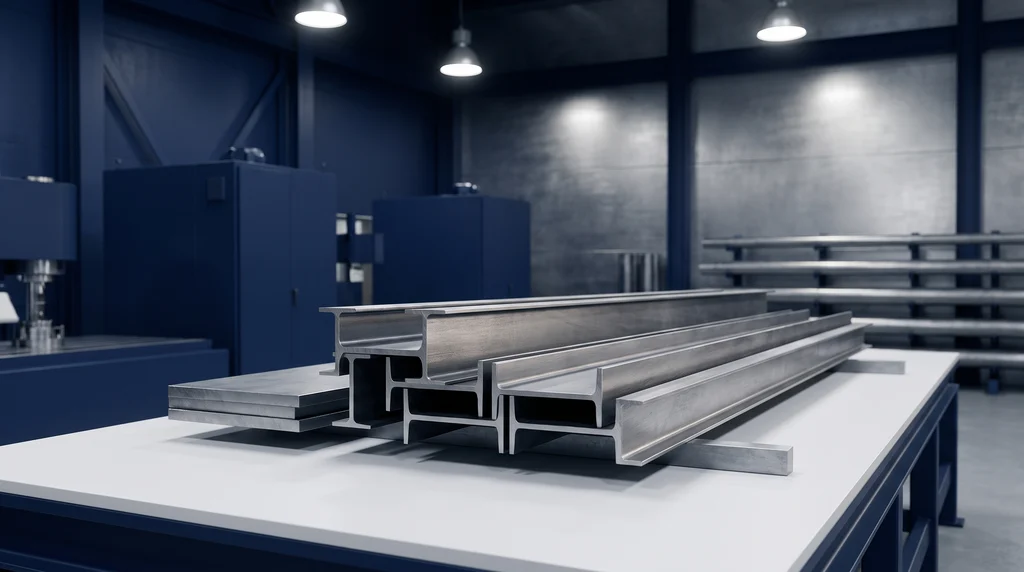
In the photo, I-beams and structural steel plates: whatever the strength grade of these steels, the modulus used in design is the same, 200 GPa according to NBR 8800.
On the stress-strain curve, E is the slope of the initial straight portion. In steel, this portion ends at a strain on the order of 0.1% to 0.2%, at the proportional limit, just below the elastic limit; above it the steel yields, that is, it starts to accumulate permanent deformation. The modulus therefore only applies below yielding and in the absence of creep, which is the condition set by ASTM E111.
A high modulus means that steel deforms little under a given stress: it is stiffness. Strength is a different question, namely at what stress the steel yields or fractures, and most mistakes with the modulus of steel come from treating the two as if they went together. In design, the modulus governs deflections, displacements and buckling, and many serviceability limit states are about deformation: a beam can be far from failure and still be unacceptable because it deflects too much.
What is the modulus of elasticity of steel: 200 or 210 GPa?
Both values are correct, because they come from different design standards. Neither of them claims that the steel in a given structure has exactly that modulus; they set a single value so that everyone calculates deflections and deformations the same way.
- ABNT NBR 8800:2008, item 4.5.2.9 (steel and composite structures): E = 200,000 MPa, with shear modulus G = 77,000 MPa, Poisson's ratio ν = 0.3, thermal expansion coefficient of 1.2 × 10⁻⁵ °C−1 and density of 7,850 kg/m³. ABNT NBR 14762:2010 (the Brazilian standard for cold-formed steel members) uses the same values.
- ABNT NBR 6118:2023, item 8.3.5 (passive reinforcement in concrete): "in the absence of tests or values provided by the manufacturer, the modulus of elasticity of steel may be taken as 210 GPa", a value used for CA-25, CA-50 and CA-60 (Brazilian reinforcing steel grades).
- EN 1993-1-2 (Eurocode 3): Ea = 210,000 MPa at 20 °C, the reference for the temperature reduction factors discussed below.
The practical rule is to use the value of the design standard: 200 GPa for steel structures under NBR 8800 and 210 GPa for reinforced concrete under NBR 6118. Swapping one for the other changes the calculated deflection by 5%, which rarely decides a design but creates discrepancies between calculation reports. Outside the standards, databases give 190 to 210 GPa for carbon and low-alloy steels, and Callister uses 207 GPa as a typical value. The table summarizes the values set by standards:
| Standard | Application | E adopted |
|---|---|---|
| ABNT NBR 8800:2008 | steel and composite structures | 200 GPa |
| ABNT NBR 14762:2010 | cold-formed steel members | 200 GPa |
| ABNT NBR 6118:2023 | passive reinforcement in concrete | 210 GPa |
| EN 1993-1-2:2005 | structural steel, reference at 20 °C | 210 GPa |
Modulus of elasticity of steel in MPa, N/mm², kgf/cm², kN/cm² and kN/m²
The modulus has units of stress, because strain is dimensionless. For steel, the convenient multiple of the pascal is the gigapascal: 1 GPa = 1,000 MPa, and since 1 MPa = 1 N/mm², the value in N/mm² is the same as in MPa. With 1 kN/cm² = 10 MPa, 1 kN/m² = 0.001 MPa and 1 kgf = 9.80665 N, it follows that 1 GPa equals 100 kN/cm², 106 kN/m², about 10,197 kgf/cm² and about 145.04 ksi.
The most common error involves kN/cm². It is often stated, including in automated search engine answers, that steel has "about 210,000 kN/cm²". This is wrong by a factor of 10: 210,000 kN/cm² would be 2,100 GPa. The correct values are 20,000 kN/cm² for 200 GPa and 21,000 kN/cm² for 210 GPa; 210,000 is the value in MPa with the wrong unit attached. The table gives the three usual values:
| Unit | 200 GPa | 205 GPa | 210 GPa |
|---|---|---|---|
| MPa and N/mm² | 200,000 | 205,000 | 210,000 |
| kN/cm² | 20,000 | 20,500 | 21,000 |
| kN/m² (kPa) | 2.0 × 10⁸ | 2.05 × 10⁸ | 2.1 × 10⁸ |
| kgf/cm² | ≈ 2,039,400 | ≈ 2,090,400 | ≈ 2,141,400 |
| kgf/mm² | ≈ 20,394 | ≈ 20,904 | ≈ 21,414 |
| psi | ≈ 29.0 × 10⁶ | ≈ 29.7 × 10⁶ | ≈ 30.5 × 10⁶ |
| ksi | ≈ 29,008 | ≈ 29,733 | ≈ 30,458 |
In kgf/cm², common in older calculation reports, steel is about 2.04 × 10⁶ (200 GPa) or 2.14 × 10⁶ (210 GPa). In US data sheets, the 29,000 ksi of A36 is the same 200 GPa.
Modulus of elasticity by steel type
The values by steel type show two things: the modulus varies little from one carbon steel to another, while yield strength varies a lot. The table below brings together the most searched steels, with typical yield strength alongside to make the contrast visible, and the source for each row. These are typical database values; for design the standard applies, and for material acceptance the test of the batch applies.
| Steel and condition | E (GPa) | Typical yield strength (MPa) | Source |
|---|---|---|---|
| ASTM A36 | 200 | 250 | MatWeb/ASM |
| SAE 1020 | ≈ 205 (186 to 207 across databases) | 350 | Kloeckner; Sonelastic/ASM; MatWeb |
| SAE 1045 cold drawn | 206 | 515 | MatWeb |
| SAE 1045 quenched and tempered (595 HB) | 206 | 1,259 | MatWeb |
| SAE 4140 quenched and tempered at 205 °C | 205 | ≈ 1,600 to 1,700, depending on the source | MatWeb |
| SAE 4340 | 207 | n/a | Sonelastic/ASM |
| CA-50 rebar (design value) | 210 | 500 (fyk) | ABNT NBR 6118; ABNT NBR 7480 |
| 304 stainless steel | 193 (193 to 200) | 215 | AK Steel; MatWeb/ASM |
| 316/316L stainless steel | 193 | n/a | Sonelastic/ASM |
| Ductile iron 60-40-18 | 169 | n/a | Sonelastic/ASM |
| Gray cast iron (G1800 to G4000) | 66 to 138 | n/a | Sonelastic/ASM |
Cast irons are not steels, but they are included in the table because they are often confused with them; the reason for their lower modulus is explained in the section on what changes the modulus.
Modulus of elasticity of A36 steel
ASTM A36, a structural steel for plates and shapes, has E = 200 GPa (29,000 ksi) in the MatWeb/ASM data sheet, with G = 79.3 GPa and ν = 0.26; other ASM compilations give 207 GPa. The minimum yield strength in the product standard is 250 MPa.
Modulus of elasticity of 1020 and 1045 steel
SAE 1020 is around 205 GPa (Kloeckner), with 207 GPa in the Sonelastic table based on ASM. MatWeb lists 186 GPa in some data sheets for cold-rolled and normalized 1020; the difference reflects the source and the method behind the data, not a "more flexible" 1020, and it is one more reason to use the value from the standard. SAE 1045 has 206 GPa both cold drawn, with a yield strength of 515 MPa, and quenched and tempered to 595 HB, with 1,259 MPa: the heat treatment multiplied the yield strength by 2.4 and did not touch the modulus.
Modulus of elasticity of CA-50 steel
For CA-50 rebar (the most common Brazilian reinforcing steel grade), the design value is Es = 210 GPa, from NBR 6118, in the absence of a test or a manufacturer's value. ABNT NBR 7480:2024 (the Brazilian standard for steel bars and wires for concrete reinforcement) sets the characteristic yield strength fyk at 500 MPa. In design, the design yield stress is fyd = 500 / 1.15 = 435 MPa, and the strain at which the reinforcement starts to yield is εyd = fyd / Es = 435 / 210,000 = 2.07‰. This is where the modulus of steel enters the design: it marks the transition from the straight portion to the plateau of the bilinear design diagram, detailed in the article on the stress-strain curve.
Modulus of elasticity of 304 and 316 stainless steel
304 stainless steel has about 193 GPa according to AK Steel and ASM, within a range of 193 to 200 GPa depending on the source; 316 is also about 193 GPa. That is 3% to 4% less than carbon steel: little for most calculations, but enough to show up when comparing deflections of the same section or when checking a modulus test on stainless steel.
Why the modulus barely changes between steels
The previous table includes steels with yield strengths from 250 MPa to about 1,700 MPa and a modulus between 200 and 207 GPa. The explanation lies in what each property measures. The modulus depends on the strength of the bonds between iron atoms and on the crystal arrangement they are in. Strength is governed by the movement of dislocations, linear defects in the lattice whose slip produces plastic deformation. Heat treatment, small alloying additions and work hardening control dislocations and, with them, yield strength, but they do not change the iron lattice or the strength of its bonds.
The clearest example is A36 versus 4140 oil quenched and tempered at 205 °C. A36 yields at 250 MPa and has E = 200 GPa; 4140 in this condition yields at about 1,600 to 1,700 MPa, depending on the source, and has E = 205 GPa. The yield strength is almost 7 times higher and the modulus is practically the same. The graph below plots both curves on the same axes: up to 250 MPa they overlap, because they rise along the same line; A36 stops there, at the yield plateau, and 4140 continues at the same slope up to about 1,450 MPa, only then curving toward the offset yield strength, Rp0.2, which is the stress that leaves 0.2% permanent strain (see yield strength).
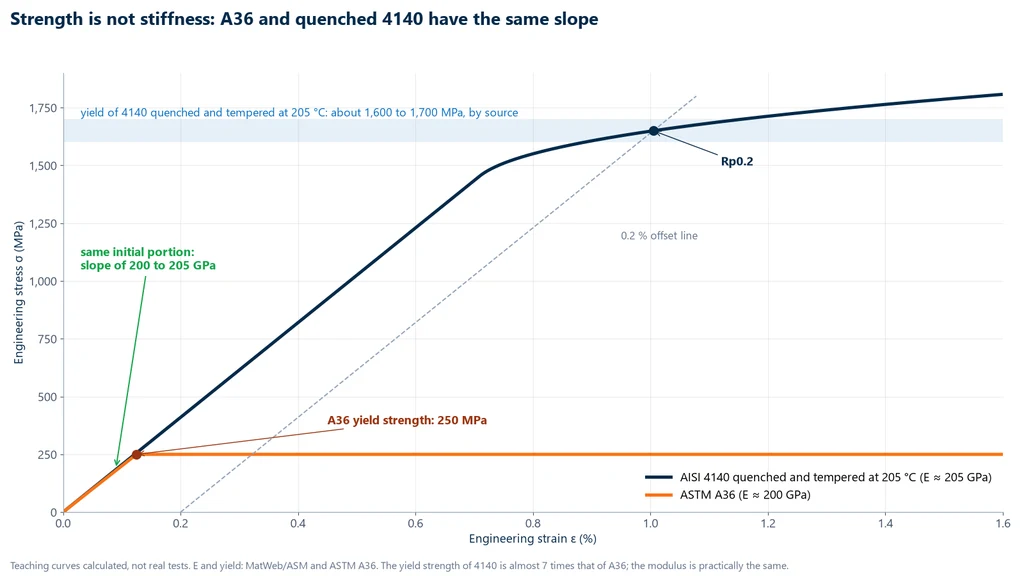
The same applies to the factors usually cited as causes of a change in modulus. Between a low-carbon and a high-carbon steel the difference is a few percent. Annealing, quenching and tempering change the microstructure without a significant effect on the modulus, as the 1045 and 4140 in the table show. And ferrite, pearlite, bainite and martensite have very similar moduli; martensite, contrary to intuition, tends to be slightly below ferrite.
The design consequence is direct: you do not increase the stiffness of a steel part by changing the steel. A higher-strength grade raises the load before yielding, but it does not reduce the deflection under service load. Stiffness is controlled by geometry: the second moment of area of the section, the span and the supports. If a beam deflects too much, increasing the section depth solves it; changing the steel does not. It is also this insensitivity that allows standards to adopt a single modulus for the whole family of structural steels, while specifying yield strength grade by grade.
What actually changes the modulus of steel
The modulus of steel changes appreciably in only a few situations: when the crystal lattice changes, when the grains become oriented, when a very different second phase appears, or when the temperature rises. Temperature, the most important case in practice, has its own section right after this one.
Crystal structure: why austenitic stainless steel has a lower modulus
Carbon and low-alloy steels have, at room temperature, a body-centered cubic structure (ferrite). Austenitic stainless steels, such as 304 and 316, have a face-centered cubic structure, stabilized by chromium and nickel. It is this change in arrangement, not the alloying elements themselves, that explains the modulus of 193 to 200 GPa: composition matters when it changes the phase.
Graphite in cast iron
In gray cast iron, the excess carbon forms graphite flakes, a phase of very low stiffness that acts like small voids in the matrix. The result is a modulus of 66 to 138 GPa, depending on the grade, and a curve without a well-defined straight portion. In ductile iron the graphite is spheroidal, disturbs the matrix less and the modulus rises to about 169 GPa. Neither of them should be calculated with the modulus of steel.
Crystallographic texture
In a single crystal of iron, the modulus depends on direction: about 130 GPa in one lattice direction and about 280 GPa in another. In ordinary steel the grains are randomly oriented and the differences average out. Cold rolling, however, aligns the grains and creates texture, and a sheet can have measurably different stiffness in the rolling direction and in the transverse direction; for this reason, the direction in which the test specimen was taken should be recorded in the test report.
Accumulated damage
Fatigue microcracks, creep voids or porosity reduce the apparent stiffness of a part, because they reduce the area that carries the load. The modulus of the material has not changed; what changed is the section that is still working. A drop in stiffness over the cycles is therefore a sign of damage, and this is how the progression of a failure is monitored in a fatigue test.
Effect of temperature on the modulus of elasticity of steel
As steel heats up, thermal agitation pushes the atoms apart and loosens the bonds, and the steel becomes less stiff. The figures most used in engineering come from EN 1993-1-2, the part of Eurocode 3 for fire design. Its Table 3.1 gives the reduction factor kE,θ = Ea,θ / Ea. You multiply the modulus at 20 °C by this factor to get the modulus at temperature θ, and interpolate linearly between the points.
Based on the standard's factors, the modulus holds steady up to 100 °C. It drops to 90% at 200 °C, 70% at 400 °C and 60% at 500 °C, then falls sharply to 31% at 600 °C and 13% at 700 °C. The chart below applies these factors to the Eurocode reference value of 210 GPa. The drop is almost linear up to 500 °C and speeds up between 500 °C and 700 °C. In a fire, a steel structure loses most of its stiffness in that range.
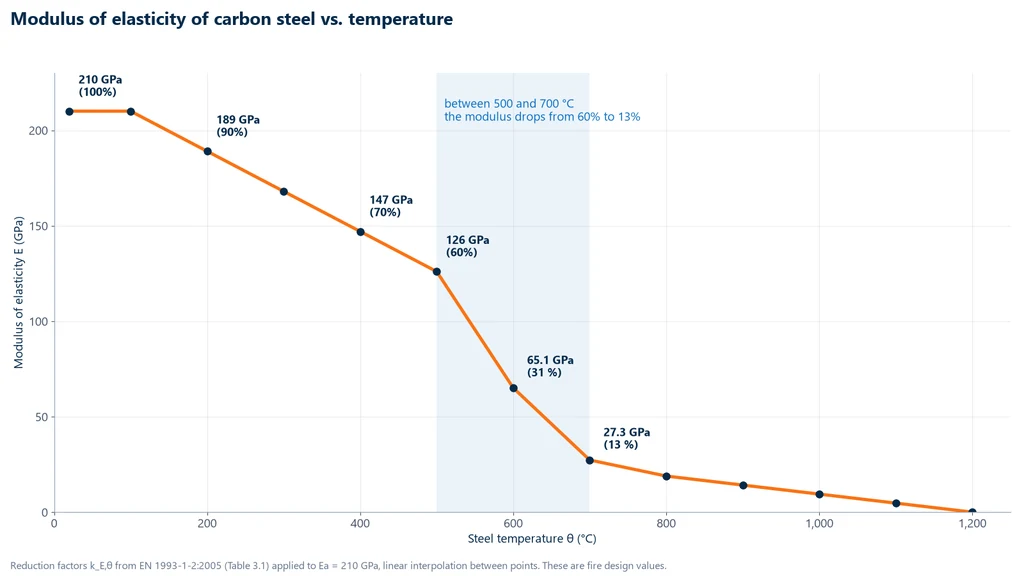
The same table shows that stiffness and strength also behave differently under heat. The yield strength factor, ky,θ, stays at 1 up to 400 °C, but by then the modulus has already lost 30%. At 400 °C the structure carries the same load before yielding but deforms much more. In slender members this brings buckling forward, because the critical buckling load is proportional to E. These are design values set by the standard, not measurements on a particular steel. The table converts the factors to GPa for the two reference values used in Brazil:
| θ (°C) | kE,θ | E with 210 GPa | E with 200 GPa |
|---|---|---|---|
| 20 to 100 | 1.000 | 210 | 200 |
| 200 | 0.900 | 189 | 180 |
| 300 | 0.800 | 168 | 160 |
| 400 | 0.700 | 147 | 140 |
| 500 | 0.600 | 126 | 120 |
| 600 | 0.310 | 65.1 | 62 |
| 700 | 0.130 | 27.3 | 26 |
| 800 | 0.090 | 18.9 | 18 |
| 900 | 0.0675 | 14.2 | 13.5 |
| 1,000 | 0.0450 | 9.5 | 9 |
| 1,200 | 0 | 0 | 0 |
Shear modulus G and Poisson's ratio of steel
In torsion and shear, stiffness is given by the shear modulus G, which is the ratio of shear stress to shear strain. It is used to design shafts, helical springs and bolted connections, and it is measured in the torsion test. Poisson's ratio, ν = −εtransverse / εlongitudinal, measures how much a bar narrows as it stretches.
In an isotropic material the three properties are related by G = E / [2(1 + ν)]. ABNT NBR 8800, the Brazilian standard for the design of steel structures, uses E = 200 GPa and ν = 0.3. These give G = 200 / 2.6 = 76.9 GPa, which the standard rounds to 77 GPa. Data sheets for specific steels give ν from 0.26 to 0.30 and G from 79 to 80 GPa, for example 79.3 GPa for A36 and 80 GPa for 1045. For 304 stainless steel, AK Steel gives 78 GPa in torsion.
How to measure the modulus of elasticity of steel
The reference method is the tensile test on a universal testing machine with an extensometer attached to the specimen, following ASTM E111, ASTM E8/E8M and ISO 6892-1 (ABNT NBR ISO 6892-1 in Brazil). First the cross-sectional area A0 of the specimen is measured. The specimen is then mounted in the grips with axial alignment, so that it is not bent while it is pulled. The extensometer is clamped to the reduced section with a known gauge length L0. The machine loads the specimen at a controlled rate and, if only the modulus is needed, stays below the proportional limit. The load cell reads the force and the extensometer reads the elongation. The software converts the two readings into stress and strain.
E is the slope of the straight portion of the curve. It is found either by linear regression of the data points or as the chord modulus between two stress levels in the linear range: E = (σ2 − σ1) / (ε2 − ε1). ASTM E111 covers Young's modulus, tangent modulus and chord modulus. It excludes initial tangent and secant moduli from its scope because the origin of the curve is hard to locate. Exercise 4 works through a complete chord modulus calculation.
Why crosshead displacement cannot be used to measure the modulus
Crosshead displacement adds up the deformation of the specimen and that of the grips, wedges, load cell and machine frame. The elastic strain of steel is small, so these extra contributions matter a lot. The apparent strain comes out several times larger than the real strain, and the modulus comes out several times smaller. In exercise 4, strain taken from the crosshead would give about 24 GPa instead of 203.7 GPa. When a test on steel returns a modulus far from 200 GPa, the steel is almost never the cause. The cause is the measurement, and typically the extensometer is missing.
Dynamic methods as an alternative
The modulus can also be obtained from the resonant frequency, without loading the part. ASTM E1876 determines the dynamic Young's modulus, shear modulus and Poisson's ratio of bars and cylinders by impulse excitation, a nondestructive method. A Brazilian study published in the journal Matéria (Mezzomo and Moraes, 2020) compared the two methods. The table shows the results:
| Material | Impulse excitation, ASTM E1876 (GPa) | Tensile test (GPa) |
|---|---|---|
| Domex 700 steel | 214.1 | 207.2 |
| SAE 1522 steel | 199.76 | 203.12 |
| 1200H14 aluminum | 76.1 | 71.33 |
With the tensile test as the reference, the difference was 1.7% for SAE 1522 and 3.3% for Domex 700, in opposite directions. The two methods agree on the order of magnitude. However, the static modulus measured with an extensometer remains the reference for design and certification.
Solved exercises
These four exercises apply the modulus to the most common cases: the elongation of a bar, the deflection of a beam, unit conversion and the acceptance of a modulus test.
Exercise 1: elongation of an A36 steel tie rod
A tie rod 3 m long and 20 mm in diameter carries a tensile force of 50 kN. Use E = 200 GPa.
- Area: A = π × 10² = 314.16 mm².
- Stress: σ = 50,000 / 314.16 = 159.2 MPa. This is below the 250 MPa yield strength of A36, so the bar is in the elastic range and Hooke's law applies.
- Elongation: δ = F·L / (A·E) = 50,000 × 3,000 / (314.16 × 200,000) = 2.39 mm.
- Strain: ε = 2.39 / 3,000 = 7.96 × 10⁻⁴, or 796 µε.
Exercise 2: deflection of a steel beam and an aluminum beam
A simply supported bar has a 1 m span and a rectangular cross section 40 mm wide by 20 mm high. A concentrated load of 2 kN acts at midspan. Compare steel (E = 200 GPa) and 6061-T6 aluminum (E = 69 GPa).
- Moment of inertia: I = 40 × 20³ / 12 = 26,667 mm⁴.
- Maximum stress: M = P·L / 4 = 500,000 N·mm; W = 40 × 20² / 6 = 2,667 mm³; σ = 187.5 MPa, within the elastic range of both materials.
- Deflection of the steel beam: δ = P·L³ / (48·E·I) = 2,000 × 1,000³ / (48 × 200,000 × 26,667) = 7.81 mm.
- Deflection of the aluminum beam: δ = 2 × 10¹² / (48 × 69,000 × 26,667) = 22.6 mm.
With the same geometry and the same load, the stress is the same in both beams, but the aluminum deflects 200 / 69 = 2.9 times more. Only the stiffness changed. Replacing the steel with a higher-strength steel would not change the deflection.
Exercise 3: converting 205 GPa and checking the kN/cm² error
Convert 205 GPa to the usual units and check the claim "200 GPa ≈ 210,000 kN/cm²".
- MPa and N/mm²: 205 × 1,000 = 205,000.
- kN/cm²: 205 × 100 = 20,500.
- kN/m²: 205 × 106 = 2.05 × 10⁸.
- kgf/cm²: 205 × 10,197 ≈ 2,090,400.
- ksi: 205 × 145.04 ≈ 29,733.
- Check: 1 kN/cm² = 10 MPa, so 210,000 kN/cm² = 2,100,000 MPa = 2,100 GPa. That is ten times the real value. The correct figure for 200 GPa is 20,000 kN/cm².
Exercise 4: acceptance of a modulus test with an extensometer
An SAE 1045 specimen has d0 = 10.00 mm, and the extensometer has a gauge length L0 = 50 mm. Two points in the linear range (illustrative values): F1 = 4.0 kN with ΔL1 = 0.0126 mm, and F2 = 12.0 kN with ΔL2 = 0.0376 mm.
- Area: A0 = π × 10.00² / 4 = 78.54 mm².
- Stresses: σ1 = 4,000 / 78.54 = 50.93 MPa; σ2 = 12,000 / 78.54 = 152.79 MPa.
- Strains: ε1 = 0.0126 / 50 = 2.52 × 10⁻⁴; ε2 = 0.0376 / 50 = 7.52 × 10⁻⁴.
- Chord modulus: E = (152.79 − 50.93) / (5.00 × 10⁻⁴) = 101.86 / 0.000500 = 203.7 GPa.
The result is about 1% below the 206 GPa on the 1045 data sheet, so it is acceptable. Now suppose the strain between the same two points came from the crosshead, say 0.25 mm over a 60 mm parallel length. That would give ε = 4.17 × 10⁻³ and an apparent E = 101.86 / 0.00417 ≈ 24 GPa. This is about 8 times too low, for the same material.
Standards for the modulus of elasticity of steel
The standards cited in this article fall into two groups. Design standards set the value to use in calculations. Testing standards specify how to measure the modulus of a real steel. The table lists both groups, with the current edition where known:
| Standard | Scope | Edition |
|---|---|---|
| ABNT NBR 8800 | Brazilian standard for the design of steel and composite structures (E = 200,000 MPa, G = 77,000 MPa, ν = 0.3) | 2008 |
| ABNT NBR 14762 | Brazilian standard for cold-formed steel sections (E = 200,000 MPa) | 2010 |
| ABNT NBR 6118 | Brazilian standard for the design of concrete structures (Es = 210 GPa) | 2023 |
| ABNT NBR 7480 | Brazilian standard for steel reinforcing bars (CA-25, CA-50, CA-60) | 2024 |
| EN 1993-1-2 (Eurocode 3) | fire design, kE,θ factors | 2005 |
| ASTM E111 | Young's modulus, tangent modulus and chord modulus | E111-17(2025)e1 |
| ASTM E8/E8M | tension testing of metals | E8/E8M-25 |
| ABNT NBR ISO 6892-1 | tensile testing of metals at room temperature (Brazilian adoption of ISO 6892-1) | 2024 |
| ISO 6892-1 | tensile testing of metals at room temperature | 2019 |
| ASTM E1876 | dynamic moduli by impulse excitation | current |
| ASTM A36 | carbon structural steel (minimum yield strength of 250 MPa) | current |
Testing machine for measuring the modulus of elasticity of steel
To measure the modulus of steel, you need three things. The force must be applied at a controlled rate with axial alignment. It must be measured with a load cell suited to the test range. Above all, the strain must be measured with an extensometer on the specimen, because without one the modulus will be wrong. The Biopdi M2 universal testing machine is electromechanical and meets all three requirements. It works with extensometers and with the BioLab software, which plots the stress-strain curve and calculates the modulus from the slope of the linear range. The panel below shows the machine, what each part does in the modulus measurement, and the grips used.
The universal testing machine in the tensile test
The M2 line includes single-column models from 200 N to 10 kN and dual-column models from 5 kN to 1,000 kN. Each part of the machine has a role in measuring the modulus of elasticity:
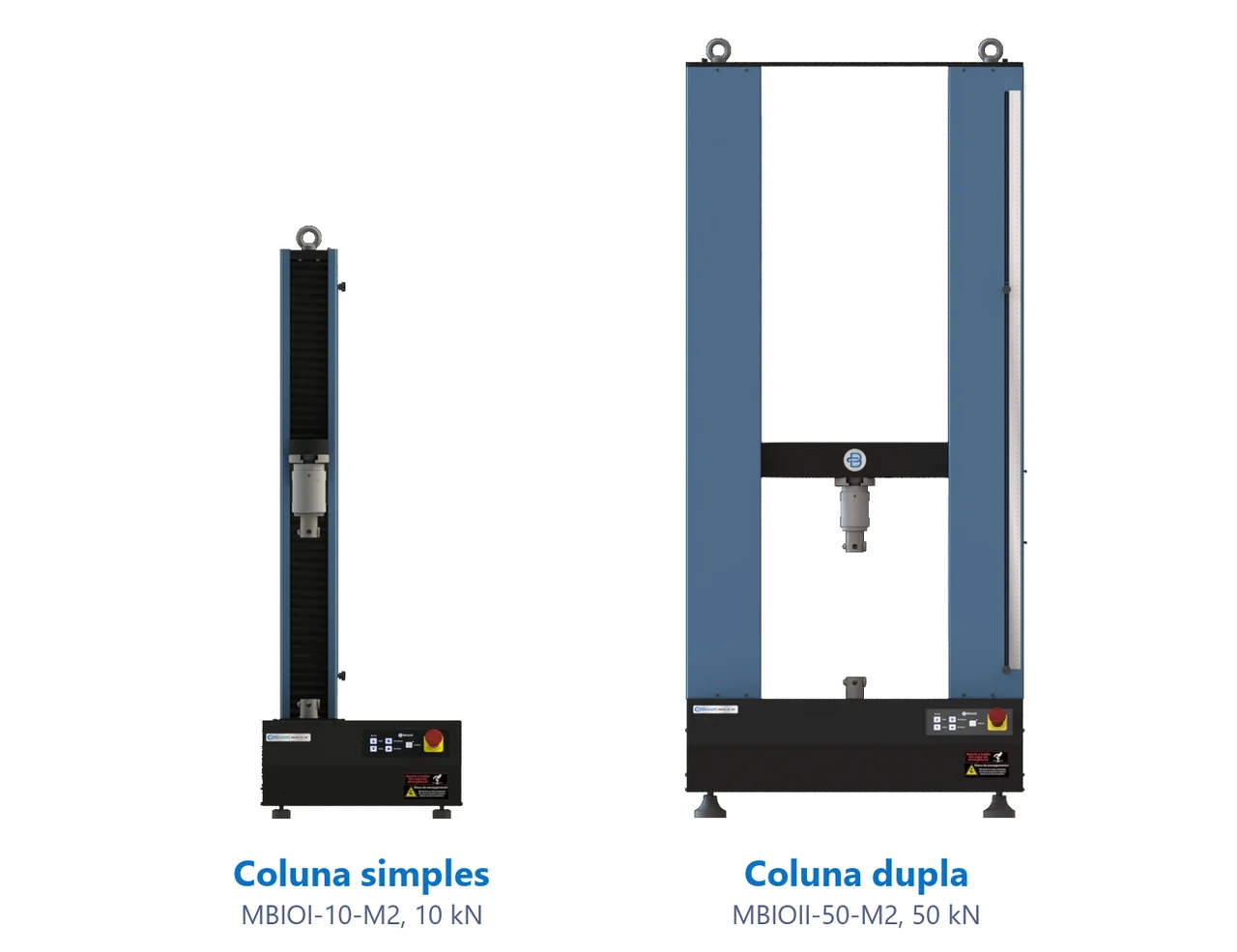
- Moving crosshead: pulls the specimen at the rate set by the standard
- Load cell: measures the force F, class 1
- Grips: wedge, pneumatic, threaded or wire grips, with axial loading
- Extensometer: measures ΔL over the gauge length L0, essential for the modulus E
- BioLab software: calculates σ and ε and obtains E by regression or as the chord modulus
- Control panel and emergency stop: positions the crosshead and stops the test
Fixtures for the tensile test
The fixtures below mount on the same machine, depending on the specimen and the standard:
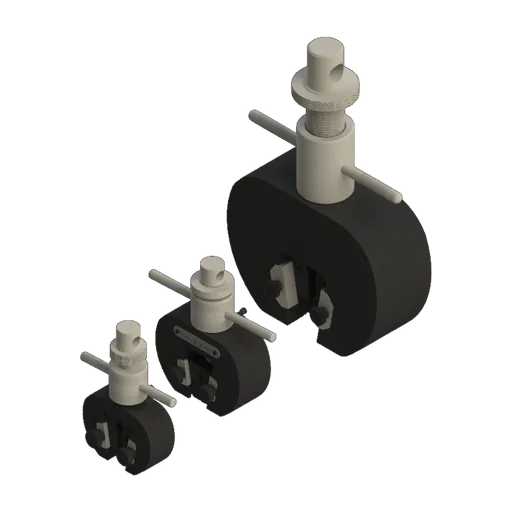 Wedge grip5, 20 and 200 kN
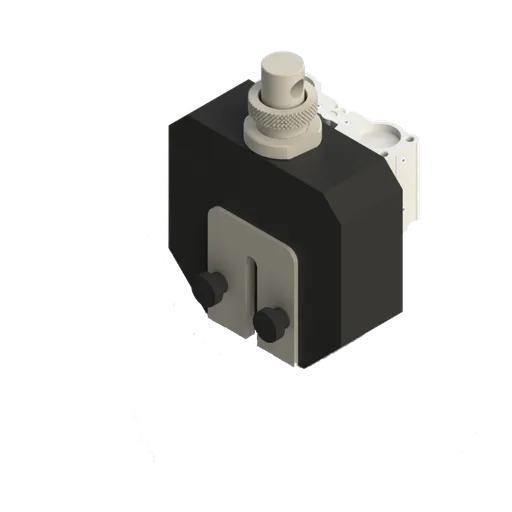 Pneumatic wedge grip50 and 200 kN
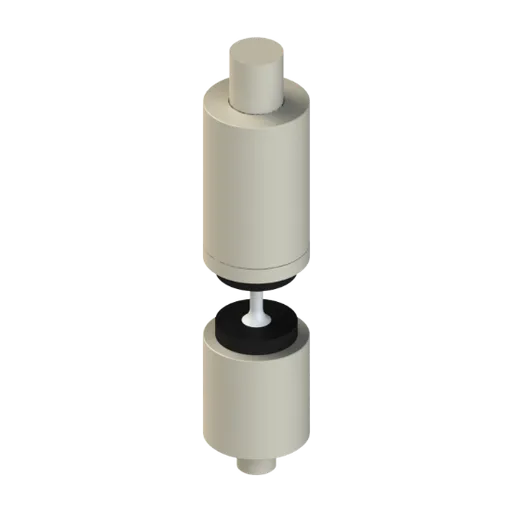 Threaded specimen gripbolts and threaded specimens
For sheet, thin bars and machined steel specimens like the one in exercise 4, use the 5 to 50 kN dual-column universal testing machine (MBIOII-50-M2). For CA-50 rebar, structural sections and cables, the recommended model is the 100 to 200 kN universal testing machine (MBIOII-200-M2). The BioLab software calculates the modulus and stresses and generates the report. Other capacities are listed on the universal testing machine page, and you can request a quote through the website.
Other tests and technical references
Poisson's ratio: what it is, formula, values for steel, concrete and soil, and how to measure it
Poisson's ratio (ν) is the negative ratio of transverse strain to longitudinal strain in a material under uniaxial load in the elastic range. See the formula, its relationship with E, G and K, the range from −1 to 0.5, the values for steel (0.3 per ABNT NBR 8800, the Brazilian steel structures design standard), concrete (0.2 per ABNT NBR 6118, the Brazilian concrete structures design standard), rubber and soils, how to measure it per ASTM E132, and worked examples.
Modulus of elasticity of concrete: NBR 6118 formula, table by strength class and NBR 8522-1 test
The modulus of elasticity of concrete measures how much it shortens under load. Under NBR 6118:2023 (the Brazilian standard for the design of concrete structures), Eci = αE·5600·√fck (C20 to C50) and Ecs = αi·Eci. A C30 concrete with granite aggregate has an Eci of about 31 GPa and an Ecs of 27 GPa. See the formula, the C20 to C90 table, the effect of the aggregate, the NBR 8522-1:2021 test (the Brazilian standard test method for the modulus of elasticity of concrete) and worked examples.
Mechanical properties of materials: what they are, the main types, tests, standards and steel values
The mechanical properties of materials define how a material responds to forces: how much it deforms, whether it returns to its shape, how much load it carries, how much energy it absorbs and how it fractures. See each property with its unit, test and standard, the values for steel (NBR 8800, the Brazilian steel structures design standard; ASTM A36; CA-50, the Brazilian rebar grade), the pairs that are often confused and solved exercises.
Modulus of elasticity (Young's modulus): what it is, formula, units, table of materials and how to measure it
The modulus of elasticity, or Young's modulus (E), is the ratio of stress to strain in the linear elastic region, E = σ/ε, and measures a material's stiffness. See the formula, the units and conversions, a table of E for more than 20 materials, the relationship with G, K and Poisson's ratio, the tangent, secant and chord moduli, and how to measure it with an extensometer.
Frequently asked questions
What is the modulus of elasticity of steel?
Between 190 and 210 GPa. ABNT NBR 8800 (the Brazilian standard for steel structures) adopts 200,000 MPa for structural steel, and ABNT NBR 6118 (the Brazilian standard for concrete structures) adopts 210 GPa for non-prestressed reinforcement when no test data are available.
What is the modulus of elasticity of A36 steel?
200 GPa (29,000 ksi), with G = 79.3 GPa and ν = 0.26, according to the MatWeb/ASM data sheet. Some ASM compilations list 207 GPa.
What is the modulus of elasticity of 1020 and 1045 steel?
1020 steel is about 205 GPa (207 GPa in the Sonelastic table based on ASM data). 1045 steel is about 206 GPa, both cold drawn and quenched and tempered, according to MatWeb.
What is the modulus of elasticity of CA-50 steel?
E = 210 GPa (210,000 MPa), the value given in item 8.3.5 of ABNT NBR 6118 when no test data are available. CA-50 (a Brazilian reinforcing bar grade) has an fyk of 500 MPa (ABNT NBR 7480, the Brazilian standard for steel reinforcing bars) and a design yield strain of about 2.07‰.
What is the modulus of elasticity of steel in kN/cm² and in kgf/cm²?
200 GPa equals 20,000 kN/cm² and about 2.04 × 10⁶ kgf/cm²; 210 GPa equals 21,000 kN/cm² and about 2.14 × 10⁶ kgf/cm². The value of 210,000 kN/cm² that circulates on the internet is ten times too high.
What is the modulus of elasticity of 304 stainless steel?
About 193 GPa, within a range of 193 to 200 GPa depending on the source (AK Steel and ASM). 316 stainless steel is also about 193 GPa.
What are the shear modulus G and Poisson's ratio of steel?
ABNT NBR 8800 adopts G = 77 GPa and ν = 0.3, consistent with the relationship G = E / [2(1 + ν)]. Data sheets for specific steels give G from 79 to 80 GPa and ν from 0.26 to 0.30.
Does the modulus of elasticity of steel change with temperature?
Yes. According to EN 1993-1-2, the modulus drops to 90% at 200 °C, 70% at 400 °C and 31% at 600 °C of its value at 20 °C.
Is quenched steel stiffer than annealed steel?
No. Quenching raises yield strength and hardness, but the modulus stays practically the same: quenched and tempered 4140 steel is about 205 GPa, compared with 200 GPa for A36.
How do you measure the modulus of elasticity of steel?
With a tensile test on a universal testing machine and an extensometer on the test specimen (ASTM E111, ISO 6892-1), calculating the slope of the linear portion of the curve. The impulse excitation technique (ASTM E1876) is a non-destructive alternative.
Why is steel about 3 times stiffer than aluminum?
Because of the strength of the bonds between atoms: about 200 GPa for steel versus about 69 GPa for aluminum. In the same beam, under the same load, aluminum deflects about 2.9 times more.