
Normalizing of steel is the heat treatment in which the part is heated above the upper critical temperature (Ac3 in hypoeutectoid steel, Acm in hypereutectoid steel), held until the whole section has become austenite and then cooled in still air. The result is a refined, uniform grain with ferrite and fine pearlite: higher strength and usually higher toughness than annealed steel, and much lower hardness than quenched steel.
The term shares search results with database normalization and with standardization (the drafting of standards, which in Brazil is the work of ABNT, the Brazilian standards body). This article covers only the heat treatment. In numbers, the rule is to heat about 50 to 60 °C above Ac3 and let the part cool outside the furnace: for 1045 steel, which has an Ac3 of about 780 °C, manufacturer datasheets specify 850 to 880 °C. The sections below cover the temperature rule, the grain refinement mechanism, the comparison with annealing and quenching, applications and how the result is checked.
What normalizing of steel is
The ASM Handbook defines normalizing as heating a ferrous alloy to a suitable temperature above the transformation range, followed by cooling in air (Dossett and Totten, "Normalizing of Steel", ASM Handbook vol. 4A, 2013). Chiaverini (Aços e Ferros Fundidos, ABM) describes the same process with an explicit goal: to refine the grain of cast, rolled or forged parts and make the structure uniform before use or before another treatment.
Like every heat treatment of metals, normalizing has three stages:
- Heating to the normalizing temperature, above the upper critical temperature of the steel.
- Soaking, holding at that temperature until the core of the part reaches it and the whole section transforms into austenite. This heating to full austenite is called austenitizing.
- Air cooling, with the part out of the furnace, in still air or, for thick sections, in forced air from a fan.
What sets normalizing apart from its neighboring treatments is the third stage: air cooling is faster than furnace cooling and much slower than a water or oil bath, and this intermediate rate produces an intermediate structure.
Normalizing temperature
The temperature is not a single number for "steel": it depends on the critical temperatures of each composition. To understand the rule, you first need to know what each critical temperature marks during heating.
Ac1, Ac3 and Acm
In the iron-carbon diagram, steel with 0.77% carbon (eutectoid) transforms entirely into austenite at 727 °C (Chiaverini). In other steels the transformation spans a temperature range, and the temperatures measured on heating carry the letter "c" (from the French chauffage):
- Ac1: pearlite starts to turn into austenite. Below it, nothing transforms.
- Ac3: in hypoeutectoid steel (less than 0.77% C), the last ferrite turns into austenite. Above Ac3, the section is fully austenitic.
- Acm: in hypereutectoid steel (more than 0.77% C), the excess cementite finishes dissolving in the austenite.
Alloying elements shift these temperatures. That is why the margin is counted from the Ac3 or Acm of the steel in question, read from the manufacturer's datasheet or estimated with a formula (exercise 1).
The margin rule above Ac3 or Acm
The general rule is to normalize 50 to 60 °C above Ac3 in hypoeutectoid steel, or above Acm in hypereutectoid steel; sources vary between 30 and 55 °C for the minimum margin. This margin is larger than for full annealing, 30 to 50 °C above Ac3, to ensure homogeneous austenite before a cooling step that leaves no time to correct heterogeneity.
In hypereutectoid steel the rules for the two treatments diverge. Annealing stays slightly above Ac1, below Acm, because slow furnace cooling from full austenite would form a continuous cementite network at the grain boundaries, which embrittles the steel. In normalizing, heating can go above Acm: air cooling is fast enough to dissolve this network without re-forming it, and normalizing is precisely the treatment used to break it up (Chiaverini).
Manufacturer datasheets work with a slightly larger margin than the rule, to make up for the actual size of the furnace load. The table lists the critical temperatures and normalizing temperatures of three engineering steels, with sources:
| Steel | Approximate Ac1 / Ac3 | Normalizing | Source |
|---|---|---|---|
| 1020 | 730 / 840 °C | 900 to 955 °C | Lucefin C22E (critical temperatures); Açovisa |
| 1045 | 735 / 780 °C | 850 to 880 °C | Lucefin C45E; Açovisa (840 to 900 °C) |
| 4140 | 745 / 790 °C | 860 to 900 °C (Lucefin: 870 °C) | Lucefin 42CrMo4; Açovisa |
The temperature also appears in product standards: ASTM A333/A333M, for low-temperature service pipe, requires normalizing by heating uniformly to at least 815 °C (1,500 °F). When the product specification gives the temperature, it takes precedence over the general rule.
Too high a temperature coarsens the grain
Going well beyond the margin does not improve the result. Above the recommended range, the austenite grain grows during soaking, and a large austenite grain gives large ferrite and pearlite on cooling, the opposite of what normalizing aims for. Microalloyed steel has a second effect: the precipitates that pinned the grain boundaries dissolve and stop restraining growth.
Li, Fan, Wang and Wang (Materials 16, 6921, 2023) measured this in a P460NL1 pressure vessel steel, microalloyed with vanadium and nitrogen, normalized from 850 to 950 °C. The chart below shows the Charpy impact energy at −40 °C at each temperature: it rises to 85 J at 900 °C and drops to 53 J at 950 °C, while the average grain size goes from 5.7 µm at 850 °C to 10.5 µm at 950 °C.
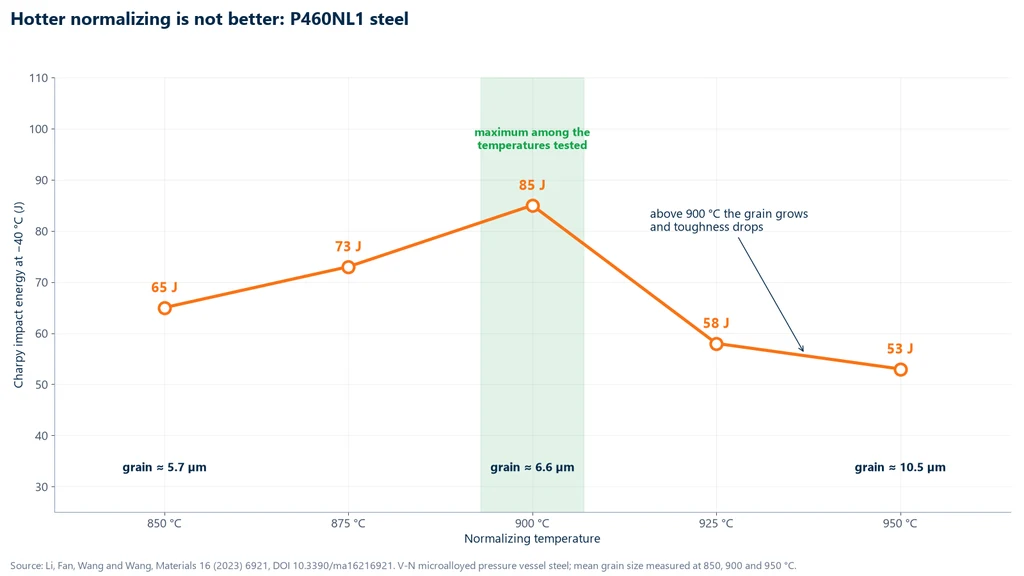
The optimum applies to this steel; the general lesson is that the normalizing temperature has a ceiling as well as a floor.
How normalizing is done: heating, soaking and air cooling
In industrial practice, the load goes into the furnace, rises to the normalizing temperature, stays for the soaking time and comes out of the furnace to cool in still air. The parts are spaced apart, because parts touching each other cool like one larger block, and more slowly, and they are supported so that air circulates over every face.
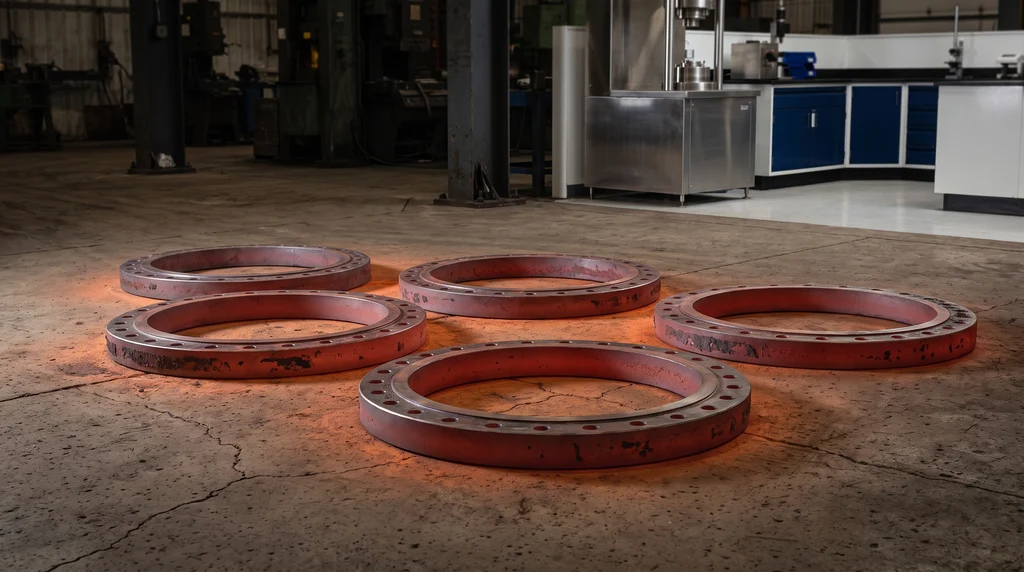
In the photo, forged steel flanges still glowing, cooling spaced apart on the floor: in normalizing the part leaves the furnace and cools in still air, faster than in annealing and much slower than in quenching.
The cycle is short from the furnace's point of view. In annealing the furnace is occupied for the whole slow cooling, which can take hours; in normalizing it is freed as soon as soaking ends. That is why normalizing is usually cheaper than annealing when both meet the specification (IspatGuru, "Normalizing process for steels").
Soaking time
Soaking is needed because the furnace heats the surface first: the core reaches temperature later, and austenitizing is complete only when it does. Two rules of thumb appear in the technical literature: about 1 hour per 25 mm of thickness, or t = 60 + D minutes, with D the maximum diameter in millimeters (IspatGuru). The two disagree (exercise 4), which shows they are estimates. When the steel datasheet or the product standard defines the time, that governs. Excessive soaking has the same effect as excessive temperature: the grain grows.
Effect of part thickness
Air removes heat through the surface. In a thin part, surface and core cool almost together; in a thick part, the core cools much more slowly and transforms into coarser pearlite, with lower hardness and strength than the surface. In the limit, the core of a very thick part ends up with properties close to those of the annealed condition.
That is why tabulated properties for "normalized steel" apply to the reference section of the source, not to any part, and for a thick part the check measures hardness at more than one point and takes the tensile test specimen from the location required by the product standard. Forced air from fans brings the core cooling closer to that of the surface.
Why normalizing refines the grain
Refinement happens at two points in the cycle, one during heating and one during cooling.
- During heating, on passing Ac1 and Ac3, the old ferrite and pearlite transform into austenite. Austenite nucleates at many points at once, at the interfaces between ferrite and cementite, and forms new, small grains, provided temperature and time do not let them grow. The previous structure, coarse from forging, dendritic from casting or oriented from rolling, is erased at this stage.
- During air cooling, austenite transforms back into ferrite and pearlite, but at a lower temperature than in the furnace, because the steel cools faster than the transformation can keep up. Below the equilibrium temperature, more ferrite and pearlite nuclei form, and carbon diffuses over shorter distances: the ferrite grain comes out smaller and the ferrite and cementite lamellae of the pearlite come out finer.
Smaller grain and finer pearlite raise the yield strength and the ultimate tensile strength, because there are more boundaries and more interfaces to block dislocation motion. Unlike most strengthening mechanisms, grain refinement also improves toughness, and this combination is what justifies normalizing for pressure vessel plates and safety-critical parts.
The expected microstructure depends on carbon content. In hypoeutectoid steel, such as 1045, the result is proeutectoid ferrite plus fine pearlite; in hypereutectoid steel, fine pearlite with dispersed cementite, without the continuous network at the boundaries. In plain carbon steel, air cooling does not form martensite, which is why normalizing does not "harden like quenching". The exception is high-hardenability steels, which form bainite or martensite even in air: in these, what is called normalizing can harden the part and has to be handled case by case, using the steel datasheet.
Annealing, normalizing and quenching: the comparison
The three treatments start the same way, with the part heated to austenite, and end in very different structures because they cool at different rates. This section brings the comparison together for the same steel, with a single source per table.
The three cycles for 1045 steel
Full annealing and quenching of 1045 use the same 820 to 850 °C range; normalizing uses 850 to 880 °C. The diagram below places the three cycles on the same temperature-time chart, with the critical temperatures from the Lucefin C45E datasheet, and shows that water cooling crosses the martensite start temperature (Ms, about 350 °C) before pearlite has time to form. The time axis is not to scale: in the furnace cooling takes hours, in air tens of minutes and in water seconds.
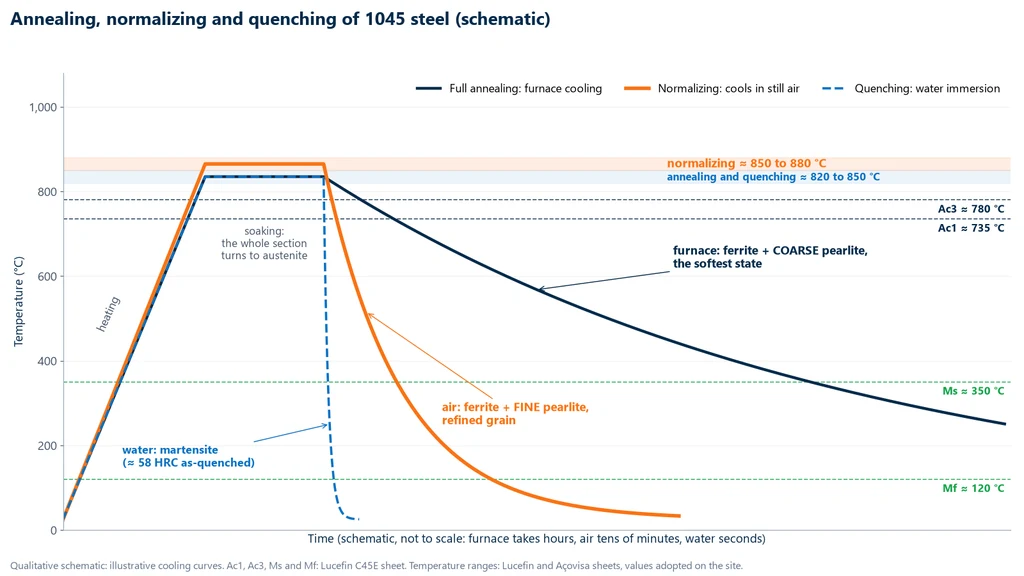
Annealing is the treatment that leaves steel in its softest and most ductile condition: the switched-off furnace cools the part slowly, the transformation takes place close to the equilibrium temperature and coarse pearlite forms. It is the starting condition for heavy machining and cold forming, and its article also covers stress relieving (550 to 650 °C, below Ac1) and spheroidizing. Quenching goes to the opposite extreme: cooling in water or oil prevents pearlite from forming and produces martensite, which in 1045 reaches about 58 HRC as quenched and needs tempering before use.
Comparison table
The table summarizes what the chart and the previous sections explained, with the 1045 temperatures and properties from two sources: 4140 steel from Callister, the only open source with all three conditions for the same steel, and the standard minimums for 1045 (C45E) from the Lucefin datasheet.
| Characteristic | Full annealing | Normalizing | Quenching |
|---|---|---|---|
| Temperature (rule) | Ac3 + 30 to 50 °C (hypereutectoid: slightly above Ac1) | Ac3 or Acm + 50 to 60 °C | above Ac3 (austenitizing) |
| Temperature for 1045 | ≈ 820 to 850 °C | ≈ 850 to 880 °C | ≈ 820 to 850 °C |
| Cooling | slow, inside the furnace | in still or forced air | in water, or oil for small sections |
| Microstructure (hypoeutectoid) | ferrite and coarse pearlite | ferrite and fine pearlite, refined grain | martensite (then tempered) |
| 4140, typical values (Callister) | yield 417 MPa, Rm 655 MPa, elongation 25.7% | yield 655 MPa, Rm 1,020 MPa, elongation 17.7% | oil quenched and tempered at 315 °C: 1,570 MPa, 1,720 MPa, 11.5% |
| 1045 (C45E), standard minimums up to 16 mm | max. hardness 207 HB (soft annealing) | min. Rm 620 MPa, min. yield 340 MPa, min. elongation 14% | quenched and tempered: Rm 700 to 850 MPa, min. yield 490 MPa, 213 to 253 HB |
| Typical use | soften for machining or forming | refine forgings, castings or welds; homogenize before machining or quenching; plates and pipes | maximum hardness and strength, always followed by tempering |
What the numbers show
The chart below shows the three conditions of 4140 steel from Callister (7th ed., Appendix B). Normalized at 870 °C, 4140 has 57% higher yield strength and 56% higher Rm than annealed at 815 °C, with lower elongation, 17.7% versus 25.7%; quenched and tempered, strength makes another jump and elongation drops to 11.5%.
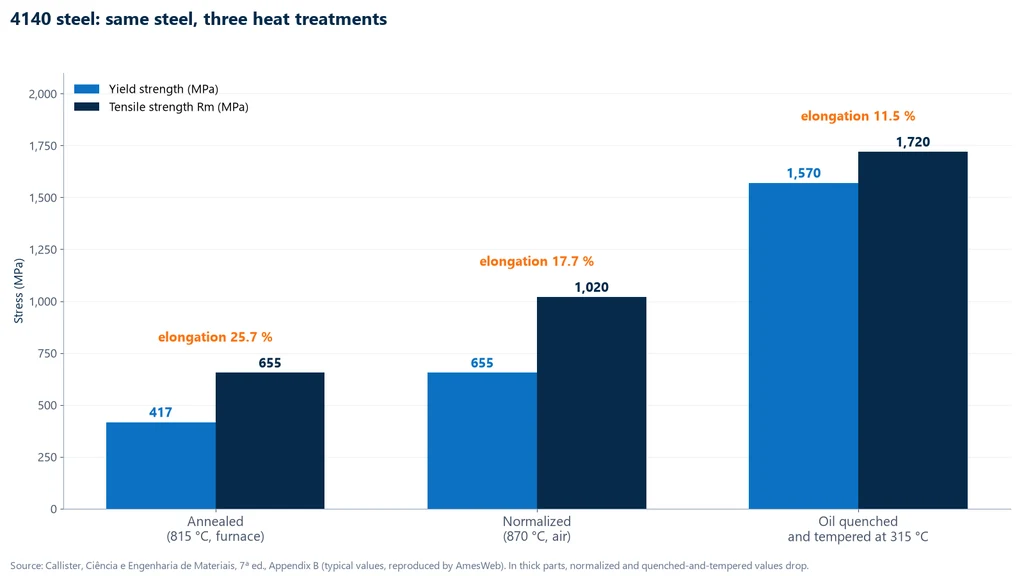
The values for normalized 4140 must be read with the caveat from the section on thickness. 4140 is a high-hardenability steel: in a small section, air cooling can form constituents harder than pearlite, which helps explain the large jump over the annealed condition. The Lucefin datasheet for the same steel (42CrMo4) gives about 190 HB for normalizing at 870 °C, which corresponds to an Rm on the order of 650 MPa by the approximate relationship between hardness and strength (exercise 5). The two sources do not contradict each other: they measure different sections and conditions, which is why a purchase specification always ties the property to the section.
In carbon steel the gain is smaller. In the same Callister appendix, 1040 steel goes from Rm 520 MPa annealed to 590 MPa normalized, and from yield 355 to 375 MPa, with elongation of 30.2% and 28.0%. The C45E minimums in the table confirm the order: normalized, 1045 guarantees 620 MPa Rm; quenched and tempered, 700 to 850 MPa.
Where normalizing is used
Normalizing is used where the starting structure is coarse or uneven, and where strength with toughness is wanted without the cost of quenching and tempering. The most common applications are these:
- Forgings: forging at high temperature leaves a coarse, mixed grain size. Forged flanges, crankshafts, shafts and rings are normalized to refine and even out the grain.
- Steel castings: normalizing removes the dendritic structure and the Widmanstätten ferrite plates that slow solidification produces.
- Welded joints: in some specifications, normalizing refines the heat-affected zone, which is left with coarse grain next to the fusion line.
- Pressure vessel plates: ASTM A516/A516M requires normalized plates above 40 mm thick; up to 40 mm, they are also normalized when toughness testing is required, unless otherwise agreed with the purchaser. In Europe, EN 10028-3 covers weldable fine-grain steels for pressure purposes supplied in the normalized condition, the family of the P460NL1 in the previous section.
- Pipes for low-temperature service: ASTM A333/A333M specifies normalizing from 815 °C, with optional tempering.
- Preparation for quenching and machining: a part that starts from a fine, uniform grain hardens more evenly on quenching, with less tendency to distort and crack. In knifemaking, normalizing the forged blade before quenching serves this purpose.
Normalizing is not the right treatment for stress relief: air cooling leaves a temperature difference between surface and core and, therefore, some residual stress. For that there is stress relieving, below Ac1, covered in the article on annealing. In Brazil, ABNT NBR 8271, which covered the normalizing of carbon steel heavy plates, has been withdrawn with no replacement; the requirement now comes from the product standard.
How to check the result: hardness, metallography and tensile testing
The furnace does not tell you whether normalizing worked. What tells you is the inspection of the part, or of a test specimen treated together with the load, through three complementary tests.
- Hardness. It is the fastest check and the first to reveal a cycle error. The normalized steel must be above the annealed condition and well below the quenched one; for 1045, the reference is about 190 HB. The usual method is Brinell, which averages over a larger area of the ferrite and pearlite structure; Rockwell serves for production control. On a thick part, the profile is measured from surface to core. The procedure for each method is in the article on hardness testing, and the relationship between the scales in the one on hardness.
- Metallography. It confirms what hardness only suggests: grain refinement, fine pearlite and the absence of a cementite network or a Widmanstätten structure. The sample is cut without heating the area to be examined, on the metallographic cutting machine; ground and polished on the grinding and polishing machine; etched with nital and observed under the metallurgical microscope, where grain size is measured per ASTM E112 or ISO 643 (G number: the higher it is, the finer the grain).
- Tensile test. It provides the figures the specification requires: yield strength, ultimate tensile strength and elongation, per ISO 6892-1 (ABNT NBR ISO 6892-1 in Brazil) or ASTM E8/E8M. On the Biopdi universal testing machine of the M2 line, the load cell and the extensometer record the curve and the BioLab software calculates the results and builds the report. For 12.5 mm normalized steel test specimens, the recommended range is that of the 100 to 200 kN machine (MBIOII-200-M2); thin sheets and smaller specimens fit on the 5 to 50 kN machine (MBIOII-50-M2). The complete procedure is in the article on the tensile test.
When the product standard calls for toughness, as with pressure vessel plates, the Charpy impact test at the specified temperature is added. It is the test that would reveal the loss of toughness from normalizing at too high a temperature.
Solved exercises
The five exercises follow the order of the article, from temperature to checking the result.
Exercise 1: normalizing temperature of 1045
Estimate the Ac3 of 1045 steel using the Andrews (1965) formula and choose the normalizing temperature. Average composition: 0.465 % C, 0.75 % Mn, 0.25 % Si, no Ni, V, Mo or W.
- Formula: Ac3 = 910 − 203·√C − 15.2·Ni + 44.7·Si + 104·V + 31.5·Mo + 13.1·W, in °C and wt%.
- √0.465 = 0.682; 203 × 0.682 = 138.4; 44.7 × 0.25 = 11.2.
- Ac3 = 910 − 138.4 + 11.2 = 783 °C, versus 780 °C in the Lucefin C45E datasheet.
- Using the 50 to 60 °C margin rule: 833 to 843 °C. Manufacturer datasheets give 850 to 880 °C, slightly higher; when in doubt, follow the steel supplier's datasheet.
Exercise 2: how much ferrite and pearlite to expect
Calculate the fractions of proeutectoid ferrite and pearlite in a steel with 0.45 % C using the lever rule, with the eutectoid at 0.77 % C and ferrite at 0.022 % C.
- Ferrite: Wα = (0.77 − 0.45) / (0.77 − 0.022) = 0.32 / 0.748 = 0.43.
- Pearlite: Wp = 1 − 0.43 = 0.57.
- The calculation applies to equilibrium, which annealing approximates. In normalizing, the transformation occurs below equilibrium, and the steel ends up with slightly less ferrite, slightly more pearlite and finer pearlite.
Exercise 3: force in the tensile test and choice of machine
Round test specimen of 12.5 mm diameter (ASTM E8/E8M) of 4140 steel, in Callister's three conditions. Calculate the maximum force and check whether it fits on a 200 kN machine.
- Area: S0 = π × 12.5² / 4 = 122.7 mm².
- Annealed, Rm 655 MPa: F = 655 × 122.7 = 80,400 N = 80.4 kN.
- Normalized, Rm 1,020 MPa: F = 1,020 × 122.7 = 125.2 kN.
- Quenched and tempered, Rm 1,720 MPa: F = 1,720 × 122.7 = 211.1 kN, above 200 kN.
- The first two fit on the 200 kN machine. For the quenched and tempered condition, the specimen is reduced to 9 mm, a small-size dimension provided for in ASTM E8/E8M: S0 = 63.6 mm² and F = 109.4 kN; or a higher-capacity model is used.
Exercise 4: soaking time of a bar
Estimate the soaking time of a 100 mm diameter bar using the two rules of thumb.
- 1 hour per 25 mm: 100 / 25 = 4 h.
- t = 60 + D: 60 + 100 = 160 min, about 2 h 40 min.
- The rules differ by more than 1 hour; the real criterion is that the core fully austenitizes, and the procedure of the supplier or of the product standard prevails.
Exercise 5: checking the test report through hardness
A batch of normalized 1045 (C45E) measures 190 HB. Estimate Rm using Callister's approximate relationship, Rm (MPa) ≈ 3.45 × HB, and compare it with the standard minimum.
- Rm ≈ 3.45 × 190 = 656 MPa, above the 620 MPa minimum for normalized C45E.
- Hardness serves as a quick screening; batch acceptance is based on the tensile test.
Common mistakes
The mistakes below show up often in course handouts, exam answer keys and commercial pages on the subject:
- "Normalizing by annealing" or "normalizing by quenching": these do not exist. Annealing, normalizing and quenching are distinct treatments, defined by the cooling.
- "Normalizing combines annealing and quenching" or "it hardens like quenching": in plain carbon steel it does not form martensite. The gain in strength over the annealed condition is real, but moderate.
- A single temperature range for any steel: figures such as "810 to 950 °C" without naming the steel are useless. The temperature comes from the Ac3 or Acm of each composition.
- Normalizing austenitic stainless steel: it has no ferrite-to-austenite transformation on heating and cannot be normalized; its usual treatment is solution annealing.
Standards cited
Normalizing has no process standard in force in Brazil: it is required by product standards and verified by test standards. The table lists those cited in this article, with the edition checked on September 30, 2026:
| Standard | Scope | Edition |
|---|---|---|
| ASTM A516/A516M | carbon steel plates for pressure vessels; normalizing above 40 mm | A516/A516M-25 |
| ASTM A333/A333M | pipes for low-temperature service; normalizing at 815 °C or higher | A333/A333M-24 |
| EN 10028-3 | flat products for pressure purposes in weldable fine-grain steel, normalized | not stated |
| ABNT NBR 8271 | normalizing of carbon steel heavy plates (Brazilian standard) | withdrawn, no replacement |
| ASTM E10 | Brinell hardness of metallic materials | E10-23 |
| ISO 6506-1 | Brinell hardness, test method | 2014 (ABNT NBR ISO 6506-1:2019) |
| ASTM E18 | Rockwell hardness | E18-25 |
| ISO 6508-1 | Rockwell hardness, test method | 2023 (ABNT NBR ISO 6508-1:2025) |
| ASTM E3 | preparation of metallographic specimens | E3-26 |
| ASTM E407 | microetching (nital and others) | E407-23 |
| ASTM E112 | determination of average grain size | E112-25e1 |
| ISO 643 | micrographic determination of the apparent grain size of steels | 2024 |
| ISO 6892-1 | tensile testing of metals at room temperature | 2019 (ABNT NBR ISO 6892-1:2024) |
| ASTM E8/E8M | tension testing of metals | E8/E8M-25 |
Other tests and technical references
Annealing of steel: what it is, types, temperatures and effects on properties
Annealing is the heat treatment that heats the metal, holds it at temperature and cools it slowly, usually inside the furnace, to reduce hardness and internal stresses and restore ductility and machinability. In steel, full annealing austenitizes about 30 to 50 °C above Ac3, and the subcritical types stay below Ac1 (stress relief annealing at 550 to 650 °C, spheroidizing at 700 to 720 °C). See the types, temperatures, microstructure, effects with numbers and how to check the result.
Quenching steel: what it is, temperatures, quenching media, types and the quench and temper cycle
Quenching steel means heating the part until austenite forms, usually 30 to 50 °C above Ac3, then cooling it rapidly in water, oil, polymer or gas to form martensite. Carbon sets the maximum hardness and alloying sets the hardened depth. See temperatures by steel (1045 at 820 to 850 °C), the Grossmann H severity, martensite and Ms, the Jominy test, types of quenching, stainless steel, cracking and the quench and temper cycle.
Nitriding: what it is, processes (gas, plasma and salt bath), white layer, NHD and difference from carburizing
Nitriding is a thermochemical treatment that diffuses nitrogen into the steel surface below the austenitizing temperature, with no quenching: 495 to 565 °C for gas nitriding, 430 to 595 °C for plasma nitriding and about 570 to 580 °C in a salt bath. It forms a white layer of 10 to 20 µm on top of a diffusion zone of 0.1 to 0.6 mm, with 600 to over 1,000 HV depending on the steel. See the processes, the steels, how to measure the NHD per ISO 18203 and the comparison with carburizing.
Tempering steel: what it is, temperatures, hardness curve and temper embrittlement
Tempering is the reheating of quenched (hardened) steel below the critical temperature, usually between 150 and 650 °C, to trade part of the hardness of martensite for toughness and to relieve quenching stresses. See what happens in martensite, the temperature ranges, the hardness and impact curve of 4140 steel, the Hollomon-Jaffe parameter, the two types of embrittlement, temper colors and how to check the result.
Frequently asked questions
What is normalizing of steel?
It is the heat treatment in which steel is heated above Ac3 (or Acm, for hypereutectoid steel), held until the whole section has turned into austenite, and cooled in still air. The result is refined grain and fine pearlite, with higher strength than in the annealed condition (ASM Handbook vol. 4A).
What is the difference between annealing and normalizing?
The cooling. In full annealing the part cools slowly inside the furnace and comes out with coarse pearlite, in its softest condition. In normalizing it cools in air and comes out with fine pearlite and refined grain. For 4140 steel (Callister), Rm goes from 655 MPa annealed to 1,020 MPa normalized.
What is the difference between normalizing and quenching?
Quenching cools in water or oil, fast enough to form martensite, and gives the steel its maximum hardness, about 58 HRC for 1045 as-quenched; it must then be tempered. Normalizing cools in air, forms ferrite and fine pearlite, and gives much lower hardness, about 190 HB for 1045.
What is the normalizing temperature of steel?
About 50 to 60 °C above Ac3 (or Acm), depending on the composition. Manufacturer datasheets give 850 to 880 °C for 1045, 860 to 900 °C for 4140 and 900 to 955 °C for 1020.
Why does normalizing refine the grain?
Because austenite nucleates at many points during heating, forming new, small grains, and because air cooling makes the transformation occur below the equilibrium temperature, with more ferrite and pearlite nuclei and finer lamellae.
What are the stages of normalizing?
Heating above Ac3 or Acm, soaking until the core austenitizes (rule of thumb of about 1 hour per 25 mm of thickness), and cooling in still or forced air, with the parts spaced apart.
Does normalizing increase hardness?
Compared with the annealed condition, yes, because the pearlite is finer and the grain smaller. But it stays well below quenching: in plain carbon steel, no martensite forms on air cooling.
Does normalizing improve toughness?
Generally yes, through grain refinement, which is the only strengthening mechanism that also increases toughness. Excessive temperature reverses the gain: in P460NL1 steel, Charpy energy at −40 °C dropped from 85 J (900 °C) to 53 J (950 °C).
Which parts are normalized?
Forgings, steel castings, welded joints under some specifications, pressure vessel plates (ASTM A516/A516M requires it above 40 mm), pipes for low-temperature service (ASTM A333/A333M, at 815 °C or higher) and parts that will be quenched later.
How do you know whether a part was properly normalized?
With Brinell or Rockwell hardness (above the annealed condition and well below the quenched one), metallography (fine grain measured per ASTM E112 or ISO 643, and fine pearlite) and a tensile test against the material specification.
Does the thickness of the part change the result?
Yes. The core of a thick part cools more slowly in air and comes out with coarser pearlite and lower hardness, closer to the annealed condition. That is why forced air is used on thick sections and the hardness profile is measured.