
The modulus of elasticity of concrete measures the stiffness of the material: how much it shortens under a compressive stress. Under ABNT NBR 6118:2023 (the Brazilian standard for the design of concrete structures), for concrete classes C20 to C50, the initial tangent modulus is Eci = αE · 5600 · √fck, in MPa, and the secant modulus used in design is Ecs = αi · Eci. A C30 concrete with granite coarse aggregate has an Eci of about 31 GPa and an Ecs of about 27 GPa.
For the two most frequently looked-up classes, with granite: C25 has Eci = 28.0 GPa and Ecs = 24.2 GPa, and C30 has Eci = 30.7 GPa and Ecs = 26.8 GPa. The 2023 revision of NBR 6118 kept the formulas and coefficients of the 2014 edition. The general concept of the modulus, valid for any material, is covered in the article on the modulus of elasticity (Young's modulus); here the topic is what is specific to concrete. The modulus is measured in a compression test with extensometers mounted on the specimen, and this article follows the order of a lecture: what it is, why there are two moduli, the formulas, the tables, what makes the value vary, the test, worked exercises and the equipment.
What the modulus of elasticity of concrete is
In any material, the modulus of elasticity is the ratio between the applied stress and the strain it produces, E = σ / ε, which is Hooke's law. On the stress-strain curve, it is the slope of the initial portion: the steeper it is, the stiffer the material and the less it shortens under the same load. A concrete beam with a high modulus has a smaller deflection; a column with a high modulus shortens less.
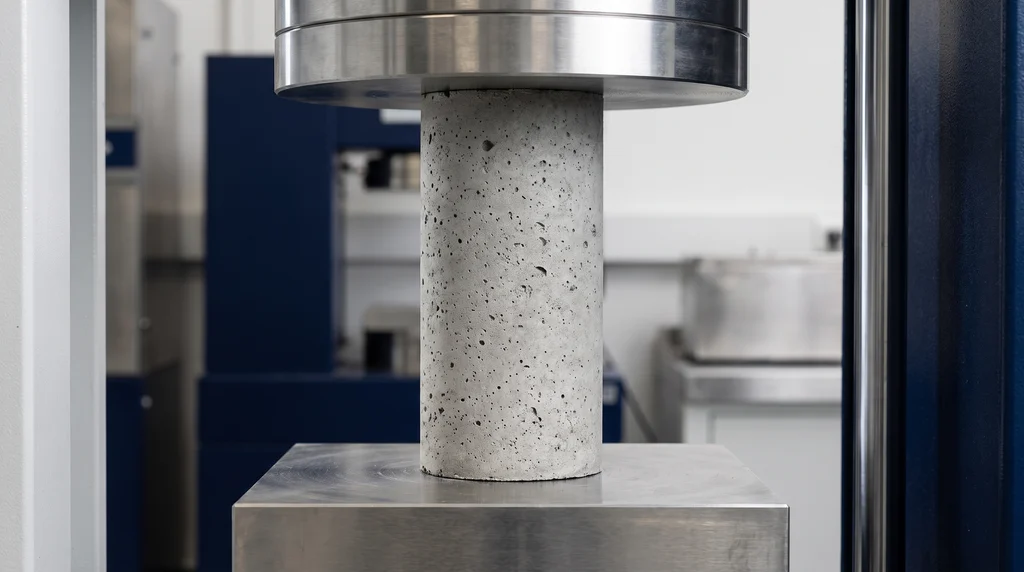
The photo shows a cylindrical concrete specimen between the compression platens, the basic setup of the modulus test under NBR 8522-1 (the Brazilian standard for determining the elastic and deformation moduli of concrete), which adds strain-measuring devices on the specimen itself.
The difference between concrete and steel lies in the shape of the curve. In steel, the initial portion is a straight line up to near yielding. In concrete, the curve starts to bend almost from the beginning. The reason is the structure of the material: concrete is a three-phase composite, made of hardened cement paste, coarse aggregate and the interfacial transition zone between the two. The transition zone is more porous and already contains microcracks before any load is applied, caused by shrinkage and bleeding. Under compression, these microcracks grow, and strain starts to increase faster than stress.
Up to about 30% to 40% of the compressive strength (fc), the curve is nearly straight and the behavior is practically reversible: when unloaded, the specimen returns to its initial length, which is what characterizes elastic deformation. Above this range, microcracking propagates, the curve bends more and more and part of the deformation becomes permanent. The peak, which is fc itself, lies near 2 ‰ shortening for ordinary concretes, and NBR 6118 adopts 3.5 ‰ as the ultimate strain for classes C20 to C50.
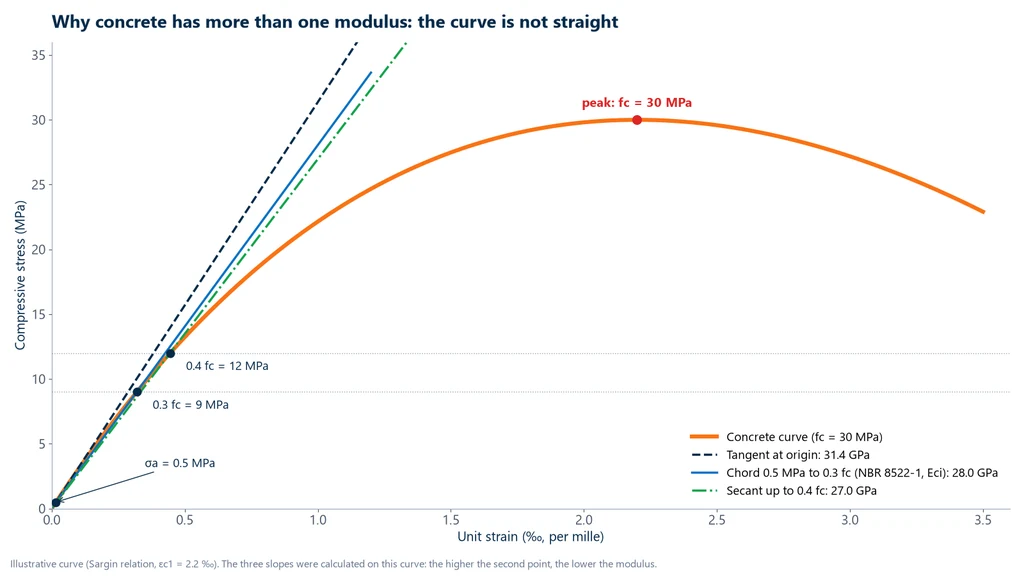
Since the curve has no perfectly straight portion, "the slope" depends on where it is measured. That is why concrete has more than one modulus, each defined by two points on the curve, and the standard has to state which one is used in each situation.
Eci and Ecs: initial tangent modulus and secant modulus
NBR 6118 and NBR 8522-1 work with two moduli. The initial tangent modulus, Eci, is the slope of the tangent to the curve at the origin: it represents the stiffness of concrete at low stresses. The secant modulus, Ecs, is the slope of a line joining the origin, or a low-stress point, to a higher-stress point on the curve. Because the curve bends as stress rises, the secant lies below the tangent, and Ecs is always less than or equal to Eci.
In laboratory practice, the exact tangent at the origin is not measured. NBR 8522-1:2021 obtains Eci as the slope of the line between two points near the start, 0.5 MPa and 30% of fc, a line joining two points on the curve called the chord. The exact tangent at the origin cannot be measured accurately, so the standard adopts this chord as Eci; it falls slightly below the theoretical tangent, and the more linear the concrete, the smaller the gap. The American standard ASTM C469/C469M uses a different chord, up to 40% of the ultimate load. The chart below plots the three lines on the curve of a concrete with fc = 30 MPa and shows that the higher the second point, the lower the modulus: 31.4 GPa for the tangent, 28.0 GPa for the NBR 8522-1 chord and 27.0 GPa for the secant up to 0.4 fc.
Modulus of elasticity or modulus of deformation
The title of NBR 8522-1 refers to "moduli of elasticity and of deformation", and the two names have distinct meanings. The modulus of elasticity is Eci, the initial tangent modulus. The secant modulus of deformation is Ecs, calculated up to a specified stress. In reports and designs, "modulus of deformation" almost always means the secant modulus.
Which modulus to use in reinforced concrete design
NBR 6118 (item 8.2.8) specifies Ecs for elastic design analyses: calculation of internal forces and verification of serviceability limit states, such as deflections. It is taken as a single modulus, in tension and in compression, to evaluate a member or a cross section. Eci is used in analyses that depend on stiffness under low, sustained stress, such as the global behavior of the structure, creep and prestress losses. Using Eci instead of Ecs in a deflection calculation underestimates the deformation, because the modulus used is higher than the recommended one.
The same item of the standard completes the elastic description of concrete with two values: Poisson's ratio ν = 0.2 and shear modulus Gc = Ecs / 2.4, valid for compressive stresses below 0.5 fc and tensile stresses below the tensile strength. Poisson's ratio has its own article.
Formula for the modulus of elasticity of concrete under NBR 6118:2023
NBR 6118 requires Eci to be obtained from the NBR 8522-1 test at 28 days. When no test is available, which is common at the design stage, the standard allows it to be estimated from the characteristic compressive strength, fck, which is the strength with a 95% probability of being exceeded and defines the concrete class (C30 has fck = 30 MPa). The estimate uses two expressions, one for each strength group, and two coefficients.
The two expressions for Eci
For group I concretes, C20 to C50, the modulus grows with the square root of the strength:
- C20 to C50: Eci = αE · 5600 · √fck, with Eci and fck in MPa.
- C55 to C90: Eci = 21.5 · 103 · αE · (fck/10 + 1.25)1/3, also in MPa.
In group II, C55 to C90, the standard replaces the square root with a cube root. In high-strength concrete, the paste is denser and the transition zone is less porous, and the modulus grows more slowly than the strength. Each expression is valid only in its own range: applying the square root to a C70 overestimates the modulus.
The aggregate coefficient, αE
Coarse aggregate takes up most of the volume of concrete and is much stiffer than the paste, so the rock type weighs on the modulus as much as the strength does. The standard accounts for this with the coefficient αE, which multiplies Eci:
- Basalt and diabase: αE = 1.2.
- Granite and gneiss: αE = 1.0.
- Limestone: αE = 0.9.
- Sandstone: αE = 0.7.
Between sandstone and basalt, the modulus of the same C30 varies by 71%. A design calculated with granite and built with sandstone aggregate will have a concrete 30% less stiff than predicted.
The αi coefficient and the secant modulus
The secant modulus is derived from the initial tangent modulus through a coefficient that increases with the class:
- Secant modulus: Ecs = αi · Eci.
- Coefficient: αi = 0.8 + 0.2 · fck/80 ≤ 1.0.
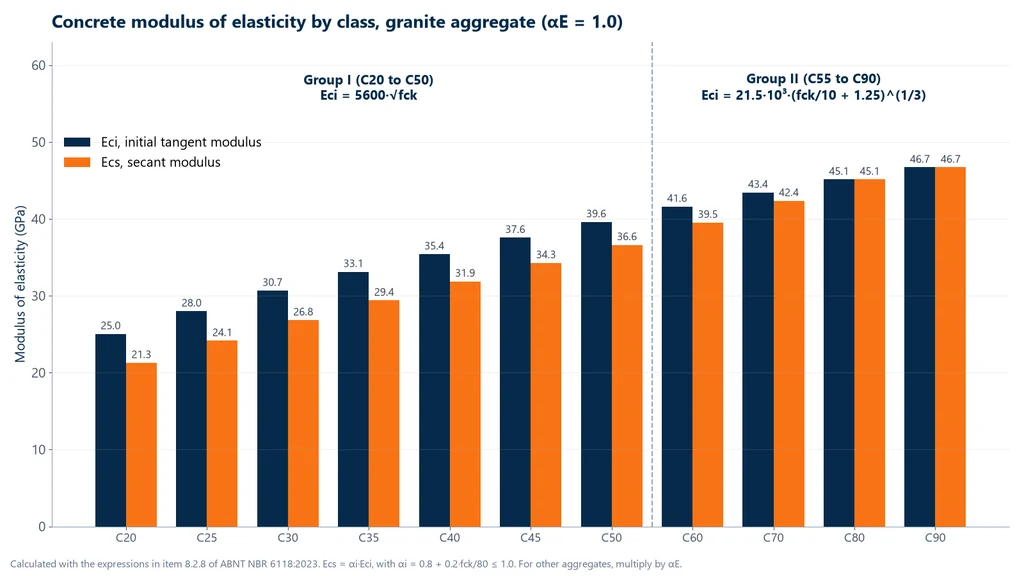
For C20, αi = 0.85; for C50, 0.925; from C80 upward, it reaches 1.0. The coefficient reflects what the previous chart showed: low-strength concretes have a curve that bends early, and the secant falls well below the tangent. High-strength concretes are nearly linear up to close to failure, and the two lines coincide.
The modulus before 28 days
The modulus increases as the cement hydrates, but more slowly than the strength. Between 7 and 28 days, NBR 6118 estimates the modulus at age t from the strength at that age, fc(t), and the 28-day strength, fc:
- C20 to C45: Eci(t) = [fc(t) / fc]0.5 · Eci.
- C50 to C90: Eci(t) = [fc(t) / fc]0.3 · Eci.
This estimate matters, for example, when removing shoring and when prestress is applied before 28 days.
What changed in NBR 6118:2023 and the old rule still in circulation
For the modulus, nothing changed: the 2023 edition kept the expressions and coefficients of 2014. The main change in item 8.2 was the brittleness coefficient ηc, in item 8.2.10.1, applied to concretes above 40 MPa, which does not affect the modulus. What still appears in course notes and websites is the rule from the 2003 and 2007 editions: Eci = 5600 · √fck without αE and Ecs = 0.85 · Eci = 4760 · √fck. It was withdrawn in 2014. The mix of the two, "Eci = 0.85 · 5600 · √fck", is wrong under any edition.
The table summarizes the current expressions:
| Quantity | Expression (NBR 6118:2023) | Validity |
|---|---|---|
| Eci, group I | αE · 5600 · √fck (MPa) | C20 to C50 |
| Eci, group II | 21.5 · 103 · αE · (fck/10 + 1.25)1/3 (MPa) | C55 to C90 |
| Ecs | αi · Eci | all classes |
| αi | 0.8 + 0.2 · fck/80 ≤ 1.0 | all classes |
| Eci(t) | [fc(t)/fc]0.5 or 0.3 · Eci | 7 to 28 days |
The expressions apply to normal-weight concrete, with a density of 2,000 to 2,800 kg/m³. Lightweight concrete and ultra-high-performance concrete have their own behavior and methods.
Table of the modulus of elasticity of concrete by class
Table 8.1 of NBR 6118 gives the estimated values of Eci, Ecs and αi by class, assuming granite as the coarse aggregate. The values below were calculated with the expressions of item 8.2.8, to one decimal place; the standard rounds to whole GPa (C30: 31 and 27 GPa).
| Class | Eci (GPa) | αi | Ecs (GPa) |
|---|---|---|---|
| C20 | 25.0 | 0.850 | 21.3 |
| C25 | 28.0 | 0.863 | 24.2 |
| C30 | 30.7 | 0.875 | 26.8 |
| C35 | 33.1 | 0.888 | 29.4 |
| C40 | 35.4 | 0.900 | 31.9 |
| C45 | 37.6 | 0.913 | 34.3 |
| C50 | 39.6 | 0.925 | 36.6 |
| C60 | 41.6 | 0.950 | 39.5 |
| C70 | 43.4 | 0.975 | 42.4 |
| C80 | 45.1 | 1.000 | 45.1 |
| C90 | 46.7 | 1.000 | 46.7 |
The chart below shows the same values as bars. Two effects stand out: the gap between Eci and Ecs narrows with the class until it disappears at C80, and the gain in modulus becomes smaller after the change of formula, in group II. From C30 to C70 the strength rises by 133%, and Eci by only 42%.
Modulus of elasticity of 25 MPa and 30 MPa concrete
These are the two most frequent questions, and the answer depends on the aggregate. With granite, concrete with fck of 25 MPa has Eci = 5600 × 5 = 28.0 GPa and Ecs = 0.8625 × 28.0 = 24.2 GPa. The 30 MPa concrete has Eci = 5600 × √30 = 30.7 GPa and Ecs = 0.875 × 30.7 = 26.8 GPa. The next table applies the αE of each rock type to both classes:
| Aggregate (αE) | C25: Eci / Ecs (GPa) | C30: Eci / Ecs (GPa) |
|---|---|---|
| Basalt, diabase (1.2) | 33.6 / 29.0 | 36.8 / 32.2 |
| Granite, gneiss (1.0) | 28.0 / 24.2 | 30.7 / 26.8 |
| Limestone (0.9) | 25.2 / 21.7 | 27.6 / 24.2 |
| Sandstone (0.7) | 19.6 / 16.9 | 21.5 / 18.8 |
C30 in other design codes
Each design code has its own expression, and comparing the same concrete shows the scatter between them. The values below were calculated for fck = 30 MPa with reference aggregate. Eurocode 2 and the fib Model Code start from the mean strength, fcm = fck + 8 MPa, which is why they give higher values.
| Standard | Expression | C30 |
|---|---|---|
| NBR 6118:2023 (granite) | Eci = 5600 · √fck | 30.7 GPa (Ecs 26.8) |
| NBR 6118:2007 (withdrawn) | Ecs = 4760 · √fck | 26.1 GPa |
| ACI 318 | Ec = 4700 · √f′c | 25.7 GPa |
| Eurocode 2 | Ecm = 22 · (fcm/10)0.3 GPa | 32.8 GPa |
| fib Model Code 2010 | Eci = 21.5 · 103 · (fcm/10)1/3 | 33.5 GPa |
For comparison with another construction material: reinforcing steel has a modulus of 210 GPa under NBR 6118, 5 to 8 times that of an ordinary concrete. The details are in the article on the modulus of elasticity of steel.
What makes the modulus of concrete vary
The code formulas depend only on fck and the rock type, but the actual modulus of a concrete depends on the mix design, the curing and even the way the test specimen is tested. Knowing these factors explains why two concretes of the same strength class can have very different moduli:
- Type and content of coarse aggregate: this is the main factor, and not only because of the rock. In a compilation of results from across Brazil, the concrete density was the variable with the greatest influence on Eci at 28 days (Leal et al., 2020). More aggregate and less paste give a stiffer concrete.
- Water/cement ratio: more water makes the paste more porous, and pores do not resist compression. A high w/c ratio lowers the modulus, and a low one raises it.
- Age: cement hydration continues after 28 days and densifies the paste; the modulus increases, but more slowly than the strength.
- Curing: insufficient moist curing stops hydration at the surface and leaves the paste more porous and microcracked, with a lower modulus. Controlled temperature and humidity during curing give a more consistent modulus.
- Moisture during the test: a saturated test specimen gives a modulus about 15% higher than a dry one, because the water in the pores helps carry the compressive load.
- Loading rate: very slow loading lets creep act during the test and lowers the modulus; very fast loading overestimates it. That is why NBR 8522-1 sets the loading rate.
- Temperature: at high temperature, as in a fire, microcracking and water loss from the paste reduce the modulus, and the structure deforms more under the same load.
- Quarry: the same "granite" varies from one quarry to another, which the formulas cannot see.
How the modulus of elasticity test of concrete is performed (NBR 8522-1:2021)
The static modulus test follows ABNT NBR 8522-1:2021 (the Brazilian standard for the static modulus of hardened concrete), "Hardened concrete: Determination of the moduli of elasticity and deformation. Part 1: Static moduli in compression". The test specimens are cylinders with a height equal to twice the diameter, usually 100 × 200 mm or 150 × 300 mm, cast and cured according to NBR 5738 (the Brazilian standard for casting and curing concrete specimens). The standard requires at least five specimens of the same concrete: two are broken beforehand, according to NBR 5739 (the Brazilian standard for concrete compression testing), to give the strength fc that defines the load levels, and three are used for the modulus.
The specimen is centered between the platens of a compression machine or universal testing machine, and the strain is measured by extensometers attached to the concrete itself, on two diametrically opposite gauge lines; the result is the average of the two. The measurement must be taken on the specimen, and not from the machine displacement, because of scale: in the range where the modulus is measured, a 200 mm specimen shortens by less than 0.1 mm, and the crosshead displacement also includes platen seating, the capping and the deformation of the machine itself. Exercise 5 shows the size of the error.
Methods A and B
The standard defines two ways of setting the starting point of the chord. Both use the stress σb = 0.3 · fc as the end point:
- Method A, fixed stress: the starting point is the stress σa = 0.5 MPa, and the strain εa is read at that stress.
- Method B, fixed strain: the starting point is the strain εa = 50 · 10-6, and the stress σa is read at that strain.
Loading and readings, step by step
Loading is applied in cycles at a rate of 0.45 ± 0.15 MPa/s, and each stress level is held for 60 s before the reading. The initial cycles seat the specimen on the platens and stabilize the extensometers. The sequence is:
- Center the test specimen and attach the extensometers on the two opposite gauge lines.
- Run the loading and unloading cycles between the initial level (σa) and σb = 0.3 · fc, holding each level for 60 s.
- Read the strains εa and εb in the last cycle, within the 30 s following each hold.
- Remove the extensometers and break the specimen to obtain the actual strength fc,ef.
- Check the strength: if fc,ef differs by more than 20% from the fc used to define σb, the result for that specimen is discarded.
Calculation of Eci and Ecs in the test
With stresses in MPa and dimensionless strains, the factor 10-3 converts the result to GPa:
- Method A: Eci = (σb − 0.5) / (εb − εa) · 10-3.
- Method B: Eci = (σb − σa) / (εb − 50 · 10-6) · 10-3.
- Secant modulus of deformation: Ecs = (σn − σa) / (εn − εa) · 10-3, where σn is the specified stress.
The stress σn for the secant modulus is chosen by whoever specifies the test, usually the structural designer, according to the service stress of interest. The test uses the actual fc of the broken specimens, not the design fck: fck appears only in the estimation formulas.
The test according to ASTM C469/C469M
The American standard measures the chord modulus and Poisson's ratio in the same test. The chord runs from the stress corresponding to a strain of 50 · 10-6 up to 40% of the ultimate load, a slightly higher range than in NBR 8522-1, and the strain is the average of two opposite gauge lines. Because of the higher end point, the ASTM modulus tends to be slightly lower than the Eci of the Brazilian standard for the same concrete, as the first chart showed.
Static modulus and dynamic modulus
The modulus can also be obtained without loading the specimen to 30% of its ultimate strength, by dynamic methods that measure vibration or wave propagation. ABNT NBR 8522-2:2021 (the Brazilian standard for the dynamic modulus) determines the dynamic modulus of elasticity, Ecd, from the natural vibration frequencies: the specimen receives a light impact, and the resonant frequency gives the modulus. Other references are ASTM C215, by resonant frequency, ASTM E1876, by impulse excitation, and the ultrasonic method of NBR 8802 (the Brazilian standard for ultrasonic pulse velocity).
The two moduli are not the same. In the dynamic method the stress is minimal, the microcracks barely open and the material responds with practically no creep, so Ecd comes out higher: about 20% above the static value in high-strength concretes, 30% in medium-strength concretes and 40% in low-strength concretes. In a study of basalt concretes from the state of Paraná, Brazil, the dynamic modulus was 16% above the static value by impulse excitation and 28% by ultrasound. NBR 8522-1 provides, in Annex B, an empirical correlation, the Popovics model, to estimate Eci from Ecd and the density. The dynamic method is fast, does not destroy the specimen and is useful for tracking how the modulus develops; the value used in NBR 6118 is the static one, and using the dynamic value without conversion overestimates the stiffness.
Why the modulus matters: estimated or measured
The modulus does not decide whether the structure can carry the load, but it does decide how much it deforms. Deflection of beams and slabs, cracks in masonry supported by them, long-term creep deformation and the global stability of tall buildings all depend on Ecs. A slab with a modulus 15% lower than expected has an immediate deflection 15% larger, and creep amplifies this difference over the years.
The problem is that the code formula is an estimate. Builders and laboratories report that tested values are often below the estimated ones, and some recommend reducing the estimate by 10% to 15% (IBRACON, the Brazilian Concrete Institute, 2023). Published data show the extent of the scatter:
- Borin et al. (2010): in job-site concretes with strength close to 30 MPa, the modulus ranged from 16.5 to 47.7 GPa, with a 20% probability of falling below the estimate of the code then in force.
- Leal et al. (2020): in the compilation of results from across Brazil, the fitted αE was 1.00 to 1.03 for granite and gneiss, which confirms the code; 1.08 for limestone, above the code's 0.9; and 1.07 to 1.14 for basalt, below 1.2.
- Santos et al. (2017): with 324 specimens of basalt and dolomite from the Triângulo Mineiro region (Minas Gerais, Brazil), the expressions of NBR 6118:2014 and the fib Model Code were the closest to the results.
- North Coast of São Paulo state: a local laboratory reports 30 MPa concretes with gneiss and Eci as low as 26 GPa, about 17% below the estimate (Sotef, 2025).
The practical conclusion is that of NBR 6118 itself: the modulus should come from the NBR 8522-1 test. In projects where deflection and cracking are critical, the designer specifies the minimum modulus, and the quality control laboratory verifies it with the project's own aggregates.
Worked examples
The six exercises follow the order of the article: estimation by the code, effect of the aggregate, high strength, calculation from the test readings, the error of measuring by the crosshead, and the effect of the modulus on deflection.
Exercise 1: Eci and Ecs of a C30 with granite
Data: fck = 30 MPa, granite coarse aggregate, αE = 1.0.
- Eci = 1.0 × 5600 × √30 = 5600 × 5.477 = 30,672 MPa ≈ 30.7 GPa.
- αi = 0.8 + 0.2 × 30/80 = 0.875, below 1.0.
- Ecs = 0.875 × 30,672 = 26,838 MPa ≈ 26.8 GPa.
Exercise 2: the same C30 with basalt, and C25 with granite
With basalt, αE = 1.2. For C25 with granite, √25 = 5.
- C30 basalt: Eci = 1.2 × 30,672 = 36,806 MPa; Ecs = 0.875 × 36,806 = 32,205 MPa, 20% above granite at the same fck.
- C25 granite: Eci = 5600 × 5 = 28,000 MPa; αi = 0.8625; Ecs = 24,150 MPa.
Exercise 3: high-strength concrete C70 with granite
C70 belongs to group II, so the cube-root expression applies.
- Eci = 21,500 × 1.0 × (70/10 + 1.25)1/3 = 21,500 × 8.251/3 = 21,500 × 2.0206 = 43,443 MPa.
- αi = 0.8 + 0.2 × 70/80 = 0.975.
- Ecs = 0.975 × 43,443 = 42,357 MPa.
With the square root, outside its range, the result would be 5600 × √70 = 46,853 MPa, 8% above the correct value.
Exercise 4: Eci from the test readings (method A)
Teaching data: 100 × 200 mm test specimen; fc of the specimens broken beforehand = 32.0 MPa; two opposite extensometers with a 100 mm gauge length. Average reading at the 0.5 MPa level: εa = 20 · 10-6. At the σb level: εb = 325 · 10-6.
- Area: A = π × 50² = 7,854 mm².
- σb = 0.30 × 32.0 = 9.6 MPa. Forces at the load levels: 0.5 × 7,854 = 3.93 kN and 9.6 × 7,854 = 75.4 kN.
- Eci = (9.6 − 0.5) / (305 · 10-6) · 10-3 = 29.8 GPa.
- Shortening measured over the 100 mm gauge length: 305 · 10-6 × 100 = 0.0305 mm, or 30.5 µm.
After the readings, the specimen is broken; if fc,ef falls outside 32.0 ± 20%, the result is discarded.
Exercise 5: the error of measuring by the crosshead
In the same test, the crosshead displacement between the same two forces was 0.122 mm. The concrete, over its 200 mm height, shortened by 305 · 10-6 × 200 = 0.061 mm; the other 0.061 mm come from platen seating, the capping and the deformation of the machine.
- Apparent strain: 0.122 / 200 = 610 · 10-6.
- Apparent modulus: 9.1 / (610 · 10-6) · 10-3 = 14.9 GPa, half the actual value.
The modulus can only be measured with an extensometer on the test specimen, and the same applies to metals in the tensile test.
Exercise 6: effect of the modulus on deflection
Simply supported beam, 5 m span, distributed load of 10 kN/m, 15 × 40 cm cross section, C25 concrete with granite. Moment of inertia of the gross section: I = 0.15 × 0.40³ / 12 = 8.0 · 10-4 m⁴. Immediate elastic deflection: δ = 5·q·L⁴ / (384·E·I).
- With Ecs = 24.15 GPa: δ = 5 × 10,000 × 625 / (384 × 24.15 · 109 × 8.0 · 10-4) = 4.2 mm.
- With Eci = 28 GPa, by mistake: δ = 3.6 mm, 14% lower.
- With basalt (Ecs = 29.0 GPa): 3.5 mm. With sandstone (16.9 GPa): 6.0 mm.
NBR 6118 calculates deflection with the equivalent moment of inertia of the cracked section and adds creep; the exercise isolates only the effect of the modulus. The relationship between stiffness and deflection is also covered in the flexural test.
Common mistakes with the modulus of concrete
The mistakes below appear frequently in design calculations, reports and technical texts, and each has been covered in a section of this article:
- Using Eci where the code requires Ecs: for deflections and internal forces, this underestimates deformation by 7% to 15% in classes C20 to C50.
- Forgetting αE: designing with granite and building with sandstone gives a modulus 30% lower.
- Using the superseded rule: Ecs = 0.85 · Eci, or the mixed form "0.85 · 5600 · √fck", has not been valid since 2014.
- Using the wrong formula range: the square root applies up to C50, and the cube root from C55 to C90.
- Using fck in the test: σb = 0.3 · fc, with fc measured on the specimens broken beforehand.
- Measuring strain from the crosshead: the modulus comes out much lower than the actual value.
- Comparing dynamic and static values without conversion: the dynamic modulus is 20% to 40% higher.
- Treating the modulus as a constant: moisture, quarry and procedure change the result, and the variation between laboratories reaches 10% to 15%.
Standards for the modulus of elasticity of concrete
The Brazilian standards cover design (NBR 6118), the static and dynamic tests (NBR 8522-1 and -2) and specimen preparation. The table lists those cited in this article:
| Standard | Scope | Edition |
|---|---|---|
| ABNT NBR 6118 | design of concrete structures (Brazil): Eci, Ecs, αE, αi, table 8.1 | 2023 |
| ABNT NBR 8522-1 | static moduli of elasticity and deformation in compression | 2021 |
| ABNT NBR 8522-2 | dynamic modulus by natural vibration frequencies | 2021 |
| ABNT NBR 5739 | compression test of cylindrical specimens | 2018 |
| ABNT NBR 5738 | casting and curing of test specimens | 2015 |
| ABNT NBR 8953 | classification of concrete by strength groups (C20 to C90) | not specified |
| ABNT NBR 8802 | ultrasonic pulse velocity | not specified |
| ASTM C469/C469M | static modulus and Poisson's ratio of concrete in compression | C469/C469M-22 |
| ASTM C215 | resonant frequencies of concrete specimens | not specified |
| ASTM E1876 | dynamic modulus by impulse excitation | not specified |
| ASTM E111 | definitions of Young's, tangent and chord modulus | E111-17(2025)e1 |
| ACI 318, Eurocode 2, fib Model Code 2010 | design codes with their own modulus expressions | not specified |
Two corrections to lists in circulation, including the previous version of this article: NBR 8953 classifies concrete by strength and does not cover ultrasound, which is the subject of NBR 8802; and ISO 6784, cited as the international standard for the static modulus, has been replaced by ISO 1920-10.
Testing machine for the concrete modulus of elasticity test
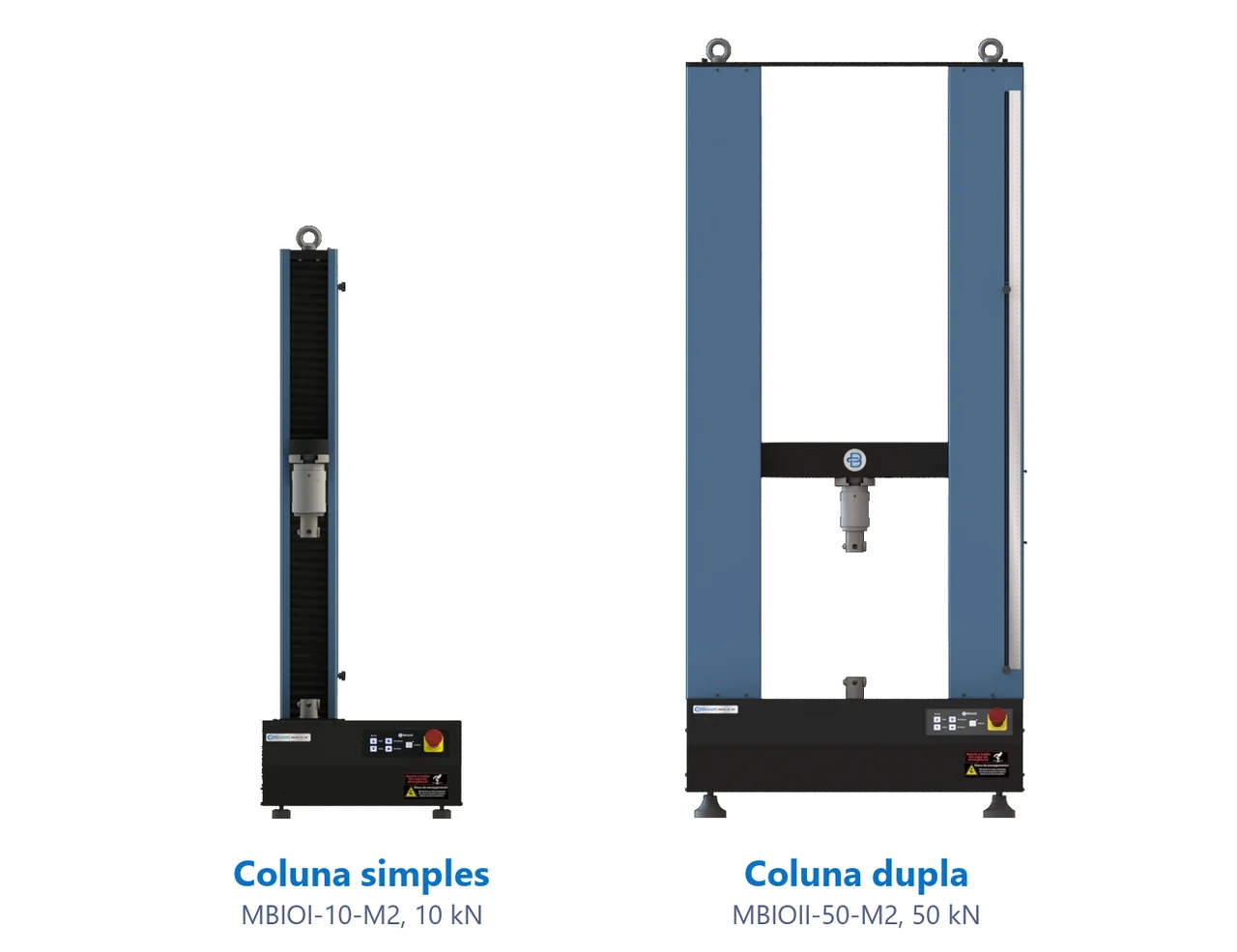
The ABNT NBR 8522-1 test (the Brazilian standard for the static modulus of elasticity of concrete in compression) requires three things from the equipment: applying compression at a controlled rate and holding the load steps, measuring force with a calibrated load cell, and reading strain with extensometers attached to the test specimen. The machine must also break the specimen at the end of the test: a 100 × 200 mm C30 cylinder fails at about 236 kN, and a 150 × 300 mm cylinder at about 530 kN. The Biopdi M2 universal testing machine line includes floor-standing models of 300 kN, 600 kN and 1,000 kN, load cells rated Class 1 according to ABNT NBR ISO 7500-1:2023 (the Brazilian adoption of ISO 7500-1), and the BioLab software. The panel below shows the machine, the role of each part in the modulus test, and the compression platens.
The universal testing machine in the compression test
The M2 line includes single-column models, from 200 N to 10 kN, and dual-column models, from 5 kN to 1,000 kN. For the concrete modulus, each part of the machine has a role:
- Moving crosshead compresses the specimen in cycles, with load steps
- Load cell measures force, Class 1, for σa, σb and failure
- Compression platens flat, with a spherical seat for concrete
- Extensometers on two opposite gauge lines of the specimen: essential for the modulus
- BioLab software script-based test, Eci calculation and report
- Control panel and emergency stop positions and stops the test
Fixtures for the compression test
The fixtures below are mounted on the same machine, according to the specimen and the standard:
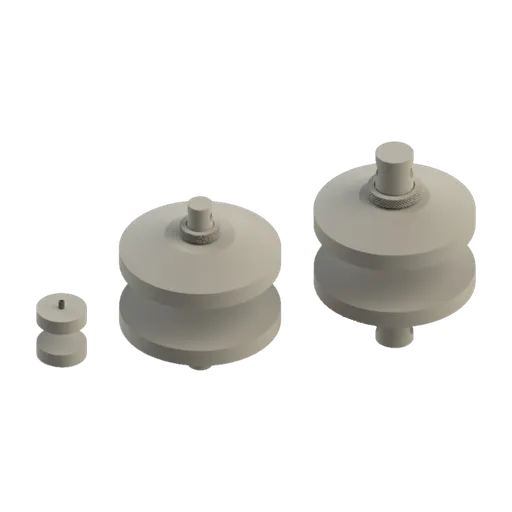
For 100 × 200 mm specimens up to C25, the recommended model is the 300 kN universal testing machine (MBIOII-300-M2), whose page mentions concrete and NBR 5739:2018 (the Brazilian standard for concrete compression testing); from C30 to C50 on the same specimen, the 600 kN model (MBIOII-600-M2); and for 150 × 300 mm cylinders of high strength classes, the 1,000 kN model (MBIOII-1000-M2). The BioLab software lets you build the test as a script and create custom calculations, such as the chord modulus (σb − 0.5) / (εb − εa). The extensometers suited to concrete specimens and the setup of the NBR 8522-1 routine are defined in the quote. To choose between models, see the universal testing machine guide.
Other tests and technical references
Poisson's ratio: what it is, formula, values for steel, concrete and soil, and how to measure it
Poisson's ratio (ν) is the negative ratio of transverse strain to longitudinal strain in a material under uniaxial load in the elastic range. See the formula, its relationship with E, G and K, the range from −1 to 0.5, the values for steel (0.3 per ABNT NBR 8800, the Brazilian steel structures design standard), concrete (0.2 per ABNT NBR 6118, the Brazilian concrete structures design standard), rubber and soils, how to measure it per ASTM E132, and worked examples.
Modulus of elasticity of steel: 200 or 210 GPa, table by grade, units and temperature
The modulus of elasticity of steel ranges from 190 to 210 GPa: NBR 8800 (the Brazilian steel structures standard) adopts 200 GPa for structural steel and NBR 6118 (the Brazilian concrete structures standard) adopts 210 GPa for reinforcing bars. See the values for A36, 1020, 1045, 4140, CA-50 rebar and 304 stainless steel, the conversion to MPa, kgf/cm² and kN/cm², the effect of temperature, G and Poisson's ratio, how to measure it and worked examples.
Strength of materials: concepts, formulas and examples
Strength of materials calculates stresses and strains in parts under load. See internal forces, formulas with units, worked exercises and books.
Mechanical properties of materials: what they are, the main types, tests, standards and steel values
The mechanical properties of materials define how a material responds to forces: how much it deforms, whether it returns to its shape, how much load it carries, how much energy it absorbs and how it fractures. See each property with its unit, test and standard, the values for steel (NBR 8800, the Brazilian steel structures design standard; ASTM A36; CA-50, the Brazilian rebar grade), the pairs that are often confused and solved exercises.
Frequently asked questions
What is the modulus of elasticity of concrete?
It is the measure of the stiffness of concrete: the ratio between the compressive stress and the strain it causes, in the initial portion of the stress-strain curve. The higher the modulus, the less the member shortens or deflects under the same load.
What is the modulus of elasticity of 30 MPa concrete?
With granite coarse aggregate, according to NBR 6118:2023 (the Brazilian code for the design of concrete structures), Eci = 5600 × √30 ≈ 30.7 GPa and Ecs = 0.875 × 30.7 ≈ 26.8 GPa (Table 8.1 rounds these to 31 and 27 GPa). With basalt, the values rise by 20%: 36.8 and 32.2 GPa.
What is the modulus of elasticity of fck 25 MPa concrete?
With granite, Eci = 5600 × 5 = 28.0 GPa and Ecs = 0.8625 × 28.0 ≈ 24.2 GPa. With limestone (αE = 0.9), 25.2 and 21.7 GPa; with basalt, 33.6 and 29.0 GPa.
How do you calculate the modulus of elasticity of concrete?
Without testing, use Eci = αE · 5600 · √fck for C20 to C50, or Eci = 21.5 · 10³ · αE · (fck/10 + 1.25)^(1/3) for C55 to C90, with the result in MPa. Then, Ecs = αi · Eci, with αi = 0.8 + 0.2 · fck/80 ≤ 1.0. With testing according to NBR 8522-1:2021, Eci = (σb − 0.5) / (εb − εa) · 10⁻³, in GPa.
What is the difference between Eci and Ecs?
Eci is the initial tangent modulus, the stiffness of concrete under low stresses. Ecs is the secant modulus, which is lower and is used to calculate internal forces and deflections. For classes C20 to C50, Ecs is 85% to 93% of Eci; from C80 upward, the two are equal.
Which modulus should be used in reinforced concrete design?
Ecs, for elastic analyses, internal forces and serviceability limit states, such as deflections. Eci is used in the global analysis of the structure, in creep and in prestress losses (NBR 6118, section 8.2.8).
Did NBR 6118:2023 change the modulus formula?
No. The 2023 edition kept the 2014 expressions and aggregate coefficients. The main change in section 8.2 was the brittleness coefficient ηc for concretes above 40 MPa, which does not affect the modulus.
Why does the type of coarse aggregate change the modulus?
Coarse aggregate takes up most of the volume and is much stiffer than the cement paste. That is why NBR 6118 multiplies Eci by αE: 1.2 for basalt and diabase, 1.0 for granite and gneiss, 0.9 for limestone and 0.7 for sandstone. Studies in Brazil show that the actual value varies from quarry to quarry.
Which standard defines the concrete modulus test?
ABNT NBR 8522-1:2021, for the static moduli in compression. It uses cycles up to 30% of fc, a loading rate of 0.45 ± 0.15 MPa/s and 60 s load steps, with extensometers on the specimen. NBR 8522-2:2021 covers the dynamic modulus; outside Brazil, the reference is ASTM C469/C469M.
Is the dynamic modulus equal to the static modulus?
No. The dynamic modulus, measured by vibration or ultrasound, comes out 20% to 40% higher than the static modulus, more so in lower-strength concretes. NBR 8522-1 provides, in Annex B, a correlation to estimate Eci from the dynamic modulus.
Why does the test sometimes give a lower modulus than the standard?
The formula depends only on fck and the aggregate, but the actual modulus also varies with the water/cement ratio, density, quarry, curing and moisture. There are reports of concretes 10% to 17% below the estimate, which is why NBR 6118 prefers the tested value.
How does the modulus of concrete compare to that of steel?
Ordinary concrete, from C20 to C50, has an Eci of roughly 25 to 40 GPa with granite. Reinforcing steel has 210 GPa according to NBR 6118, 5 to 8 times stiffer.