
Poisson's ratio (ν) is the negative ratio of transverse strain to longitudinal strain in a material under uniaxial load in the elastic range: ν = −εtrans/εlong. It is dimensionless and equals 0.3 for steel (ABNT NBR 8800:2008), 0.2 for concrete (ABNT NBR 6118:2023) and close to 0.5 for rubber.
Poisson's ratio tells you how much a material gets thinner sideways when it is stretched, or how much it widens when it is compressed. Together with the modulus of elasticity, it fully describes the elastic behavior of an isotropic material, and it is the link to the shear modulus G and the bulk modulus K. This article starts with the definition and moves on to the formulas, the theoretical limits and typical values by material. It ends with measurement on a universal testing machine, and includes worked examples along the way.
What is Poisson's ratio
A bar in tension elongates in the direction of the force. At the same time, its cross-section shrinks: the width and thickness of a plate, or the diameter of a round bar, become slightly smaller. In compression the opposite happens: the part shortens and its cross-section grows. In a homogeneous, isotropic material in the elastic range, the lateral strain stays at a constant ratio to the axial strain. That constant is Poisson's ratio. According to ASTM E132-17, it is a material property, like Young's modulus and the shear modulus. The diagram below shows the bar before and after loading, with the strains exaggerated. In steel under service loads they are around 0.1%, too small to see with the naked eye.
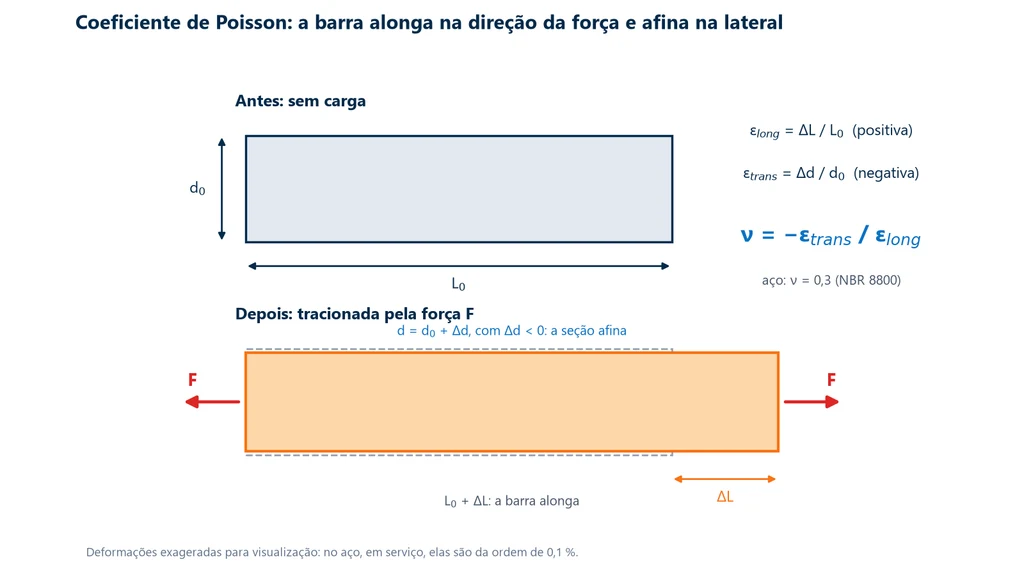
With ν = 0.3, for example, the lateral strain of steel is 30% of the axial strain: if the bar elongates by 1,000 millionths of its length, the diameter shrinks by 300 millionths of the diameter.
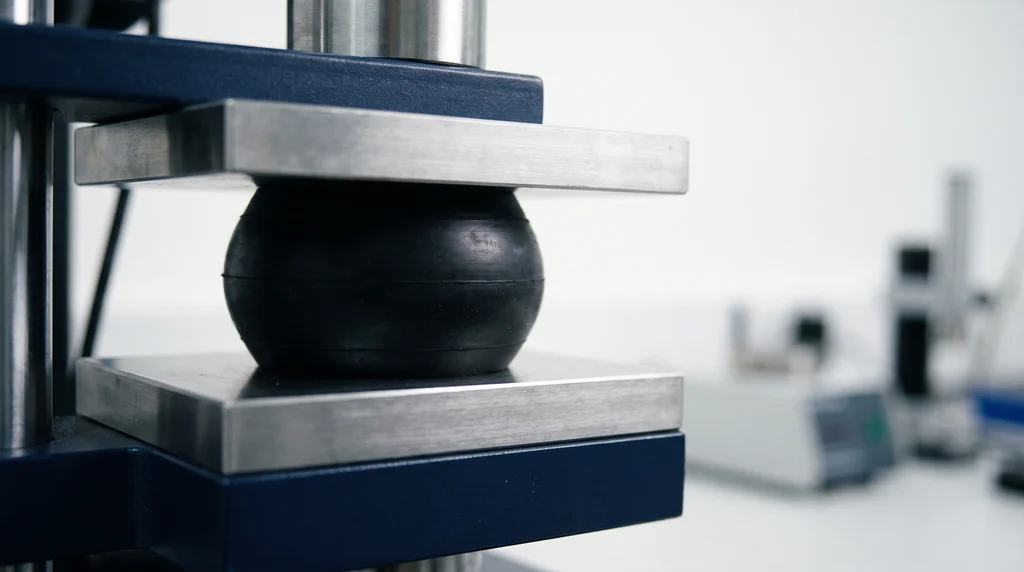
The photo shows the Poisson effect in an exaggerated form: a rubber cylinder compressed between plates shortens and expands sideways. With ν close to 0.5, rubber barely changes volume, which is why the bulging is so visible.
Why the formula has a negative sign
In tension, the longitudinal strain is positive (the bar elongates) and the transverse strain is negative (the cross-section shrinks). In compression both signs flip. In common materials the two strains always have opposite signs, so their ratio is negative, and the minus sign in the definition makes ν positive. Forgetting the sign is the most common mistake in exercises: εtrans/εlong gives −0.3 for steel, while the correct value is 0.3.
Symbol and unit
The symbol is the Greek letter ν (nu). Some textbooks use μ, and NBR 8800 (the Brazilian standard for the design of steel structures) writes νa for steel. The ratio has no unit because it divides one strain by another, and each strain is already a ratio of lengths (mm/mm). Since it is a pure number, it lets you compare materials regardless of part size: a 10 mm steel bar and a 1 m steel beam have the same ν.
Where the name comes from
The ratio is named after the French mathematician Siméon Denis Poisson, who introduced it into the theory of elasticity in the late 1820s. Based on a molecular theory, Poisson predicted that ν would be 1/4 for all solids. Later tests showed that the value varies from one material to another, as noted in the review by Greaves, Greer, Lakes and Rouxel in Nature Materials (2011).
It only applies in the elastic range
The ratio between the strains is constant only while the stress-strain relationship is linear, that is, up to the proportional limit of the stress-strain curve. This is the domain of elastic deformation. During plastic deformation of metals, volume is conserved and the ratio between the strains rises toward 0.5. This apparent value is not the material's Poisson's ratio, which is why measurement is done only in the linear portion.
Poisson's ratio formula and how to calculate it
The calculation starts from the two strains. Longitudinal strain is the change in length divided by the initial length: εlong = ΔL/L0 = (L − L0)/L0. Transverse strain is the change in a lateral dimension divided by its initial value: εtrans = Δd/d0 = (d − d0)/d0, or Δw/w0 for a plate of width w. Because both are relative, a small change in a large part can be a large strain, and vice versa. The usual forms are:
- Definition: ν = −εtrans/εlong.
- Predicted lateral strain: εtrans = −ν·εlong. For a bar in tension along x, εy = εz = −ν·εx.
- With Hooke's law: since εlong = σ/E, where E is the modulus of elasticity, the lateral strain is εtrans = −ν·σ/E.
Generalized Hooke's law
When a part is stressed in more than one direction, each stress elongates the material in its own direction and makes it thinner in the other two. The generalized Hooke's law, written for three directions, adds up these effects: εx = [σx − ν(σy + σz)]/E, and likewise for y and z. Through this expression the ratio enters almost every two- or three-dimensional stress calculation, from pressure vessels to soil under a foundation.
Example 1: ν from strain gauges
A steel bar in tension, in the elastic range, reads +1,200 µε on the axial electrical strain gauge and −360 µε on the transverse one (1 µε = 10−6). The ratio is ν = −(−360)/1,200 = 0.30, the value NBR 8800 adopts for steel.
Example 2: how much the diameter decreases
A steel bar with d0 = 20 mm is loaded in tension with 50 kN, with E = 200 GPa and ν = 0.3.
- Area: A = π × 20²/4 = 314.16 mm².
- Stress: σ = 50,000 N/314.16 mm² = 159.2 MPa, below the minimum yield strength of A36 steel (250 MPa), so the behavior is elastic.
- Longitudinal strain: εlong = 159.2/200,000 = 7.96 × 10⁻⁴.
- Transverse strain: εtrans = −0.3 × 7.96 × 10−4 = −2.39 × 10⁻⁴.
- Change in diameter: Δd = −2.39 × 10−4 × 20 mm = −0.0048 mm, about 5 µm. The final diameter is 19.9952 mm.
A 5 µm change will not show up on a caliper or on a standard shop micrometer. That is why Poisson's ratio is measured with a transverse extensometer or a bonded electrical strain gauge, as the measurement section shows.
Relationship between E, G, K and Poisson's ratio
An isotropic material, with the same properties in every direction, has three common elastic moduli. The modulus of elasticity (Young's modulus) E measures stiffness in tension and compression. The shear modulus G (also called the modulus of rigidity) measures stiffness against distortion, G = τ/γ; it is obtained from the torsion test and is related to the shear test. The bulk modulus K measures resistance to volume change under equal pressure in all directions. Together with Poisson's ratio, only two of these four constants are independent:
- E = 2G(1 + ν), or G = E/[2(1 + ν)];
- E = 3K(1 − 2ν), or K = E/[3(1 − 2ν)];
- ν = (3K − 2G)/(6K + 2G), from K and G;
- ν = E/(2G) − 1, used when E and G are measured separately, as in dynamic methods.
Brazilian design standards already give values that agree with these relationships. The table checks both cases:
| Quantity | Steel (NBR 8800:2008, 4.5.2.9) | Concrete (NBR 6118:2023, 8.2.9) |
|---|---|---|
| E | 200 GPa | Ecs, depending on the strength class |
| ν | 0.3 | 0.2 |
| G | 77 GPa | Gc = Ecs/2.4 |
| Check with E = 2G(1 + ν) | 200/2.6 = 76.9 GPa | 2 × (1 + 0.2) = 2.4 |
Example 3: G and K of steel
With E = 200 GPa and ν = 0.3, the shear modulus is G = 200/(2 × 1.3) = 200/2.6 = 76.9 GPa, which NBR 8800 rounds to 77 GPa. The bulk modulus is K = 200/[3 × (1 − 0.6)] = 200/1.2 = 166.7 GPa. For concrete, with ν = 0.2, the same calculation gives G = E/[2 × 1.2] = E/2.4, which is the expression in NBR 6118 (the Brazilian standard for the design of concrete structures). These relationships do not hold for wood, composites and single crystals, which are not isotropic.
Range of values: from −1 to 0.5
For an isotropic material, the theory of elasticity limits Poisson's ratio to the range from −1 to 0.5. The limits come from the relationships in the previous section: K and G must be positive for the material to be stable, because a negative modulus would mean a solid that deforms by itself, releasing energy. From ν = (3K − 2G)/(6K + 2G), ν approaches 0.5 when K is much larger than G and approaches −1 when K is much smaller than G. Greaves and co-authors (2011) put it simply: the numerical limits are 1/2 and −1.
Why 0.5 is the upper limit
In a bar under tension, the length increases and both lateral dimensions decrease. For small strains, the relative volume change is the sum of the three: ΔV/V0 = εx + εy + εz = εx(1 − 2ν). With ν = 0.5 the volume does not change and the material is incompressible: K = E/[3(1 − 2ν)] goes to infinity. With ν above 0.5, a bar in tension would lose volume and K would be negative. Rubber is close to the limit, between 0.48 and about 0.5, but an exact value of 0.5 is theoretical.
Example 4: volume change in tension
A bar is loaded in tension to εx = 0.001. For steel, with ν = 0.30, ΔV/V0 = 0.001 × (1 − 0.6) = +0.0004, or 0.04%: the volume increases slightly. For rubber, with ν = 0.49, ΔV/V0 = 0.001 × (1 − 0.98) = +0.00002, practically nothing. With ν = 0.5 the result would be zero.
Why −1 is the lower limit
At the other end, K is small compared with G: the material changes volume easily but resists changes in shape. From G = E/[2(1 + ν)], as ν approaches −1 the shear modulus grows without bound relative to E. Below −1, G would be negative. Anisotropic materials such as wood, composites and crystals can fall outside this range in specific directions, because isotropic theory does not apply to them.
ν equal to zero: cork
A ratio of zero means the material does not change width when it is stretched or compressed. Cork comes close to this, as Fortes and Nogueira showed (Materials Science and Engineering A, 1989). This is what makes a cork stopper work: when it is compressed to go into the bottle neck, it barely expands sideways, so the pressure against the glass does not block insertion.
Negative ν: auxetic materials
An auxetic material gets wider when it is stretched. The first one made on purpose was the re-entrant foam developed by Roderic Lakes (Science, 1987). He started from an ordinary polyester foam with ν of about 0.4, compressed it permanently in all three directions, then heated and cooled it. The cells ended up folded inward, and the foam reached ν = −0.7. When these cells are stretched, the folded walls open up and push the sides outward. Impact-absorbing foams, stents and fasteners are among the applications studied for this behavior.
Poisson's ratio of materials
Poisson's ratio varies less between materials than the modulus of elasticity does, and it follows the material class. Metals generally fall between 0.26 and 0.35, with soft metals such as gold and lead above 0.4. Glass, concrete and ceramics are lower, between 0.1 and 0.25, because ionic and covalent bonds resist changes in shape. Rigid polymers fall between 0.33 and 0.40, and elastomers approach 0.5, because their chains rearrange easily while their volume hardly changes. Foams depend more on the geometry of their cells than on the polymer they are made of.
The table lists reference values at room temperature, in the elastic range. The metals from the Callister and Rethwisch table (Table 6.1) are the same ones used in the article on the modulus of elasticity:
| Material | ν | Condition | Source |
|---|---|---|---|
| Structural steel (design) | 0.3 | code value | ABNT NBR 8800:2008 |
| Carbon steel | 0.303 | low carbon | Engineering ToolBox |
| A36 steel | 0.26 to 0.30 | rolled | MatWeb/ASM (0.26); Sonelastic/ASM (0.30) |
| 304 and 316 stainless steel | 0.30 | annealed | Sonelastic (ASM data) |
| Gray cast iron | 0.21 to 0.26 | depending on grade | Engineering ToolBox; Sonelastic/ASM |
| Ductile (nodular) cast iron | 0.28 to 0.31 | depending on grade | Sonelastic (ASM data) |
| Tungsten | 0.28 | pure | Callister, Table 6.1 |
| Magnesium | 0.29 | Callister, Table 6.1 | |
| Nickel | 0.31 | Callister, Table 6.1 | |
| Aluminum | 0.33 | also alloy 6061 | Callister; Sonelastic/ASM |
| Copper, brass and titanium | 0.34 | Callister, Table 6.1 | |
| Gold | 0.42 | pure | Sonelastic (ASM data) |
| Lead | 0.43 to 0.44 | Engineering ToolBox; Sonelastic | |
| Concrete (design) | 0.2 | σc < 0.5 fc and σt < fct | ABNT NBR 6118:2023 |
| Concrete (range) | 0.1 to 0.2 | Engineering ToolBox | |
| Soda-lime glass | 0.22 | Engineering ToolBox | |
| Polystyrene | 0.33 to 0.34 | Sonelastic; Engineering ToolBox | |
| Polycarbonate | 0.36 | Sonelastic (Modern Plastics Encyclopedia) | |
| PVC | 0.38 | rigid | Sonelastic (Modern Plastics Encyclopedia) |
| Nylon 6,6 | 0.39 | Sonelastic (Modern Plastics Encyclopedia) | |
| Rubber | 0.48 to about 0.5 | small strains | Lakes; Engineering ToolBox |
| Common polymer foam | 0.3 to 0.4 | Lakes (1987) | |
| Cork | ≈ 0 | Fortes and Nogueira (1989); Lakes | |
| Re-entrant auxetic foam | −0.6 to −0.7 | after permanent compression | Lakes, Science (1987) |
Poisson's ratio of steel
For design, ABNT NBR 8800:2008 (the Brazilian standard for the design of steel and composite structures) sets νa = 0.3 for structural steel, together with E = 200 GPa and G = 77 GPa. Data sheets for specific steels give values between 0.26 and 0.30, and alloys in general fall between 0.27 and 0.33. A36 is the case where sources disagree: the MatWeb/ASM data sheet gives ν = 0.26 with G = 79.3 GPa, and the Sonelastic table, also based on ASM data, gives 0.30. Both sets are consistent with the relation E = 2G(1 + ν), because 200/(2 × 79.3) − 1 = 0.26. Like the modulus, the ratio hardly changes with heat treatment or work hardening. The values of E for each type of steel are in the article on the modulus of elasticity of steel.
Poisson's ratio of concrete
ABNT NBR 6118:2023 (the Brazilian standard for the design of concrete structures), in item 8.2.9, allows ν = 0.2 and Gc = Ecs/2.4 to be adopted for compressive stresses below 0.5 fc and tensile stresses below fct. The condition matters: concrete starts to microcrack under high stresses, and the cracks open laterally, so the apparent ratio increases with load. The value also changes with the aggregate, the mix proportions and the age, and the reference range is 0.1 to 0.2. A design that depends on an accurate ν should use the value measured on the concrete actually used on site. ASTM C469/C469M measures the modulus and Poisson's ratio of concrete in the same compression test. The calculation of Ecs is in the article on the modulus of elasticity of concrete.
Rubber and polymers
In polymers, Poisson's ratio depends on temperature and test speed, as the modulus does. Above the glass transition temperature, the chains move easily and the ratio rises toward that of rubber. Rubber is nearly incompressible: it changes shape easily, but not volume. That is why a rubber pad confined between rigid plates is much stiffer than the same pad with its sides free to expand.
Poisson's ratio of soil
In soils the formula is the same, but the ratio depends on the soil type, the degree of saturation and the drainage. A saturated soil loaded quickly, with no time for water to leave the pores, behaves as incompressible, and ν close to 0.5 is used for this undrained condition. Loaded slowly, with drainage, the grain skeleton deforms on its own and the ratio is lower. The table gives the most frequently cited design ranges, from Bowles' table (Foundation Analysis and Design):
| Soil | ν |
|---|---|
| Saturated clay | 0.4 to 0.5 |
| Unsaturated clay | 0.1 to 0.3 |
| Sandy clay | 0.2 to 0.3 |
| Silt | 0.3 to 0.35 |
| Sand and gravelly sand | 0.3 to 0.4 (typical values) |
| Rock | 0.1 to 0.4 |
These are preliminary design values. Poisson's ratio and the modulus of the soil at a specific site come from the triaxial test, which controls the confining pressure and the drainage, performed on a triaxial testing system.
Anisotropic materials: wood and composites
An anisotropic material does not have a single Poisson's ratio. Wood has three principal directions, longitudinal (along the grain), radial and tangential, and one ratio for each pair of directions: νLR, νLT, νRT and their reciprocals. Giving a single value for "wood" is a simplification with no physical meaning. The same happens in a composite laminate: the ratio ν12, which relates the transverse strain to the strain along the fibers, is different from ν21, and the two are linked by the reciprocity relation ν12/E1 = ν21/E2. Since E1, in the fiber direction, is much larger than E2, one of the ratios is much smaller than the other. For these materials, the test report must state in which direction each strain was measured.
How to measure Poisson's ratio
Poisson's ratio is measured in a tensile test on a universal testing machine, with two simultaneous strain measurements: one axial and one transverse. For metals and structural materials, the method is ASTM E132-17, which applies at room temperature, to specimens with a rectangular cross section and to stresses at which creep is negligible. For plastics, ISO 527-1:2019 covers Poisson's ratio using a transverse extensometer. The procedure has five steps:
- Prepare the rectangular specimen according to the standard and measure its width and thickness.
- Install the strain sensors: an axial and a transverse extensometer, or strain gauges bonded in both directions. Preferably on both faces of the specimen, to cancel the effect of bending.
- Load within the elastic range, below the proportional limit, and record force, axial strain and transverse strain throughout the test.
- Fit straight lines by least squares to many points in the linear portion, not to two isolated points, and calculate ν from the ratio of the slopes.
- Report the value, the load range used in the fit and, for an anisotropic material, the directions measured.
Crosshead displacement is not suitable for this test. It adds the deformation of the frame, the grips and the load cell to that of the specimen, and it measures nothing in the transverse direction. The extensometer measures directly on the specimen, in the micrometer range that Exercise 2 showed to be necessary.
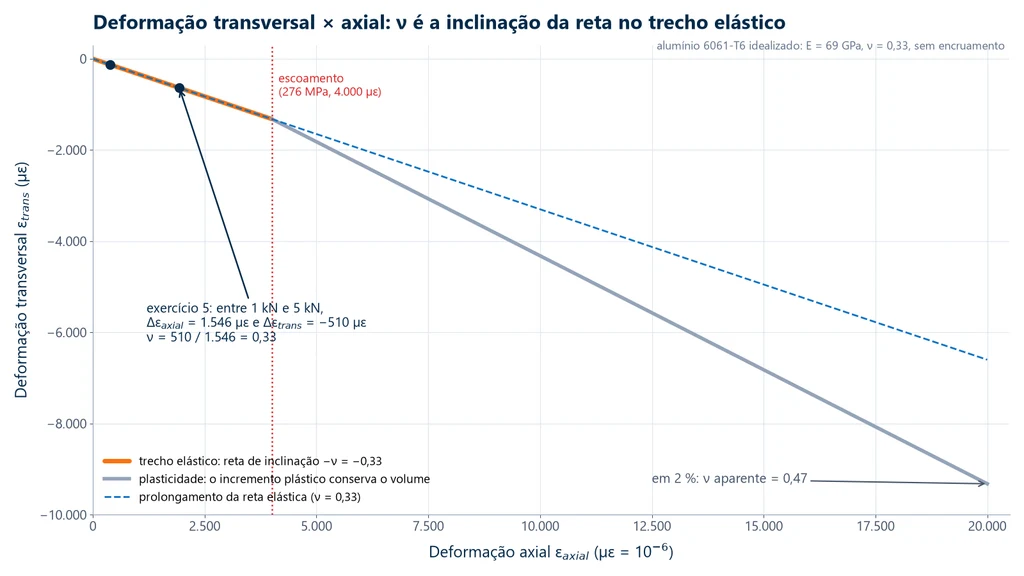
Plotted on a graph, the two strains form a straight line in the elastic range, and ν is the absolute value of the slope of that line. The graph below shows this reading for an idealized 6061-T6 aluminum, with E = 69 GPa, ν = 0.33 and yield at 276 MPa. After yielding, the plastic part of the strain conserves volume, the curve becomes steeper and the apparent ratio reaches 0.47 at 2% strain. That is the portion the measurement must avoid.
Exercise 5: test on a universal testing machine
A rectangular 6061-T6 aluminum specimen, with a cross section of 12.5 mm × 3.0 mm, is fitted with an axial and a transverse extensometer. Between 1.0 kN and 5.0 kN, in the linear portion, the software records Δεaxial = 1,546 µε and Δεtrans = −510 µε.
- Area: A = 12.5 × 3.0 = 37.5 mm².
- Stress change: Δσ = (5,000 − 1,000)/37.5 = 106.7 MPa. At 5 kN the stress is 133 MPa, half the yield strength.
- Modulus: E = 106.7/0.001546 ≈ 69,000 MPa = 69 GPa.
- Ratio: ν = −(−510)/1,546 = 0.33.
- Shear modulus: G = 69/(2 × 1.33) = 25.9 GPa.
The values match the reference values for aluminum. The 12.5 mm width decreased by only 510 × 10−6 × 12.5 mm = 6.4 µm between the two loads. The example uses differences between two points for teaching purposes; ASTM E132 fits straight lines to many points.
Dynamic method
Poisson's ratio can also be obtained without a universal testing machine, by impulse excitation (ASTM E1876). A bar or disk is struck lightly, and the natural frequencies of flexural and torsional vibration give E and G. The ratio is obtained from the relation ν = E/(2G) − 1. The method is fast and non-destructive, but the dynamic value does not necessarily match the static one, and a design code that calls for a static value must be followed.
Where Poisson's ratio enters design
Poisson's ratio looks like a detail next to the modulus of elasticity, but it changes the result whenever the part works in more than one direction or has its lateral deformation restrained:
- Plates and slabs: the flexural rigidity of a plate is D = E·h³/[12(1 − ν²)], where h is the thickness. With ν = 0.3, the factor 1/(1 − 0.09) = 1.10 makes the plate 10% stiffer than a beam strip of the same cross section, because the plate cannot deform freely in the lateral direction.
- Pressure vessels and pipes: the hoop strain is εθ = (σθ − ν·σz)/E. In a thin-walled closed cylinder, σz = σθ/2, and with ν = 0.3 this gives εθ = 0.85·σθ/E. Anyone calculating the diameter expansion, or reading strain gauges bonded to a pipe, needs ν.
- Confinement: when lateral expansion is restrained, a lateral stress σh = [ν/(1 − ν)]·σv develops. With ν = 0.3, it equals 0.43 of the vertical stress. This is the elastic interpretation of earth pressure at rest in soils and of the confinement of concrete by stirrups.
- Interference fits: the ratios of the shaft and of the hub enter the Lamé equations that give the contact pressure of a press fit. A bolt in tension also becomes slightly thinner, which matters in precision joints.
- Finite elements: with ν very close to 0.5, as in rubber, standard elements become artificially stiff, a numerical locking that requires a dedicated formulation for incompressible materials.
Common mistakes with Poisson's ratio
The precautions regarding sign, elastic range, extensometer and direction have already appeared in the previous sections. Three mistakes still deserve attention, because they show up in exercises and reports:
- Calculating ν with large strains: an exercise in which the bar elongates 2% or 10% is already outside the elastic range of a metal, and the result is not the ratio of the material.
- Accepting ν above 0.5 or below −1 for an isotropic material: this indicates a measurement or calculation error, not a special material.
- Associating ν with stiffness: a high ratio does not indicate a flexible material. PVC has a higher ν than steel with a modulus 50 to 80 times lower, and gold, at 0.42, is a metal. Stiffness is given by the modulus of elasticity.
Not to be confused with Poisson's equation and the Poisson distribution
The same Poisson gives his name to other concepts unrelated to the ratio. Poisson's equation, ∇²φ = f, is a differential equation in physics and mathematics, used in electrostatics and fluid flow. The Poisson distribution and Poisson regression are statistical tools for counting events. None of them deals with deformation.
Poisson's ratio standards
The right standard depends on the material and the purpose: test standards say how to measure the ratio, and design codes say which value to adopt when it is not measured. The table lists the standards cited in this article:
| Standard | Scope | Edition |
|---|---|---|
| ASTM E132 | Poisson's ratio in tension at room temperature | E132-17 |
| ASTM E111 | Young's modulus, tangent modulus and chord modulus | E111-17(2025)e1 |
| ISO 527-1 | tensile testing of plastics, with Poisson's ratio by transverse extensometer | 2019 |
| ASTM D638 | tensile testing of plastics | D638-22 |
| ISO 6892-1 | tensile testing of metals at room temperature | 2019 |
| ABNT NBR ISO 6892-1 | Brazilian adoption of ISO 6892-1 | 2024 |
| ASTM E8/E8M | tensile testing of metals | E8/E8M-25 |
| ISO 9513 | calibration and classification of extensometers | 2012 |
| ASTM E1876 | dynamic moduli and Poisson's ratio by impulse excitation | not specified |
| ASTM C469/C469M | static modulus and Poisson's ratio of concrete in compression | not specified |
| ABNT NBR 8800 | Brazilian design code for steel and composite structures (ν = 0.3, E = 200 GPa, G = 77 GPa) | 2008 |
| ABNT NBR 6118 | Brazilian design code for concrete structures (ν = 0.2, Gc = Ecs/2.4) | 2023 |
Machine for measuring Poisson's ratio
Measuring Poisson's ratio requires the same setup as measuring the modulus of elasticity, plus one more thing: two strains recorded at the same time, with micrometer resolution, as exercises 2 and 5 showed. The Biopdi M2 universal testing machine (UTM) is electromechanical. It comes in single-column models from 200 N to 10 kN and dual-column models from 5 kN to 1,000 kN, with class 1 load cells per ABNT NBR ISO 7500-1:2023 (the Brazilian adoption of ISO 7500-1). The BioLab software reads up to four extensometer channels, so it can record axial strain and a transverse sensor in the same test. The setup for calculating ν is defined with Biopdi on request. The panel below shows the machine, the role of each part in the measurement and the grips used.
The universal testing machine in the tensile test
The M2 line includes single-column models from 200 N to 10 kN and dual-column models from 5 kN to 1,000 kN. Each part of the machine plays a role in measuring Poisson's ratio:
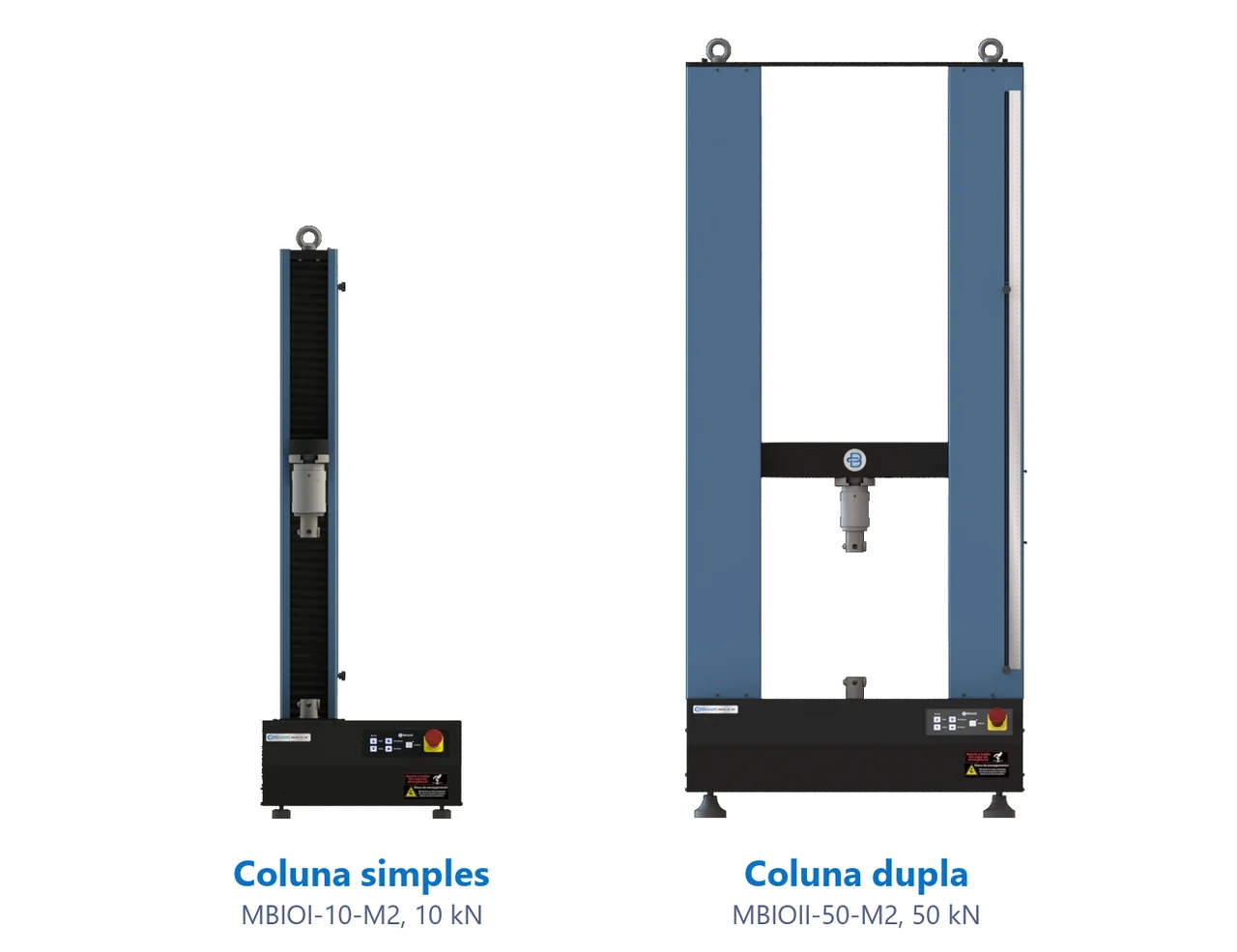
- Moving crosshead pulls the test specimen at the rate set by the standard, within the elastic range
- Load cell measures the force F, class 1
- Grips align the specimen with the force axis, without bending
- Extensometer measures axial strain; a second sensor measures transverse strain
- BioLab software records the strain channels and the force throughout the test
- Control panel and emergency stop position and stop the test
Fixtures for the tensile test
The fixtures below are mounted on the same machine, depending on the specimen and the standard:
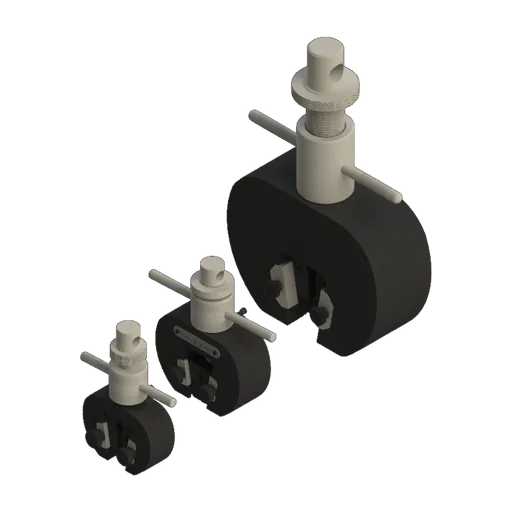 Wedge grip5, 20 and 200 kN
 Pneumatic wedge grip50 and 200 kN
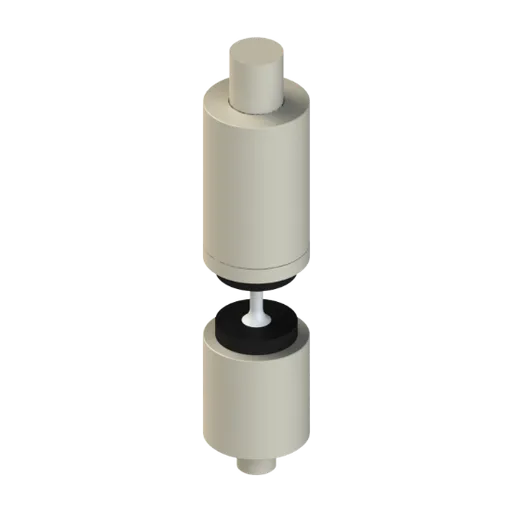 Threaded specimen gripbolts and threaded test specimens
For sheet metal and rectangular specimens like the one in exercise 5, the starting point is the dual-column machine from 5 to 50 kN; for plastics tested to ISO 527-1, the single-column machine from 2 to 10 kN. Poisson's ratio of soils comes from the triaxial test, on dedicated equipment. The other capacities and the BioLab software are on the universal testing machine page, and the other properties measured in the same test are covered in mechanical properties of materials.
Other tests and technical references
Shear modulus (G): what it is, formula, relationship with E and ν, values and how to measure it
Shear modulus (G): the τ/γ ratio in the elastic range, 77 GPa for steel per NBR 8800. G = E/[2(1+ν)], values by material, measured by torsion.
Modulus of elasticity of steel: 200 or 210 GPa, table by grade, units and temperature
The modulus of elasticity of steel ranges from 190 to 210 GPa: NBR 8800 (the Brazilian steel structures standard) adopts 200 GPa for structural steel and NBR 6118 (the Brazilian concrete structures standard) adopts 210 GPa for reinforcing bars. See the values for A36, 1020, 1045, 4140, CA-50 rebar and 304 stainless steel, the conversion to MPa, kgf/cm² and kN/cm², the effect of temperature, G and Poisson's ratio, how to measure it and worked examples.
Modulus of elasticity of concrete: NBR 6118 formula, table by strength class and NBR 8522-1 test
The modulus of elasticity of concrete measures how much it shortens under load. Under NBR 6118:2023 (the Brazilian standard for the design of concrete structures), Eci = αE·5600·√fck (C20 to C50) and Ecs = αi·Eci. A C30 concrete with granite aggregate has an Eci of about 31 GPa and an Ecs of 27 GPa. See the formula, the C20 to C90 table, the effect of the aggregate, the NBR 8522-1:2021 test (the Brazilian standard test method for the modulus of elasticity of concrete) and worked examples.
Proportional limit: what it is, how it differs from the elastic limit and yield strength, and how to measure it
In strength of materials, the proportional limit is the highest stress at which stress and strain are still proportional: the end of the straight portion of the curve and of Hooke's law. See the ASTM E6 definition, how it differs from the elastic limit and Rp0.2, how to measure it with an extensometer, and worked examples.
Frequently asked questions
What is Poisson's ratio?
It is the negative ratio of transverse strain to longitudinal strain in a material under uniaxial load in the elastic range, ν = −εtrans/εlong. It indicates how much the material narrows laterally when stretched, or bulges when compressed (ASTM E132-17).
What is the formula for Poisson's ratio?
ν = −εtrans/εlong, with εlong = ΔL/L0 and εtrans = Δd/d0. The minus sign is there because the two strains have opposite signs, and it makes ν positive for common materials.
How do you calculate Poisson's ratio?
Measure the axial and transverse strains over the same elastic segment and divide one by the other, with the sign reversed. With +1,200 µε axial and −360 µε transverse, ν = 360/1,200 = 0.30. In the test, the slopes of lines fitted to many points are used.
How do you calculate longitudinal strain?
It is the change in length divided by the original length: εlong = (L − L0)/L0. Transverse strain follows the same logic with the lateral dimension: εtrans = (d − d0)/d0.
What is the unit of Poisson's ratio?
None. It is the ratio of two strains, which are already dimensionless, so it is a pure number, the same for parts of any size made of the same material.
What is Poisson's ratio of steel?
The design value is 0.3, per ABNT NBR 8800:2008 (the Brazilian standard for the design of steel structures), which also sets E = 200 GPa and G = 77 GPa. Data sheets for specific steels give 0.26 to 0.30; for A36, MatWeb/ASM gives 0.26 and Sonelastic/ASM gives 0.30.
What is Poisson's ratio of concrete?
ABNT NBR 6118:2023 (the Brazilian standard for the design of concrete structures) allows 0.2 to be adopted, with Gc = Ecs/2.4, for compressive stresses below 0.5 fc and tensile stresses below fct. The general range for concrete is 0.1 to 0.2.
What is Poisson's ratio of soil?
It depends on the soil type and drainage: saturated clay 0.4 to 0.5, unsaturated clay 0.1 to 0.3, sand 0.3 to 0.4 and rock 0.1 to 0.4 (Bowles). The value for a specific site comes from the triaxial test.
Why can't Poisson's ratio exceed 0.5?
Because the volume change in tension is ΔV/V0 = ε(1 − 2ν). With ν = 0.5 the volume does not change and the material is incompressible; above that, the bulk modulus K = E/[3(1 − 2ν)] would be negative, which is unstable. The lower limit is −1 (Greaves et al., 2011).
Can Poisson's ratio be negative?
Yes, in auxetic materials, which get wider when stretched. Lakes's re-entrant foam (Science, 1987) reached ν = −0.7.
How are E, G and Poisson's ratio related?
In an isotropic material, E = 2G(1 + ν) and E = 3K(1 − 2ν). For steel, with E = 200 GPa and ν = 0.3, G = 200/2.6 = 76.9 GPa, rounded to 77 GPa by NBR 8800.
What is Poisson's ratio of rubber and cork?
Rubber falls between 0.48 and about 0.5, nearly incompressible. Cork is close to zero, which is why a cork stopper barely expands sideways as it enters the bottle neck (Fortes and Nogueira, 1989).