
The Marshall test is the laboratory test used to determine the binder content of asphalt mixtures and to measure their stability and flow: a cylindrical specimen 101.6 mm in diameter and 63.5 mm thick, heated to 60 °C, is loaded across its diameter at (50 ± 5) mm/min until it fails. The maximum load, corrected for thickness, is the Marshall stability (in kgf or kN); the deformation up to that load is the flow (in mm). In Brazil, the test follows DNIT 447/2024-ME (a test method from DNIT, Brazil's National Department of Transport Infrastructure), which canceled and replaced DNER-ME 043/95. When it is repeated at five binder contents and combined with the calculation of air voids (Vv), voids in the mineral aggregate (VMA, called VAM in Brazilian standards) and voids filled with asphalt (VFA, called RBV, the bitumen/voids ratio, in Brazilian standards), it forms the Marshall mix design (or Marshall method), which sets the design binder content, the "optimum content", of the asphalt concrete.
The Marshall mix design sets the design binder content: three specimens are molded at each of five contents, and the content chosen is the one that meets, at the same time, Vv of 3% to 5% and VFA of 65% to 75% (DNIT 031/2024-ES). That is why the test matters on the job site. With too little binder, the mix is dry, permeable and prone to raveling; with too much, it ruts in the wheel paths on hot days.
In short:
- Current standard: DNIT 447/2024-ME, approved on 02/06/2024 and corrected on 05/22/2025. Specimen preparation follows DNIT 178/2018-PRO.
- Test specimen: 101.6 mm in diameter and (63.5 ± 2.5) mm thick, compacted with 50 or 75 blows per face.
- Conditioning: 30 to 40 min in a water bath or 120 to 130 min in an oven, at (60 ± 1) °C.
- Loading to failure: (50 ± 5) mm/min, with no more than 30 s between removal from the bath and the end of the test.
- Asphalt concrete requirement (DNIT 031/2024-ES): stability of at least 500 kgf (4.9 kN) with 75 blows, Vv of 3% to 5% and VFA of 65% to 75%.
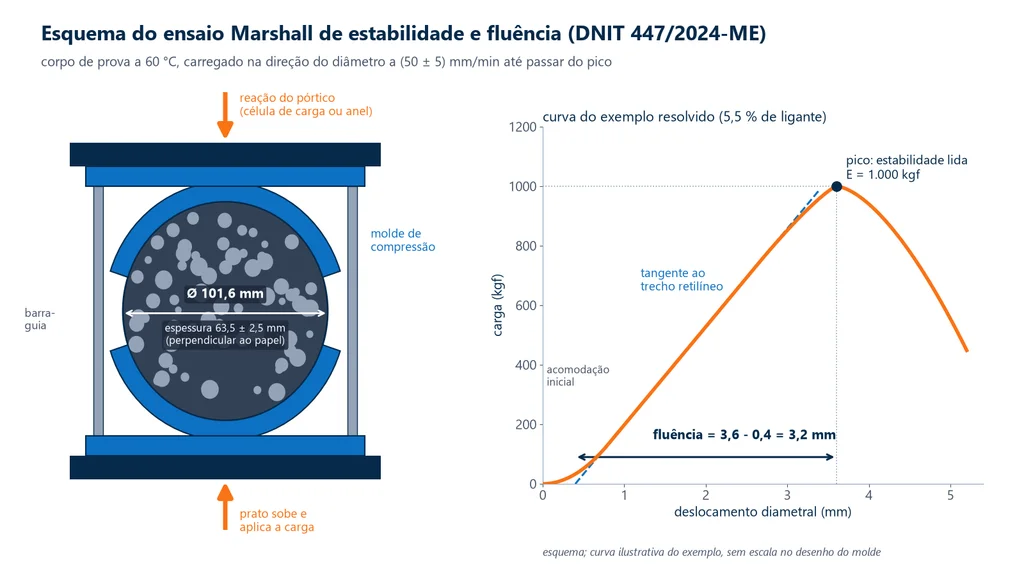
The diagram below shows the two parts of the test: on the left, the specimen lying in the compression mold (breaking head), between the platen that moves up and the reaction frame; on the right, the recorded curve, in which the peak is the stability and the projection of the tangent line to the peak is the flow.
What the Marshall test and the Marshall mix design are
The Marshall test is a laboratory test on asphalt mixtures, the combination of mineral aggregates (crushed stone, sand and filler) with an asphalt binder. In hot-mix asphalt concrete, known on Brazilian job sites as CBUQ, the binder is petroleum asphalt cement (CAP in Brazil): a material that is semisolid at room temperature, obtained from petroleum refining, which must be heated to coat the aggregates. In elemental analysis, asphalts contain 82% to 88% carbon, 8% to 11% hydrogen, up to 6% sulfur, up to 1.5% oxygen and up to 1% nitrogen (Bernucci et al., Pavimentação asfáltica). In cold mixes, the binder is an asphalt emulsion, which requires no heating.
The method was developed by Bruce G. Marshall at the Mississippi State Highway Department in 1939 and refined by the US Army Corps of Engineers from 1943 on. The idea is to measure, on a small heated specimen, how the mixture resists flowing under load. DNIT 447/2024-ME defines the two quantities of the test:
- Marshall stability: the maximum radial compressive resistance of the specimen, in kgf (or N). It indicates how much load the mixture carries before failing at a high temperature, 60 °C, at which the asphalt is already softening, as on a hot summer day.
- Marshall flow: the total deformation of the specimen from zero initial load to maximum load, in millimeters. It indicates whether the mixture is stiff or deformable.
The word "Marshall" refers to two different things, and it is worth keeping them apart. The Marshall test is the loading of one specimen to failure, which gives stability and flow. The Marshall mix design is the design of the mixture: specimens are molded at five binder contents, the density of each is measured, the voids are calculated and all of them are tested to failure. The design content comes from the whole set of results. It is the same testing principle that the CBR test applies to soils, on a compression testing press, but CBR measures the bearing capacity of soils and bases, while the Marshall test evaluates the asphalt surface course. Both tests are part of the daily routine of the pavement laboratory and of highway civil engineering.
Marshall test standards in 2026
The Marshall test standard in Brazil is DNIT 447/2024-ME, which in 2024 replaced DNER-ME 043/95; much of the material in circulation still cites the old one. DNIT 447/2024-ME was approved by the DNIT Board of Directors on 02/06/2024, had a corrected version issued on 05/22/2025 and, in its preface, states that it cancels and replaces DNER-ME 043/95. It applies to asphalt mixtures with a maximum aggregate size of 25.4 mm and refers to two standards that complete the procedure: DNIT 178/2018-PRO, for preparing the specimens, and DNIT 428/2022-ME, for measuring bulk specific gravity.
The corrected version of 05/22/2025 incorporated Erratum 1, which changed two things. Flow is now expressed in millimeters, no longer in tenths of a millimeter or hundredths of an inch as in DNER-ME 043/95. And the horizontal axis of the curve in Annex B is now called displacement, not deformation. A report that gives flow in 0.1 mm follows the old standard.
Cold mixes have their own standard, DNER-ME 107/94, which remains in the DNIT collection. It uses cationic asphalt emulsion, accepts aggregate up to 38.1 mm and tests the specimen at 40 °C, after 2 h in an oven. At ABNT (the Brazilian standards body), NBR 15785, on Marshall apparatus for specimen preparation, is listed in the catalog as canceled in January 2019, with no replacement standard. The table lists the standards involved in the Marshall mix design, with their status checked on 10/01/2026 in the DNIT standards collection (gov.br), the Target/ABNT catalog and the ASTM store:
| Standard | Subject | Status |
|---|---|---|
| DNIT 447/2024-ME | Marshall stability and flow of asphalt mixtures | current (corrected version of 05/22/2025) |
| DNER-ME 043/95 | Marshall test of hot mixes | canceled, replaced by DNIT 447/2024-ME |
| DNER-ME 107/94 | Marshall test of cold mix with emulsion | current in the DNIT collection |
| DNIT 178/2018-PRO | specimen preparation (Superpave gyratory or Marshall) | current |
| DNIT 428/2022-ME | bulk specific gravity of the specimen (Gmb) | current |
| DNIT 427/2020-ME | theoretical maximum specific gravity, Rice method (Gmm) | current |
| DNIT 449/2024-PRO | calculation of volumetric parameters (Vv, VMA, VFA, F/A) | current (corrected version of 04/18/2024) |
| DNIT 031/2024-ES | asphalt concrete: design and control requirements | current (replaced 031/2006-ES; corrected version of 11/27/2025) |
| ABNT NBR 15785 | Marshall apparatus for specimen preparation | canceled in 01/2019, no replacement |
| ASTM D6927 | Marshall stability and flow | D6927-22, active |
| ASTM D6926 | specimen preparation with Marshall apparatus | D6926-20, active |
ASTM D6927-22 is in the bibliography of DNIT 447/2024-ME and covers the same test, for 4 inch (101.6 mm) specimens and aggregate up to 1 inch. ASTM D6926-20 covers molding: 101.6 mm in diameter by 63.5 mm nominal height. The figures in the two are close but not identical: the US loading rate is 2 inches per minute (50.8 mm/min) and the Brazilian one is (50 ± 5) mm/min. A report for a DNIT project cites the DNIT standard.
Much of the material in circulation, including course handouts and spreadsheets, still uses the old values of DNER-ME 043/95 and DNIT 031/2006-ES. The table shows what changed in the test and in the asphalt concrete specification:
| Item | Before | Now |
|---|---|---|
| Test standard | DNER-ME 043/95 | DNIT 447/2024-ME |
| Specimen thickness tolerance | (63.5 ± 1.3) mm | (63.5 ± 2.5) mm; outside this range, a laboratory-molded specimen is discarded |
| Flow unit | tenths of a millimeter or hundredths of an inch | millimeter (Erratum 1 of 447) |
| Load and deformation measurement | proving ring and dial gauge | Method A (ring and dial gauge) or Method B (load cell and LVDT) |
| Asphalt concrete specification | DNIT 031/2006-ES | DNIT 031/2024-ES |
| Air voids | 3% to 5% in the wearing course; 4% to 6% in the binder course | 3% to 5% |
| Voids filled with asphalt (VFA) | 75% to 82% in the wearing course; 65% to 72% in the binder course | 65% to 75% |
| Minimum VMA | fixed by maximum size: 14%, 15%, 16% and 18% for 1", 3/4", 1/2" and 3/8" | a function of NMAS and Vv (Table 5 of 031/2024-ES) |
| Filler/asphalt ratio | not specified | 0.6 to 1.6 |
| Minimum stability | 500 kgf, with 75 blows | 500 kgf, with 75 blows (no change) |
Asphalt characterization tests and where the Marshall test fits
Asphalt characterization tests fall into two groups: binder tests, which classify the asphalt cement before mix design, and tests on the compacted mixture, which include the Marshall test. The binder arrives at the laboratory already graded by penetration: the depth, in tenths of a millimeter, that a 100 g needle penetrates in 5 s at 25 °C. Under ANP Resolution No. 897/2022 (from Brazil's National Petroleum Agency), CAP 50/70 has a penetration of 50 to 70 (0.1 mm) and CAP 30/45 of 30 to 45: the latter is harder, softens at a higher temperature and produces a stiffer mixture at the same content. The Marshall mix design is done with the asphalt cement that will go to the job site, because changing the grade changes the viscosity, the mixing and compaction temperatures and the design content itself.
The table lists the most requested tests in each group, with the DNIT standards checked on 10/01/2026 in the IPR standards list:
| Test | What it measures | Standard |
|---|---|---|
| Penetration (binder) | consistency of the asphalt cement at 25 °C; defines the grade | DNIT 155/2010-ME |
| Softening point (binder) | temperature at which the asphalt cement softens, ring and ball method | DNIT 131/2010-ME |
| Rotational viscosity (binder) | Brookfield viscosity; gives the mixing and compaction temperatures | ABNT NBR 15184 |
| Elastic recovery (modified binder) | elastic return in the ductilometer | DNIT 130/2010-ME |
| Theoretical maximum specific gravity, Rice (mixture) | Gmm of the loose mixture | DNIT 427/2020-ME |
| Marshall stability and flow (mixture) | maximum load and deformation at 60 °C | DNIT 447/2024-ME |
| Indirect tensile strength by diametral compression (mixture) | indirect tension at 25 °C | DNIT 136/2018-ME |
| Resilient modulus (mixture) | stiffness under repeated loading | DNIT 135/2018-ME |
Equipment and test specimen
Marshall test apparatus falls into two families: molding equipment, which produces the test specimen, and testing equipment, which loads it to failure. Molding follows DNIT 178/2018-PRO:
- Compaction mold: a 4 inch steel cylinder with an inside diameter of 101.6 mm (101.5 to 101.7 mm in the drawing of the old DNER-ME 043/95), collar and base plate. The range of 99.90 to 100.00 mm that appears in DNIT 178/2018-PRO refers to the 100 mm mold of the gyratory compactor, not to the Marshall mold.
- Compaction hammer: a mass of 4,540 ± 1 g falling freely from 457.2 ± 1.5 mm, manual or mechanical. Blows are applied at 64 ± 4 per minute; in manual compaction, the operator keeps this pace and holds the hammer shaft as perpendicular as possible to the base plate.
- Compaction pedestal: a 200 × 200 mm hardwood block, about 450 mm high, capped with a steel plate and fixed to a concrete base, so that the energy of each blow is always the same.
Testing uses the items listed by DNIT 447/2024-ME in section 4:
- Press, electromechanical, hydraulic or manual, able to apply up to 4 tf (39.2 kN) with an error below 2.5 kgf, with the platen moving up at (50 ± 5) mm/min against a reaction frame.
- Compression mold (breaking head): two half-moon segments, upper and lower, that hold the specimen lying on its side, and a base plate with guide rods.
- Load and deformation measurement by one of two methods. In Method A, a proving ring of at least 2 tf (20 kN), sensitive to 5 kgf, with a dial gauge, and a flowmeter with a sensitivity of 0.25 mm or better. In Method B, a load cell of at least 2 tf, also sensitive to 5 kgf, and an LVDT, connected to a data acquisition unit that records the curve in real time.
- Water bath for 15 specimens, with a perforated shelf 50 mm above the bottom and water at least 3 cm above the specimens, or an oven that holds the temperature within ± 1 °C.
- Caliper with a resolution of 0.1 mm and a thermometer graduated in 0.1 °C or 0.2 °C.
The standard states that the two methods differ only in how stability and deformation are obtained: A is the traditional one, with manual reading; B is the automated one. In Method A, the ring's dial gauge does not read load but the deformation of the ring: the reading is multiplied by the ring's calibration constant, taken from the calibration certificate, to convert it to kgf. The construction audit procedure of IBRAOP (the Brazilian Institute of Public Works Auditing, PROC-IBR-ROD 104/2021) draws attention precisely to this step and prefers an automated press, which controls the speed and records load and deformation with no manual conversion. The practical advantage of Method B also shows when the peak of the curve is not well defined, in which case the standard requires the tangent line to be offset by 1.5 mm. With a ring and dial gauge, this takes two operators writing down points to draw the curve; with a load cell and LVDT, the curve is already recorded.
How the Marshall test is performed: step by step
The Marshall test is performed in nine steps, from choosing the binder contents to calculating the voids. It combines the specimen preparation of DNIT 178/2018-PRO, the density measurement of DNIT 428/2022-ME and the specimen breaking of DNIT 447/2024-ME (DNIT standards are issued by Brazil's National Department of Transport Infrastructure):
- Define the binder contents. Start from an estimated initial content and add 0.5% and 1.0% above and below it, for five contents in total. Test at least three specimens at each content.
- Heat and mix. The temperatures come from the binder viscosity: (0.17 ± 0.02) Pa·s for mixing and (0.28 ± 0.03) Pa·s for compaction. The aggregate is heated to no more than 10 °C above the mixing temperature. A 100 mm by 60 mm specimen takes about 1,200 g of mix. Under DNIT 178/2018-PRO, the loose mix stays in the oven for 2 h at the compaction temperature before it goes into the mold: this is short-term conditioning, which simulates aging at the plant and during transport. The original Marshall criteria were set without this conditioning; for specimens intended for mechanical testing, it is mandatory.
- Compact. The mix goes into the mold and receives 50 or 75 blows of the compaction hammer, depending on the mix type and traffic; the mold is inverted and the other face receives the same number of blows. DNIT 031/2024-ES sets the minimum stability for 75 blows.
- Cool and measure. The specimen cools for at least 12 h on a smooth surface. The thickness is the average of four caliper readings taken at diametrically opposite positions, and it must be within (63.5 ± 2.5) mm.
- Weigh for density. Under DNIT 428/2022-ME, the specimen is weighed dry (A), submerged in water at (25 ± 1) °C (B) and saturated surface-dry (C), and Gmb = A / (C − B). None of the three specimens at each content may deviate from the average by more than ± 0.020.
- Condition at 60 °C. 30 to 40 min in a water bath or 120 to 130 min in an oven, at (60 ± 1) °C. The rings of the breaking head stay between 20 °C and 40 °C, with the guide rods clean and lubricated.
- Break. The specimen goes into the breaking head lying on its side, and the platen rises at (50 ± 5) mm/min until the load starts to drop. No more than 30 s may elapse between removal from the bath and the end of the test, and the entire test must be completed within 24 h of compaction.
- Read and correct. The maximum load is the measured stability (with a proving ring, the dial gauge reading times the ring constant), corrected for thickness; the flow comes from the curve. For each group of three specimens, the report gives the individual values and the average of density, flow and stability, the latter both corrected and uncorrected, rounded to the nearest whole kgf and stating how it was read (at the peak or by the offset tangent). It also records the test temperature, to a precision of 0.2 °C, and the origin of the specimen: laboratory mix, plant mix or core taken from the pavement.
- Calculate the volumetrics. With the maximum specific gravity measured by the Rice test (DNIT 427/2020-ME), calculate Vv, VAM and RBV for each content, plot the curves and choose the design binder content.
The 30 s limit between the bath and the end of the test is not a minor detail. Asphalt stiffens quickly as it cools, and a specimen that loses a few degrees before breaking gives a higher stability than the real one, which makes the mix look better on paper.
Calculating stability and flow
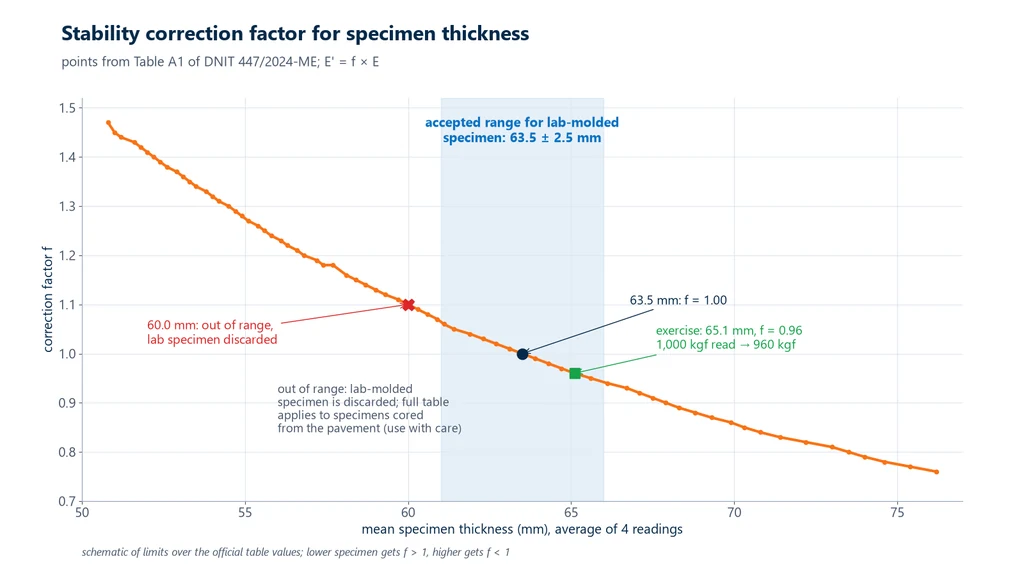
The corrected Marshall stability is the maximum load read multiplied by a factor that brings the result to the reference thickness of 63.5 mm. The maximum load read, E, depends on the specimen thickness: a taller specimen has more material resisting and breaks at a higher load. To compare results, DNIT 447/2024-ME converts them all to the reference thickness, 63.5 mm, using the equation E′ = f × E, where E′ is the corrected stability (kgf) and f is the correction factor from Table A1 in Annex A of the standard. The factor is 1.00 at 63.5 mm, greater than 1 for shorter specimens and less than 1 for taller ones.
The correction has a limit. A laboratory-molded specimen is corrected only if its thickness is between 61.0 and 66.0 mm; outside this range it is discarded, and the laboratory molds another one. The full table, from 50.8 to 76.2 mm, is for cores taken from the pavement, which vary more, and the standard calls for caution with results that receive large corrections. The chart below plots all the points of Table A1, with the accepted range highlighted and the two cases from the worked example further on:
Within the accepted range, the table values are as follows:
| Thickness (mm) | f | Thickness (mm) | f |
|---|---|---|---|
| 61.1 | 1.06 | 63.5 | 1.00 |
| 61.4 | 1.05 | 63.9 | 0.99 |
| 61.9 | 1.04 | 64.3 | 0.98 |
| 62.3 | 1.03 | 64.7 | 0.97 |
| 62.7 | 1.02 | 65.1 | 0.96 |
| 63.1 | 1.01 | 65.6 | 0.95 |
The flow is not simply the displacement read at the peak, because the beginning of the curve includes a seating portion where the specimen settles into the breaking head. DNIT 447/2024-ME requires drawing the line tangent to the straight portion of the load × displacement curve and measuring the horizontal projection between the point where this line crosses the displacement axis and the peak. In the diagram at the beginning of the article, the tangent crosses the axis at 0.4 mm, the peak is at 3.6 mm, and the flow is 3.2 mm. When the curve has no defined peak, the standard offsets the tangent laterally by 1.5 mm to locate the reading point (Annex B). Since Erratum 1, the standard calls the horizontal axis of this curve displacement and expresses flow in millimeters, no longer in tenths of a millimeter. This Marshall flow, read over seconds of testing, should not be confused with the sustained-load creep of materials, covered in the article on creep testing.
To convert units: 1 kgf = 9.80665 N. The 500 kgf minimum stability of DNIT 031/2024-ES corresponds to 4.90 kN. ASTM records flow in units of 0.01 inch (0.25 mm); 8 to 16 units, the Asphalt Institute range for heavy traffic, are equivalent to 2.0 to 4.0 mm.
Volumetric parameters: Gmb, Gmm, Vv, VAM and RBV
The volumetric parameters of Marshall mix design, Vv, VAM and RBV, describe how the volume of the compacted specimen is divided among aggregate, binder and air. Stability alone does not decide the mix design. What decides it is how the specimen volume is divided among aggregate, binder and air, and DNIT 449/2024-PRO standardizes this calculation for both Marshall and Superpave mix designs. Everything starts from two measured specific gravities:
- Gmb, bulk specific gravity of the compacted mix: the specimen mass divided by the mass of an equal volume of water, per DNIT 428/2022-ME.
- Gmm, measured maximum specific gravity of the loose mix, with no air voids, by the Rice test of DNIT 427/2020-ME (the method of ASTM D2041): the mix is broken apart and subjected to vacuum to remove the air. The standard notes that Gmm replaces the theoretical maximum density (DMT), previously calculated as the weighted average of the components, and is equal to or lower than it, depending on aggregate absorption.
With these and the bulk specific gravity of the aggregate blend (Gsb), the three mix design parameters are calculated:
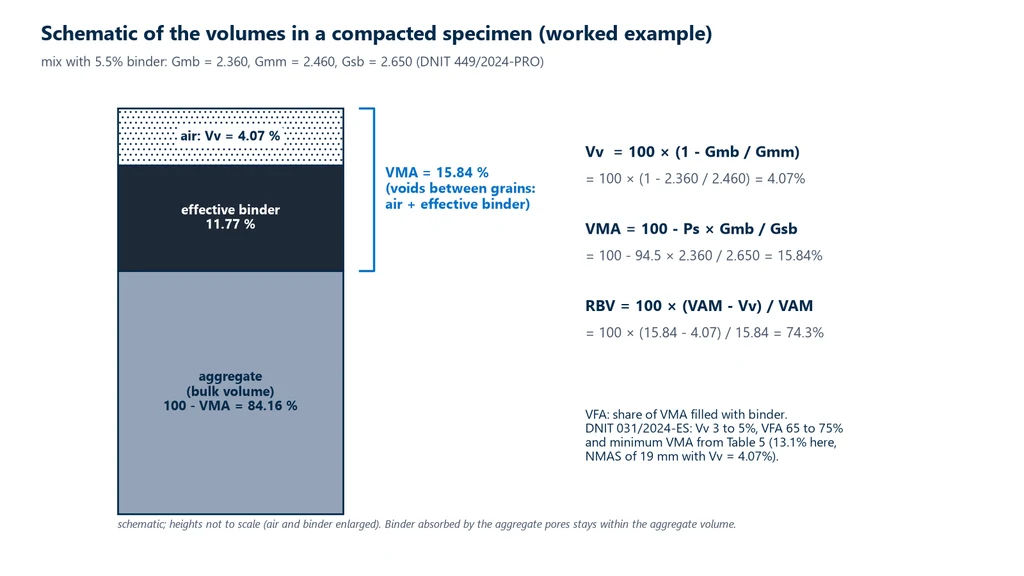
- Air voids (Vv): the air remaining between the binder-coated particles. Vv = 100 × (1 − Gmb / Gmm).
- Voids in mineral aggregate (VAM, known in English as VMA): all the space between the aggregate particles, occupied by air and effective binder. VAM = 100 − (Ps × Gmb / Gsb), where Ps is the percentage of aggregate in the mix (100 − Pb, Pb being the binder content).
- Voids filled with binder (RBV, known in English as VFA): the fraction of the VAM filled with binder. RBV = 100 × (VAM − Vv) / VAM.
The diagram below shows this division in the specimen from the worked example, with the three calculations done: air occupies 4.07% of the volume, effective binder 11.77%, and together they make up the VAM of 15.84%.
DNIT 449/2024-PRO also calculates the binder absorbed by the aggregate pores, the effective binder left to coat the particles, and the filler-to-binder ratio (F/A), the ratio between the material passing the 0.075 mm sieve and the effective binder. The table summarizes the quantities and the standard for each:
| Quantity | Formula | Standard |
|---|---|---|
| Bulk specific gravity of the specimen | Gmb = A / (C − B) | DNIT 428/2022-ME |
| Measured maximum specific gravity | Gmm, Rice test | DNIT 427/2020-ME |
| Air voids | Vv = 100 × (1 − Gmb/Gmm) | DNIT 449/2024-PRO |
| Voids in mineral aggregate | VAM = 100 − Ps·Gmb/Gsb | DNIT 449/2024-PRO |
| Voids filled with binder | RBV = 100 × (VAM − Vv)/VAM | DNIT 449/2024-PRO |
| Corrected stability | E′ = f × E | DNIT 447/2024-ME |
Marshall mix design charts and choosing the design binder content
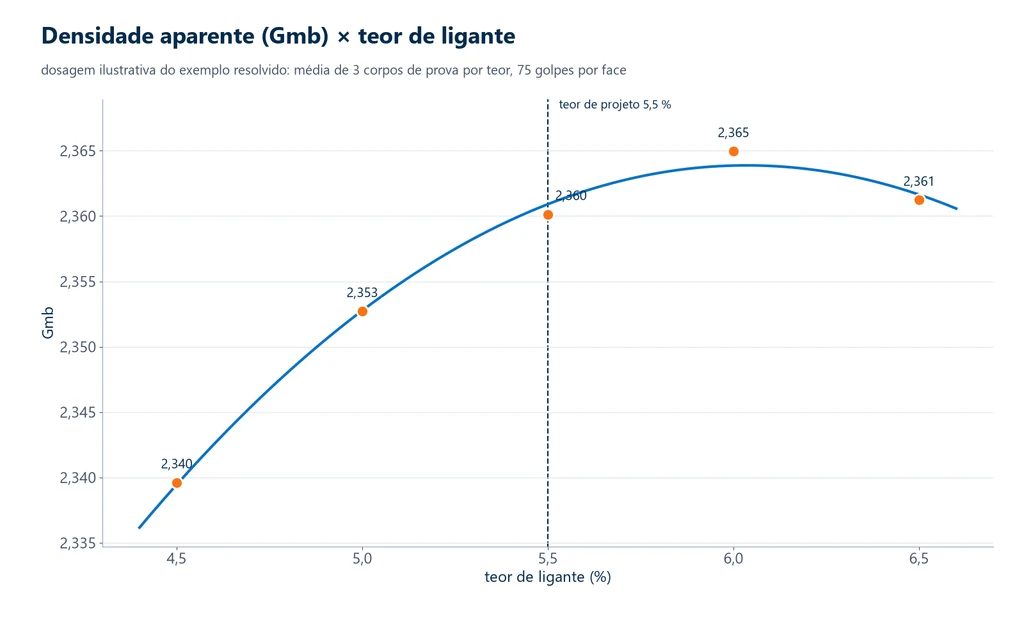
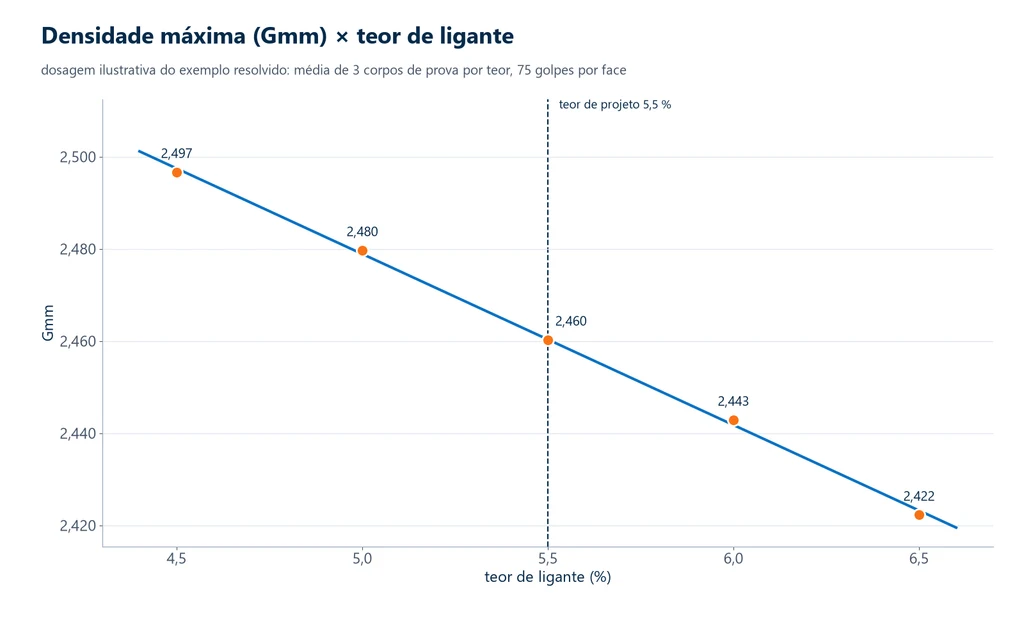
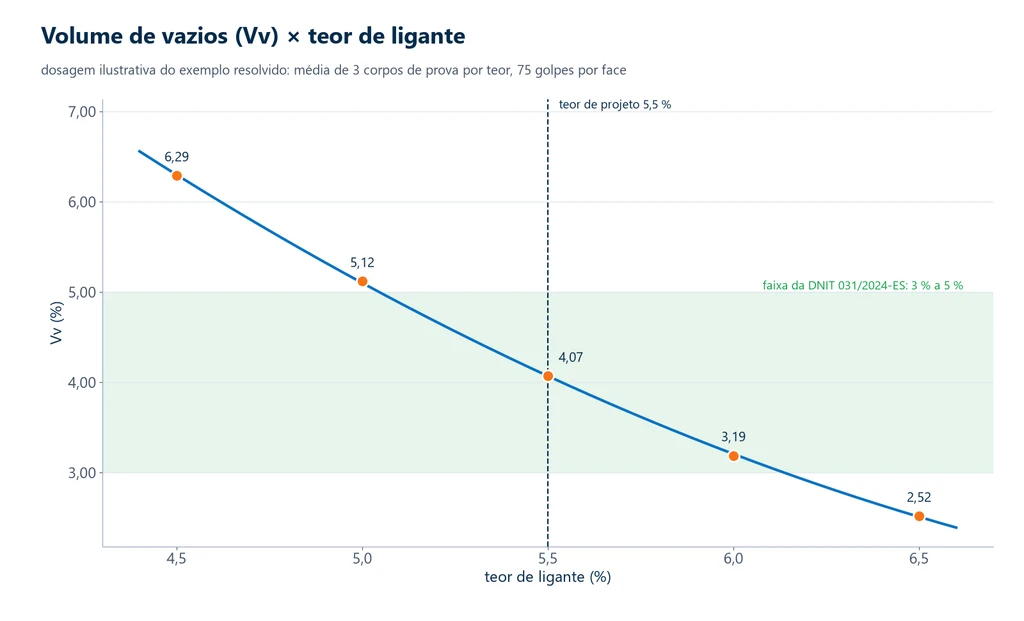
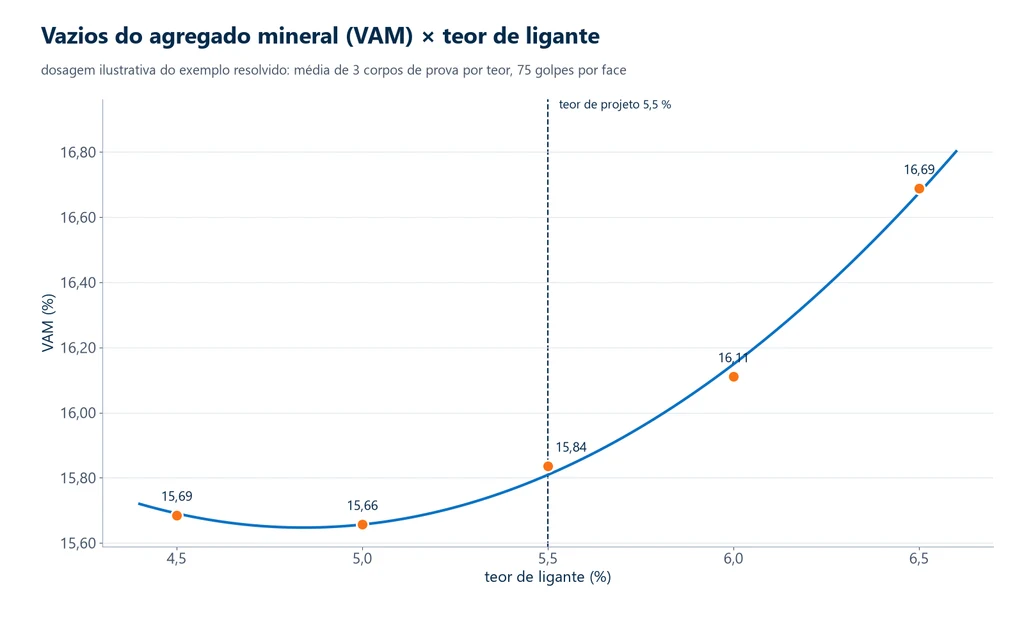
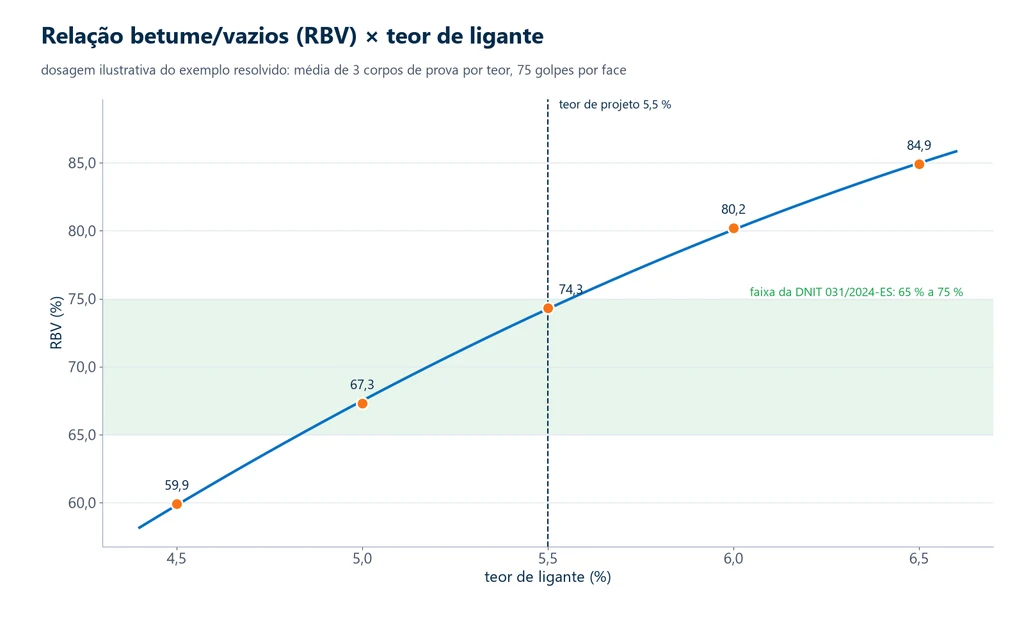
The Marshall mix design charts are the curves of each test quantity versus binder content, and the design binder content is derived from them. In the mix design, each quantity is plotted one point per content, using the average of the three specimens. The six curves have typical shapes, and each shape has a physical explanation. The charts below are from the mix design in the worked example further on, from 4.5% to 6.5% binder, with the dashed line at the design content of 5.5%. They help you recognize these shapes:
Bulk specific gravity (Gmb) × binder content
Maximum specific gravity (Gmm) × binder content
Air voids (Vv) × binder content
Voids in mineral aggregate (VAM) × binder content
Voids filled with binder (RBV) × binder content
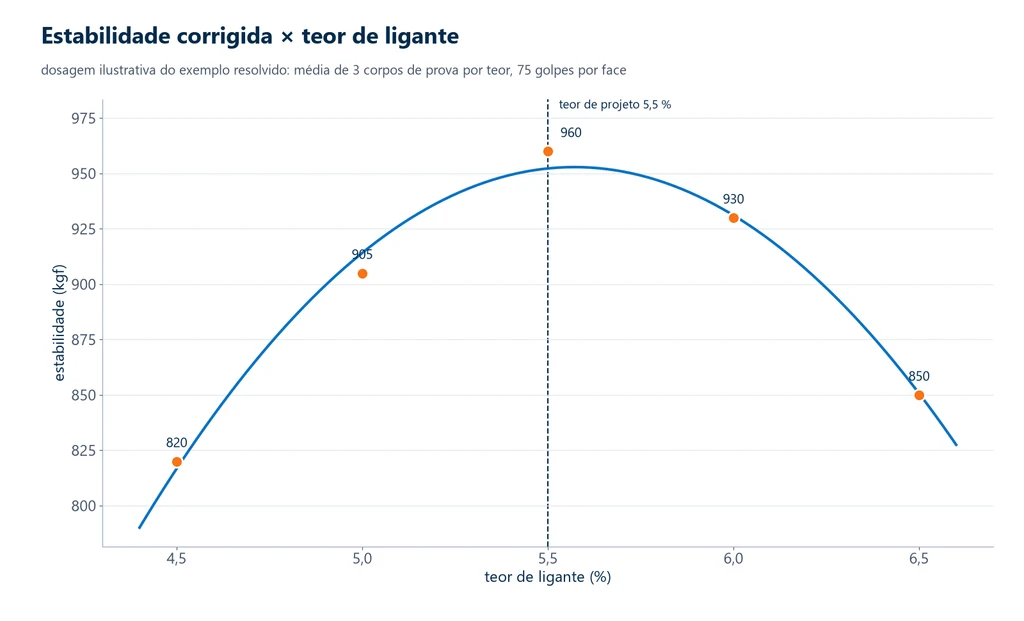
Corrected stability (kgf) × binder content
What each curve shows:
- Bulk specific gravity (Gmb): rises while the binder lubricates the particles and aids compaction, reaches a maximum and falls when the excess binder, lighter than the aggregate, starts to push the particles apart. It always stays below the maximum specific gravity: if it exceeded it, the air voids would come out negative, and the error is in the weighing or the calculation.
- Maximum specific gravity (Gmm): always falls, because each additional percentage point of binder replaces denser aggregate with less dense asphalt.
- Air voids: always falls, because the binder gradually takes up the space of the air. This is the curve used to locate the design binder content.
- VAM: a shallow U shape, with the minimum near the optimum content or slightly below it, as here. Past the minimum, the excess binder pushes the particles apart and the VAM rises again.
- RBV: always rises, from a dry mix to a mix saturated with binder.
- Stability: generally passes through a maximum. In the mix design, flow is also plotted against binder content; it tends to increase with binder content and is read together with stability.
The most widely used selection rule is the Asphalt Institute's, cited in the bibliography of DNIT 447/2024-ME: the design binder content, also called the optimum asphalt content, is the one that gives air voids in the middle of the specified range, usually 4%, after which the other parameters are checked for compliance. DNIT 031/2024-ES (the Brazilian specification for asphalt concrete), which replaced 031/2006-ES, sets the design requirements for asphalt concrete and a tolerance of ± 0.3% on the design binder content at the plant. The table lists the requirements related to Marshall mix design:
| Parameter | Test standard | Requirement (DNIT 031/2024-ES) |
|---|---|---|
| Air voids | DNIT 449/2024-PRO | 3% to 5% |
| Voids filled with binder | DNIT 449/2024-PRO | 65% to 75% |
| VAM | DNIT 449/2024-PRO | minimum from Table 5, a function of the nominal maximum aggregate size (NMAS) and Vv |
| Filler-to-binder ratio | DNIT 449/2024-PRO | 0.6 to 1.6 |
| Stability (75 blows) | DNIT 447/2024-ME | ≥ 500 kgf |
| Tensile strength | DNIT 136/2018-ME | ≥ 0.65 MPa |
| Moisture-induced damage | DNIT 180/2018-ME | ratio ≥ 0.70 |
The minimum VAM is no longer a fixed number per aggregate size: in 031/2024-ES, it depends on the nominal maximum aggregate size (NMAS) and on the air voids, with interpolation between 3%, 4% and 5%. For an NMAS of 19.0 mm, for example, the minimum is 12% with Vv of 3%, 13% with 4% and 14% with 5%. Flow has no limit in 031/2024-ES; as a reference, the Asphalt Institute accepts 2.0 to 4.0 mm for heavy traffic.
Four-intersection method (Vv × RBV)
Another criterion widely used in Brazil, described in Bernucci et al. (Pavimentação asfáltica), intersects the Vv and RBV curves with the specification limits. Each curve crosses the two limits of its range, giving four binder contents. With the data from the worked example further on, interpolating between the measured points:
- RBV = 65% at 4.84% binder;
- Vv = 5% at 5.06%;
- RBV = 75% at 5.56%;
- Vv = 3% at 6.14%.
The two central contents, 5.06% and 5.56%, bound the range that meets both parameters at the same time, and the design binder content is their average: 5.31%, about 5.3%. Using the 4% Vv criterion, the same example gives 5.54%. The difference, 0.2 percentage point, is within the ± 0.3% plant tolerance, but the design must state which criterion was used. Watch out for older sources: with the 75% to 82% RBV range of 031/2006-ES, the intersections change and the design content goes up.
Worked example of Marshall mix design
The data below are illustrative, built so that the calculation closes, and follow the rules of DNIT 447/2024-ME (the Brazilian DNIT test method for the Marshall test). The mix is an asphalt concrete with a nominal maximum aggregate size (NMAS) of 19.0 mm and a bulk specific gravity of the combined aggregate Gsb = 2.650, compacted with 75 blows per face. The estimated initial binder content is 5.5%, so the five binder contents are 4.5%, 5.0%, 5.5%, 6.0% and 6.5%.
1. Density and voids of a specimen with 5.5% binder
Weighings per DNIT 428/2022-ME: dry in air A = 1,200.0 g, submerged B = 695.0 g, saturated surface-dry C = 1,203.5 g. The Rice test at the same binder content gave Gmm = 2.460.
- Water absorption: 100 × (1,203.5 − 1,200.0) / (1,203.5 − 695.0) = 100 × 3.5 / 508.5 = 0.69%. Since it is below 2%, the direct calculation applies.
- Gmb = 1,200.0 / 508.5 = 2.360.
- Vv = 100 × (1 − 2.360 / 2.460) = 100 × 0.0407 = 4.07%.
- Ps = 100 − 5.5 = 94.5%. VMA = 100 − 94.5 × 2.360 / 2.650 = 100 − 84.16 = 15.84%.
- VFA = 100 × (15.84 − 4.07) / 15.84 = 100 × 11.77 / 15.84 = 74.3%.
Check against DNIT 031/2024-ES (the Brazilian DNIT specification for asphalt concrete): a Vv of 4.07% is between 3% and 5%; a VFA of 74.3% is between 65% and 75%; the minimum VMA for a 19.0 mm NMAS, interpolated between 13% (Vv of 4%) and 14% (Vv of 5%), is 13 + 0.07 = 13.07%, and 15.84% passes.
2. Corrected stability
The same specimen gave four thickness readings of 65.0, 65.3, 64.9 and 65.2 mm: an average of 65.1 mm, within the 61.0 to 66.0 mm range. The maximum load read was E = 1,000 kgf. From Table A1, f = 0.96 for 65.1 mm:
- E′ = 0.96 × 1,000 = 960 kgf.
- In kN: 960 × 9.80665 = 9,414 N = 9.41 kN.
- The 960 kgf comfortably exceeds the 500 kgf minimum.
Another specimen in the same group came out with an average thickness of 60.0 mm. The table has a factor for this thickness (1.10), but it does not apply: 60.0 mm is outside (63.5 ± 2.5) mm, and a laboratory-molded specimen is discarded, not corrected.
3. Flow
On this specimen's curve, the line tangent to the straight portion crosses the displacement axis at 0.4 mm, and the peak is at 3.6 mm. Flow = 3.6 − 0.4 = 3.2 mm, within the 2.0 to 4.0 mm reference range. Read directly at the peak, without subtracting the seating, it would come out at 3.6 mm, 12% higher.
4. Selecting the design binder content
Repeating the calculation at the five binder contents, with the average of three specimens at each, the mix design produced these results:
| Binder content (%) | Vv (%) | VFA (%) | Stability (kgf) |
|---|---|---|---|
| 4.5 | 6.29 | 59.9 | 820 |
| 5.0 | 5.12 | 67.3 | 905 |
| 5.5 | 4.07 | 74.3 | 960 |
| 6.0 | 3.19 | 80.2 | 930 |
| 6.5 | 2.52 | 84.9 | 850 |
- A Vv of 4% lies between 5.5% (4.07) and 6.0% (3.19). By linear interpolation: 5.5 + 0.5 × (4.07 − 4.00) / (4.07 − 3.19) = 5.5 + 0.5 × 0.080 = 5.54%, rounded to 5.5%.
- VFA at 5.5%: 74.3%, within 65% to 75%. At 6.0% the VFA would already be 80.2%, outside the range: the mix would be binder-rich.
- At 4.5% and 5.0%, Vv exceeds 5%: the mix would be dry and permeable.
- Stability exceeds 500 kgf at all binder contents, and the maximum (960 kgf) coincides with the selected content, which does not always happen. The flow of 3.2 mm completes the check.
- With the four-intersection method, the same data give 5.31%, the average of 5.06% (Vv = 5%) and 5.56% (VFA = 75%). The two criteria are 0.2 points apart, within the ± 0.3% tolerance.
Design binder content: 5.5%, with a production tolerance of ± 0.3%. Note that only binder contents from 5.1% to about 5.6% meet Vv and VFA at the same time: the useful window is narrow, which is why the mix design calls for five binder contents rather than two or three.
Marshall mix design worksheet
The mix design worksheet has one row per specimen and one average row per binder content, with the columns in the order in which the values are calculated. The table lists these columns, from top to bottom, filled in with the 5.5% specimen from the example:
| Column | How it is obtained | 5.5% specimen from the example |
|---|---|---|
| Binder content (%) | set in the mix design | 5.5 |
| Dry mass in air, A (g) | weighing (DNIT 428/2022-ME) | 1,200.0 |
| Submerged mass, B (g) | weighing in water at (25 ± 1) °C | 695.0 |
| Saturated surface-dry mass, C (g) | weighing | 1,203.5 |
| Gmb | A / (C − B) | 2.360 |
| Gmm | Rice test (DNIT 427/2020-ME) | 2.460 |
| Vv (%) | 100 × (1 − Gmb/Gmm) | 4.07 |
| VMA (%) | 100 − Ps·Gmb/Gsb | 15.84 |
| VFA (%) | 100 × (VMA − Vv)/VMA | 74.3 |
| Average thickness (mm) | average of 4 readings | 65.1 |
| Factor f | Table A1 of DNIT 447/2024-ME | 0.96 |
| Measured stability, E (kgf) | peak of the curve | 1,000 |
| Corrected stability, E′ (kgf) | f × E | 960 |
| Flow (mm) | projection of the tangent to the peak | 3.2 |
The three specimens at each binder content go on separate rows, and the group average is the point on the chart. Before calculating the average, check that each Gmb is within ± 0.020 of the group average and that the thickness is between 61.0 and 66.0 mm.
Field control: degree of compaction and quantity of hot mix asphalt (CBUQ)
The design binder content comes from the laboratory, but the surface course is accepted on the road. DNIT 031/2024-ES controls the finished layer by the degree of compaction (DC), the ratio between the bulk specific gravity of the layer and that of the mix design: DC = field Gmb / mix design Gmb × 100. The accepted DC ranges from 97% to 100%, with two-sided statistical control and at least one determination every 100 m, made after the layer has cooled completely. The field Gmb comes from a non-nuclear density gauge (DNIT 431/2020-ME) or from a core specimen extracted with a rotary core drill (ASTM D5361) and weighed per DNIT 428/2022-ME.
With the Gmb of 2.360 from the worked example, three illustrative cores show how the criterion works:
- Gmb of 2.315: DC = 2.315 / 2.360 × 100 = 98.1%, compliant.
- Gmb of 2.280: DC = 96.6%, non-compliant; the layer has too many voids and tends to be permeable.
- Gmb of 2.372: DC = 100.5%, also out of range; the layer is denser than the design, which may indicate high binder content or excessive compaction.
The same specification allows a ± 5% variation in thickness, checked every 100 m, and ± 5 °C around the design temperature during spreading, avoiding temperatures below 145 °C.
The bulk specific gravity also answers the cost estimate question. One cubic meter of compacted hot mix asphalt (CBUQ) weighs Gmb times the density of water: with a Gmb of 2.360 and water at 25 °C, about 2.35 t. The quantity of mix for a section is the area times the compacted thickness times this weight. A section 1,000 m long by 7.0 m wide and 5 cm thick has 350 m³, about 824 t; with the ± 5% thickness tolerance, the quantity ranges from 782 t to 865 t. The figures are illustrative: the project cost estimate uses the Gmb of the approved mix design.
How to interpret the Marshall test
Stability and flow only make sense when read together and alongside the volumetrics. The questions below are the ones that come up when reading a report.
Is high stability always a good sign?
No. High stability with low flow indicates a stiff mix, which carries load well but may crack under the repeated flexing caused by traffic. It can come from too little binder, very angular aggregate or excess filler. That is why stability is a minimum requirement, not a target to maximize, and the design binder content comes from the air voids.
What does high flow indicate?
High flow, above 4 mm, with low stability, is the picture of a plastic mix, usually with excess binder or low voids. In service, it tends to rut in the wheel paths on hot days. If it appears together with VFA above 75% and Vv below 3%, the diagnosis is high binder content.
What if Vv is right and VMA is below the minimum?
The aggregate is too dense and leaves little room for the binder: the film coating the particles becomes thin, and the mix loses durability. The fix is in the gradation, not in the binder content. DNIT 031/2024-ES recommends the Bailey Method (DNIT 438-PRO) precisely to adjust the aggregate skeleton when the minimum VMA is hard to achieve.
Does field stability match the design stability?
Specimens cored from the road usually have a thickness other than 63.5 mm and are corrected with larger factors, which the standard says to use with caution. In addition, roller compaction is not the same as hammer compaction. The useful comparison in quality control is with specimens molded from mix sampled at the plant, which reproduce the design conditions. This is what public works auditing does in Brazil: procedure PROC-IBR-ROD 104/2021 of IBRAOP (the Brazilian Institute of Public Works Auditing) preferably molds specimens with mix sampled on site, accepts the contractor's quality control when the averages do not deviate by more than ± 20% from the audited averages, and points out that a specimen broken in the Marshall test cannot be used for the indirect tensile test, because both tests are destructive. The procedure, from 2021, still cites DNER-ME 043/95 and DNIT 031/2006-ES; today the references are DNIT 447/2024-ME and DNIT 031/2024-ES.
What does the Marshall test not tell you?
It does not measure modulus, fatigue or resistance to permanent deformation under repeated loading, which are the data mechanistic pavement design needs. Stability and flow are empirical parameters, useful for mix design and control, but with no direct relationship to pavement life. This limitation is the subject of the section on Superpave and MeDiNa.
Common mistakes in the Marshall test
Common mistakes in the Marshall test fall into three areas: outdated standards, specimens outside the required conditions and incorrect reading of the curve. The list below covers the ones that most distort the design binder content.
- Citing DNER-ME 043/95 as current. It was canceled by DNIT 447/2024-ME. The same applies to ABNT NBR 15785 (a Brazilian standard), canceled in 2019.
- Correcting a specimen outside the range. A laboratory-molded specimen with thickness outside (63.5 ± 2.5) mm is discarded, not corrected.
- Using the height tolerance of the old standard. DNER-ME 043/95 required (63.5 ± 1.3) mm; DNIT 447/2024-ME accepts ± 2.5 mm. DNER-ME 107/94, for cold mixes, still in force, keeps ± 1.3 mm. Each standard has its own.
- Taking too long between the water bath and breaking. More than 30 s and the specimen cools, stiffens and gives a higher stability than the real one.
- Recording the proving ring reading as load. In Method A, the dial gauge measures the deformation of the ring; without multiplying by the calibration constant, stability comes out in the wrong unit.
- Reading flow at the peak, without the tangent. The seating portion enters the reading and inflates the flow.
- Using the calculated theoretical maximum density (TMD) instead of the measured Gmm. Since the TMD is greater than or equal to Gmm, the Vv calculated with it comes out higher than the real value and the design binder content comes out higher.
- Using the limits of 031/2006-ES in a design under 031/2024-ES. The VFA range and the minimum VMA table changed, and the filler-to-asphalt ratio and moisture-induced damage were added.
- Chasing maximum stability. The design binder content comes from Vv and the check of the other parameters.
- Expressing stability as stress. Stability is a force, in kgf or kN. "500 kgf/cm²" is a unit error.
- Recording stability in newtons with the kgf number. 500 kgf is 4,903 N; the DNIT 031/2024-ES minimum written as "500 N" becomes almost 10 times smaller.
- Recording flow in tenths of a millimeter. Since Erratum 1 of DNIT 447/2024-ME, the unit is the millimeter. The 3.2 mm in the example is not "32".
- Forgetting the age of the specimen. The test must be completed within 24 h after compaction, and the specimen needs at least 12 h of cooling beforehand.
Limitations of the Marshall method: Superpave, MeDiNa and mechanical tests
The asphalt mixtures course of IPR/DNIT (2022) records two criticisms of the method: the scatter of results, caused by equipment and operating conditions, and the poor representativeness of impact compaction. It also notes that stability has been losing ground to indirect tensile strength and resilient modulus. The scatter has been measured: in laboratories in the state of Georgia, in the United States, the mechanical hammer gave higher voids and lower stability and flow than the manual hammer on the same mix, and in a Canadian interlaboratory program the breaking heads ranged from 108 to 127 mm (Siddiqui, Trethewey and Anderson, Transportation Research Record 1171, 1988). That is why the standard calls for three specimens per binder content and Gmb within ± 0.020 of the average.
The main limitation of the Marshall test is that it is empirical: stability and flow are not properties used in pavement design. Compaction also matters. The hammer compacts by impact, and the particle arrangement it produces is not the same as that produced by the roller and traffic on the road. That is why DNIT 178/2018-PRO gives preference to the Superpave gyratory compactor, which forms an aggregate skeleton closer to the one obtained in the field, and keeps the Marshall method as an alternative for some tests. One exception stated in the standard itself: with asphalt rubber, the Marshall equipment is the most suitable.
Pavement design has also changed. MeDiNa, the DNIT mechanistic-empirical method used in Brazil, designs the pavement using the mechanical properties of the materials: the resilient modulus, measured in repeated-load indirect tension per DNIT 135/2018-ME, fatigue per DNIT 183/2018-ME and resistance to permanent deformation by the Flow Number test of DNIT 184/2018-ME. DNIT 031/2024-ES lists these tests in Table 4, but only requires them when the pavement design specifies them, along with the values to be met. Indirect tensile strength (DNIT 136/2018-ME, ≥ 0.65 MPa) and moisture-induced damage (DNIT 180/2018-ME, ≥ 0.70), on the other hand, are always required.
In practice, the Marshall method remains the most widespread mix design and plant control tool in Brazil, and the 500 kgf stability requirement remains in the specification. What has changed is that it is no longer sufficient on its own: the same 100 mm specimen, compacted in the gyratory compactor or with the Marshall hammer, now also feeds the mechanical tests performed on dynamic testing machines, such as the one used for the repeated-load triaxial test.
Biopdi CBR/Marshall test press for the Marshall test
Biopdi manufactures the CBR/Marshall test press in two versions, manual and automatic electric. Both run the CBR test and the Marshall test with their own fixtures, and the automatic version also runs the consolidation test. Under DNIT 447/2024-ME (the Brazilian DNIT test method for the Marshall test), the manual version, with a proving ring and a dial indicator, corresponds to Method A. The automatic version has a load cell, an LVDT and curve recording, which are the instruments of Method B. It controls speed from 0.001 to 50 mm/min, which covers the (50 ± 5) mm/min the standard sets for the Marshall test. The panel below shows the automatic version, the role of each part in the test and the accessories:
The automatic electric CBR/Marshall test press in the Marshall test
The automatic electric version is electromechanical, with a recirculating ball screw and microprocessor control, a capacity of 5,000 kgf (50 kN) and a stroke of 100 mm. Each part has a function in the test:
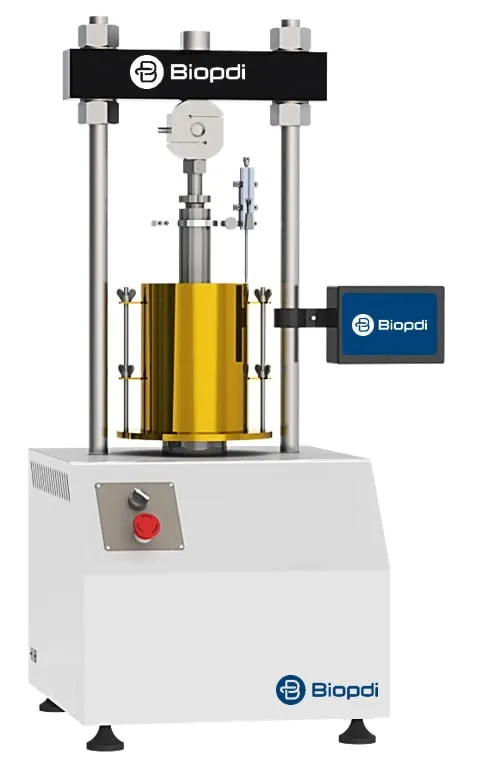
- Platen and drive: electromechanical, with speed and displacement control
- Marshall fixture: holds the compression mold with the specimen
- Load cell: interchangeable, from 5 to 5,000 kgf (0.05 to 50 kN)
- LVDT: 50 mm, 0.01 mm resolution, for the flow
- Touchscreen display: acquisition at 1 reading per second, graph and recording to an SD card
- Safety: emergency stop button, upper and lower limit switches and automatic stop by force or displacement
CBR/Marshall test press fixtures and accessories
The fixtures below are mounted on the same press, depending on the test:
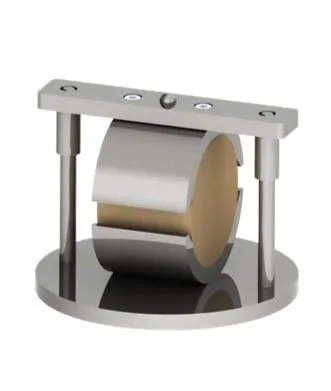 Marshall fixturestability and flow test
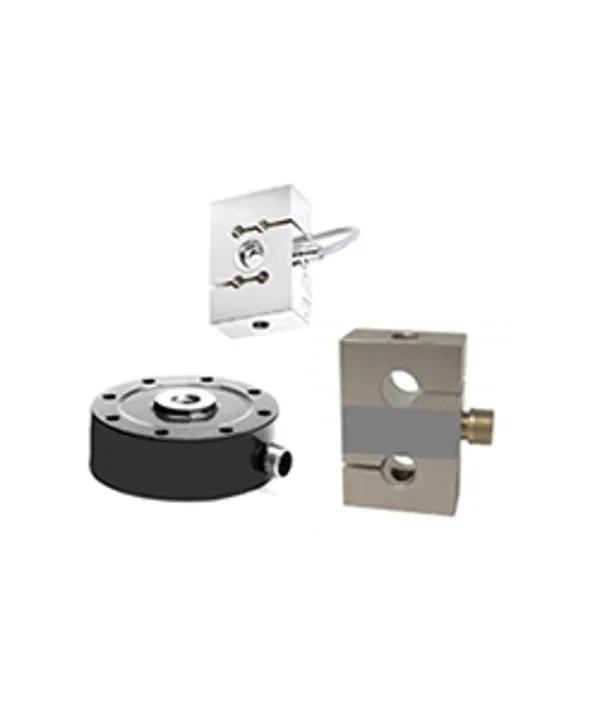 Load cellfrom 5 to 5,000 kgf
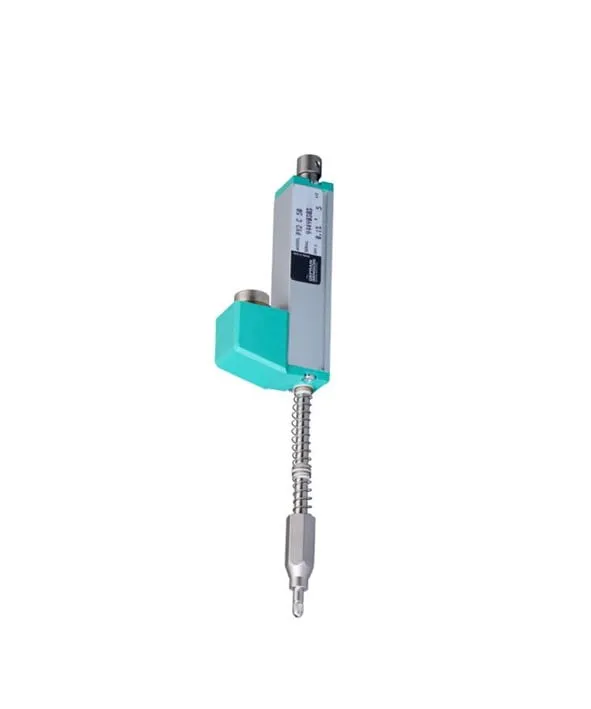 LVDTdisplacement measurement
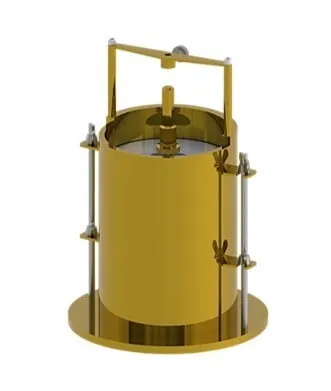 CBR fixtureCalifornia Bearing Ratio
The manual version is lever-operated, has a proving ring from 500 to 5,000 kgf (4.9 to 49 kN) and a dial indicator for displacement, and can be upgraded to a load cell and touchscreen display. The photos below show both versions with the Marshall fixture mounted: the manual version on the left, the automatic electric version on the right.
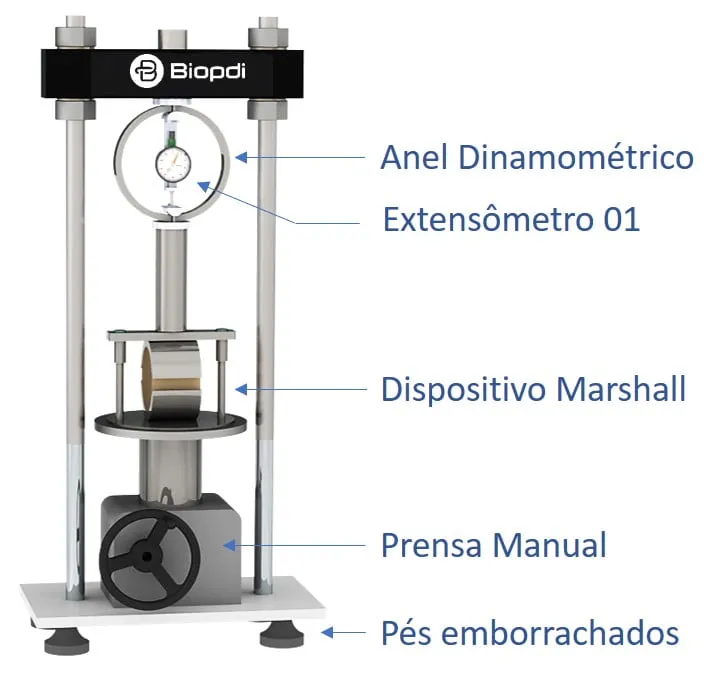
Manual CBR/Marshall test press with the Marshall fixture
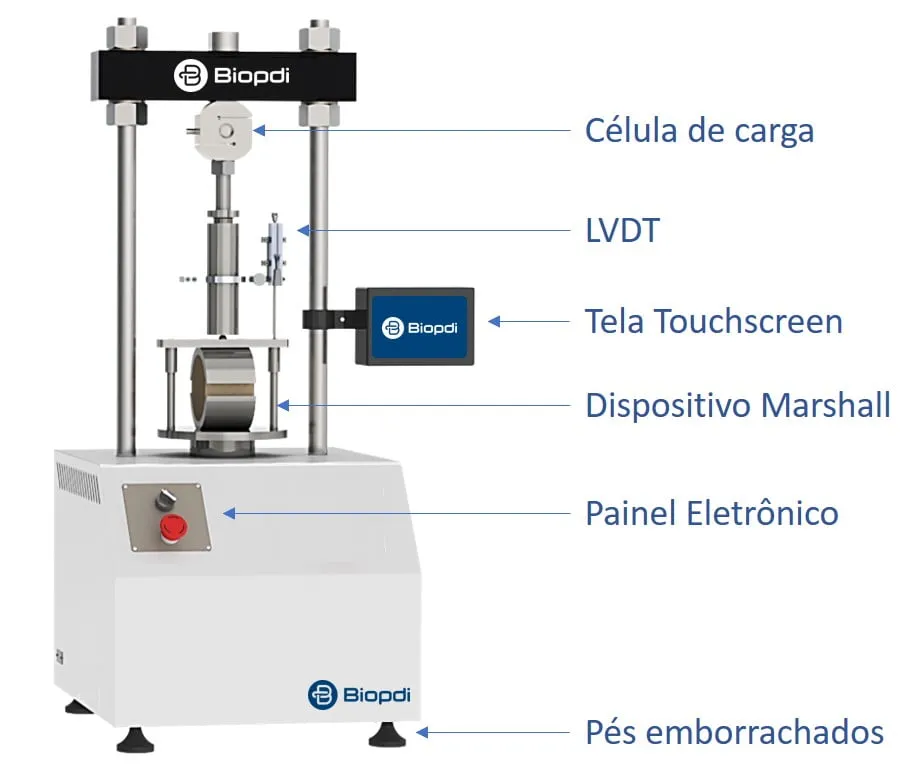
Automatic electric CBR/Marshall test press with the Marshall fixture
Exercise: are the press and the load cell enough for the test?
DNIT 447/2024-ME requires a press able to apply up to 4 tf (39 kN) and a load-measuring instrument of at least 2 tf (19.6 kN). An asphalt concrete like the one in the example fails at around 1,000 kgf (9.8 kN).
- Press capacity: 5,000 kgf, above the 4,000 kgf required by the standard.
- Load cell: among the capacities offered, the 2,000 kgf and 5,000 kgf cells meet the 2 tf minimum. The expected load, 1,000 kgf, uses half of the 2,000 kgf cell and one fifth of the 5,000 kgf cell.
- Deformation: the 3.2 mm flow in the example fits comfortably within the 50 mm LVDT, and the 0.01 mm resolution is 25 times finer than the 0.25 mm sensitivity the standard requires of the Method A flowmeter.
- Speed: the standard requires (50 ± 5) mm/min, and the automatic version runs from 0.001 to 50 mm/min. The same control delivers the 1.27 mm/min of the CBR test.
For stiffer mixes, which may exceed 2,000 kgf, the 5,000 kgf cell, the same capacity as the press, covers the full range. Other load cell and fixture configurations, and the use of the same press for the CBR test, are on the CBR/Marshall test press page; the other equipment for soils and pavements is in the soil testing line. To configure the press for your laboratory, request a quote.
Other tests and technical references
CBR test and the California Bearing Ratio
CBR test (California Bearing Ratio): NBR 9895:2025 and DNIT 172 standards, procedure, formula with 6.9 and 10.35 MPa, worked example and CBR by layer.
Direct shear test: ASTM D3080 standard, step-by-step procedure and how to calculate c' and φ'
The direct shear test measures soil shear strength and gives the cohesion c' and friction angle φ'. ASTM D3080-23, step by step, with a worked example.
Resilient modulus (MR): what it is, how to calculate it and the repeated load test per Brazilian standards DNIT 134 and 135/2018
Resilient modulus (MR) is repeated deviator stress divided by recoverable strain in soils, aggregates and asphalt: MR = σd/εr, in MPa (DNIT 134, 135).
Soil compaction and the Proctor test per ABNT NBR 7182:2025
Soil compaction on site and the Proctor test per NBR 7182:2025: compaction energies, worked curve example, optimum moisture content and degree of compaction.
Frequently asked questions
What is the Marshall test?
It is the laboratory test, also called the Marshall method, that breaks a cylindrical asphalt mix specimen, 101.6 mm in diameter, heated to 60 °C, by compression along its diameter, to measure stability (maximum load) and flow (deformation up to maximum load). Repeated at five binder contents, together with the void calculations, it makes up the Marshall mix design.
What is the standard for the Marshall test in Brazil?
DNIT 447/2024-ME, approved on 02/06/2024 and corrected on 05/22/2025, which canceled and replaced DNER-ME 043/95; 043/95 is no longer valid. For cold mixes with emulsion, DNER-ME 107/94 applies. ABNT NBR 15785, on the Marshall apparatus, was canceled in 2019. In the United States, ASTM D6927-22 covers the test and ASTM D6926-20 covers specimen preparation.
What is Marshall stability?
It is the maximum radial compressive strength of the specimen, in kgf or kN, corrected to the 63.5 mm reference thickness by the factor f in Table A1 of DNIT 447/2024-ME. DNIT 031/2024-ES (the Brazilian DNIT specification for asphalt concrete) requires at least 500 kgf (4.90 kN) with 75 blows per face.
What is Marshall flow?
It is the deformation of the specimen from zero load to maximum load, in millimeters, measured as the horizontal projection of the line tangent to the straight portion of the curve up to the peak. It shows whether the mix is stiff or plastic; the Asphalt Institute reference for heavy traffic is 2.0 to 4.0 mm.
What are the Marshall test methods?
DNIT 447/2024-ME provides two methods, which differ only in how load and deformation are measured. In Method A, with a proving ring, dial indicator and flowmeter, readings are manual; in Method B, with a load cell and LVDT connected to a data acquisition unit, the load × displacement curve is recorded automatically.
How many blows are applied in the Marshall test?
Fifty or 75 blows on each face, depending on the mix type and traffic, with a 4,540 g hammer falling from 457.2 mm (DNIT 178/2018-PRO). The minimum stability in DNIT 031/2024-ES is set for 75 blows; the Asphalt Institute uses 35, 50 and 75 blows for light, medium and heavy traffic.
What are the temperature and speed of the Marshall test?
The specimen is kept for 30 to 40 min in a water bath or 120 to 130 min in an oven at (60 ± 1) °C, and is broken at (50 ± 5) mm/min. No more than 30 s may pass between removal from the bath and the end of the test.
What is the standard for the Rice test?
DNIT 427/2020-ME, which measures the maximum specific gravity (Gmm) of the loose mix under vacuum. Gmm replaces the calculated theoretical maximum specific gravity and is used to calculate the air voids.
What does DNIT 178 establish?
DNIT 178/2018-PRO defines how to prepare and compact asphalt mix specimens for mechanical tests, with the Superpave gyratory compactor as the preferred method and the Marshall compactor as an alternative for some tests. It sets the gyratory and Marshall molds, the hammer, the number of blows and the mixing and compaction temperatures based on binder viscosity.
What is a CBUQ test?
CBUQ (concreto betuminoso usinado a quente) is hot-mix asphalt concrete, the asphalt concrete of DNIT 031/2024-ES. Quality control covers volumetrics (Vv of 3% to 5%, RBV of 65% to 75%), Marshall stability (≥ 500 kgf), tensile strength (≥ 0.65 MPa), moisture-induced damage (≥ 0.70), binder content and particle size distribution.
What are the asphalt characterization tests?
For the binder, the main ones are penetration (DNIT 155/2010-ME), which defines the CAP (asphalt binder) grade, softening point (DNIT 131/2010-ME), Brookfield rotational viscosity (ABNT NBR 15184) and, for modified binders, elastic recovery (DNIT 130/2010-ME). For the mix, they include the Rice test (DNIT 427/2020-ME), the Marshall test (DNIT 447/2024-ME), tensile strength (DNIT 136/2018-ME) and resilient modulus (DNIT 135/2018-ME).
What is the difference between the Marshall test and the CBR test?
The purpose of the CBR test is to measure the bearing capacity of soils and bases by the penetration of a piston; the Marshall test evaluates asphalt mixes by breaking a specimen along its diameter. Both use a compression press, and the CBR/Marshall test press runs both with different fixtures.
What is the DNIT standard for asphalt?
For asphalt concrete, the DNIT standard is DNIT 031/2024-ES, which replaced 031/2006-ES. It is the construction specification and sets the design requirements (Vv of 3% to 5%, RBV of 65% to 75%, minimum VAM from Table 5, filler/binder ratio of 0.6 to 1.6, tensile strength of at least 0.65 MPa, moisture-induced damage of at least 0.70 and Marshall stability of at least 500 kgf with 75 blows), the ± 0.3% tolerance on binder content and plant and field control. The Marshall test follows DNIT 447/2024-ME and specimen preparation follows DNIT 178/2018-PRO.
What is the mix for making asphalt?
Asphalt concrete is made with coarse aggregate, fine aggregate, filler and asphalt binder (CAP), proportioned so that the gradation falls within one of the DNIT 031/2024-ES bands and the binder is at the design content, with a ± 0.3% tolerance at the plant. The design content comes from the Marshall mix design.
How much does 1 m³ of CBUQ weigh?
The weight of 1 m³ of compacted CBUQ is the bulk specific gravity of the mix (Gmb) times the density of water: with a Gmb of 2.360, about 2.35 t. The value varies with the aggregate and binder content, so the estimate should use the Gmb from the project's mix design.
How do you calculate the quantity of asphalt mix?
Multiply the area by the compacted thickness and by the weight per cubic meter. A section 1,000 m long by 7.0 m wide at 5 cm thick has 350 m³; at about 2.35 t/m³, that is about 824 t. DNIT 031/2024-ES allows ± 5% on thickness, which changes the quantity in the same proportion.
What degree of compaction is required for asphalt concrete?
From 97% to 100% of the mix design bulk density, with at least one determination every 100 m, made after the layer has cooled, per DNIT 031/2024-ES.
What is the difference between TSD and CBUQ?
Double surface treatment (TSD) is built on the road, with two applications of binder, each covered with aggregate and compacted, per DNIT 147/2012-ES, and does not go through Marshall mix design. CBUQ is hot-mix asphalt concrete, designed in the laboratory and specified by DNIT 031/2024-ES.
What does DNIT 164 establish?
DNIT 164/2013-ME covers soil compaction using non-reused samples, the Proctor test. It is not an asphalt standard: for asphalt concrete, DNIT 031/2024-ES applies and, for the Marshall test, DNIT 447/2024-ME.
Is the Marshall test outdated?
Not for mix design and plant control: DNIT 031/2024-ES still requires stability of at least 500 kgf. The IPR/DNIT asphalt mixtures course (2022) notes, however, that stability is losing ground to tensile strength and resilient modulus, and that results vary with equipment and operation. In pavement design with MeDiNa (Brazil's mechanistic-empirical pavement design method), mechanical tests are what count.