
Materials engineering is the engineering discipline that links the processing, structure, properties and performance of metals, polymers, ceramics, composites and biomaterials in order to select, develop, manufacture and test the right material for each application. In Brazil, the profession is regulated by Confea, the Federal Council of Engineering and Agronomy (Resolution No. 241/1976). Practitioners must be registered with a Crea (the regional engineering council), and the degree program requires at least 3,600 hours over a minimum of 5 years.
The materials engineer works where raw material becomes a product: steelmaking, plastics, ceramics, automotive, packaging, medical devices, testing laboratories and research. In Caged (Brazil's official formal employment registry), over the 12 months ending in July 2026, the average salary for the occupation in Brazil was R$ 11,836.71 per month in Brazilian reais (Salario.com.br, updated on September 3, 2026).
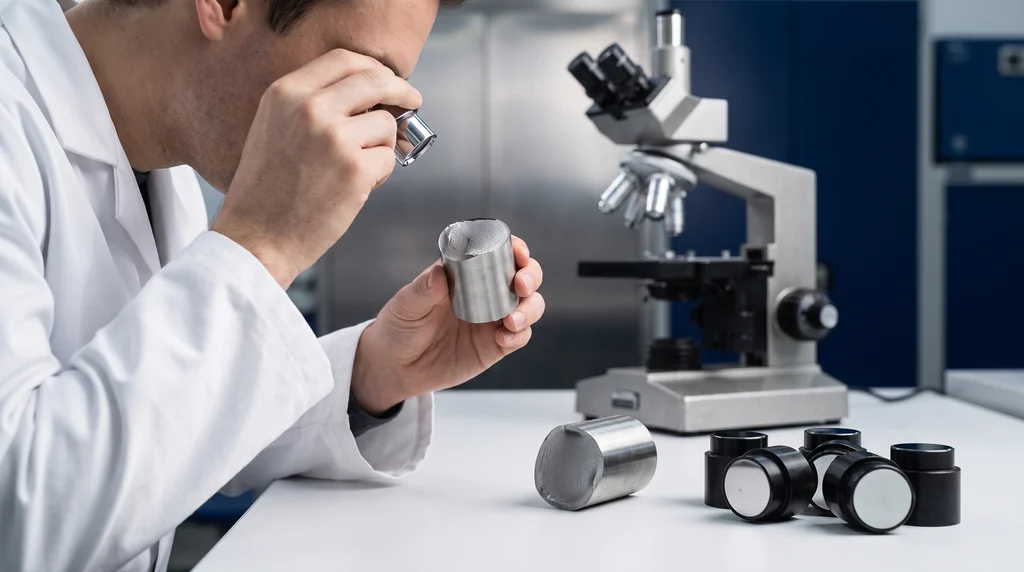
In the photo, a materials engineer uses a magnifying glass to examine the fracture surface of a broken steel bar, next to polished metallographic samples and the microscope. The scene sums up the profession: the shape of the fracture tells how the material behaved, the microstructure explains why, and the choice of material and process decides whether the part will withstand service.
What is materials engineering
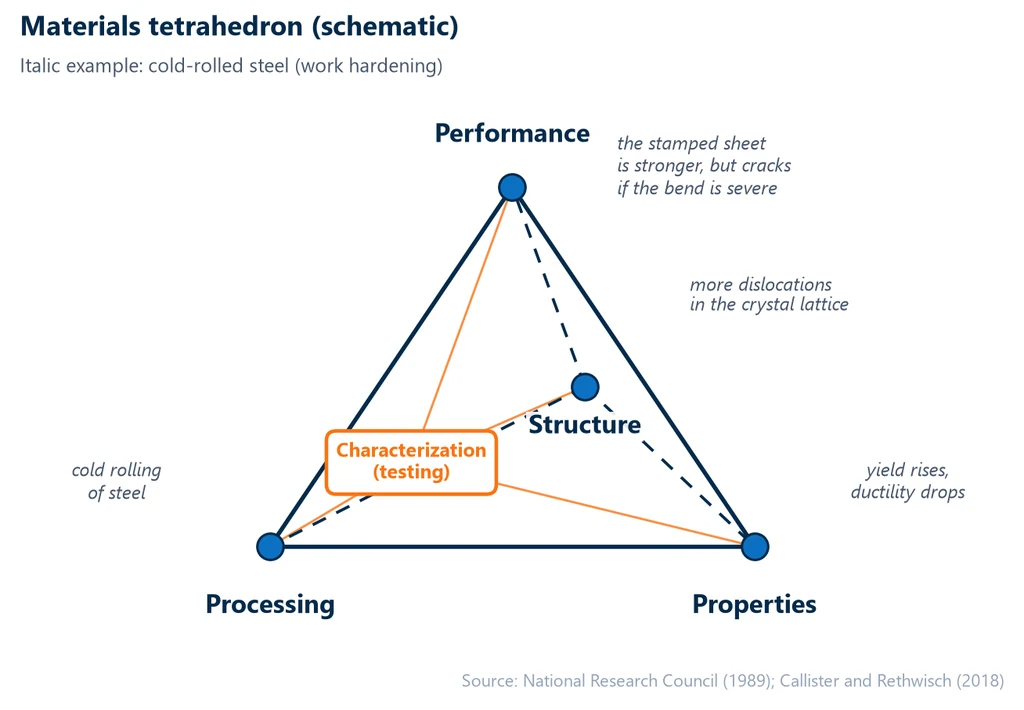
The discipline is organized around a chain of cause and effect. The way the material is processed (cast, rolled, injection molded, sintered, heat treated) defines its structure, from the arrangement of atoms to the microstructure of grains and phases. The structure determines the properties (mechanical, thermal, electrical, optical), and the properties define the performance of the part in service. These four elements form the so-called materials tetrahedron, established by the report Materials Science and Engineering for the 1990s from the US National Research Council (1989), and used as the common thread by Callister and Rethwisch in Materials Science and Engineering: An Introduction.
The name combines two activities. Materials science investigates the relationships between structure and properties; materials engineering uses those relationships to design or specify the structure that delivers a desired set of properties, at a viable cost and with a viable process. At the center of the tetrahedron is characterization, the set of tests and analyses that measures each vertex: without it, the link between processing and performance remains an assumption.
One example runs through all four vertices. Cold rolling a steel (processing) multiplies the dislocations in the crystal lattice (structure), raises the yield strength and reduces ductility (properties), and the sheet becomes stronger but may crack in a severe bend (performance). This is work hardening, quantified by tensile tests before and after rolling. The diagram below shows the tetrahedron with this example at each vertex.
What does a materials engineer do
The Brazilian Classification of Occupations (CBO) describes the materials engineer (CBO 2146-05) as the professional who designs material structures, properties and processes and who, to do so, selects materials and processes, plans and supervises tests and experiments, characterizes products, develops applications and manages quality. The CBO recognizes three specializations by name: ceramics, metals and polymers materials engineer. In practice, the work is split into fronts that usually appear together:
- Materials selection: choosing, among the options that withstand the loads, temperature and environment, the one with the lowest total cost, including processing and disposal.
- Material and product development: formulating an alloy, a polymer compound or a ceramic body, or adapting an existing material to a new use.
- Processing: defining and adjusting casting, forming, injection molding, extrusion, sintering and heat treatment, the steps that set the structure.
- Characterization and testing: measuring mechanical properties, analyzing the microstructure and issuing test reports.
- Failure analysis: finding out why a part broke, through the fracture surface, metallography and testing of the material.
- Quality and certification: specifying, inspecting and approving raw materials and products, a role that overlaps with quality engineering.
- Research and teaching: at universities, institutes and corporate R&D centers.
A cell phone sums up these fronts: the circuit board combines a glass fiber and resin laminate, metal traces and solder joints that must not crack under heat; the screen is glass treated against scratches; the housing is a polymer or a light alloy. Each choice went through someone who understood the relationship between processing, structure and properties.
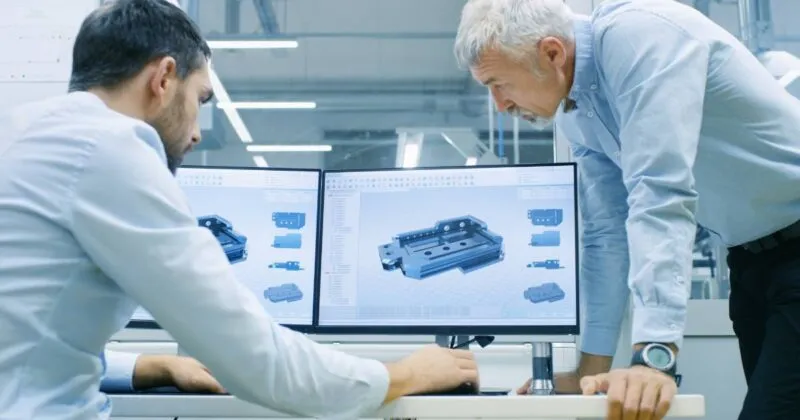
Materials selection rarely happens in isolation from design. In the photo, two engineers discuss the 3D model of a part: geometry, loads and material are decided together, and it is in this conversation that the materials engineer answers whether the part will hold up, how much it costs to make and how it will age.
Difference from metallurgical and mechanical engineering
Metallurgical engineering deals with metals, from ore extraction to the steel product, and has its own occupation code in the CBO (2146-10, metallurgical engineer). Materials engineering also covers polymers, ceramics and composites. Mechanical engineering, in turn, designs the component and the system starting from known properties; materials engineering explains where those properties come from and how to change them. The three meet in materials selection and failure analysis.
Confea responsibilities and Crea registration
In Brazil, practicing the profession requires registration with the Crea of the state where the engineer will work. The activities the engineer is authorized to sign off on come from three Confea acts, checked against the council's regulatory database on September 30, 2026:
- Resolution No. 218, of June 29, 1973: lists the 18 professional activities of the engineering fields, from supervision, studies, design and expert examination to teaching, research, testing, standardization, quality control, execution and operation.
- Resolution No. 241, of July 31, 1976: assigns to the materials engineer activities 01 to 18 of Resolution 218 relating to technological procedures in the manufacture of materials for industry and their transformations. The Confea page records no revocation or amendment.
- Resolution No. 1,073, of April 19, 2016 (published in the DOU, Brazil's Official Gazette, on April 22, 2016, with a correction on May 3, 2016): regulates how the Crea assigns title, activities and fields of practice based on the curriculum completed, and allows responsibilities to be extended through complementary training. It is the general procedure; Resolution 241 remains the specific resolution for this discipline.
Because testing and quality control are among the activities in Resolution 218, test reports and failure analysis opinions are documents that the materials engineer signs with a technical responsibility record (ART). The table below summarizes the Brazilian legal basis cited in this article:
| Act | What it defines | Date |
|---|---|---|
| Law No. 4,950-A | minimum professional salary for engineers | April 22, 1966 |
| Confea Resolution No. 218 | the 18 professional activities | June 29, 1973 |
| Confea Resolution No. 241 | responsibilities of the materials engineer | July 31, 1976 |
| CNE/CES Resolution No. 2 | minimum course load (3,600 h) and program length (5 years) | June 18, 2007 |
| Confea Resolution No. 1,073 | assignment of title and activities by the Crea | April 19, 2016 |
| CBO 2146-05 | official description of the occupation | CBO 2002 (MTE, Brazilian Ministry of Labor) |
Fields of work and classes of materials
Materials engineers usually specialize by class of material, because each class has its own structure, processes and tests. UFSCar (Federal University of São Carlos), for example, offers concentrations in ceramics, metals and polymers. The main classes are the same as in Callister (metals, ceramics, polymers and composites), plus biomaterials and materials for electronics and energy; the article on types of materials covers each one in detail. The table below links each class to applications and to the test that appears most often in quality control:
| Class | Examples | Applications | Typical test |
|---|---|---|---|
| Metals and alloys | steels, cast irons, aluminum, copper, titanium | structures, vehicles, machines, implants | tensile, hardness, impact, metallography |
| Polymers | polyethylene, polypropylene, PVC, polyamide, elastomers | packaging, injection-molded parts, shoe soles, films | tensile testing of plastics, flexural, thermal analysis |
| Ceramics and glasses | alumina, porcelain tile, refractories, glass | tiles and cladding, insulators, furnaces, screens | flexural, compression, hardness |
| Composites | glass and carbon fiber in resin, concrete | aerospace, wind turbine blades, construction | tensile, flexural, interlaminar shear |
| Biomaterials | titanium, bioactive ceramics, biodegradable polymers | prostheses, implants, sutures | tensile, compression, fatigue |
Biodegradable polymers are one of the most active research fronts in the field. Manufacturing industry is the largest employer: steelmaking and metallurgy, petrochemicals, plastics, ceramics, automotive, aerospace, packaging and medical devices. Outside the factory, there are positions in testing and certification laboratories, research institutes, universities, consulting and forensic engineering, and in technical support for materials and equipment suppliers.
History of materials engineering in Brazil
Until the 1960s, materials in Brazilian industry were the domain of metallurgical engineering, because metals dominated. In 1970, the newly founded Federal University of São Carlos (UFSCar) created the first undergraduate program in Materials Engineering in Latin America, to train engineers in all classes of materials. Its main mentor was the physicist and chemist Sergio Mascarenhas de Oliveira, then a professor at USP (University of São Paulo), and the Department of Materials Engineering (DEMa) was founded in 1972.
Six years after the program was created, Confea Resolution No. 241/1976 set out the responsibilities of the new profession. In its article marking DEMa's 40th anniversary, the Brazilian Materials Research Society (SBPMat) reported that UFSCar had already graduated more than 1,700 materials engineers and that Brazil had more than 40 undergraduate programs in the field; these figures date from that time and have grown since.
Materials engineering degree in Brazil: duration, curriculum and training
Resolution CNE/CES No. 2 of June 18, 2007 (issued by Brazil's National Education Council) sets 3,600 hours as the minimum workload for bachelor's degrees in engineering in Brazil, and 5 years as the minimum completion time for programs of 3,600 to 4,000 hours. In practice, the program takes 10 semesters. One example is the program at the Lorena School of Engineering of the University of São Paulo (EEL-USP), which is full-time and offers 40 places per year: 28 through Fuvest, 6 through Enem-USP and 6 through Provão Paulista (Brazilian university entrance exams). Federal universities in Brazil usually admit students through Sisu (the national unified selection system), and the cut-off score changes with each round.
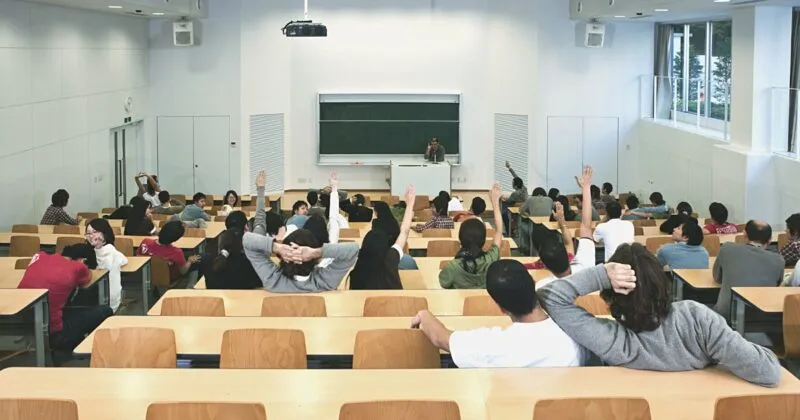
The first two years are the basic cycle shared by all engineering programs, and they are usually the hardest part of the degree. The photo below shows this classroom phase, with large calculus, physics and chemistry classes. Only after this phase does the program move into the materials laboratories.
Typical curriculum
Each institution has its own program plan, but the sequence is much the same everywhere. The basic cycle, from the 1st to the 4th semester, covers calculus, linear algebra and analytic geometry, theoretical and experimental physics, general, inorganic, organic and analytical chemistry, programming, technical drawing, statistics and the first materials science courses. The professional cycle covers thermodynamics and phase diagrams, metallic, ceramic and polymeric materials, composites, transport phenomena, mechanical properties of materials, testing and characterization, heat treatments, processing, corrosion and degradation, materials selection, an internship and a final-year project. Electives in the last semesters steer each student toward a specialization.
UFSCar and USP Lorena curricula, semester by semester
The tables below compare the required courses at UFSCar (in red) and at USP in Lorena (in yellow), semester by semester, from the 1st to the 10th. They show two different ways of designing the program. UFSCar covers the three major groups of materials (metallic, ceramic and polymeric) as early as the 5th semester and keeps the 9th semester for electives. EEL-USP spreads integrated materials engineering laboratories across the whole program and leaves the 9th and 10th semesters for the final project and the internship.
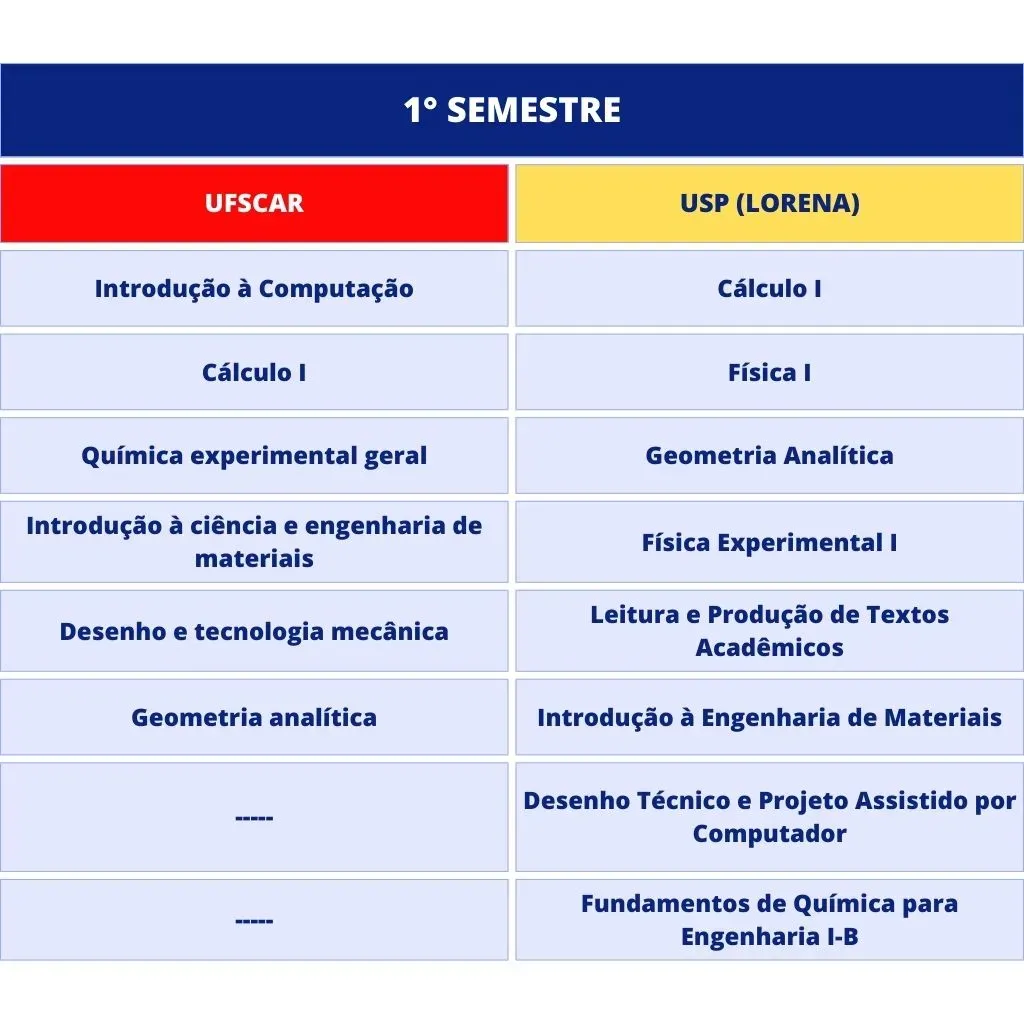
1st semester
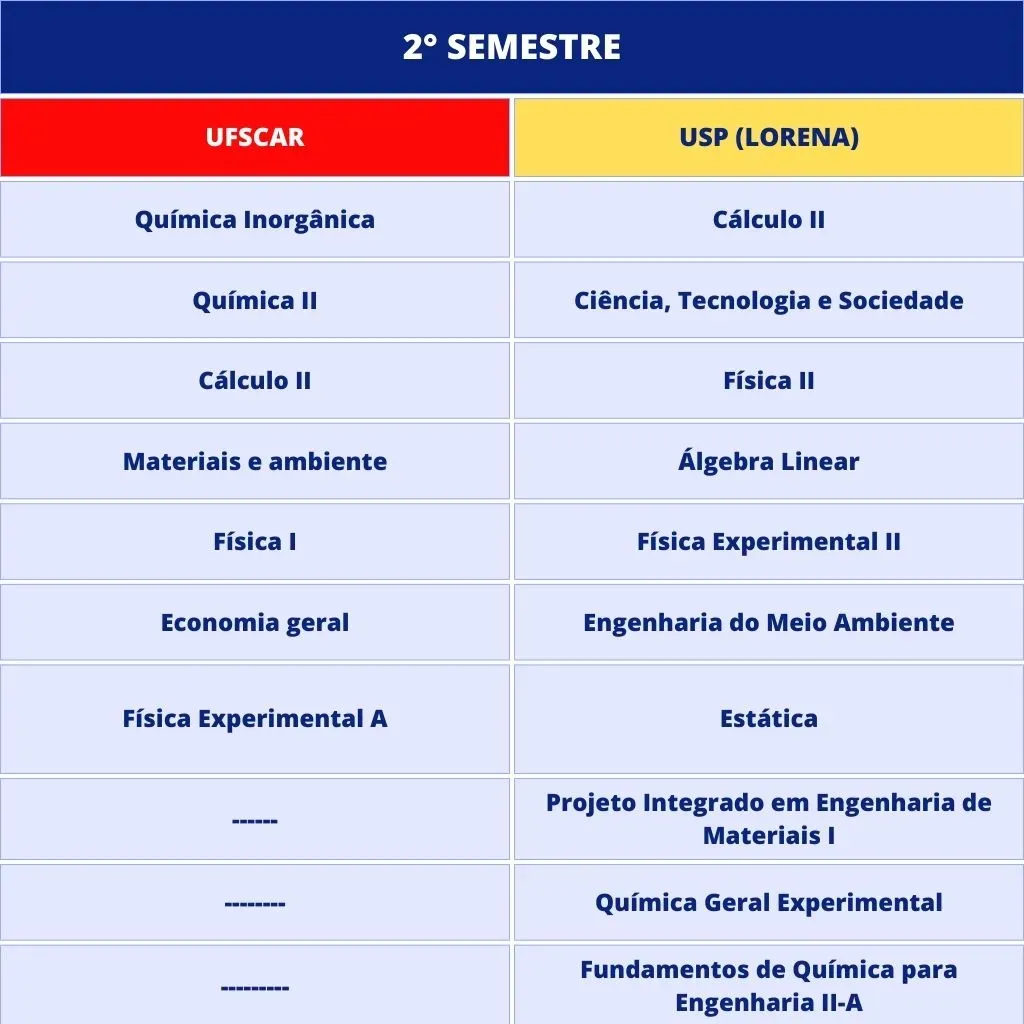
2nd semester
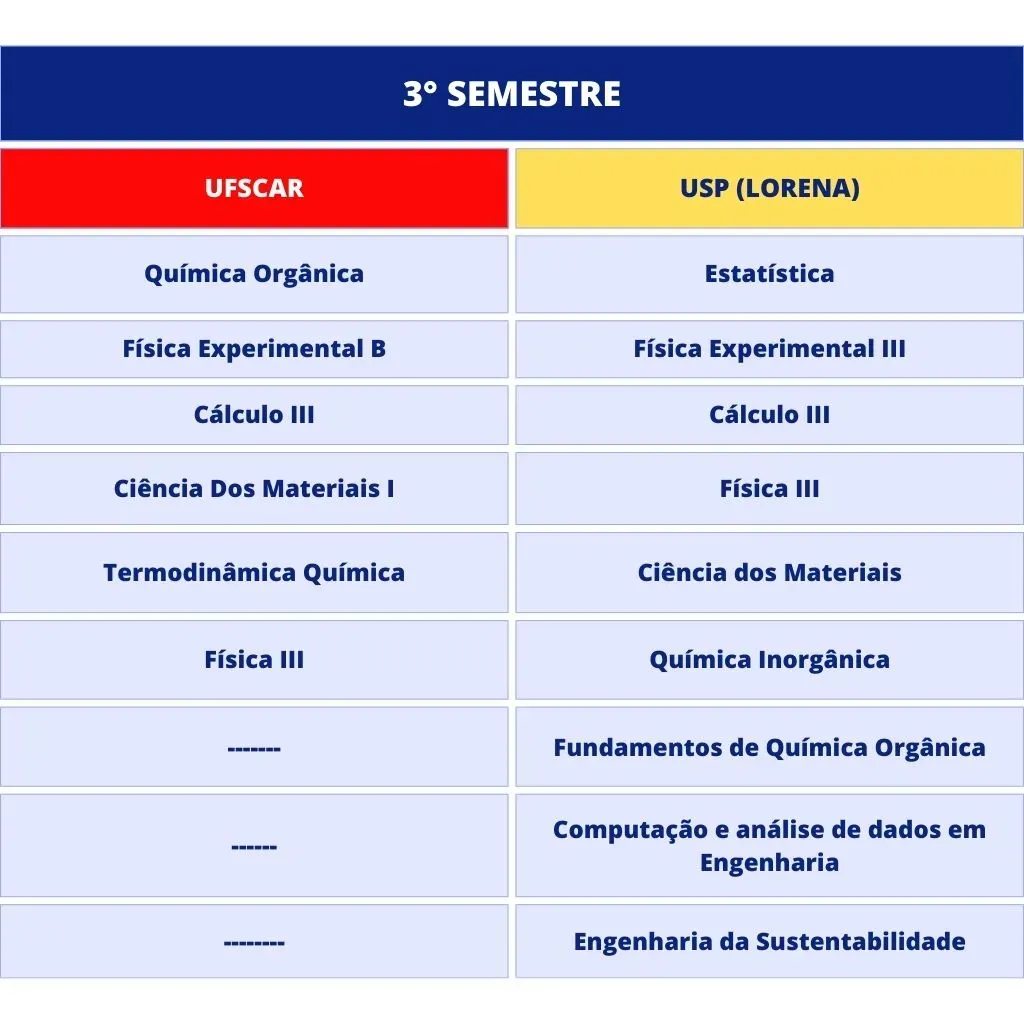
3rd semester
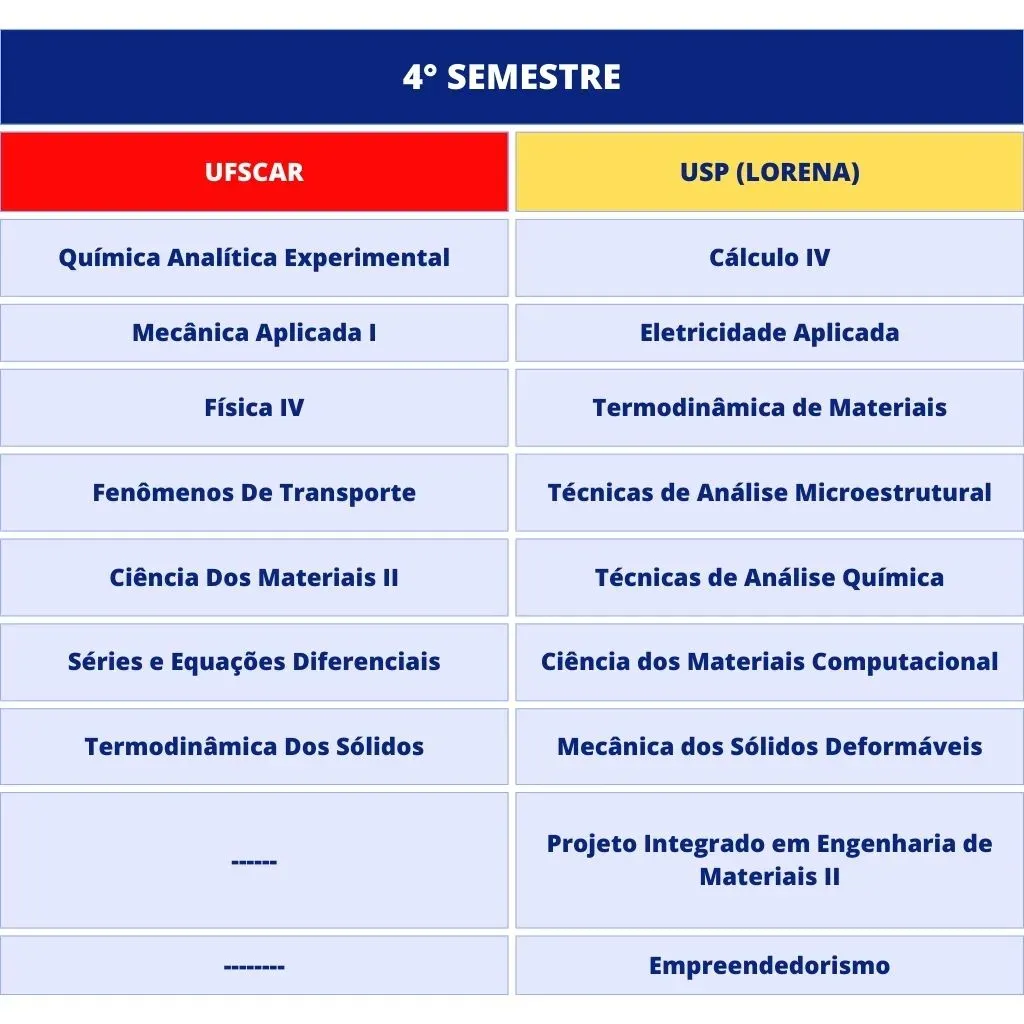
4th semester
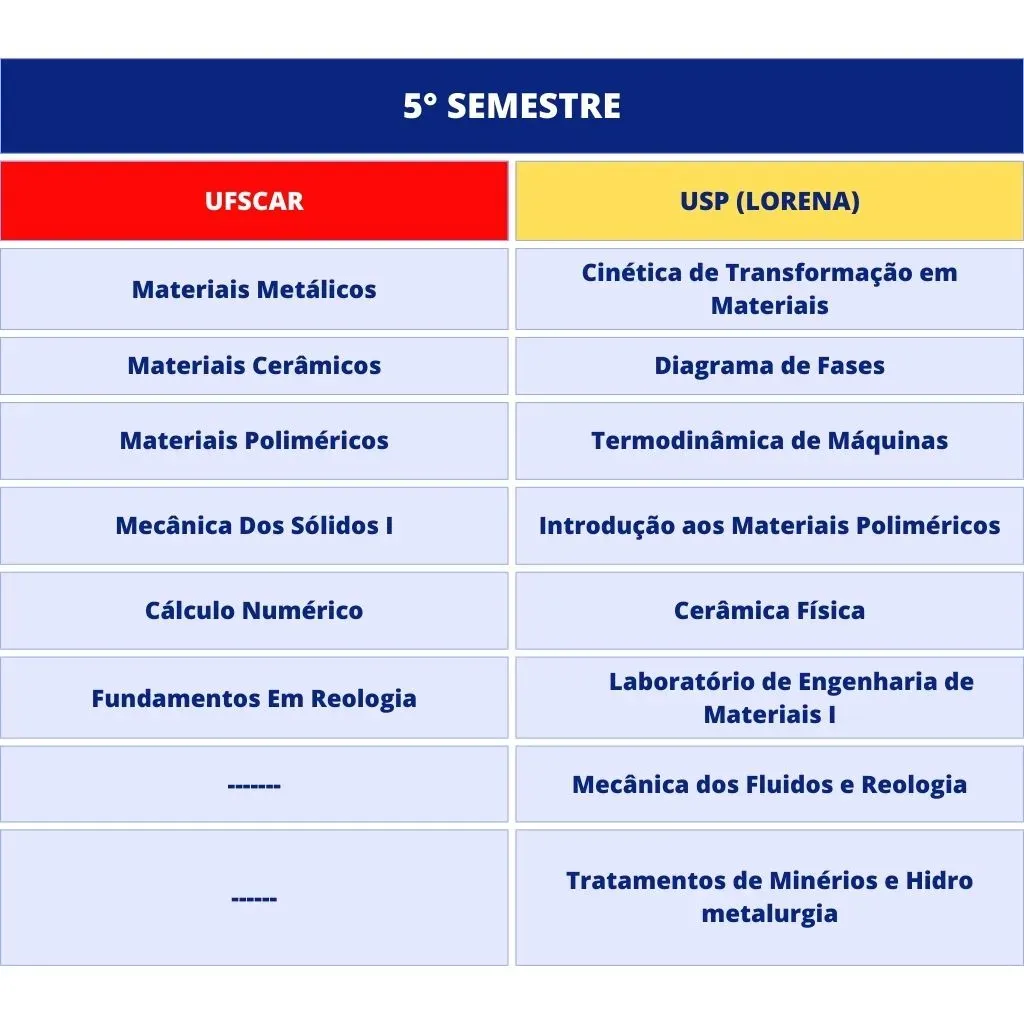
5th semester
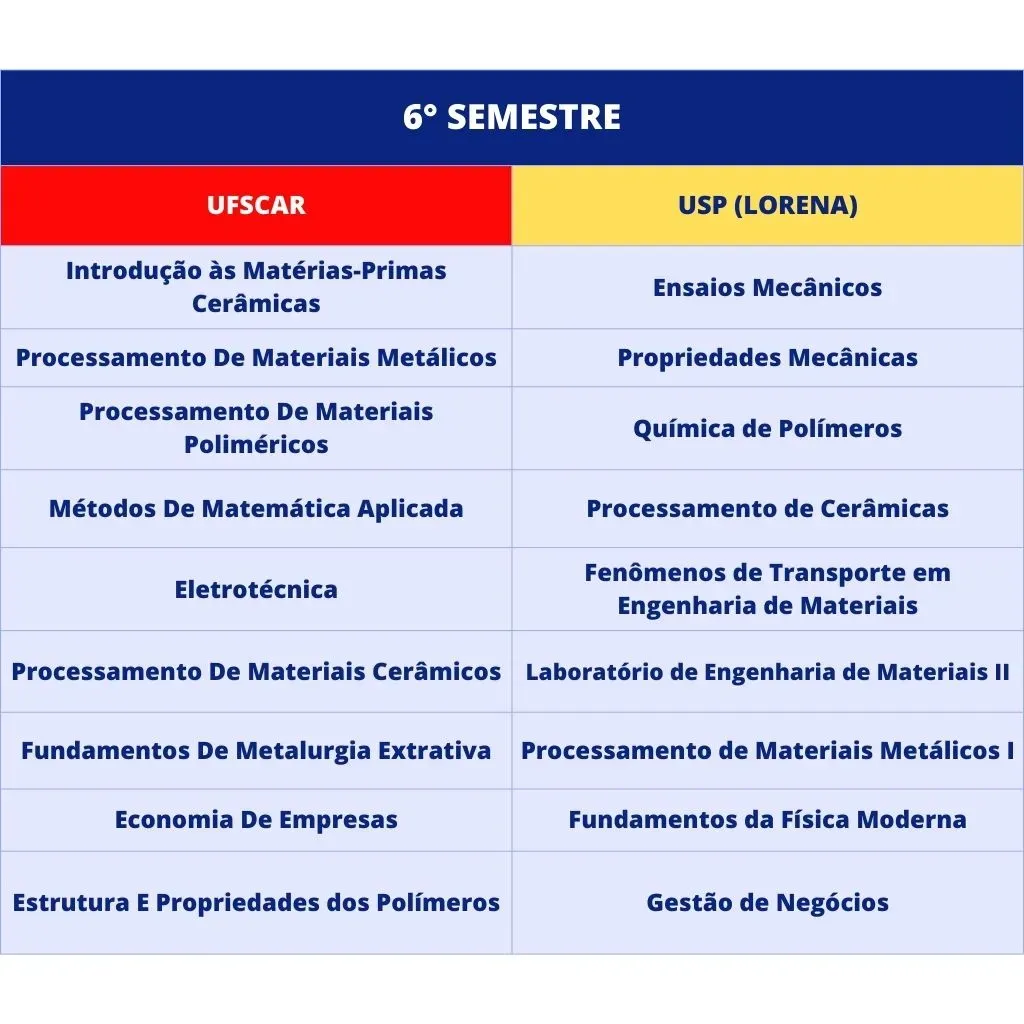
6th semester
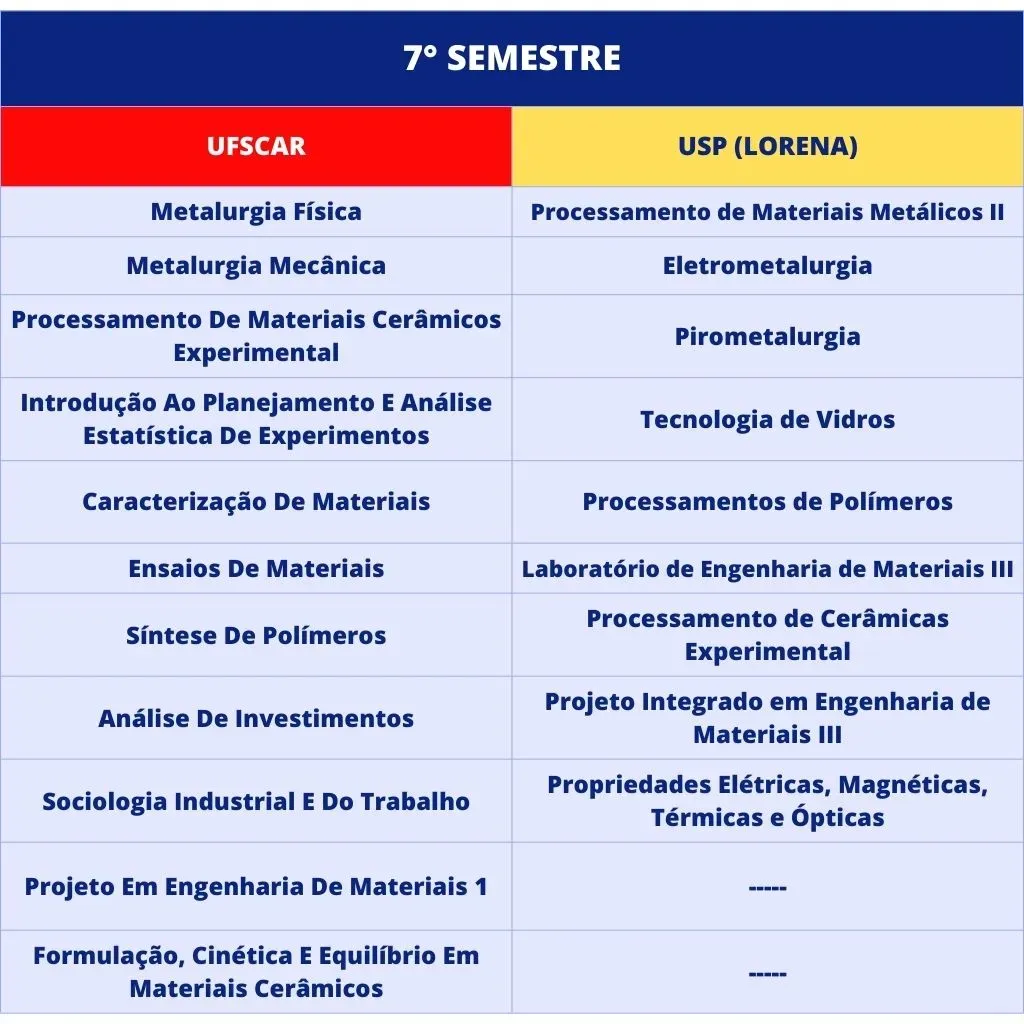
7th semester
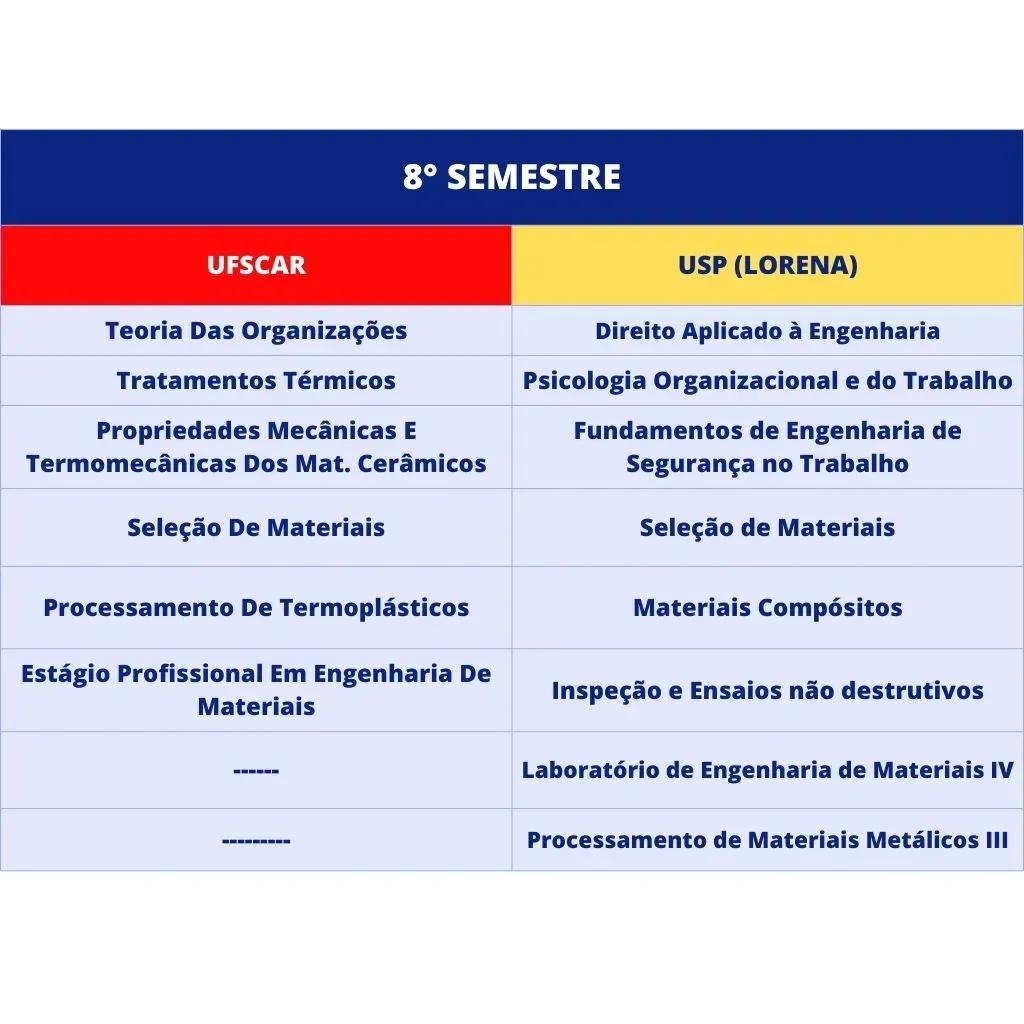
8th semester
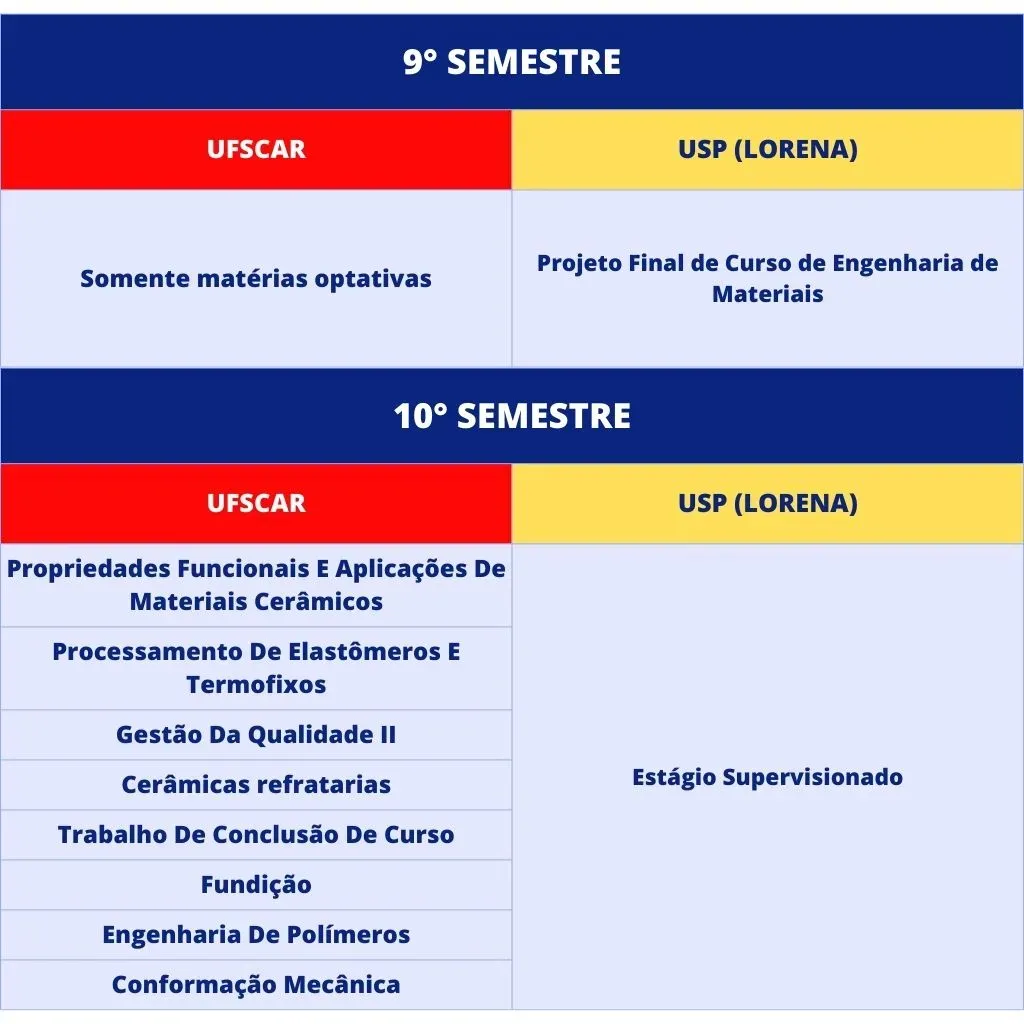
9th and 10th semesters
These curricula are illustrative and change over time. The UFSCar column matches the 2005/1 curriculum that the program coordination publishes on its website. In its JupiterWeb system, EEL-USP publishes a new curriculum starting on January 1, 2027. It reorganizes the basic cycle (Newtonian Physics, Differential and Integral Calculus, Scientific Computing in Python) and merges Mechanical Testing and Mechanical Properties into a single 6th-semester course, Mechanical Behavior of Materials. It also adds Fatigue and Fracture Mechanics, Degradation and Protection of Materials, and Failure Analysis of Materials and Components. Before choosing a program, check the current program plan of each institution.
Graduate studies, distance learning and reference reading
Graduates in other engineering fields, physics and chemistry can move into materials through a specialization course or through a master's degree and a PhD. Distance-learning courses exist in the field, mostly at the graduate level. For an undergraduate distance-learning program, check in e-MEC (the official registry of Brazil's Ministry of Education) that it is authorized and accredited, and find out whether it includes hands-on laboratory classes. For reading, EdUFSCar publishes Engenharia de Materiais para Todos ("Materials Engineering for Everyone"), an introductory book. The technical reference for the whole program is the textbook by Callister and Rethwisch.
The testing laboratory in materials engineering education
The laboratory is where the tetrahedron becomes more than a diagram. Students process a sample, look at its structure under the microscope and measure a property in a standardized test. The main mechanical tests and metallography are at the core of this laboratory. Engineers use these same tools in industry to qualify batches, develop materials and investigate failures.
Mechanical testing on the universal testing machine
The universal testing machine (UTM) applies force at a controlled rate and measures it with a load cell. It measures displacement from the crosshead or, more accurately, with an extensometer attached to the test specimen. With the right grips and fixtures, the same machine can run tensile, compression, flexural and bend tests. The tensile test is the most important test in the program. It gives the modulus of elasticity, yield strength, ultimate tensile strength and elongation, all read from the stress-strain curve. The article on the universal testing machine explains how the machine works.
A typical first-class exercise shows the calculations. A steel test specimen with a diameter of 10.0 mm has a cross-sectional area S0 = π × 10.0² / 4 = 78.54 mm². If it breaks at a maximum force of 31.4 kN, its ultimate tensile strength is 31,400 N / 78.54 mm² = 399.8 MPa, or about 400 MPa. If the gauge marks were 50.0 mm apart before the test and 61.0 mm apart after fracture, the elongation is (61.0 − 50.0) / 50.0 × 100 = 22 %. In the elastic region, at 7.85 kN with a strain of 0.000500 measured by the extensometer, the stress is 7,850 / 78.54 = 99.95 MPa. The modulus is 99.95 / 0.000500 = 199,900 MPa, or 200 GPa, which is the value adopted for steel by ABNT NBR 8800 (the Brazilian standard for the design of steel structures).
A teaching laboratory usually has both universal testing machine configurations. Single-column models (left) are used for polymers, elastomers, films and textiles. In the Biopdi M2 line, the single-column benchtop model ranges from 2 to 10 kN. Dual-column models (right) are used for metals, sheet metal, welded joints and composites. The first dual-column model ranges from 5 to 50 kN. The image below shows the complete M2 line, from the lowest to the highest capacity.
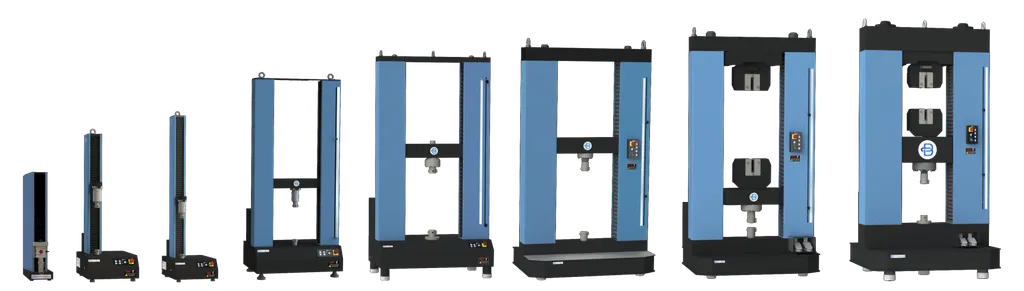
The videos below show two tensile tests on polymers run on Biopdi machines. The first was run on a 100 kN universal testing machine, and the second on a recycled plastic strap. In both tests, the crosshead pulls the grips apart at a constant rate while the specimen stretches and narrows, and the software records the force at every instant until fracture. For a strap, the breaking force is the design value. For the materials engineer developing the recycled compound, it proves that the formulation meets the specification.
The BioLab software converts the force-displacement curve into a stress-strain curve and calculates the properties. The other capacities, up to 1,000 kN, are listed on the universal testing machine page.
Hardness, impact and fatigue
Three more tests complete the mechanical testing laboratory, and each one needs its own equipment. The hardness test (Brinell, Rockwell, Vickers and microhardness) is the fastest way to check a heat treatment. The Charpy impact test measures the energy absorbed in a fast fracture and reveals the ductile-to-brittle transition of steels. The fatigue test measures life under cyclic loading, which causes most in-service failures. For load cycling, Biopdi offers the Biocycle mechanical cycling machine, and the universal testing machine can be fitted with a dynamic module on request.
Metallography
Metallography is the "structure" vertex of the tetrahedron, seen under the microscope. Specimen preparation follows a fixed sequence. The sample is cut with an abrasive wheel and coolant so that it does not heat up and change its structure. It is mounted in resin for easier handling, then ground through successive grit sizes and polished to a mirror finish. A chemical etchant then reveals the grain boundaries and phases, and the sample is examined under a reflected-light optical microscope. ASTM E3 covers specimen preparation, and ASTM E112 covers grain size measurement.
For each step of this sequence, Biopdi manufactures the metallographic cutting machine, in 600 rpm (low-speed cutting) and 1,200 rpm (high-speed) versions, and the grinding and polishing machine, also in 600 and 1,200 rpm versions. It also makes the trinocular metallurgical microscope, with a 10X eyepiece, 20X, 40X and 100X (oil immersion) objectives, Köhler illumination and a camera port. Together with hardness and tensile testing, metallography confirms whether a heat treatment gave the expected result.
Standards used in the testing laboratory
The tests taught in the program follow standards that engineers will find in any purchase specification or test report. The table lists the main ones, with the current edition checked on September 30, 2026:
| Standard | Subject | Edition |
|---|---|---|
| ISO 6892-1 | tensile testing of metals at room temperature | 2019 (ABNT NBR ISO 6892-1:2024) |
| ASTM E8/E8M | tensile testing of metals | E8/E8M-25 |
| ASTM D638 | tensile testing of plastics | D638-22 |
| ASTM E3 | preparation of metallographic specimens | E3-26 |
| ASTM E112 | average grain size | E112-25e1 |
| ASTM E4 | force calibration and verification of testing machines | E4-24 |
| ISO 7500-1 | verification of the force-measuring system of testing machines | 2018 (ABNT NBR ISO 7500-1:2023) |
Where to study materials engineering in Brazil
There is no official ranking of materials engineering programs, and this article does not rank institutions by quality. What each program does have is a regulatory status, which you can check in e-MEC, the official registry of Brazil's Ministry of Education:
- Go to emec.mec.gov.br and choose the advanced search by program.
- Type "Engenharia de Materiais" (materials engineering) and filter by state (UF), city or mode of study (on-campus or distance learning).
- Open the program and check its status (active), its authorization and accreditation acts, and its evaluation scores, such as the program score (CC) and the preliminary program score (CPC).
- On the institution's website, read the current program plan and curriculum, and check which laboratories are available.
The table below lists some public institutions in Brazil that offer the program, in alphabetical order of their acronyms. The list is not complete and is not a ranking. e-MEC is the source for the full list, which also includes private institutions such as Mackenzie and Centro Universitário Fundação Santo André.
| Institution | City (state) |
|---|---|
| CEFET-MG | Belo Horizonte (MG) |
| EEL-USP (Lorena School of Engineering) | Lorena (SP) |
| UFABC | Santo André (SP) |
| UFCA (Federal University of Cariri) | Juazeiro do Norte (CE) |
| UFMG | Belo Horizonte (MG) |
| UFPB (Federal University of Paraíba) | João Pessoa (PB) |
| UFPel | Pelotas (RS) |
| UFRGS | Porto Alegre (RS) |
| UFRJ | Rio de Janeiro (RJ) |
| UFSC | Blumenau (SC) |
| UFSCar | São Carlos (SP) |
| Unesp | Guaratinguetá (SP) |
| Unifei | Itajubá (MG) |
| Unifesp | São José dos Campos (SP) |
| UTFPR | Londrina (PR) |
Salary and job market
The most current public salary data in Brazil comes from Novo Caged, the Brazilian Ministry of Labor's record of hirings and separations in formal employment. The portal Salario.com.br compiles this data by occupation. For the materials engineer (CBO 2146-05 in the Brazilian Classification of Occupations), the table shows the compilation updated on 09/03/2026, with data from August 2025 to July 2026 (amounts in Brazilian reais):
| Indicator | Value |
|---|---|
| Average salary | R$ 11,836.71 per month, average working week of 43 h |
| Median | R$ 11,352.00 |
| Lowest and highest salary in the sample | R$ 3,744.46 and R$ 19,159.82 |
| Sample | 257 professionals |
| Hirings and separations | 124 and 133, net balance of −9 jobs |
| Hiring indicator | 0.93 (fewer hirings than separations) |
Three points to keep in mind when reading it. The sample covers hirings and separations, not all employed engineers, and it mixes recent graduates with experienced professionals: the average is not an entry-level salary. The period is rolling, and portals using a different cut of the same Caged data publish different averages. And the negative balance points to a stable or slightly shrinking market in Brazil, with no shortage of professionals; what sets an engineer apart is specialization and hands-on laboratory skills.
Minimum salary: what Law 4.950-A/66 says
Brazilian Law No. 4.950-A, of 1966, sets the professional minimum salary for engineers who graduated from programs of 4 years or more. Article 5 sets it at 6 times the highest minimum wage in force in Brazil for a 6-hour working day. For a longer day, Article 6 requires calculating at the same hourly rate, with a 25% premium on the hours beyond 6 per day. For an 8-hour day, this gives 6 + 2 × 1.25 = 8.5 minimum wages, which is the calculation in the Confea (Brazil's Federal Council of Engineering and Agronomy) manual. The unions apply the 50% overtime premium of the Brazilian Constitution (Art. 7, XVI) to the two extra hours and arrive at 6 + 2 × 1.5 = 9 minimum wages.
With Brazil's 2026 minimum wage of R$ 1,621, the figures are: 6 × 1,621 = R$ 9,726 for 6 hours; 8.5 × 1,621 = R$ 13,778.50 for 8 hours under the text of the law; and 9 × 1,621 = R$ 14,589 for 8 hours under the union reading, which is the amount published by the Union of Engineers in the State of São Paulo (SEESP) on 01/05/2026 (SEESP published R$ 9,729 for 6 hours, R$ 3 above the calculation).
There is one caveat that changes the amount owed. In the joint ruling on ADPFs 53, 149 and 171, concluded in 2022, Brazil's Supreme Federal Court (STF) upheld the law but prohibited automatic adjustment by the minimum wage and froze the calculation base at the minimum wage in force when the ruling's minutes were published, on 03/03/2022, which was R$ 1,212. Since then, the 6-hour minimum has stood at 6 × 1,212 = R$ 7,272, the amount applied by the Brazilian Labor Courts (TST, 1st Panel, 2024), and increases depend on collective bargaining. The minimum also does not apply to statutory public servants. In practice, the reference is the collective agreement for the profession in each Brazilian state.
Other tests and technical references
Types of materials: metals, ceramics, polymers and composites (properties, how to choose and how to test)
Engineering materials fall into four classes: metals, ceramics, polymers and composites. The first three differ in the type of chemical bonding, which explains stiffness, ductility and service temperature; composites combine two or more classes. See examples, typical properties with sources, the Ashby chart, how to choose and how to test each class.
Biodegradable polymers: what they are, types (PLA, PHA, PBAT, PBS, PCL, starch), standards and mechanical properties
Biodegradable polymers are plastics that microorganisms convert into CO₂, water and biomass, rather than simply breaking into fragments. Biodegradation depends on the environment: PLA reaches 90% in six months only under industrial composting. Learn the difference between biodegradable, compostable, bio-based and oxo-degradable, plus the types, standards, mechanical properties and how to test them.
Industrial engineering: what it is, the 10 ABEPRO areas, professional duties, salary in Brazil and tools
Industrial engineering (engenharia de produção in Brazil) is the engineering that designs, implements, operates and improves integrated production systems for goods and services, according to ABEPRO (the Brazilian Association of Production Engineering). See the 10 areas and 58 subareas defined by ABEPRO, the professional duties set by Confea Resolution 235/1975 (Brazil's Federal Council of Engineering), the course curriculum, the salary in Brazil according to Novo CAGED (the Brazilian formal employment registry) and the minimum wage under Brazilian Law 4.950-A, and the Lean, Six Sigma, PPC, MRP and OEE tools with worked examples.
Mechanical engineering: what it is, what mechanical engineers do, curriculum, professional duties and salary in Brazil
Mechanical engineering is the branch of engineering that designs, manufactures, tests and maintains machines, equipment, vehicles and thermal systems. In Brazil, the professional duties of a mechanical engineer are set out in Article 12 of CONFEA Resolution 218/1973 (CONFEA is Brazil's Federal Council of Engineering and Agronomy). The degree requires at least 3,600 hours over 5 years, and the legal minimum salary for a 6-hour workday is R$ 7,272.00 (Brazilian reais). See the fields of work, the curriculum, the role of mechanical testing in training and in industry, and salary data with a dated source.
Frequently asked questions
What does a materials engineer do?
Selects, develops and processes metals, polymers, ceramics and composites, plans and supervises tests, characterizes products, performs failure analysis and controls the quality of raw materials and products. This is the description in CBO 2146-05 (Brazilian Classification of Occupations), and Confea Resolution No. 241/1976 includes testing, standardization and quality control among the profession's activities in Brazil.
What is a materials engineer's salary?
In Brazil's Caged data from August 2025 to July 2026, the average was R$ 11,836.71 and the median R$ 11,352 per month (Brazilian reais), with an average working week of 43 hours and a sample of 257 professionals (Salario.com.br, updated on 09/03/2026). The average mixes professionals of all levels and is not the entry-level salary.
What is the minimum salary for a materials engineer?
In Brazil, Law 4.950-A/66 sets 6 minimum wages for 6 hours per day, with the extra hours paid at a 25% premium (8.5 minimum wages for 8 hours). In 2022, the STF (Brazil's Supreme Federal Court) froze the calculation base at the March 2022 minimum wage (R$ 1,212), which gives R$ 7,272 for 6 hours. Increases now depend on the collective agreement in each state.
How long is a Materials Engineering degree?
In Brazil, at least 5 years and 3,600 hours, under CNE/CES Resolution No. 2/2007. It is usually 10 semesters, as at EEL-USP, including a supervised internship and a final undergraduate project.
What are the 5 hardest engineering degrees?
There is no official difficulty ranking among engineering degrees. All of them have two heavy years of calculus, physics and chemistry; materials engineering adds solid-state chemistry, thermodynamics of materials and many hours of laboratory work, which calls for an interest in chemistry and experimentation.
What was the first Materials Engineering program in Brazil?
The one at the Federal University of São Carlos (UFSCar), created in 1970, which was also the first in Latin America. It was conceived by Professor Sergio Mascarenhas de Oliveira, and the Department of Materials Engineering was founded in 1972.
Is registration with Crea required?
Yes, in Brazil. Practicing the profession requires registration with the Crea (Regional Council of Engineering and Agronomy) of the state, which grants the title and professional activities based on the curriculum completed, under Confea Resolution No. 1.073/2016. The activities of the materials engineer are those of Resolution 241/1976.
What is the difference between materials engineering and metallurgical engineering?
Metallurgical engineering deals with metals, from extraction to the finished steel product. Materials engineering also covers polymers, ceramics and composites. They are separate occupations in the Brazilian CBO: 2146-10 (metallurgical engineer) and 2146-05 (materials engineer).
Is there an online (distance learning) Materials Engineering degree?
There are distance learning programs in the field in Brazil, mainly at the graduate level. For an undergraduate degree, check on e-MEC (the Brazilian Ministry of Education's registry) that the program is authorized and accredited, and that its curriculum includes hands-on laboratory classes, which are a core part of the training.
What laboratories does the program have?
Mechanical testing on a universal testing machine (tensile, compression, flexural and bend tests), hardness, impact, fatigue, metallography (cutting, mounting, grinding, polishing, etching and microscopy), thermal analysis and microstructural and chemical characterization techniques.
Where do materials engineers work?
In manufacturing industries (steel, metallurgy, petrochemicals, plastics, ceramics, automotive, aerospace, packaging and medical devices), in testing and certification laboratories, research institutes, universities, consulting and forensic engineering.