
Mechanical engineering is the branch of engineering that designs, manufactures, tests and maintains machines, equipment, vehicles and thermal systems, applying solid mechanics, thermodynamics, fluid mechanics and materials science. In Brazil, the legal duties of a mechanical engineer are set out in article 12 of CONFEA Resolution No. 218/1973 (CONFEA is Brazil's Federal Council of Engineering and Agronomy).
In Brazil, the degree program requires at least 3,600 hours, completed over at least 5 years. The average salary recorded by CAGED (Brazil's official formal employment registry) between August 2025 and July 2026 was R$ 11,793.37 (Brazilian reais) per month. Law 4.950-A/1966 also guarantees a minimum wage for engineers which, using the base set by the STF (Brazil's Supreme Federal Court), comes to R$ 7,272.00 for a 6-hour workday. This article explains the fields of practice, the legal duties, the curriculum, the role of mechanical testing in education and in industry, and the job market, with the source for each figure.
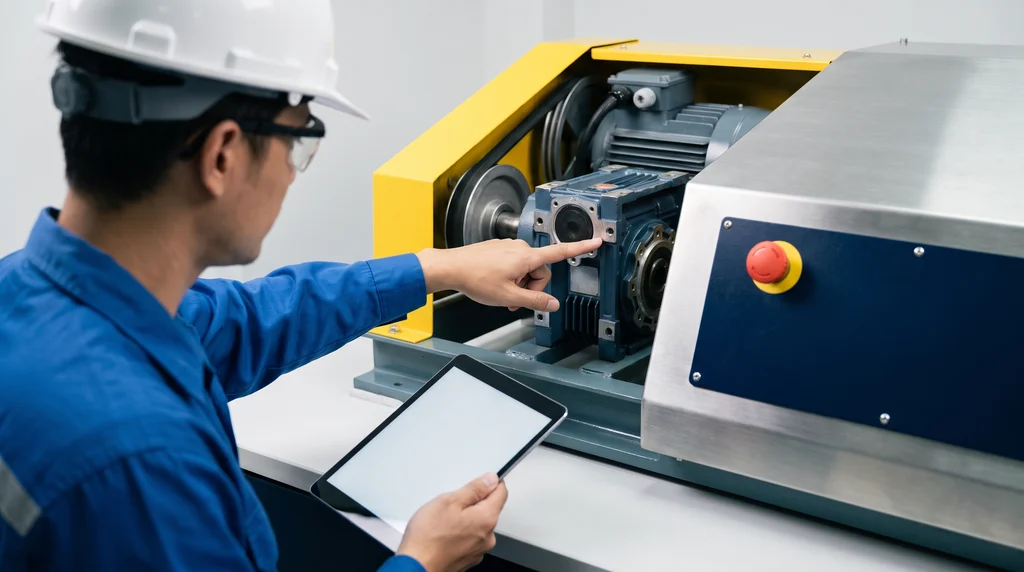
In the photo, a mechanical engineer inspects a machine with its guard open: the electric motor, the belt drive and the gear reducer are mounted on the steel frame, and the emergency stop button is on the panel. Mechanism, drive, structure and safety form a whole that the mechanical engineer sizes, specifies and keeps running.
What is mechanical engineering
Mechanical engineering deals with everything that transmits force, motion or heat. A gear reducer, a pressure vessel, an engine, a cold storage room and a testing machine are problems of the same family: choosing the material, calculating stresses and strains, predicting wear and fatigue, defining how it will be manufactured and making sure the assembly operates safely throughout its service life.
Brazilian law describes this field by its subject matter. Article 12 of CONFEA Resolution 218/1973 refers to "mechanical processes, machines in general; industrial and mechanical installations; mechanical and electromechanical equipment; motor vehicles; systems for the production, transmission and use of heat; refrigeration and air conditioning systems; and their related and correlated services". In other words, mechanical engineering is not limited to moving parts: it includes boilers, heat exchangers, industrial piping and HVAC.
Where the profession came from
As an organized profession, mechanical engineering was born in the Industrial Revolution. The Institution of Mechanical Engineers (IMechE) was founded in 1847 in Birmingham by railway engineers led by George Stephenson. The American Society of Mechanical Engineers (ASME) followed in 1880, at a time when steam boiler explosions were killing workers and passengers; the ASME Boiler and Pressure Vessel Code, still in use today, grew out of that concern.
In Brazil, engineering education began in 1810 with the Royal Military Academy in Rio de Janeiro, but it trained military and civil engineers, without today's specializations. Mechanical engineering as a separate degree program only appeared in Brazil in the 20th century, with industrialization. The difference from its closest neighbor is one of focus: materials engineering studies and develops the material itself, while mechanical engineering uses that material's properties to design the machine.
Fields of practice
The education is the same for everyone, but the work splits into very distinct fields, and most engineers spend their careers in one or two of them.
Mechanical design. The design engineer turns a need into a manufacturing drawing: chooses the operating principle, sizes shafts, bearings, gears, springs and joints, specifies the material and heat treatment, and defines tolerances and surface finish. Today the work relies on 3D CAD and finite element simulation, but strength of materials calculations remain the basic check. In the photo, the technical drawing of a part is being reviewed on a tablet: dimensions, geometric tolerances, surface roughness and chamfers are the information the manufacturer will follow.

Manufacturing and processes. Here the engineer decides how the part will be made (machining, forming, casting, welding or additive manufacturing), defines the sequence of operations, the tooling and the inspection points, and is responsible for the cost and productivity of the line.
Maintenance and reliability. An industrial plant depends on hundreds of machines that cannot stop without warning. The maintenance engineer sets up preventive and predictive maintenance plans (vibration analysis, thermography, oil analysis), investigates failures and decides when to repair and when to replace. The photo below shows a technician adjusting a machine with shafts and gears, the kind of equipment whose failure stops an entire line.

Thermal and fluid systems. Engines, turbines, pumps, compressors, boilers, refrigeration and air conditioning, based on thermodynamics, fluid mechanics and heat transfer.
Materials and quality. The engineer specifies the material, qualifies suppliers, defines incoming inspection tests and interprets test reports. When a part breaks in service, the engineer brings together fracture analysis, metallography and mechanical testing to find the cause.
Automation, vehicles and management. Automatic machines and robotics combine mechanics, electronics and control; the automotive and aerospace industries employ engineers in structures, propulsion and certification. With experience, many move into industrial management, teaching or research.
The table summarizes the fields and what each one involves day to day:
| Field | What it does | Tools and examples |
|---|---|---|
| Mechanical design | sizes parts and mechanisms, specifies materials | CAD, finite elements, machine elements |
| Manufacturing and processes | defines how the part is made | machining, forming, welding, casting, additive manufacturing |
| Maintenance | keeps the plant available and investigates failures | preventive and predictive plans, failure analysis |
| Thermal and fluid systems | designs and operates heat and flow systems | pumps, boilers, refrigeration, air conditioning |
| Materials and quality | selects and qualifies materials and suppliers | mechanical testing, metallography, inspection |
| Automation and vehicles | integrates mechanics, electronics and control | PLCs, sensors, actuators, vehicle structures |
What a mechanical engineer does: legal duties under CONFEA
The practice of engineering in Brazil is regulated by Law 5.194/1966, and only those registered with the CREA (Regional Council of Engineering and Agronomy) of the state where they work can sign as engineers. What each discipline is allowed to do comes from CONFEA resolutions. For mechanical engineers, the reference is article 12 of Resolution 218/1973, which remains in force for this discipline (the resolution was partially revoked in other articles, such as articles 8 and 9, covering electrical engineering, which were replaced by Resolution 1.156/2025).
Article 12 grants mechanical engineers activities 01 to 18 of article 1 of the same resolution, within the field described in the previous section. The 18 activities cover the entire cycle of a technical job:
- Planning and deciding: technical supervision, coordination and guidance (01); study, planning, design and specification (02); technical and economic feasibility study (03); technical assistance, advisory and consulting (04); preparation of cost estimates (09).
- Executing and inspecting: management of works and technical services (05); execution (11) and inspection (12) of works and technical services; technical and specialized production (13); leading technical work (14) and teams for installation, assembly, operation, repair or maintenance (15); carrying out installation, assembly and repair (16); operation and maintenance of equipment and installations (17); preparation of technical drawings (18).
- Evaluating and measuring: inspection, expert examination, appraisal, arbitration, technical reports and opinions (06); teaching, research, analysis, experimentation, testing and technical dissemination (08); standardization, measurement and quality control (10).
- Holding technical positions: performance of technical positions and functions (07).
Two of these activities link the profession to the laboratory: activity 08 explicitly mentions testing, and activity 10 covers measurement and quality control. Material test reports, incoming inspection and failure investigation are therefore duties of the mechanical engineer, not only of the materials engineer.
For new graduates, legal duties are granted under CONFEA Resolution 1.073/2016: the CREA reviews the program's curriculum and the graduate's transcript and may grant the activities in full or in part. In practice, a mechanical engineer from a regular degree program is usually registered with the duties of article 12. Each signed service requires a Technical Responsibility Record (ART, Anotação de Responsabilidade Técnica), established by Law 6.496/1977.
What the degree program looks like: duration and curriculum
In Brazil, the minimum duration comes from CNE/CES Resolution 2/2007 (Brazil's National Education Council), which sets 3,600 hours for bachelor's degrees in engineering, completed in at least 5 years. The content follows Brazil's National Curriculum Guidelines for Engineering (CNE/CES Resolution 2/2019). Article 9, § 1, lists the basic content that is mandatory for every engineering discipline: Business Administration and Economics; Algorithms and Programming; Materials Science; Environmental Sciences; Electricity; Statistics; Technical Drawing; Transport Phenomena; Physics; Computing; Mathematics; Solid Mechanics; Scientific and Technological Methodology; and Chemistry.
The guidelines also require programs to include practical and laboratory activities in the basic, specific and professional content (article 9, § 3), a supervised internship of at least 160 hours (article 11) and a capstone project (article 12). The first two years concentrate on calculus, algebra, physics and chemistry. The image below, of a graduate facing a board covered in equations, sums up this first half well: it provides the mathematical foundation for the professional courses.

From the third year on, the professional courses begin. They vary from one institution to another, but almost always include three areas related to materials.
Strength of materials
This is the course that turns forces into stresses. Students learn to calculate the normal stress σ = F / A in bars under tension and compression, the shear stress in pins and rivets, bending in beams, torsion in shafts and buckling in columns, and to compare the result with the material's yield strength divided by a safety factor. The properties used in these calculations are gathered in the article on mechanical properties of materials.
Materials science
It explains why a material has the properties it has: atomic bonding, crystal structure, dislocations, phase diagrams, the iron-carbon diagram and the transformations that heat treatment causes in steel. This is what makes it possible to understand why a quenched and tempered steel is stronger and less ductile than the same steel in the annealed condition. An overview of metals, ceramics, polymers and composites is in types of materials, and the annealing, normalizing, quenching and tempering cycles are covered in the article on heat treatment of metals.
Machine elements
This course applies strength of materials to standardized components: shafts, keys, rolling and plain bearings, gears, belts, springs, bolts and welded joints. The focus shifts from static load to service life, because almost every machine element operates under varying load and fails by fatigue or wear, not by a single overload.
The other professional courses
The curriculum is completed by thermodynamics, fluid mechanics, heat transfer, manufacturing processes, vibrations, control, thermal machines and, in many programs, a course on materials testing and metallography. It is in this last course that students enter the materials laboratory, the subject of the next section.
Mechanical testing in engineering education and industry
Every design calculation starts from material properties: yield strength, ultimate tensile strength, modulus of elasticity, hardness, toughness, fatigue strength. None of them is calculated. They are all measured in standardized tests, and a value only means something together with the standard, the material condition and the test specimen. That is why a mechanical engineer needs to know what each test measures and how to read the test report, even without operating the equipment.
In engineering school, the laboratory work required by the DCN (Brazil's National Curriculum Guidelines for engineering) appears mainly in Materials Science and Mechanics of Solids: students break test specimens, measure hardness, run impact tests and prepare metallographic samples. In industry, the same tests appear in purchase specifications, incoming inspection, heat treatment control, welding qualification and failure analysis. The full overview, with every type of test, is in the article on the main mechanical tests; here we cover the four that a mechanical engineer encounters most often.
Tensile test
The test specimen is pulled until it fractures while the machine records force and elongation. Dividing the force by the original area and the elongation by the original length gives the stress-strain curve, from which we obtain the modulus of elasticity E, the yield strength, the ultimate tensile strength, the elongation after fracture and the reduction of area. This is the test that supplies the numbers used in strength of materials: a hot-rolled 1020 steel, for example, has a yield strength of about 205 MPa and an ultimate tensile strength of about 380 MPa, and ASTM A36 structural steel has a minimum yield strength of 250 MPa and an ultimate tensile strength of 400 to 550 MPa. For metals, the standards are ASTM E8/E8M and ISO 6892-1 (ABNT NBR ISO 6892-1 in Brazil). The complete procedure is in the article on the tensile test, and how to read each region of the curve is in the stress-strain curve article. The same machine performs compression and flexural tests by swapping the grips for the appropriate fixtures.
Hardness test
An indenter of defined geometry is pressed into the part, and hardness is obtained from the size of the indentation (Brinell, Vickers) or its depth (Rockwell). The test is fast, leaves only a small mark and can be performed on the part itself, which is why it is the most widely used check in industry, mainly to confirm that a heat treatment achieved the specified result. In carburized or nitrided parts, the depth of the hardened case is measured with a microhardness profile, whose procedure is described in the article on the hardness test. A result is only valid with the full scale, such as 60 HRC or 200 HBW.
Impact test
The Charpy test breaks a notched test specimen with a pendulum and measures the energy absorbed in the fracture, in joules. This energy indicates the toughness of the material in the presence of a notch and varies strongly with temperature: many steels shift from ductile, high-energy fracture to brittle, low-energy fracture as the temperature drops. That is why the test appears in specifications for welded structures, pressure vessels and equipment operating in cold conditions. The standards are ASTM E23 and ISO 148-1, and the method is described in the article on the impact test.
Fatigue test
Parts under variable loading, such as shafts, springs, connecting rods and bolts, can fail at stresses well below the ultimate tensile strength after millions of cycles. The fatigue test applies load cycles at several stress levels and records how many cycles the test specimen withstands, producing the S-N curve used in machine element design. ASTM E466 covers force-controlled axial fatigue testing of metals, and ISO 1099 is the international equivalent. The methods, the curve and the factors that reduce fatigue life are in the article on the fatigue test.
Summary: what each test gives the engineer
The table brings together the four tests with the standard for metals, what each one measures and where a mechanical engineer encounters it in practice:
| Test | Standard (metals) | What it measures | Where it appears |
|---|---|---|---|
| Tensile | ASTM E8/E8M, ABNT NBR ISO 6892-1 | E, yield strength, ultimate tensile strength, elongation, reduction of area | purchase specification, incoming inspection, material certificate |
| Hardness | ASTM E18, ISO 6508-1 (Rockwell) | resistance to localized indentation | heat treatment control, inspection of finished parts |
| Charpy impact | ASTM E23, ISO 148-1 | energy absorbed in fracture, in J | welded structures, pressure vessels, low-temperature service |
| Axial fatigue | ASTM E466, ISO 1099 | number of cycles to failure, S-N curve | shafts, springs, fasteners, failure analysis |
Worked laboratory calculations
These four calculations are the ones students do in their lab report and that engineers redo when checking a test report. They all use stress σ = F / A0, strain ε = ΔL / L0 and Hooke's law σ = E · ε.
- Stress in the test specimen. A cylindrical A36 steel test specimen with a diameter of 10 mm is under 30 kN. The area is A0 = π × 10² / 4 = 78.54 mm², and the stress is σ = 30,000 / 78.54 = 382 MPa. This value exceeds the minimum yield strength guaranteed by the standard (250 MPa) and is below the minimum ultimate tensile strength (400 MPa). If the actual yield strength of that batch is lower than 382 MPa, the specimen is already in the plastic range; the test curve or the material certificate confirms it.
- Modulus of elasticity. In the elastic region, the extensometer measures ε = 0.00075 when σ = 150 MPa. So E = 150 / 0.00075 = 200,000 MPa = 200 GPa, the value adopted for structural steel by ABNT NBR 8800 (the Brazilian standard for the design of steel structures).
- Elongation after fracture. With a gauge length L0 = 50 mm and a final length Lf = 61.5 mm, the elongation is A = (61.5 − 50) / 50 × 100 = 23 %.
- Machine capacity. An A36 sheet test specimen with a reduced section of 12.5 × 6 mm has an area of 75 mm². In the worst case, with the ultimate tensile strength at the top of the range (550 MPa), the maximum force will be 550 × 75 = 41,250 N, or 41.3 kN. A 50 kN machine handles it with margin to spare.
The laboratory: universal testing machine and metallography
The materials laboratory of a mechanical engineering program, or of a manufacturing company, revolves around two sets of equipment. The first is the universal testing machine, which performs tensile, compression, flexural, shear and bend tests with the same load frame by changing grips and fixtures. The load cell measures force, the extensometer measures strain over the gauge section of the test specimen, and the software builds the curve and calculates the properties. How each part works is explained in the article what is a universal testing machine. For the sheet test specimen in calculation 4, the dual-column MBIOII-50-M2, from 5 to 50 kN, is the right range.
The second set is metallography, which reveals the microstructure behind the test result. The sample is cut on the metallographic cutting machine without heating the region of interest, ground and polished on the grinding and polishing machine to a mirror finish, chemically etched and examined under the metallurgical microscope. This is how an engineer confirms that a steel was quenched and tempered as specified, measures grain size, evaluates a weld heat-affected zone or finds the inclusion where a fatigue crack started. Hardness, metallography and tensile testing together complete the verification of a heat treatment result.
Machine safety: NR-12
Those who design, install or maintain machines are also responsible for their safety. NR-12 (Brazil's regulatory standard for safety in machinery and equipment), whose current wording comes from Ordinance SEPRT No. 916/2019 and whose latest amendment is Ordinance MTE No. 344/2024, requires guards, emergency stop devices, safety systems and operator training. Testing machines fall under the rule: Biopdi's M2 line complies with NR-10 and NR-12, with an emergency button on the panel, mechanical limit switches, automatic stop on loss of communication, and software with user levels and usage history. The requirements as applied to the laboratory are covered in the article on NR-12 for testing machines.
Job market and salary
Mechanical engineers work in manufacturing (metalworking, automotive, machinery and equipment, food), in energy, oil and gas, mining, refrigeration and HVAC, in maintenance and installation, in testing and quality laboratories, in consulting and forensic engineering, and in teaching. Because the legal scope of practice is broad, it is common to change sectors without changing qualifications.
The most recent salary data in Brazil from a public source comes from Salário.com.br, which compiles CAGED (the Brazilian Ministry of Labor and Employment's registry of formal employment) for occupation code CBO 2144-05 (mechanical engineer) in the Brazilian Classification of Occupations. In the update of September 3, 2026, with 6,655 records of CLT contracts (formal employment under Brazil's labor code) between August 2025 and July 2026, the average was R$ 11,793.37 (Brazilian reais) per month for an average workweek of 42 hours, with a range of R$ 5,038.23 to R$ 17,286.20. Two caveats: CAGED records the salary at the time of hiring or termination, not the career salary, and it does not include people working as contractors (PJ), public servants or self-employed professionals. Junior, mid-level and senior ranges vary widely from company to company and have no reliable public source.
Minimum salary for engineers in Brazil: Law 4.950-A/1966
The engineer's minimum salary in Brazil is set by law and is often calculated incorrectly. Law 4.950-A/1966 sets, for graduates of engineering programs of 4 years or more, a minimum professional salary of 6 minimum wages for a 6-hour workday (art. 5). For longer workdays, hours beyond 6 are paid with a 25 % premium (art. 6). In an 8-hour workday, the 2 extra hours are worth 2 × 1.25 = 2.5 minimum wages, and the floor reaches 8.5 minimum wages.
In 2022, ruling on ADPFs 53, 149 and 171, the STF (Brazil's Supreme Federal Court) upheld the law but prohibited the floor from following increases in the minimum wage. The base was fixed at the minimum wage in force on the date the ruling's minutes were published, March 3, 2022, which was R$ 1,212.00; any adjustment now depends on legislation or collective bargaining. The TST (Brazil's Superior Labor Court) reaffirmed this benchmark in 2024. The correct calculations are:
- 6 hours per day: 6 × R$ 1,212.00 = R$ 7,272.00;
- 8 hours per day: 8.5 × R$ 1,212.00 = R$ 10,302.00.
The most common mistake is to multiply by the current year's minimum wage. With the R$ 1,621.00 of 2026 (Decree 12.797/2025), the calculation would give R$ 9,726.00 for 6 hours, a value with no legal basis since the STF ruling. The table summarizes the figures in this section:
| Indicator | Value | Condition and source |
|---|---|---|
| Average CLT salary | R$ 11,793.37 | 42 h per week, Aug 2025 to Jul 2026; Salário.com.br/CAGED, updated September 3, 2026 |
| Recorded range | R$ 5,038.23 to R$ 17,286.20 | same data set |
| Legal minimum, 6 h per day | R$ 7,272.00 | 6 × R$ 1,212.00; Law 4.950-A/1966 and STF, ADPFs 53, 149 and 171 |
| Legal minimum, 8 h per day | R$ 10,302.00 | 8.5 × R$ 1,212.00; art. 6 of the same law |
Mechanical engineering and the other engineering disciplines
The boundaries with neighboring engineering disciplines are a matter of focus, not of content. The difference from materials engineering was covered in the first section. Industrial engineering organizes the production system (costs, logistics, processes, people), while mechanical engineering takes care of the equipment and the product. Civil engineering designs structures and construction works, where steel, concrete and soil are also tested. Quality engineering deals with control methods, and the mechanical engineer is usually the one who defines them for mechanical parts. Finally, mechatronics is a separate degree in Brazil that combines mechanics, electronics and computing from the start of the program.
Standards and legislation cited
The table lists the laws, resolutions and technical standards used in this article, with the edition or year in force checked on September 30, 2026:
| Standard or law | Subject | Edition |
|---|---|---|
| Law 5.194 | practice of the engineering profession in Brazil | 1966 |
| Law 4.950-A | minimum pay for engineers in Brazil | 1966 |
| CONFEA Resolution 218 | activities of each engineering discipline; art. 12, mechanical engineer | 1973 |
| CONFEA Resolution 1.073 | assignment of professional titles and activities | 2016 |
| CNE/CES Resolution 2 | minimum workload for bachelor's degrees | 2007 |
| CNE/CES Resolution 2 | National Curriculum Guidelines for Engineering (Brazil) | 2019 |
| NR-12 | safety in machinery and equipment (Brazil) | Ordinance SEPRT 916/2019, amended by Ordinance MTE 344/2024 |
| ASTM E8/E8M | tension testing of metals | E8/E8M-25 |
| ISO 6892-1 | tensile testing of metals at room temperature | 2019 |
| ABNT NBR ISO 6892-1 | tensile testing of metals at room temperature (Brazilian adoption) | 2024 |
| ASTM E18 | Rockwell hardness | E18-25 |
| ISO 6508-1 | Rockwell hardness, test method | 2023 |
| ASTM E23 | notched bar impact testing (Charpy and Izod) | E23-25 |
| ISO 148-1 | Charpy impact, test method | 2016 |
| ASTM E466 | force-controlled axial fatigue testing of metals | E466-21 |
| ISO 1099 | force-controlled axial fatigue testing of metals | 2017 |
| ABNT NBR ISO 7500-1 | force verification of testing machines | 2023 |
Other tests and technical references
Civil engineering: what it is, what civil engineers do, fields, salary and materials testing
Civil engineering is the branch of engineering that plans, designs, builds and maintains buildings and infrastructure, such as roads, bridges, dams, ports and sanitation. In Brazil, the duties of a civil engineer are set out in Article 7 of CONFEA Resolution 218/1973 (CONFEA is Brazil's Federal Council of Engineering and Agronomy), and practicing the profession requires registration with a CREA (Brazil's Regional Council of Engineering and Agronomy). See the fields, the degree program, salaries in Brazil with a dated source, the minimum wage for engineers under Brazilian Law 4,950-A/66, and the tests on concrete, steel, mortar and soils.
Industrial engineering: what it is, the 10 ABEPRO areas, professional duties, salary in Brazil and tools
Industrial engineering (engenharia de produção in Brazil) is the engineering that designs, implements, operates and improves integrated production systems for goods and services, according to ABEPRO (the Brazilian Association of Production Engineering). See the 10 areas and 58 subareas defined by ABEPRO, the professional duties set by Confea Resolution 235/1975 (Brazil's Federal Council of Engineering), the course curriculum, the salary in Brazil according to Novo CAGED (the Brazilian formal employment registry) and the minimum wage under Brazilian Law 4.950-A, and the Lean, Six Sigma, PPC, MRP and OEE tools with worked examples.
Quality engineering: what it is, tools (SPC, Cp/Cpk, FMEA, MSA), standards and career
Quality engineering is the field that uses statistics, metrology and testing to design, measure, control and improve processes so that products meet their specifications. See the tools (SPC, Cp/Cpk, MSA, FMEA, Ishikawa, Pareto, PDCA) with worked examples, the standards in force in 2026 (ISO 9001:2026, IATF 16949, ISO/IEC 17025, ISO 10012), testing machine calibration and the career outlook with dated figures.
Materials engineering: what it is, what materials engineers do, degree, legal duties and salary
Materials engineering relates processing, structure, properties and performance of metals, polymers, ceramics and composites to select, develop, manufacture and test the right material for each use. See what a materials engineer does, the professional duties defined by Confea (Brazil's Federal Council of Engineering and Agronomy), the degree curriculum, where to study in Brazil, salaries reported in Caged (Brazil's formal employment registry) and the Brazilian minimum engineering salary set by Law 4.950-A/66.
Frequently asked questions
What is mechanical engineering?
It is the branch of engineering that designs, manufactures, tests and maintains machines, equipment, vehicles and thermal systems such as boilers, refrigeration and air conditioning. In Brazil, its scope of practice is defined in Article 12 of CONFEA Resolution 218/1973 (CONFEA is Brazil's Federal Council of Engineering and Agronomy).
What does a mechanical engineer do?
A mechanical engineer designs and specifies parts and machines, defines manufacturing processes, plans maintenance, operates thermal systems, writes technical reports and expert assessments, and controls the quality of materials and products. Brazilian law grants mechanical engineers the 18 activities listed in Article 1 of Resolution 218/1973, from design to the production of technical drawings, including testing and quality control.
What is a mechanical engineer's salary?
In Brazil, the average of formal employment (CLT) contracts recorded in CAGED (the Brazilian government's registry of formal hiring) between August 2025 and July 2026 was R$ 11,793.37 (Brazilian reais) per month, for a 42-hour week (Salário.com.br, updated 09/03/2026). The legal minimum salary is R$ 7,272.00 for 6 hours a day and R$ 10,302.00 for 8 hours.
How is the engineer's minimum salary calculated?
In Brazil, Law 4,950-A/1966 sets 6 minimum wages for 6 hours a day and adds 25% for the hours beyond 6, which gives 8.5 minimum wages for 8 hours. Since the ruling of Brazil's Supreme Federal Court (STF) in ADPFs 53, 149 and 171, the base is the minimum wage in force on 03/03/2022, R$ 1,212.00, and not the current year's minimum wage.
Is mechanical engineering hard to study?
It is a demanding program in mathematics and physics: in Brazil it requires at least 3,600 hours, with calculus, solid mechanics, transport phenomena and thermodynamics. How hard it is depends on the math background the student brings from high school.
What are the 3 hardest engineering degrees?
There is no official difficulty ranking among engineering degrees. In mechanical engineering, the courses with the highest failure rates are usually calculus, strength of materials and transport phenomena, but the weight of each one varies with the student's aptitude.
How long is a mechanical engineering degree?
In Brazil, at least 5 years and 3,600 hours, according to Resolution CNE/CES 2/2007 of the National Education Council. The program includes a supervised internship of at least 160 hours and a final project, both required by the 2019 National Curriculum Guidelines (DCN).
Where do mechanical engineers work?
In manufacturing, the automotive industry, machinery and equipment, energy, oil and gas, mining, refrigeration and HVAC, maintenance and installation, testing and quality laboratories, consulting and expert assessment, and teaching.
Does a mechanical engineer need to be registered with CREA?
In Brazil, yes. The profession is regulated by Law 5,194/1966, and professional duties are granted by the CONFEA/CREA system (the federal and regional engineering councils) under Resolution 1,073/2016. Every technical service the engineer signs requires an ART (Technical Responsibility Record).
What is the difference between mechanical engineering and materials engineering?
Materials engineering studies and develops the material; mechanical engineering uses that material's properties to design and maintain machines and systems. The two meet in mechanical testing and metallography.
Which mechanical tests should a mechanical engineer know?
Mainly tensile, compression, flexural, hardness, Charpy impact and fatigue tests, plus metallography. The reference standards for metals are ASTM E8/E8M and ISO 6892-1 (ABNT NBR ISO 6892-1 in Brazil) for tensile testing, ASTM E18 (Rockwell hardness), ASTM E23 (impact) and ASTM E466 (axial fatigue).
Is being a mechanical engineer a good career?
In Brazil, the legal scope of practice is broad, the minimum salary is set by law and the average CLT salary recorded in CAGED is above R$ 11,000. The choice depends on your interest in physics, design and machines, and the career lets you change industries without changing your degree.