
Industrial engineering (engenharia de produção in Brazil) is the branch of engineering that designs, implements, operates, improves and maintains integrated production systems for goods and services, involving people, materials, technology, information and energy, according to the Brazilian Association of Industrial Engineering (ABEPRO). In Brazil, the professional duties of this engineering discipline are set by Confea Resolution No. 235/1975.
ABEPRO divides the profession into 10 areas and 58 subareas, ranging from operations and the supply chain to quality, ergonomics and sustainability. In Brazil, the degree program requires at least 3,600 hours, completed over at least 5 years. The average salary for hirings and separations recorded in the Novo CAGED (Brazil's formal employment register) from August 2025 to July 2026 was R$ 11,392.68 (Brazilian reais). This article explains each area, the legal duties, the typical curriculum, the salary and the minimum wage set by Law 4,950-A/1966, and the tools of the trade, with step-by-step calculations.
The photo shows an industrial engineer on the shop floor, wearing a hard hat and safety vest and holding a tablet on which she tracks the line's indicators. That is where the profession works: the object of the design is not the machine, but the system it is part of.

What is industrial engineering
The reference definition in Brazil is ABEPRO's, adapted from the Institute of Industrial Engineers (IIE) in the United States: "Industrial Engineering is concerned with the design, implementation, operation, improvement and maintenance of integrated production systems of goods and services, involving people, materials, technology, information and energy." The same page adds that the profession is responsible for specifying, predicting and evaluating the results of these systems for society and the environment, using mathematics, physics and the human and social sciences together with the methods of engineering analysis and design.
A production system is the whole that transforms inputs into a product or service: people, machines, materials, methods, information and energy, organized into a flow. An auto parts plant is a production system, and so are a distribution center, a hospital and a testing laboratory. Industrial engineering designs this whole and measures its performance in terms of lead time, cost, quality and safety.
The discipline originates in the scientific management of Frederick W. Taylor, who published The Principles of Scientific Management in 1911 and proposed studying each task through time and method measurement instead of leaving it to habit. Henry Ford took this reasoning to the moving assembly line in 1913. After World War II, the Toyota Production System shifted the focus from scale to flow: produce only what the customer orders, when they order it, with minimum inventory. The tools described later in this article stem from these three lineages.
Two misconceptions are common. Industrial engineering, as an engineering discipline, is not the "production department" of a factory, although it works there. Nor is it product engineering: product development is one of its areas, but not the whole of it.
Industrial, mechanical and quality engineering: the difference
The most frequent question from those choosing between engineering fields is where the boundary with mechanical engineering lies. Mechanical engineering designs machines, components and thermal systems: the shaft, the gearbox, the heat exchanger. Industrial engineering designs and manages the system in which these machines work: how many are needed, in what sequence they operate, with how much inventory between them and at what cost. Quality engineering, in turn, is one of the ten areas of industrial engineering, and it also exists as a specialization and a job title of its own. The table summarizes the focus of each:
| Engineering | Main object | Typical question |
|---|---|---|
| Industrial | the production system | how much, when, with what resources and at what cost to produce |
| Mechanical | the machine and the component | what geometry and what material withstand the load |
| Quality | conformity of product and process | does the lot meet the specification and is the process stable |
The 10 areas of industrial engineering according to ABEPRO
ABEPRO organizes the profession into 10 areas, broken down into 58 subareas. The list serves as a reference for curricula, research lines and conferences in the field, such as ENEGEP (Brazil's national industrial engineering conference). Two notes before the table: area 2 appears as "Logistics" in older sources and is now called Supply Chain, and area 9, formerly listed as environmental management, is now called Sustainability Engineering. The table lists the areas with their subareas summarized, as shown on the "Profession" page of the ABEPRO portal, checked on September 30, 2026:
| No. | Area | Subareas (summary) |
|---|---|---|
| 1 | Operations and Production Process Engineering | production systems management; production planning, scheduling and control; maintenance; plant design; discrete and continuous processes; methods engineering (6) |
| 2 | Supply Chain | supply chain management; inventory; logistics systems; business logistics; transportation and distribution; reverse, defense and humanitarian logistics (8) |
| 3 | Operations Research | modeling, simulation and optimization; mathematical programming; decision-making and stochastic processes; game theory; demand analysis; computational intelligence (7) |
| 4 | Quality Engineering | quality systems; quality planning and control; standardization, auditing and certification; metrological organization of quality; reliability (5) |
| 5 | Product Engineering | product development management and process; product planning and design (3) |
| 6 | Organizational Engineering | strategy; projects; performance; information; business networks; innovation; technology; knowledge; creativity and entertainment (9) |
| 7 | Engineering Economics | economic management; costs; investments; risks (4) |
| 8 | Work Engineering | work design and organization; ergonomics; occupational health and safety; accident risks (4) |
| 9 | Sustainability Engineering | environmental management; environmental certification; natural resources and energy; effluents and waste; cleaner production; social responsibility; sustainable development (7) |
| 10 | Industrial Engineering Education | engineer education; research and extension; ethics and professional practice; teaching practices; program assessment (5) |
In practice, the areas combine. A new line project involves area 1 (layout and methods), area 3 (capacity simulation), area 7 (return on investment) and area 8 (workstation ergonomics). That is why an industrial engineer rarely works in a single area, and the position they hold usually shapes their routine more than the name of the area.
What an industrial engineer does
The industrial engineer's work comes down to deciding and measuring. They plan what, how much and when to produce; define work methods and sequences; size inventory and capacity; calculate costs and investment feasibility; organize quality and workstation safety; and monitor everything through indicators. They work in industry (automotive, food, metallurgy, chemicals, capital goods) and in services (logistics, healthcare, banking, consulting), because every service is also a production system.
An example shows the scale of the work and the care it requires. An operation that produces 100,000 parts per day and saves 1 second per part saves 100,000 s, or 27.8 hours of combined machine time. This gain only becomes capacity if it happens at the bottleneck, the slowest step in the flow, which limits the output of the entire line. Saving time at a step that is already waiting for the next one only lengthens the queue between the two. This is the principle of the Theory of Constraints, and it is why the industrial engineer measures the whole flow before changing a workstation.
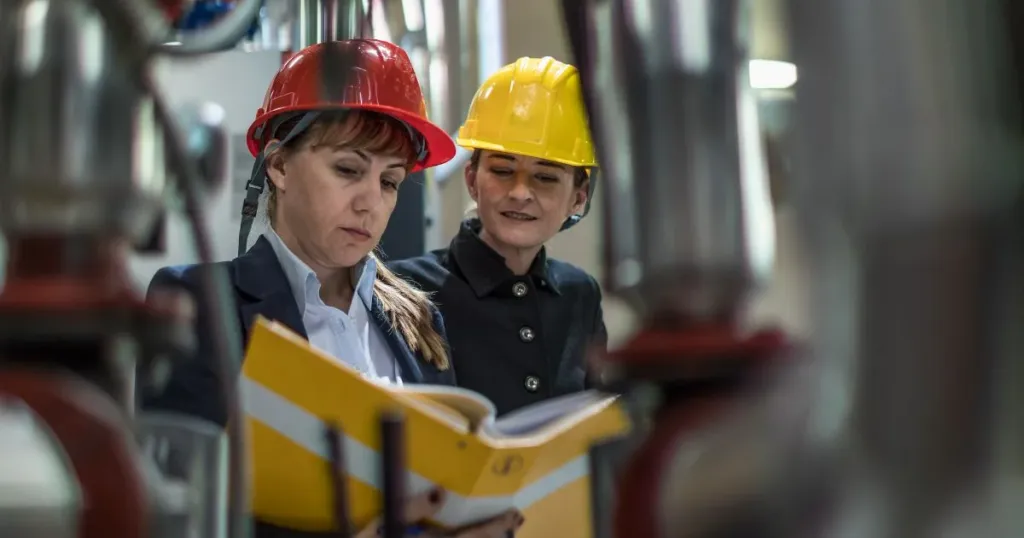
In the photo below, two professionals check a technical document among the piping of an industrial facility. Procedures, operating sequences and records like this one are part of the daily work, and they are the subject of the legal duties in the next section.
Professional duties in the Confea/CREA system (Brazil)
In Brazil, engineering is regulated by the Federal Council of Engineering and Agronomy (Confea) and the regional councils (CREA). Confea Resolution No. 235, of October 9, 1975, is still in force and is the one that defines the discipline. It assigns to the industrial engineer activities 01 to 18 of Article 1 of Confea Resolution No. 218, of June 29, 1973, "relating to procedures in industrial manufacturing, to methods and sequences of industrial production in general and to the industrialized product", as well as related and correlated services.
The 18 activities of Resolution 218 range from supervision, coordination and technical guidance to technical and economic feasibility studies, design, inspection, expert examination and technical reports, teaching and research, quality control, and the execution and oversight of technical services. What defines the discipline is not the list of activities, which is common to several engineering fields, but the field in which it applies: industrial manufacturing, production methods and sequences, and the industrialized product.
Once registered with the CREA, the industrial engineer issues the Technical Responsibility Annotation (ART) for services within these duties. The former "Mechanical Production Engineering", "Civil" or "Electrical" qualifications, granted under a different rule, are not the same as the full discipline; in those cases, the duties are recorded in each professional's CREA registration. Extending duties beyond one's training follows a specific Confea rule and is assessed case by case.
Degree program and curriculum
Two resolutions of Brazil's National Education Council (CNE) define the degree program. CNE/CES Resolution No. 2/2007 sets the minimum workload for bachelor's degrees and, for engineering, requires 3,600 hours completed over at least 5 years. CNE/CES Resolution No. 2/2019, which established the National Curriculum Guidelines (DCN) for Engineering and was amended by CNE/CES Resolution No. 1/2021, organizes training around competencies and requires a supervised internship of at least 160 hours and a final thesis project.
The program starts with the basic cycle common to all engineering fields: calculus, physics, chemistry, linear algebra, statistics, programming, technical drawing, transport phenomena and the materials courses, in which students learn the mechanical properties of materials and strength of materials. The professional cycle brings the courses specific to the discipline, and the program ends with the internship and the final thesis. The table shows a typical curriculum, built from programs on the market; each institution defines its own within the DCN, so it is not a normative list:
| Stage | Typical courses |
|---|---|
| Basic cycle | calculus, physics, chemistry, linear algebra, statistics, programming, technical drawing, materials science, strength of materials, transport phenomena |
| Professional cycle | production planning and control, operations research, engineering economics, costs, quality management and statistical process control, ergonomics, logistics, plant design, manufacturing processes, project management, product development, simulation |
| Integration | supervised internship (minimum of 160 h) and final thesis project |
The program is also offered as distance learning. What guarantees the degree and CREA registration is the program's authorization or recognition by Brazil's Ministry of Education (MEC), and the DCN apply equally to distance learning, including the internship and practical activities.
Job market and salary in Brazil
The most recent data with a known sample come from the Novo CAGED, the Brazilian Ministry of Labor's register of formal hirings and separations, compiled by the Salario.com.br portal for the occupation "industrial engineer" (CBO 2149-05). On the page updated on September 3, 2026, with data from August 2025 to July 2026, the average salary was R$ 11,392.68 and the median R$ 11,712, for an average workweek of 43 hours. The sample totals 8,831 records: 4,380 hirings and 4,451 separations, a net balance of 71 fewer jobs in the period. The published range goes from R$ 4,477.99 to R$ 16,951.01; the lowest value is described by the portal as an average floor and is below the legal minimum wage, so it does not serve as a reference for the profession's minimum salary.
The legal minimum comes from Law 4,950-A/1966, which sets the professional minimum salary for engineers formally employed in Brazil as a multiple of the national minimum wage. For a 6-hour workday, the minimum is 6 minimum wages. Hours beyond the sixth are paid with a 25% premium on the hourly rate, which brings the 8-hour workday to 8.5 minimum wages: 6 + 2 × 1.25 = 8.5.
In 2022, Brazil's Federal Supreme Court (STF) ruled on ADPFs 53, 149 and 171 and upheld the law, but prohibited automatic adjustment by the minimum wage, which the Brazilian Constitution forbids as an index. The calculation base was frozen at the minimum wage in force on March 3, 2022, the date the minutes of the ruling were published: R$ 1,212. On this base, the minimum is R$ 7,272 for 6 hours and R$ 10,302 for 8 hours, and since then it only increases through new legislation or collective bargaining. Some unions, such as SEESP, still publish values calculated with the 2026 minimum wage (R$ 1,621); these values do not follow the base frozen by the STF and are therefore not the enforceable minimum. The amendment that would have updated Law 4,950-A, proposed to Provisional Measure 1,334/2026, was rejected: the measure became Law 15,437/2026 without addressing the engineers' minimum salary (Brazilian National Congress, checked on September 30, 2026). The table brings the figures together:
| Indicator | Value | Condition and source |
|---|---|---|
| Average salary | R$ 11,392.68 | Aug 2025 to Jul 2026, 43 h/week; Novo CAGED via Salario.com.br (September 3, 2026) |
| Median salary | R$ 11,712 | same source and period |
| Records | 8,831 (net balance of −71) | 4,380 hirings and 4,451 separations |
| Legal minimum, 6 h/day | R$ 7,272 | 6 × R$ 1,212; Law 4,950-A/1966 and STF, ADPFs 53, 149 and 171 |
| Legal minimum, 8 h/day | R$ 10,302 | 8.5 × R$ 1,212; same base |
Salary varies more with the position than with years since graduation, because the same degree leads to very different roles: PPC (production planning and control) analyst, quality coordinator, operations manager, consultant. For a comparison with another industry-based career, the article on materials engineering gives an overview of that profession.
Production management tools
An industrial engineer's tools are methods that come with a metric. Each one answers a question about the production system and gives a number you can compare before and after a change. Five are used most. Lean, or lean manufacturing, eliminates waste and organizes flow around demand. Six Sigma reduces process variation. PPC, production planning and control, decides what to produce, how much and when. MRP, material requirements planning, calculates purchasing and manufacturing of components from the end-product plan. OEE, overall equipment effectiveness, measures how much of a machine's planned time became good parts. The table summarizes the origin, purpose and metric of each, and the subsections below show the calculations:
| Tool | Origin | What it is for | Typical metric |
|---|---|---|---|
| Lean (lean manufacturing) | Toyota Production System; term coined by Krafcik (1988), popularized by Womack, Jones and Roos (1990) | eliminate waste and produce to demand | takt time, lead time, work in process |
| Six Sigma | Motorola, 1986 | reduce variation through the DMAIC cycle | DPMO, sigma level, Cp and Cpk |
| PPC | scientific management (Taylor, Ford) | plan and control what to produce, how much and when | schedule adherence, on-time delivery |
| MRP (MRP II, ERP) | Orlicky, 1975 | calculate material requirements from the end product | net requirement, inventory coverage |
| OEE (TPM) | Nakajima, 1988; ISO 22400-2 | measure the effectiveness of a piece of equipment | OEE in % |
Lean and takt time
Lean starts from a simple question: at what rate does the customer consume? The answer is the takt time, the available time divided by demand. With 450 minutes available per day and a demand of 900 parts per day, takt is 450 / 900 = 0.5 min, or 30 s per part. If the slowest step on the line takes 34 s per part, the line cannot meet demand without a change: 450 min × 60 = 27,000 s, and 27,000 / 34 gives about 794 parts per day, against the 900 required. The options are to cut the time of that step, split it between two stations or increase the available time. Tools such as 5S (workplace organization), kanban (replenishment authorized by card, only after consumption) and SMED (quick changeover) all serve this rhythm.
Six Sigma and DPMO
Six Sigma measures quality in DPMO, defects per million opportunities: the number of defects divided by the product of units inspected and defect opportunities per unit, times 106. In a batch of 1,000 machined test specimens, with 5 characteristics checked on each (for example width, thickness, gauge length, fillet radius and surface roughness) and 17 defects found, DPMO = 17 / (1,000 × 5) × 106 = 3,400. The Six Sigma target is 3.4 DPMO, a value that assumes a long-term shift of 1.5 standard deviations in the process mean. The supplier in the example is a thousand times above it. The five characteristics are a teaching example and do not reproduce the list of any standard.
PPC and MRP
PPC turns the sales forecast into a production schedule, and MRP breaks that schedule down into purchase orders and manufacturing orders for each component. The core MRP calculation is the net requirement: gross requirement minus available inventory minus scheduled receipts, never below zero. With a gross requirement of 500 units, inventory of 120 and a scheduled receipt of 80, the net requirement is 500 − 120 − 80 = 300 units. If the minimum lot is 100 and the lead time is 2 weeks, the system releases 3 lots of 100 two weeks before the need date. MRP II added capacity and costs to this calculation, and ERP extended the same database to finance, sales and human resources.
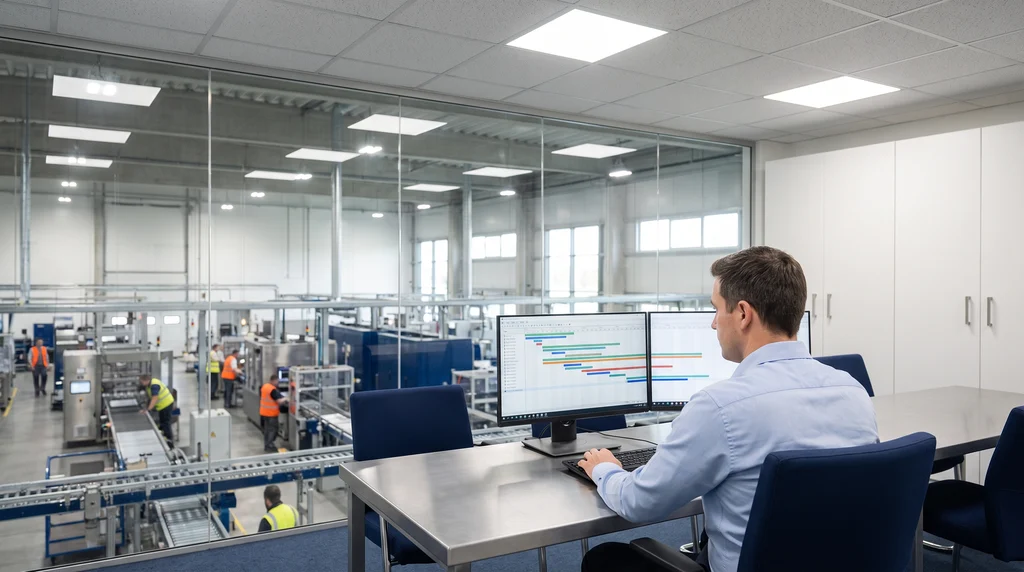
In the photo, an industrial engineer follows the plant schedule on a monitor, shown as time bars per production order, with the assembly line visible through the glass. This is PPC today: the schedule comes out of an MRP or ERP system and reaches the shop floor as a production order, and the line's progress reports go back to the system for control.
OEE: worked example
OEE was defined by Seiichi Nakajima within total productive maintenance (TPM, Introduction to TPM, 1988) and is one of the standardized indicators in ISO 22400-2. It multiplies three ratios. Availability is operating time divided by planned time and captures stops. Performance is ideal cycle time times parts produced, divided by operating time, and captures below-nominal speed and minor stops. Quality is the number of good parts divided by parts produced, and captures scrap and rework. Nakajima's six big losses fall into these ratios: equipment failure and setup under stops; minor stops and reduced speed under performance; process defects and startup losses under quality.
In the example, a planned 480 min shift had 60 min of downtime from setup and breakdown. The ideal cycle is 1.0 min per part, 350 parts were produced and 14 were scrapped. The calculations:
- Availability = (480 − 60) / 480 = 420 / 480 = 87.5%
- Performance = (1.0 × 350) / 420 = 83.3%
- Quality = (350 − 14) / 350 = 336 / 350 = 96.0%
- OEE = 0.875 × 0.8333 × 0.96 = 0.700, or 70%
The check is straightforward: the 336 good parts, at 1.0 min each, amount to 336 min, and 336 / 480 = 0.700. The chart below shows the same calculation as a waterfall: each orange bar is a loss, each blue bar is the time left, and the ratio between two blue bars is one of the three factors.
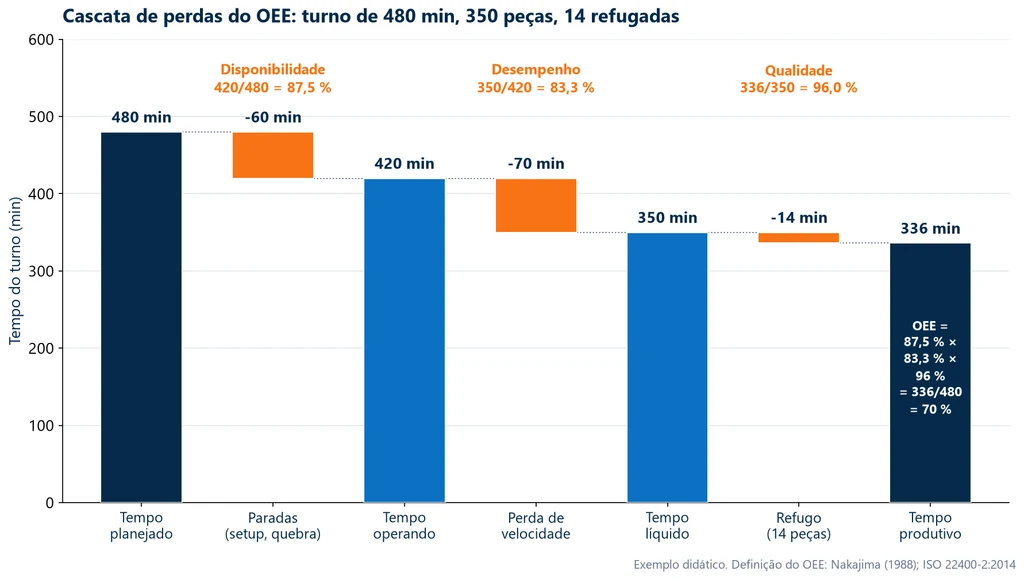
The waterfall also shows where to act: the largest loss in the example is speed loss (70 min), larger than stops (60 min). OEE is an indicator per piece of equipment or per work unit, not an overall plant efficiency; comparing the OEE of different processes, with ideal cycles defined in different ways, leads to wrong conclusions. Generic "world-class OEE" targets circulate among consultancies, but they do not come from any standard.
Quality and materials testing
It is in area 4 of ABEPRO (the Brazilian Association of Production Engineering), Quality Engineering, that the industrial engineer meets the laboratory. The "metrological organization of quality" subarea covers instrument calibration, verification of testing machines and measurement traceability, and the quality planning and control subarea covers incoming inspection and lot control. The content of this area has its own article, on quality engineering, and an overview of laboratory methods is in the article on materials testing; what matters here is the industrial engineer's role in that bridge.
That role has three parts. The first is deciding what to test and how often: an incoming tensile test for every lot of sheet metal, a compression test on packaging, a hardness check after heat treatment. The second is sizing the laboratory like any other resource in the production system: how many tests per shift, what force capacity, what cycle time, and even the OEE of the testing machine itself. The third is turning results into decisions: each lot's values feed statistical process control (SPC), whose control charts show when the supplier or the process has moved away from normal behavior. The competence of the laboratory issuing those results is covered by ISO/IEC 17025, and the company's quality management system by ISO 9001.
In the incoming inspection laboratory, the central piece of equipment is usually the universal testing machine (UTM), which performs tensile, compression, flexural and bend tests by changing grips and fixtures. Biopdi manufactures the M2 line, with single-column models from 200 N to 10 kN and dual-column models from 5 kN to 1,000 kN, and the testing and reporting software that records results by lot. For failure analysis and heat treatment control, sample preparation and observation use the cutting machine, the grinding and polishing machine and the metallurgical microscope. The mechanical tests themselves are covered in the mechanical testing hub.
Occupational safety and ergonomics
Area 8 of ABEPRO, Work Engineering, deals with workstation design, ergonomics and accident risk management. The industrial engineer takes part because safety is a property of the system: the layout, the sequence of operations and the pace set by takt define operator exposure as much as protective equipment does. For machinery and equipment in Brazil, the legal reference is NR-12 (the Brazilian regulatory standard for machinery safety), and the article on NR-12 for testing machines shows how it applies to the laboratory.
Standards and documents cited
The table lists the technical standards and legal acts cited in the article, with the edition checked on 09/30/2026. ISO 9001 received a new edition on 09/16/2026, replacing the 2015 edition with a 36-month transition period for certifications.
| Document | Subject | Edition |
|---|---|---|
| Confea Resolution No. 235 (Brazil's Federal Council of Engineering and Agronomy) | activities of the industrial (production) engineer | 1975 |
| Confea Resolution No. 218 | the 18 professional activities of the engineering disciplines | 1973 |
| Law 4.950-A (Brazil) | minimum professional salary for engineers | 1966 |
| CNE/CES Resolution No. 2 (Brazil's National Education Council) | minimum course load for bachelor's degrees | 2007 |
| CNE/CES Resolution No. 2 | National Curriculum Guidelines (DCN) for Engineering (amended by CNE/CES Res. No. 1/2021) | 2019 |
| ISO 22400-2 | key performance indicators for manufacturing operations management, including OEE | 2014 |
| ISO 9001 | quality management systems: requirements | 2026 |
| ISO/IEC 17025 | competence of testing and calibration laboratories | 2017 |
| NR-12 | occupational safety for machinery and equipment in Brazil | current text from the MTE (Brazil's Ministry of Labor and Employment) |
Other tests and technical references
Mechanical engineering: what it is, what mechanical engineers do, curriculum, professional duties and salary in Brazil
Mechanical engineering is the branch of engineering that designs, manufactures, tests and maintains machines, equipment, vehicles and thermal systems. In Brazil, the professional duties of a mechanical engineer are set out in Article 12 of CONFEA Resolution 218/1973 (CONFEA is Brazil's Federal Council of Engineering and Agronomy). The degree requires at least 3,600 hours over 5 years, and the legal minimum salary for a 6-hour workday is R$ 7,272.00 (Brazilian reais). See the fields of work, the curriculum, the role of mechanical testing in training and in industry, and salary data with a dated source.
Civil engineering: what it is, what civil engineers do, fields, salary and materials testing
Civil engineering is the branch of engineering that plans, designs, builds and maintains buildings and infrastructure, such as roads, bridges, dams, ports and sanitation. In Brazil, the duties of a civil engineer are set out in Article 7 of CONFEA Resolution 218/1973 (CONFEA is Brazil's Federal Council of Engineering and Agronomy), and practicing the profession requires registration with a CREA (Brazil's Regional Council of Engineering and Agronomy). See the fields, the degree program, salaries in Brazil with a dated source, the minimum wage for engineers under Brazilian Law 4,950-A/66, and the tests on concrete, steel, mortar and soils.
Quality engineering: what it is, tools (SPC, Cp/Cpk, FMEA, MSA), standards and career
Quality engineering is the field that uses statistics, metrology and testing to design, measure, control and improve processes so that products meet their specifications. See the tools (SPC, Cp/Cpk, MSA, FMEA, Ishikawa, Pareto, PDCA) with worked examples, the standards in force in 2026 (ISO 9001:2026, IATF 16949, ISO/IEC 17025, ISO 10012), testing machine calibration and the career outlook with dated figures.
Materials engineering: what it is, what materials engineers do, degree, legal duties and salary
Materials engineering relates processing, structure, properties and performance of metals, polymers, ceramics and composites to select, develop, manufacture and test the right material for each use. See what a materials engineer does, the professional duties defined by Confea (Brazil's Federal Council of Engineering and Agronomy), the degree curriculum, where to study in Brazil, salaries reported in Caged (Brazil's formal employment registry) and the Brazilian minimum engineering salary set by Law 4.950-A/66.
Frequently asked questions
What does an industrial engineer do?
Plans and controls production, defines methods and layout, sizes inventory and capacity, calculates costs and investments, and organizes quality and occupational safety, in both manufacturing and services. Under Confea Resolution 235/1975 (Brazil), the industrial (production) engineer works on industrial manufacturing procedures, production methods and sequences, and the manufactured product.
What are the areas of industrial engineering?
ABEPRO, the Brazilian Association of Production Engineering, defines 10 areas with 58 subareas: Production Operations and Processes, Supply Chain, Operations Research, Quality, Product, Organizational, Economic, Work, Sustainability, and Production Engineering Education.
How much does an industrial engineer earn in Brazil?
In Brazil's Novo CAGED (the formal employment registry) from August 2025 to July 2026, the average was R$ 11,392.68 and the median R$ 11,712 (Brazilian reais), for a 43-hour week and 8,831 hiring records (Salario.com.br, 09/03/2026). The legal minimum under Law 4.950-A, with the base frozen by Brazil's Supreme Federal Court (STF) at R$ 1,212, is R$ 7,272 for 6 hours and R$ 10,302 for 8 hours per day.
Is industrial engineering a hard degree?
The basic cycle is the same as in other engineering degrees, with calculus, physics, chemistry and strength of materials. After that the weight shifts to statistics, optimization, costs and management. The difficulty changes in nature, but it does not go away.
How long is an industrial engineering degree in Brazil?
At least 5 years and 3,600 hours (CNE/CES Resolution 2/2007), with a supervised internship of at least 160 hours and a final thesis project (CNE/CES Resolution 2/2019).
Is an online (distance learning) industrial engineering degree recognized in Brazil?
Yes, if the program is authorized or recognized by the MEC (Brazil's Ministry of Education), which allows registration with the CREA (the regional engineering council). The curriculum guidelines apply equally to distance learning, including internship and practical activities.
What are the 3 best engineering degrees?
There is no official ranking of the best or the hardest engineering degree. The useful comparison is by salary recorded in CAGED, by field of work and by affinity with the content. Industrial engineering stands out for the breadth of sectors in which it works.
Can an industrial engineer sign an ART in Brazil?
Yes. With CREA registration, the engineer issues an ART (Technical Responsibility Annotation) for services within the attributions of Confea Resolution 235/1975, which refers to activities 01 to 18 of Resolution 218/1973 applied to industrial manufacturing.
What is the difference between industrial engineering and mechanical engineering?
Mechanical engineering designs machines and components. Industrial engineering designs and manages the production system in which those machines work: people, materials, methods, inventory and costs.
What is OEE and how is it calculated?
It is overall equipment effectiveness: availability × performance × quality (Nakajima, 1988; ISO 22400-2). In a 480 min shift with 60 min of downtime, 350 parts at a 1.0 min ideal cycle and 14 scrapped, OEE is 87.5% × 83.3% × 96% = 70%.
Where does materials testing fit in industrial engineering?
In the Quality Engineering area: incoming raw material testing, lot control and metrology. The tensile or compression results for each lot feed the statistical process control charts.