
NR-12 is the Regulatory Standard (Norma Regulamentadora) issued by Brazil's Ministry of Labor and Employment (MTE) that sets the minimum safety requirements for designing, manufacturing, selling and using machinery and equipment in Brazil. The universal testing machine falls within its scope: it is not listed in any of the exclusions in item 12.1.4, and it has typical machine hazards, such as crushing between the crosshead and the table, fragments ejected when the test specimen fractures, and the energy stored in the assembly.
The current text is the revision made by Portaria SEPRT nº 916 (an ordinance of July 30, 2019), last amended by Portaria MTE nº 344 of March 21, 2024, according to the official NR-12 page on gov.br (the Brazilian government portal) consulted on 09/30/2026. In one sentence: the manufacturer must deliver the machine safe and documented, and the employer must assess the risks of use, maintain the guards and the emergency stop, record maintenance and train whoever operates the machine. This article is not legal advice: bringing each machine into compliance is the employer's responsibility and requires a risk assessment (the analysis of the machine's hazards in actual use) carried out by a legally qualified professional.
What NR-12 is and which text is in force
NR-12 regulates articles 184 to 186 of the CLT (Brazil's Consolidated Labor Laws), as worded by Law nº 6.514/1977. It was issued by Portaria MTb nº 3.214 of June 8, 1978, fully revised in 2010 and restructured in 2019, when it gained cut-off dates for new and used machines and began to accept harmonized European type-C standards in the absence of a Brazilian or international standard.
After 2019 only specific adjustments followed. The official PDF is named "nr-12-atualizada-2025", but its list of amendments ends with Portaria MTE nº 344/2024, and the search on 09/30/2026 found no ordinance from 2025 or 2026. The table summarizes the main acts:
| Act | Publication in the DOU (Brazil's Official Gazette) | What it did |
|---|---|---|
| Portaria MTb nº 3.214/1978 | 07/06/1978 | Creates NR-12 |
| Portaria SIT nº 197/2010 | 12/24/2010 | Complete revision (numbering with items 12.38 onward) |
| Portaria SEPRT nº 916/2019 | 07/31/2019 | Last substantial amendment: new structure and new numbering (12.5.1 onward) |
| Portaria MTP nº 428/2021 | 10/08/2021 | Adds item 1.6 to Annex III (means of access) |
| Portaria MTP nº 806/2022 | 04/19/2022 | Amends item 12.10.2 (additional risks, reference to NR-09) |
| Portaria MTP nº 4.219/2022 | 12/22/2022 | Item 12.11.2.1: the CIPA becomes the Internal Commission for Accident and Harassment Prevention |
| Portaria MTE nº 344/2024 | 03/22/2024 | Latest amendment: changes the glossary (Annex IV) |
The official document also lists Portarias SEPRT nº 8.560/2021 and MTE nº 224/2024. To cite the standard in a procedure or report, use the consolidated text on gov.br.
Old and new numbering: item 12.38 became 12.5.1
Many references still use the 2010 numbering, which ran in a simple sequence. In 2019 the standard was divided into sections and the items were renumbered. In most cases the content was kept, with wording adjustments. The former item 12.38, which required in danger zones "safety systems, characterized by fixed guards, movable guards and interlocked safety devices", is now item 12.5.1, which replaces "guarantee" with "safeguard" health protection. Items 12.39 and 12.40, however, changed in content: 12.39 replaced "risk analysis" with "risk assessment", now requires installation that makes defeating the system difficult, instead of preventing it from being neutralized or defeated, and only requires monitoring when the assessment indicates it; 12.40, which required manual reset according to the category, became 12.5.3, in which manual reset depends on the risk assessment. The correspondence of the core items:
| 2010 text | Current text | Content |
|---|---|---|
| 12.38 | 12.5.1 | Danger zones with fixed guards, movable guards and interlocked safety devices |
| 12.39 | 12.5.2 | Requirements for safety systems (category, technical lead, monitoring) |
| 12.40 | 12.5.3 | Manual reset of safety systems, now required if the risk assessment indicates it |
Who NR-12 applies to
Item 12.1.1 states that the standard applies "in the design and use phases of machinery and equipment, and also to their manufacture, import, sale, exhibition and transfer on any basis, in all economic activities". The use phase goes beyond operation: under item 12.1.1.1 it includes transport, assembly, installation, adjustment, cleaning, maintenance, inspection, decommissioning and dismantling. On a testing machine, this covers changing grips and calibration.
Item 12.1.2 extends the requirements to new and used machines, except where the item itself makes a distinction. The exceptions are few. Under item 12.1.3, machines demonstrably intended for export are exempt from the technical requirements. Under item 12.1.4, NR-12 does not apply:
- to machines moved or driven by human or animal power;
- to machines displayed in museums, fairs and events, for historical purposes or as antiques, that are no longer used for production, provided the physical integrity of visitors and exhibitors is protected;
- to household appliances;
- to static equipment (but machines installed on it remain subject to the standard, under 12.1.4.1);
- to electrically operated portable and transportable tools that meet the applicable type-C technical standard;
- to machines certified by INMETRO (Brazil's National Institute of Metrology, Quality and Technology), provided all technical construction requirements related to safety are met.
The universal testing machine is motor-driven, has moving parts and falls into none of these categories. It is therefore subject to NR-12, as are testing presses and the other motorized machines in the laboratory.
The standard binds those who use the machine and also those who manufacture, import, sell or rent it; the split is covered in the section on responsibilities. The weight of the subject shows in official data: according to the Occupational Safety and Health Observatory (SmartLab, run by Brazil's Labor Prosecution Office, MPT, with the ILO), Brazil recorded 8.8 million occupational accidents and 32 thousand deaths in formal employment from 2012 to 2024, and the operation of machinery and equipment accounted for 13.6% of the accidents.
Risk assessment: the starting point
NR-12 does not provide a closed list of devices for each machine. Item 12.1.9 requires taking into account the characteristics of the machine, the process, "the risk assessment and the state of the art", and item 12.5.2, subitem a, requires safety systems to have a category "according to the risk assessment provided for in the official technical standards". The risk assessment is the document that justifies each guard chosen, and the reference method is that of ISO 12100 (ABNT NBR ISO 12100 in Brazil), in four steps:
- Determine the limits of the machine: intended use, reasonably foreseeable misuse, space occupied and life cycle phases. On a testing machine: force range, accessories and materials that will be broken.
- Identify the hazards: every source of harm, in every task.
- Estimate the risk: combine the severity of the harm with the probability of it occurring.
- Evaluate the risk: decide whether the estimated risk has been sufficiently reduced or whether action is needed.
When action is needed, ISO 12100 sets an order for risk reduction: first inherently safe design, then guards and complementary protective measures and, last, information for use. The flowchart below shows the complete cycle and why it repeats: a new guard can create a new hazard, such as a crushing point on the door itself, and this must be analyzed again.
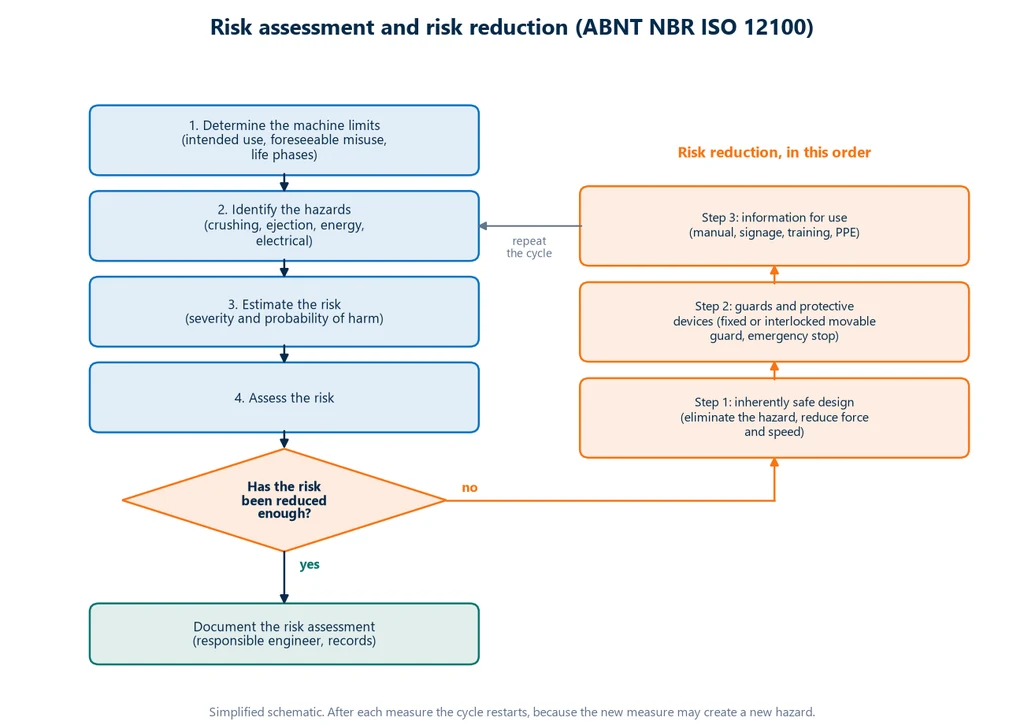
NR-12 has a similar order. Item 12.1.8 requires adopting protective measures in this priority: collective, then administrative or work organization measures and, last, individual measures. Physical guarding of the test zone comes before the written procedure, and the procedure comes before safety glasses; under item 12.14.1.1, a procedure complements, but does not replace, collective protection.
The photo illustrates the last step of this scale: a hard hat and PPE icons (gloves, hearing protection, face shield and protective clothing), which in the testing laboratory complement the machine's guards but never take their place.

The hazards of a universal testing machine
In hazard identification, the testing machine differs from a production machine: it breaks the material on purpose, and the operator puts their hands into the test zone for every test specimen. The typical hazards:
- Crushing and pinching: between the moving crosshead and the table, the base or the compression and flexural fixture, and in the wedge or pneumatic grips when clamping the test specimen.
- Fragments ejected at fracture: brittle test specimens, such as concrete, ceramics, cast iron and composites, shatter; steel wires and cables whip; the specimen can slip out of the grip. Item 12.5.10 requires guards on machines that present a risk of their parts breaking or of materials and particles being ejected.
- Stored energy: the elastic energy accumulated in the test specimen and the load train, the compressed air of pneumatic grips and, in hydraulic equipment such as the electric hydraulic press, the pressurized fluid, covered by item 12.7 (pressurized components).
- Electrical hazard: control panel, motor and drive, covered by item 12.3 and by NR-10 (the Brazilian standard for electrical safety).
- Additional risks under item 12.10: hot surfaces of a furnace or environmental chamber coupled to the test, and noise at fracture.
- Unexpected start-up: item 12.4.2 requires that the machine not start on its own when energized.
In the tensile test the greatest risk is usually the sudden fracture of high-strength metal and cables; in the compression test of concrete and ceramics, shattering.
How much energy the test specimen stores
The energy released at fracture gives the measure of the ejection hazard. While the material is in the elastic range, Hooke's law applies: the elongation is δ = F·L / (E·A), and the stored energy is the area under the force × elongation line, U = ½·F·δ = F²·L / (2·E·A). This is the same elastic strain energy that defines the resilience of materials.
Exercise 1: energy in the steel bar. A bar of 4140 steel, quenched and tempered at 205 °C, with a yield strength of about 1,600 to 1,700 MPa, has a diameter of 10 mm and a gauge length of 200 mm, with E = 200 GPa.
- Area: A = π·d²/4 = π × 10²/4 = 78.54 mm² = 7.854 × 10⁻⁵ m².
- With F = 40 kN, the stress is σ = 40,000 / 78.54 = 509 MPa, well below yield: the linear calculation holds.
- Elongation: δ = 40,000 × 0.200 / (200 × 10⁹ × 7.854 × 10⁻⁵) = 5.09 × 10⁻⁴ m = 0.51 mm.
- Energy: U = 0.5 × 40,000 × 5.09 × 10⁻⁴ ≈ 10.2 J, in the gauge length alone.
- Taken to 1,500 MPa, still elastic, the force rises to 117.8 kN and the energy to U = σ²·V / (2E) = (1.5 × 10⁹)² × 1.571 × 10⁻⁵ / (4 × 10¹¹) ≈ 88 J.
Energy grows with the square of the force: with almost three times the load (117.8 kN versus 40 kN), the energy became about 8.7 times greater. Grips, pins and the frame also store energy. The calculation is illustrative and does not describe any particular machine.
Exercise 2: velocity of a fragment. Suppose 10% of the 10.2 J, about 1.0 J, goes into a 5 g fragment. The velocity is v = √(2·U / m) = √(2 × 1.0 / 0.005) = √400 = 20 m/s, or 72 km/h. The assumption is for teaching purposes, but it shows why safety glasses alone are not enough and why the priority in item 12.1.8 is collective protection. In brittle materials, fracture releases almost all the energy at once, as explained in the article on toughness.
Safety systems, category and PL
Once the hazards are identified, item 12.5.1 requires the danger zones to have safety systems made up of fixed guards, movable guards and interlocked safety devices. Item 12.5.2 states how these systems must be selected and installed:
- a) have a safety category according to the risk assessment set out in the official technical standards;
- b) be under the technical responsibility of a legally qualified professional;
- c) be technically compatible with the control system they are integrated into;
- d) be installed so as to make tampering (defeating) difficult;
- e) have automatic monitoring, if the risk assessment calls for it, according to the required category (except purely mechanical devices);
- f) stop hazardous movements and other risks when there is a failure or abnormal situation.
If the assessment calls for it, the system must require a manual reset, keeping the machine stopped until a safe condition exists (12.5.3). The machine must remain in a safe state when the power fluctuates, fails or returns (12.5.5). Guards and safety systems are an integral part of the machine and cannot be treated as optional (12.5.16), and, depending on the risk, a diagram of these systems may be required, in Portuguese, prepared by a legally qualified professional (12.5.17).
Category and PL: the link with ABNT NBR ISO 13849
NR-12 refers to a "safety category" but does not specify which one. Under item 12.1.11, machines built in accordance with ISO 13849 (NBR ISO 13849 in Brazil), parts 1 and 2, are considered compliant with the NR regarding the safety-related parts of control systems. This standard works with two quantities that are often confused:
- Category (B, 1, 2, 3 and 4): describes the architecture of the safety circuit and how it behaves when a fault occurs. In category 3, for example, a single fault does not lead to loss of the safety function. It is the same classification used in ABNT NBR 14153 (the Brazilian standard on safety-related parts of control systems).
- PL, performance level (a, b, c, d and e): combines the category with the reliability of the components (MTTFd, the mean time to dangerous failure) and the diagnostic coverage (DC, the fraction of failures the circuit detects). PL "a" is the lowest and "e" the highest.
For each safety function, such as "stop the crosshead when the test zone is accessed", the design first defines the required PL (PLr) and then selects the architecture and components that achieve it. The PLr comes from the risk graph in Annex A of ISO 13849-1, which combines three parameters: severity of injury (S), frequency or duration of exposure (F) and possibility of avoiding the hazard (P). The diagram below shows the tree from the 2015 edition, mirrored in ABNT NBR ISO 13849-1:2019 (ISO published the 4th international edition in 2023).
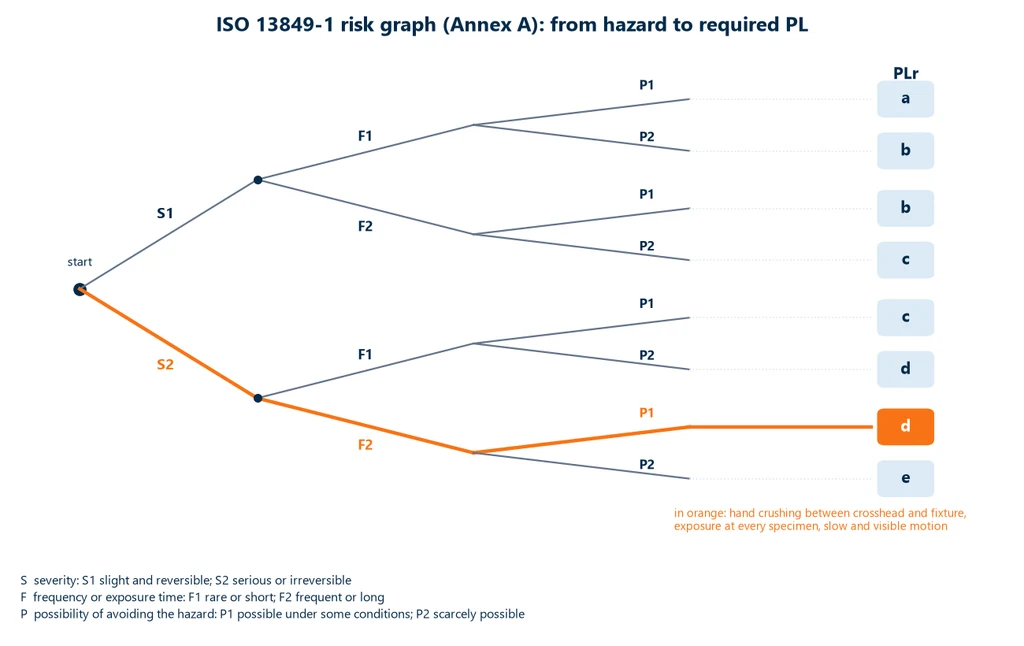
Exercise 3: required PL for hand crushing. The hazard is trapping the fingers between the crosshead and the compression fixture while mounting the test specimen.
- Severity S2: a crushed finger can result in an irreversible injury.
- Frequency F2: the operator puts a hand in the zone for every specimen, several times per shift.
- Possibility of avoidance P1: with the crosshead moving slowly and visibly, it is possible to withdraw the hand under certain conditions. If there is a fast approach movement, P2 applies.
From the graph, S2, F2 and P1 lead to PLr d; S2, F2 and P2 lead to PLr e. The function "stop the crosshead when the zone is accessed" therefore tends toward PLr d or e. The actual result depends on the risk assessment of each machine, signed by a legally qualified professional.
Fixed and movable guards in the test zone
Item 12.5.4 defines a guard as the physical barrier used to provide safety and distinguishes two types. A fixed guard stays in a permanent position or is held by fasteners that can only be removed with a tool. A movable guard opens without a tool and must be associated with an interlocking device, the component that prevents hazardous operation while the guard is open.
The selection criterion is in item 12.5.6: the guard must be movable when access to the danger zone is needed more than once per shift. If the opening does not allow the zone to be reached before the hazard ends, interlocking alone is enough (subitem a). If it does, the interlocking must include guard locking, which keeps the guard locked until the movement stops (subitem b). Under item 12.5.7, the machine only operates with the guard closed, stops if it opens and does not restart just because it has been closed.
In the test zone, the guard must also contain anything ejected: item 12.5.11 requires materials suitable for containing parts and particles, secure fastening and no new crushing points.
Exercise 4: fixed or movable guard? On a tensile testing machine, the operator changes the test specimen 30 times per shift. Since access exceeds once per shift, the test zone guard must be movable and interlocked (12.5.6). If, on opening, the operator can reach the zone before the crosshead stops, the interlocking needs guard locking. Fixed guards are reserved for zones that are rarely accessed.
Emergency stop, controls and limit switches
Item 12.6.1 requires the machine to have one or more emergency stop devices, which cannot be used to start it (12.6.1.1). The standard only waives this device on self-propelled machines and where it does not reduce the risk (12.6.1.2), which is not the case for a testing machine. The main requirements are:
- be in an easily accessible location, visible to the operator and to other people, and always unobstructed (12.6.2);
- be a complementary measure, not a substitute for guards or automatic safety systems (12.6.3 b);
- override all other controls and stop the hazardous process in the shortest technically possible time, without creating new hazards (12.6.3 d and e);
- work in any operating mode (12.6.3 f);
- stay latched after being actuated and be released only by an intentional manual action (12.6.5 and 12.6.5.1);
- require a manual reset, carried out only after the cause of the actuation has been corrected (12.6.8).
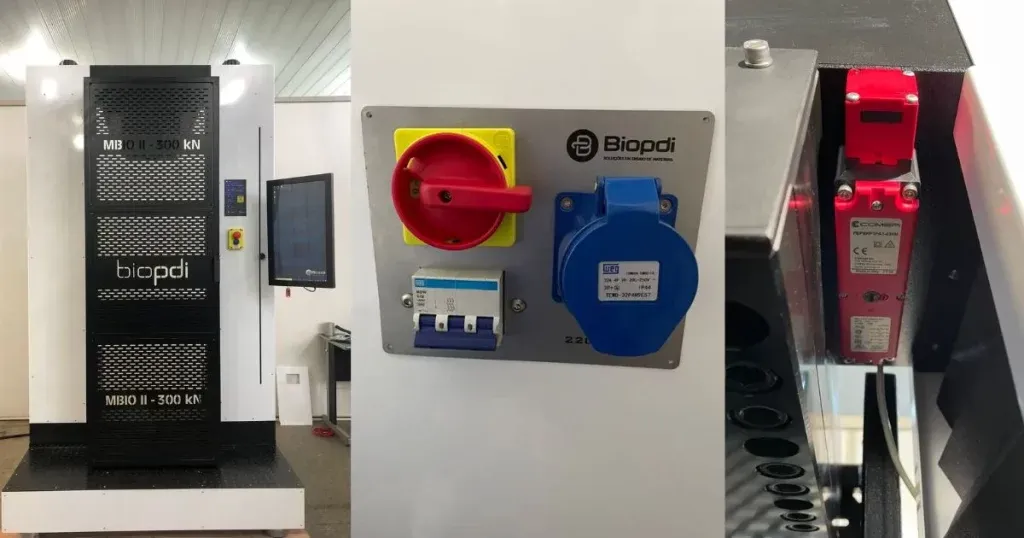
The design principles of the emergency stop function are given in ISO 13850 (ABNT NBR ISO 13850 in Brazil). The electrical side has one more rule that often comes up in inspections: the main switch cannot be used as a start and stop device (12.3.8 a). In the photo, a 300 kN Biopdi universal testing machine shows the two elements kept separate: on the left, the emergency stop button on the column panel, within the operator's reach; in the center, the power supply plate with the main switch, circuit breaker and industrial socket; on the right, an internal detail of the machine.
Start and motion controls follow item 12.4.1: they are located outside the danger zone, can be switched off in an emergency by another person, prevent unintended actuation and make tampering difficult. The limit switch restricts crosshead travel and protects the machine, the accessory and the operator; whether or not it is a safety function is decided by the risk assessment. Software limits, such as the maximum load cell force and maximum displacement, are complementary: they do not replace a physical barrier or the emergency stop.
Exercise 5: how far the crosshead travels after the stop command. In a test at 10 mm/min, the speed is 10 / 60 = 0.167 mm/s. With a hypothetical stopping time of 0.2 s, the crosshead travels s = v·t = 0.167 × 0.2 = 0.033 mm. On fast return at 500 mm/min, the speed is 8.33 mm/s and the travel rises to 1.7 mm. The conclusion is that the approach and return movement, not the slow test itself, calls for more attention to crushing. The speed and time values are hypothetical.
Manual, signage, maintenance and training
NR-12 does not stop at the machine: it requires documentation and a routine of use.
Manual (12.13). The manufacturer or importer supplies the manual (12.13.1), in Brazilian Portuguese, clearly written, with safety warnings highlighted and available at the workplace (12.13.2). For machines manufactured or imported from June 24, 2012 until the 2019 text came into force, item 12.13.4 sets 16 minimum contents, including the standards used in the design, the diagrams of the safety functions, the hazards and the maintenance intervals; for later machines, the manual follows the applicable technical standards (12.13.3). A lost manual is reconstructed by the employer, under the responsibility of a qualified or legally qualified professional (12.13.5).
Signage (12.12). Warnings are in Portuguese and state the hazard and the part of the machine, without using just the word "danger" (12.12.4.1). Machines manufactured from December 24, 2011 onward carry an indelible nameplate with the manufacturer's details, model, capacity, serial number, year, registration with CREA (the Brazilian regional engineering council) and weight (12.12.7).
Maintenance (12.11). It follows the manufacturer's intervals (12.11.1) and is recorded with seven items of data: interventions, date, service performed, parts, safety conditions, conclusion on the safety of the machine and person responsible (12.11.2), available to workers, to the CIPA (the internal accident prevention committee), to the SESMT (the company's occupational safety and health service) and to labor inspectors (12.11.2.1). Work is done with the machine stopped and the energy sources isolated, locked out and tagged (12.11.3). The operator also performs a routine inspection at the start of the shift and after any new machine setup, such as a grip change (12.14.2); the standard does not require this inspection to be recorded (12.14.2.1).
Training (12.16). Anyone who operates, maintains or inspects the machine is trained by the employer (12.16.2) before taking on the role, at no cost, during working hours, with a minimum workload defined by the employer, content from Annex II and supervision by a legally qualified professional (12.16.3). Records are kept available to labor inspectors (12.16.5), and refresher training is given when changes create new hazards (12.16.8). The table summarizes the four routines:
| Topic | What NR-12 requires | Items |
|---|---|---|
| Manual | In Portuguese, with safety functions and hazards, available on site | 12.13.1 to 12.13.5 |
| Signage | Warnings in Portuguese and identification nameplate | 12.12.1 to 12.12.7 |
| Maintenance | Manufacturer's intervals, record with 7 items of data, energy lockout | 12.11.1 to 12.11.3 |
| Training | Before taking the role, during working hours, Annex II content, records | 12.16.2 to 12.16.8 |
Old machine and new machine: bringing into compliance
An old testing machine is not exempt: item 12.1.2 applies the standard to used machines. What changes is the technical reference. Under item 12.1.9.2, it is not mandatory to follow requirements of technical standards published after the date the machine was manufactured, imported or brought into compliance, provided that it meets NR-12 as published by SIT Ordinance No. 197/2010, with its annexes and amendments, and the technical standards in force at the time.
Machines manufactured after SIT Ordinance No. 197/2010 must have an inherently safe design in all phases (12.15.1). While awaiting compliance work, the machine can be kept segregated, locked out and signposted (12.1.6).
There are two paths. A retrofit adds an interlocked guard, emergency stop, new controls and documentation, based on the risk assessment and with an ART (the Brazilian Technical Responsibility Note) issued by a legally qualified professional. Replacement makes sense when compliance work costs close to a new machine or the old controls cannot accommodate the safety functions.
Who is responsible for what
NR-12 assigns obligations by party, and none transfers another's: the manufacturer is responsible for the design and the manual, and whoever uses the machine is responsible for installation, use, maintenance and people. The table brings the items together:
| Who | Obligation | Items |
|---|---|---|
| Manufacturer and importer | Design for inherent safety, supply the manual, not sell machines that do not comply with the NR | 12.15.1, 12.13.1, 12.15.2 |
| Employer | Adopt protective measures, train, maintain and record maintenance | 12.1.7, 12.16.2, 12.11 |
| Legally qualified professional | Take responsibility for the safety systems and supervise training | 12.5.2 b, 12.16.3 e |
| Worker | Follow procedures, not alter guards, report failures | 12.1.10 |
An "NR-12 report" (laudo NR-12) is not a document provided for in the standard: the NR requires the risk assessment, technical responsibility for the safety systems and the maintenance and training records, and the report is how the market usually brings these elements together.
What to ask the manufacturer when buying
Since item 12.15.2 prohibits selling a machine that does not comply with NR-12, the purchase is the time to check the documentation. For the technical specification, ask for:
- a manual in Brazilian Portuguese, with the diagrams of the safety functions, residual risks, emergency procedures and maintenance intervals;
- a list of the technical standards used in the design and of the safety devices included, with any optional ones identified;
- the position and operation of the emergency stop and the limit switch;
- how the machine behaves on power loss and on loss of communication with the computer;
- an identification nameplate with the data of item 12.12.7;
- inspection and maintenance recommendations, to start the record required by item 12.11.2 from day one.
What the Biopdi M2 line declares
Biopdi manufactures the M2 line of universal testing machines, which complies with NR-10 (the Brazilian electrical safety regulation) and NR-12. The safety features declared by the manufacturer are:
- emergency stop button on the panel;
- mechanical limit switch and electronic limit switch via digital scale (optional);
- automatic stop on loss of communication;
- the BioLab software, with user levels and usage history.
These features enter the buyer's risk assessment as part of what the machine already provides. Making the workstation compliant remains the employer's responsibility: installation, the accessories used, the materials tested, training and recorded maintenance. To specify a machine for your laboratory, request a quote.
NR-12 checklist for the testing laboratory
The table turns the points in this article into a checklist and adds three installation items that complete the review: marked walkways (12.2.1), a stable, anchored machine (12.2.6) and a closed, labeled and grounded electrical panel (12.3.2 and 12.3.5). Use it for periodic internal checks. It does not replace the risk assessment:
| Check | NR-12 item |
|---|---|
| Risk assessment carried out and signed by a legally qualified professional | 12.1.9, 12.5.2 a and b |
| Test area guarded, with a movable interlocked guard if it is accessed more than once per shift | 12.5.1, 12.5.6, 12.5.7 |
| Guard able to contain fragments ejected at fracture | 12.5.10, 12.5.11 b |
| Emergency stop visible, accessible, latching and with manual reset | 12.6.2, 12.6.5, 12.6.8 |
| Machine does not start by itself when powered on | 12.4.2 |
| Main switch not used to start and stop the test | 12.3.8 a |
| Electrical panel closed, labeled and grounded | 12.3.2, 12.3.5 |
| Walkways around the machine marked and kept clear | 12.2.1 |
| Machine stable and anchored according to the manufacturer | 12.2.6 |
| Hazard signs in Portuguese and identification plate | 12.12.4, 12.12.7 |
| Manual in Portuguese available at the workplace | 12.13.2 |
| Maintenance recorded with the 7 required data items | 12.11.2 |
| Lockout and tagout of energy sources during maintenance | 12.11.3 |
| Routine inspection at the start of the shift and after a new machine setup, with no mandatory record | 12.14.2, 12.14.2.1 |
| Operators trained, with training records available | 12.16.3, 12.16.5 |
Technical standards for machinery safety
In several items, NR-12 (the Brazilian regulatory standard on machinery safety) refers to "official technical standards". The machinery safety standards most often used when bringing a testing machine into compliance are listed below, with their status checked on September 30, 2026 (ISO catalog, and the Target catalog for the ABNT standards):
| Standard | Scope | Edition |
|---|---|---|
| ABNT NBR ISO 12100 | General principles for design, risk assessment and risk reduction | 2013 |
| ISO 12100 | Same, international version | 2010 (confirmed in 2022, revision under way) |
| ABNT NBR ISO 13849-1 and ABNT NBR ISO 13849-2 | Safety-related parts of control systems: design (PL) and validation | 2019 |
| ISO 13849-1 | Same, part 1, international version | 2023 (4th edition) |
| ISO 13849-2 | Same, part 2 (validation), international version | 2012 |
| ABNT NBR 14153 | Classification into safety categories (B, 1, 2, 3 and 4) | 2022 |
| ABNT NBR ISO 13850 | Emergency stop function: principles for design | 2021 |
| ISO 13850 | Same, international version | 2015 (confirmed in 2020) |
| NR-10 | Safety in electrical installations and services (Brazilian regulatory standard) | current text from Brazil's Ministry of Labor and Employment (MTE) |
ABNT NBR ISO 7500-1:2023 (the Brazilian adoption of ISO 7500-1), which covers the verification and calibration of the force-measuring system of testing machines, often appears alongside these standards, but it is a metrology standard: it ensures that the measured force is correct, not that the machine is safe. Always check the current edition in the ABNT catalog before citing a standard in a purchase specification.
Other tests and technical references
Universal testing machine: what it is, how it works and types
Universal testing machine (UTM): what it is, how it works, electromechanical and hydraulic types, tests, standards, calibration and how to choose.
Universal testing machine calibration: ISO 7500-1, classes, interval and certificate
Universal testing machine calibration per ISO 7500-1:2023: traceable standard, 3 series from 20 to 100%, classes 0.5 to 3, 12 months, certificate.
Tensile tester: types, specifications and how to choose
How to choose a tensile tester: types, capacity, load cell, ISO 7500-1 class, grips, extensometer, cost and a quote checklist.
Load cell: what it is, how it works, types, accuracy class and the load cell of a testing machine
A load cell is the sensor that converts force into an electrical signal, typically 2 mV/V. How it works, types, 4- and 6-wire wiring and ISO 7500-1 class.
Frequently asked questions
Does a universal testing machine have to comply with NR-12?
Yes. NR-12 applies to new and used machines (item 12.1.2), and the universal testing machine is not among the exclusions in item 12.1.4. Its typical hazards, such as crushing between the crosshead and the table, fragments ejected at fracture and stored energy, fall within the scope of the standard.
What does NR-12 require of machines?
Safety systems in the danger zones (12.5), emergency stop (12.6), safe controls (12.4), a safe electrical installation (12.3), signage (12.12), a manual in Portuguese (12.13), recorded maintenance (12.11) and trained operators (12.16). The measures follow the order of priority in item 12.1.8: collective protection first, then administrative measures and, last, personal protection.
What does item 12.38 of NR-12 say?
In the 2010 text (Ordinance SIT No. 197), item 12.38 required the danger zones of machines to have safety systems made up of fixed guards, movable guards and interconnected safety devices. With Ordinance SEPRT No. 916/2019, this content moved to item 12.5.1, which is the current numbering.
What does item 12.5.1 of NR-12 establish?
That the danger zones of machines and equipment must have safety systems, consisting of fixed guards, movable guards and interconnected safety devices, that protect the health and physical integrity of workers. The next item, 12.5.2, details the requirements for these systems, such as the category defined by the risk assessment and the technical responsibility of a legally qualified professional.
Which types of machines and equipment are not covered by NR-12?
Under item 12.1.4: machines driven by human or animal power, machines displayed in museums, fairs and events as historical pieces, provided that visitors and exhibitors are protected, household appliances, static equipment, portable electric tools that meet the type-C standard, and machines certified by INMETRO (Brazil's national metrology and certification institute) that meet the safety requirements. Machines proven to be intended for export are exempt from the technical requirements (12.1.3).
Who is NR12 mandatory for?
For the employer that uses machines and equipment, in any economic activity (12.1.1 and 12.1.7), and also for anyone who manufactures, imports, sells, rents, auctions, lends or displays machines, which cannot be placed on the market if they do not comply with the standard (12.15.2). Workers have their own duties, such as not altering the guards (12.1.10).
Did NR-12 change in 2025 or 2026?
As of September 30, 2026, no 2025 or 2026 ordinance amending NR-12 was found. The last substantial amendment is Ordinance SEPRT No. 916/2019, and the last change recorded on gov.br is Ordinance MTE No. 344 of March 21, 2024, which amended the glossary.
What category or PL does a testing machine need?
NR-12 does not set a value: the category comes from the risk assessment (12.5.2 a), under the responsibility of a legally qualified professional. Using the risk graph in ISO 13849-1, crushing with irreversible injury and frequent exposure, such as a hand near the crosshead for every test specimen, usually leads to PLr d or e.
Is the emergency stop button enough to comply with NR-12?
No. Item 12.6.3, subitem b, states that the emergency stop is a complementary measure and cannot replace guards or automatic safety systems. It must also stay latched after being actuated and require a manual reset (12.6.5 and 12.6.8).
My testing machine is old. Do I need to replace it?
Not necessarily. NR-12 applies to used machines, but a machine does not have to follow technical standards published after it was manufactured if it complies with the 2010 NR-12 and with the standards in force at the time (12.1.9.2). The way forward is the risk assessment and, depending on the result, either an upgrade backed by an ART (the Brazilian record of technical responsibility) or replacement.
What should I ask the manufacturer for when buying?
A manual in Portuguese with the diagrams of the safety functions, the residual risks and the maintenance intervals; the list of standards and safety devices, with optional items identified; a description of the emergency stop, the limit switches and the behavior on power loss; and the identification plate required by item 12.12.7. Selling a machine that does not comply with the NR is prohibited (12.15.2).