
Civil engineering is the branch of engineering that plans, designs, builds and maintains buildings and infrastructure such as roads, bridges, dams, ports, and water and sewage systems. In Brazil, the duties of a civil engineer are set out in Article 7 of CONFEA Resolution No. 218/1973 (CONFEA is Brazil's Federal Council of Engineering and Agronomy), and practicing the profession requires registration with a CREA (Regional Council of Engineering and Agronomy).
The civil engineer designs the structure, sizes the foundation, prepares the cost estimate, builds and inspects the work, and is technically responsible for it. Civil engineers also use testing to confirm that the concrete, steel and soil have the properties the design calculations assumed. This article covers the profession in Brazil (definition, legal duties, fields, degree program, job market and minimum salary) and gives a full section to materials testing in civil engineering, with the ABNT standards (Brazilian Association of Technical Standards) and worked calculation examples.
In the photo, an engineer holds the drawings. Every project starts with the design, and Brazilian law requires a qualified professional to sign it.

What is civil engineering
The word "civil" separates this field from military engineering. Until the 18th century, engineers mainly built fortifications, bridges and roads for armies. The Englishman John Smeaton, who built the Eddystone Lighthouse, was the first to call himself a civil engineer, to show that he worked on public works. While researching for that lighthouse in 1756, he studied limes that harden under water, known as hydraulic limes. Portland cement came later, patented by Joseph Aspdin in 1824, and it is the basis of the reinforced concrete used today.
Engineering education in Brazil began in the military. It became separate in 1874, when Decree No. 5.600 created the Polytechnic School of Rio de Janeiro, which began training civil engineers outside the Army. Today the profession in Brazil is regulated by Law 5.194/1966, which created the CONFEA/CREA system, and CONFEA resolutions define the activities of each engineering discipline.
Civil engineering therefore deals with fixed works: buildings, roads, bridges, dams, ports, water and sewer networks, canals and tunnels. It shares its method with the other engineering fields: start from the loads, choose materials by their measured properties, and size each member with a safety margin.
What a civil engineer does: CONFEA duties and the ART
CONFEA Resolution No. 218 of June 29, 1973 remains in force. Resolution 1.156/2025 revoked only Articles 8 and 9 (checked on CONFEA's regulations portal on September 30, 2026). Article 1 lists 18 professional activities. Article 7 gives civil engineers all of these activities when they relate to buildings; roads, runways and airports; transportation, water supply and sanitation systems; ports, rivers, canals, dams and dikes; drainage and irrigation; bridges and large structures; and related services.
The 18 activities run from concept to maintenance. The table groups them by the project stage where they occur:
| Stage | Activities in Article 1 | Civil engineering example |
|---|---|---|
| Concept | study, planning, design, specification and technical-economic feasibility | structural design of a building, route study for a highway |
| Consulting | technical assistance, advisory services, consulting, inspection, expert examination, appraisal, technical report and opinion | report on cracking, property appraisal, court-appointed expert examination |
| Cost and quality | cost estimating, standardization, measurement and quality control | project cost estimate, concrete quality control testing |
| Construction | management, execution and inspection of works and services, team supervision | resident engineer, inspector on a public contract |
| Operation | operation, maintenance, repair, installation and assembly | bridge maintenance, operation of a treatment plant |
| Teaching and research | teaching, research, analysis, experimentation, testing and technical outreach | materials testing laboratory, university teaching |
Every construction project or technical service in Brazil requires an ART (Anotação de Responsabilidade Técnica, the technical responsibility record), created by Law 6.496/1977. The ART is registered with the CREA before the work begins and names the professional responsible for the design, the construction or the technical report. It gives the engineer's signature legal standing and lets the CREA check that a qualified professional is in charge.
In the photo below, a team discusses a project around a table. On a large project, different professionals handle the structural design, the foundation design, the building services design and the cost estimate, and each one registers their own ART.

Fields of civil engineering
There is no official list of fields. The division that universities use, and that matches Article 7, has five major fields: structures, geotechnics, transportation, hydraulics and sanitation, and construction and project management. Construction materials and quality control testing often appear as a sixth field because they cut across all the others.
Structures
The structural engineer designs slabs, beams, columns and foundations so the structure can safely carry its loads without excessive deformation. The work covers reinforced and prestressed concrete (ABNT NBR 6118, the Brazilian standard for the design of concrete structures), steel, timber, structural masonry, bridges and large structures. Design calculations use the design properties of the materials, such as the characteristic compressive strength of concrete (fck) and the yield strength of steel (fyk). The section on testing explains how these properties are measured.
Geotechnics
Geotechnics studies soil and rock both as a support and as a construction material. It covers foundation design, slope stability, retaining structures, embankments and earth dams, tunnels and settlement prediction. The field relies on site investigation (borings) and laboratory testing to determine the strength and compressibility of each soil layer.
The photo shows an engineer in front of an earthworks site with off-highway trucks. Cut, fill and compaction are where geotechnics meets transportation engineering.

Transportation
Transportation covers highways, railways, airports, urban streets and ports. The engineer defines the alignment, road drainage and pavement structure, and sizes the base and subbase layers from the bearing capacity of the subgrade, measured by the CBR test. For asphalt mixtures, mix design and quality control use the Marshall test.
Hydraulics and sanitation
This field designs and operates water supply systems, sewage collection and treatment, urban drainage, canals, dams and irrigation works. It combines hydraulics, hydrology, and water and wastewater treatment, and it is where civil engineering overlaps most with environmental engineering.
Construction and project management
This is the field of the people who build: planning and scheduling, cost estimating, procurement, occupational safety, quality and handover. It includes building information modeling (BIM), which brings design, quantities and schedule together in a single model. Two other activities that Article 1 assigns to civil engineers also belong here: expert examination and property appraisal, with reports prepared according to ABNT standards, and design for lower environmental impact.
Materials and quality control testing
Quality control testing confirms that the material delivered to the site is the material specified in the design. It is carried out by contractors' in-house laboratories, independent laboratories and universities, and it is the direct link between civil engineering and testing machines. The materials testing section later in this article covers each test in detail.
What the civil engineering degree is like
In Brazil, the undergraduate degree usually takes five years, or ten semesters. The content follows the National Curriculum Guidelines for Engineering (Resolution CNE/CES No. 2 of April 24, 2019), which define the graduate profile and require a supervised internship of at least 160 hours. The guidelines refer to Resolution CNE/CES No. 2/2007 for the total workload, which sets 3,600 hours for engineering programs. Each institution builds its own curriculum within these limits, so the actual number of hours varies from school to school.
A typical curriculum starts with the basic sciences and moves toward the design courses. The table summarizes the most common sequence:
| Stage | Typical courses | Link to testing |
|---|---|---|
| Years 1 and 2 | calculus, physics, chemistry, linear algebra, technical drawing, CAD, statistics, statics | statistics is the basis of fck |
| Years 2 and 3 | strength of materials, construction materials, surveying, hydraulics, soil mechanics | concrete, steel and soil laboratories |
| Years 3 and 4 | structural analysis, reinforced concrete, steel and timber structures, foundations, highway engineering, sanitation | design properties of materials |
| Year 5 | building construction, planning and cost estimating, law and ethics, internship, capstone project | quality control testing on site |
Construction materials and soil mechanics are the courses that bring students into the laboratory. There they cast and break concrete specimens, test steel bars and characterize soils. The mechanical properties of materials covered in these classes later become input data in the structures and foundations courses.
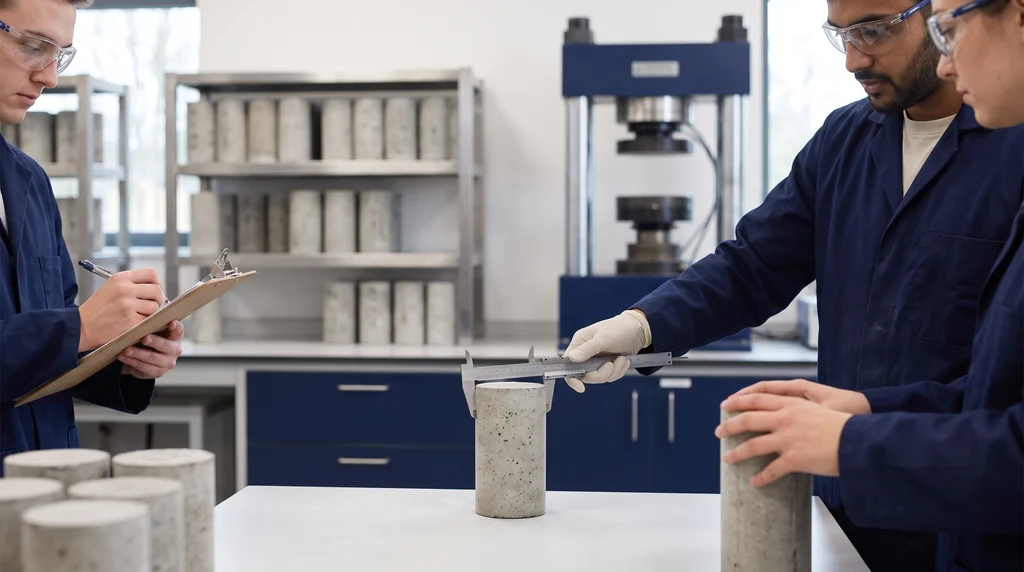
Distance-learning programs authorized by MEC (Brazil's Ministry of Education) also exist. Under the guidelines, the internship and practical activities, including laboratory work, are still mandatory, and part of the workload is in person. In the photo, civil engineering students use a caliper to measure the diameter of a cylindrical concrete specimen, with the compression testing machine in the background. The materials laboratory is where the degree connects calculations to measured strength.
After graduating, a civil engineer in Brazil can sign designs and construction only after registering with the CREA of the state where they work. The image below shows a graduate in front of a blackboard full of calculations, the moment when the degree ends and technical responsibility begins.

Job market and civil engineer salary in Brazil
Civil engineers work for contractors and real estate developers, design firms, quality control testing laboratories, highway, railway and sanitation concessionaires, government agencies, expert examination and appraisal firms, and the construction materials industry. Employment follows the construction cycle and infrastructure investment, so it fluctuates more than in other engineering fields.
Average salary, with source
The most complete market data comes from Novo CAGED, a database of Brazil's Ministry of Labor that records hires and separations in formal employment. The website Salario.com.br compiles these records by occupation in the CBO (Brazilian Classification of Occupations). For civil engineers (CBO 214205), the average is R$ 9,808.94 (Brazilian reais) per month for a 42-hour work week, based on 25,932 records from August 2025 to July 2026 (page updated on September 3, 2026 and checked on September 30, 2026). The average varies considerably by specialty:
| Occupation (CBO) | Average monthly salary |
|---|---|
| Civil engineer (ports and waterways) | R$ 14,472.82 |
| Civil engineer (foundations) | R$ 13,934.20 |
| Civil engineer (bridges and viaducts) | R$ 12,423.01 |
| Civil engineer (highways) | R$ 11,368.28 |
| Civil engineer, general | R$ 9,808.94 |
| Civil engineer (buildings) | R$ 8,152.14 |
These figures are averages for formal employment contracts under the CLT (Brazil's labor code). They leave out engineers who work as contractors through their own company, freelancers and tenured civil servants, and they do not include benefits or profit sharing.
Minimum salary: Law 4.950-A/66 and the Supreme Court ruling
Brazilian Law 4.950-A/1966 sets the professional minimum salary for engineers with a degree of four years or more at 6 minimum wages for a 6-hour workday. The law does not set a figure for 8 hours: hours beyond 6 are paid with a 25% premium. Since 6 minimum wages for 6 hours equals 1 minimum wage per daily hour, the two extra hours are worth 2 × 1.25 = 2.5 minimum wages, and the 8-hour workday totals 8.5 minimum wages.
In 2022, Brazil's Supreme Federal Court (STF), in ADPFs 53, 149 and 171, upheld the law but prohibited the minimum salary from following future increases in the national minimum wage. It froze the calculation base at the value in force on March 3, 2022, the date the ruling's minutes were published: R$ 1,212. The minimum salary therefore became R$ 7,272 for 6 hours (6 × 1,212) and R$ 10,302 for 8 hours (8.5 × 1,212). The Superior Labor Court (TST) reaffirmed this reference in July 2024, according to Conjur (July 10, 2024). Any increase above these values depends on collective bargaining agreements.
The profession disputes the freeze. With the 2026 minimum wage (R$ 1,621, Decree 12.797/2025), the formula in the law would give R$ 9,726 for 6 hours, and unions publicize this figure along with R$ 14,589 for 8 hours (9 minimum wages). An amendment to Provisional Measure 1.334/2026 proposed setting R$ 9,726 in law, with annual adjustment by the INPC (a Brazilian consumer price index), but the joint committee rejected it. The provisional measure became Law 15.437 of June 18, 2026, which covers only the minimum salary for teachers (National Congress, checked on September 30, 2026). The value recognized by the STF, the frozen one, therefore still applies.
Materials testing in civil engineering
Structural design starts from design values: the concrete has an fck of 30 MPa, the steel yields at 500 MPa, the soil can carry a certain bearing pressure. Materials testing is what confirms, on the job site, that these values are real. For concrete, quality control is done by breaking test specimens cast from the material in each truck; for steel, by testing bars from each lot; for soil, by testing samples from each layer. The table summarizes the most common tests and the standard for each (ABNT NBR standards are the Brazilian national standards):
| Material | Test and standard | What it measures | Equipment |
|---|---|---|---|
| Concrete | axial compression test, ABNT NBR 5739:2018 | fc of each specimen and fck of the lot | compression testing machine or universal testing machine |
| Concrete | splitting tensile test, ABNT NBR 7222:2011 | indirect tensile strength, fct,sp | compression testing machine or universal testing machine |
| Concrete | flexural tensile test, ABNT NBR 12142:2010 | fct,f, used for concrete pavements | universal testing machine with flexural fixture |
| CA-50 steel | tensile test, ABNT NBR ISO 6892-1:2024, with the requirements of ABNT NBR 7480:2024 | fy, fst and elongation | universal testing machine |
| CA-50 steel | bend test, ABNT NBR 7480:2024 | no cracking after a 180° bend | universal testing machine with bend fixture |
| Mortar | flexural and compression tests, ABNT NBR 13279:2005 | Rf and Rc | universal testing machine |
| Soil | CBR, consolidation, triaxial, direct shear | bearing capacity, settlement and shear strength | soil testing presses |
Concrete: compression, splitting tensile and flexural tests
The test that approves the concrete is the axial compression test per ABNT NBR 5739:2018 (the Brazilian standard for concrete compression testing, equivalent to ASTM C39). The 10 × 20 cm or 15 × 30 cm cylinders are cast on site per NBR 5738, cured and broken, usually at 7 and 28 days. The force increases continuously, at 0.45 ± 0.15 MPa/s, until failure, and the strength is the maximum force divided by the area: fc = 4F / (πD²). Under NBR 12655, the results of the specimens in a lot are treated statistically to estimate the fck, the strength exceeded by 95% of the concrete. The full procedure, the failure types and the fck calculation are in the article on the compression test.
Example. A 100 × 200 mm cylinder fails at 235.6 kN. The area is π × 100² / 4 = 7,854 mm², and fc = 235,600 N / 7,854 mm² = 30.0 MPa. This is the result for one specimen; the fck comes from the full set of specimens.
Concrete is weak in tension, at about one tenth of its compressive strength, which is why it needs reinforcement. This strength is measured indirectly. In the splitting tensile test (ABNT NBR 7222:2011, reaffirmed in 2024, equivalent to ASTM C496), the cylinder is laid on its side between the platens, and the load along two opposite generatrices opens a crack in the diametral plane: fct,sp = 2F / (π·d·L). A 100 × 200 mm cylinder that fails at 100 kN has fct,sp = 200,000 / (π × 100 × 200) = 3.18 MPa. In the flexural tensile test (ABNT NBR 12142:2010, equivalent to ASTM C78), a 150 × 150 × 500 mm prism receives two loads at the third points of a 450 mm span, and with failure in the middle third fct,f = F·ℓ / (b·d²). This is the value used in concrete pavement design; the procedure is in the article on the flexural test.
Structural design also needs the stiffness of the concrete, which governs deflections and displacements. It is estimated per NBR 6118 from the fck or measured in a test per NBR 8522-1, as explained in the article on the modulus of elasticity of concrete.
CA-50 steel: tensile and bend tests
Reinforcing bar (rebar) for reinforced concrete in Brazil is specified by ABNT NBR 7480:2024, which defines the grades CA-25, CA-50 and CA-60 by their characteristic yield strength. For CA-50, fyk ≥ 500 MPa. The number 50 comes from the old unit, kgf/mm²: it does not mean 50 MPa. NBR 7480 is a requirements standard; the tensile test method is that of ISO 6892-1 (ABNT NBR ISO 6892-1:2024 in Brazil), performed on the full bar, unmachined, in a universal testing machine.
The test gives three CA-50 requirements: yield strength of at least 500 MPa, a tensile-to-yield ratio fst/fy of at least 1.10, and elongation after fracture of at least 8% over 10 diameters (or total elongation at maximum force of 5%). The fst/fy ratio ensures the bar still gains strength after yielding, and the elongation ensures ductility: the structure gives warning, by deforming, before it fails. The test, the reading of the yield point and the curve are covered in the articles on the tensile test and the stress-strain curve.
Example. What yield force must a 16 mm CA-50 bar reach? The nominal area is π × 16² / 4 = 201.1 mm², and Fy,min = 500 × 201.1 = 100,500 N, or 100.5 kN. With fst ≥ 1.10 fy, the maximum force must exceed 110.6 kN. Since real steel yields above the minimum and typically fails near 600 MPa, a 16 mm bar reaches about 121 kN.
The second acceptance test is the bend test: the bar is bent 180° around a mandrel of 3 diameters (bars under 20 mm) or 6 diameters (20 mm or more) and must not crack. It checks whether the bar can withstand being bent on site, as explained in the article on the bend test.
Mortar: flexural and compression tests
Masonry and rendering mortar is tested per ABNT NBR 13279:2005 (the Brazilian standard for mortar flexural and compressive strength). The 4 × 4 × 16 cm prisms are first broken in flexure, with a load at the center of a 100 mm span: Rf = 1.5·Ff·L / 40³. The two remaining halves go to the compression test, with a loaded area of 40 × 40 mm: Rc = Fc / 1,600. A half-prism that fails at 12.8 kN has Rc = 12,800 / 1,600 = 8.0 MPa. The forces are small, a few kilonewtons in flexure and tens of kilonewtons in compression.
Soils: CBR, consolidation, triaxial and direct shear tests
In geotechnical and pavement engineering, each test answers a different question about the soil:
- CBR (California Bearing Ratio, ABNT NBR 9895): measures the bearing capacity and swelling of compacted soil, to design the pavement layers. Details in the article on the CBR test; the equipment is the CBR/Marshall test press.
- Consolidation, or oedometer test (ABNT NBR 16853, which replaced NBR 12007): measures the compressibility of the soil and makes it possible to predict the settlement of a foundation over time. The CBR test does not measure settlement; this test does. See the consolidation test and the consolidation apparatus.
- Triaxial: tests the confined specimen, with control of drainage and pore water pressure, and gives the strength parameters for foundations, slopes and dams. See the triaxial test and the triaxial testing system.
- Direct shear: forces the soil to fail along a defined plane and measures cohesion and friction angle, used in the stability analysis of slopes and retaining walls. See the direct shear test and the direct shear apparatus.
The video below shows Biopdi's dynamic triaxial testing system, the most complete equipment on the list: it tests the soil specimen confined in the cell and applies repeated loads, like those of traffic on a pavement. The other equipment is in our soil testing line.
Equipment for the civil engineering laboratory
Choosing the machine starts with the highest force the test will require. A 10 × 20 cm concrete cylinder at 30 MPa fails at about 236 kN; a 16 mm CA-50 bar at about 121 kN; a 25 mm bar at about 295 kN; and a 32 mm bar at about 483 kN. Biopdi manufactures for this laboratory:
- M2 line universal testing machine: tensile testing of rebar, compression testing of concrete and mortar, flexural and bend testing on the same machine, by changing the fixtures. The 100 to 200 kN model handles rebar up to about 20 mm; the 1,000 kN model covers concrete cylinders and bars from 10 to 32 mm. How it works in general is explained in the article on the universal testing machine.
- Electric and hydraulic concrete compression testing machine for compression tests.
- Soil testing presses: CBR/Marshall, consolidation, triaxial and direct shear.
Under NBR 5739, the concrete testing machine is calibrated per ISO 7500-1 (ABNT NBR ISO 7500-1 in Brazil) at most every 12 months, and the failure load must fall within the calibrated range.
Standards and legislation cited
ABNT standards (Brazilian standards) are sold through the ABNT catalog and are not linked here. Editions were checked on September 30, 2026:
| Standard or law | Subject | Edition |
|---|---|---|
| ABNT NBR 5739 | concrete, compression testing of cylindrical specimens | 2018 |
| ABNT NBR 7222 | concrete and mortar, splitting tensile strength | 2011, reaffirmed in 2024 |
| ABNT NBR 12142 | concrete, flexural tensile strength of prisms | 2010 |
| ABNT NBR 7480 | steel for reinforced concrete, requirements | 2024 (equivalent to the 2022 edition corrected with Amendment 1) |
| ABNT NBR ISO 6892-1 | metallic materials, tensile testing at room temperature | 2024 |
| ISO 6892-1 | international source standard of NBR ISO 6892-1 | 2019 |
| ABNT NBR 13279 | mortar, flexural and compressive strength | 2005 |
| ABNT NBR ISO 7500-1 | force calibration of tension and compression testing machines | 2023 |
| ISO 7500-1 | international source standard of NBR ISO 7500-1 | 2018 |
| CONFEA Resolution 218 | professional duties in Brazil (art. 7: civil engineer) | 1973, arts. 8 and 9 revoked in 2025 |
| Law 5.194 | regulates the engineering profession in Brazil and creates the CONFEA/CREA System | 1966 |
| Law 6.496 | Technical Responsibility Record (ART) | 1977 |
| Law 4.950-A | professional minimum salary in Brazil | 1966, base frozen by the Brazilian Supreme Court (STF) in 2022 |
| CNE/CES Resolution 2 | Brazilian curriculum guidelines for engineering | 2019 |
For soils, the article cites ABNT NBR 9895 (CBR) and ABNT NBR 16853 (consolidation) without the year; the editions are given in the article on each test.
Civil engineering, architecture and other engineering fields
In Brazil, architects and urban planners are registered with the CAU, created by Law 12.378/2010, and civil engineers with the CREA. Both work on buildings, but with different focuses: the architect handles the design of space, comfort and urban planning; the civil engineer handles the structure, foundations, building services and infrastructure works such as roads, bridges, dams and sanitation.
Among the engineering fields, civil engineering deals with fixed works. Mechanical engineering deals with machines, equipment and thermal systems, and materials engineering develops and characterizes the materials themselves. All three meet in the testing laboratory, where the same tensile test serves the rebar, the machine part and the new material.
Other tests and technical references
Mechanical engineering: what it is, what mechanical engineers do, curriculum, professional duties and salary in Brazil
Mechanical engineering is the branch of engineering that designs, manufactures, tests and maintains machines, equipment, vehicles and thermal systems. In Brazil, the professional duties of a mechanical engineer are set out in Article 12 of CONFEA Resolution 218/1973 (CONFEA is Brazil's Federal Council of Engineering and Agronomy). The degree requires at least 3,600 hours over 5 years, and the legal minimum salary for a 6-hour workday is R$ 7,272.00 (Brazilian reais). See the fields of work, the curriculum, the role of mechanical testing in training and in industry, and salary data with a dated source.
Industrial engineering: what it is, the 10 ABEPRO areas, professional duties, salary in Brazil and tools
Industrial engineering (engenharia de produção in Brazil) is the engineering that designs, implements, operates and improves integrated production systems for goods and services, according to ABEPRO (the Brazilian Association of Production Engineering). See the 10 areas and 58 subareas defined by ABEPRO, the professional duties set by Confea Resolution 235/1975 (Brazil's Federal Council of Engineering), the course curriculum, the salary in Brazil according to Novo CAGED (the Brazilian formal employment registry) and the minimum wage under Brazilian Law 4.950-A, and the Lean, Six Sigma, PPC, MRP and OEE tools with worked examples.
Quality engineering: what it is, tools (SPC, Cp/Cpk, FMEA, MSA), standards and career
Quality engineering is the field that uses statistics, metrology and testing to design, measure, control and improve processes so that products meet their specifications. See the tools (SPC, Cp/Cpk, MSA, FMEA, Ishikawa, Pareto, PDCA) with worked examples, the standards in force in 2026 (ISO 9001:2026, IATF 16949, ISO/IEC 17025, ISO 10012), testing machine calibration and the career outlook with dated figures.
Materials engineering: what it is, what materials engineers do, degree, legal duties and salary
Materials engineering relates processing, structure, properties and performance of metals, polymers, ceramics and composites to select, develop, manufacture and test the right material for each use. See what a materials engineer does, the professional duties defined by Confea (Brazil's Federal Council of Engineering and Agronomy), the degree curriculum, where to study in Brazil, salaries reported in Caged (Brazil's formal employment registry) and the Brazilian minimum engineering salary set by Law 4.950-A/66.
Frequently asked questions
What does a civil engineer do?
Designs, calculates, estimates costs for, builds and inspects buildings and infrastructure works such as roads, bridges, dams, ports and sanitation, and takes technical responsibility for them (in Brazil, through the ART record). Civil engineers also carry out forensic inspections, technical reports and quality control of materials through testing. In Brazil, the legal duties are set out in art. 7 of CONFEA Resolution 218/1973.
What are the 5 areas of civil engineering?
The five most often cited are structures, geotechnics, transportation, hydraulics and sanitation, and building construction with construction management. Construction materials and quality control are often treated as a sixth area, because they cut across all the others.
What is a civil engineer's salary?
In Brazil, the average for formally employed civil engineers is R$ 9,808.94 (Brazilian reais) per month, for 42 hours a week, according to Novo CAGED data from August 2025 to July 2026 compiled by Salario.com.br (updated September 3, 2026). Specialties such as ports, foundations and bridges are above R$ 12,000; building construction is close to R$ 8,200.
What is the minimum salary for a civil engineer?
In Brazil, Law 4.950-A/1966 sets 6 minimum wages for 6 hours a day, and hours beyond 6 carry a 25% premium, which gives 8.5 minimum wages for 8 hours. The Brazilian Supreme Court (STF) froze the base at the minimum wage of March 3, 2022 (R$ 1,212), resulting in R$ 7,272 for 6 hours and R$ 10,302 for 8 hours. A 2026 amendment that would have raised the floor to R$ 9,726 (6 hours) was rejected in Congress, and the frozen value still applies.
How long is a civil engineering degree?
In Brazil, usually five years, or ten semesters. The national guidelines require a supervised internship of at least 160 hours, and the minimum total workload for engineering programs is 3,600 hours.
Is civil engineering a good choice?
It depends on the profile. In Brazil, the average salary exceeds R$ 9,000 and the field is broad, from design to construction, forensic work and laboratory. On the other hand, employment follows the construction and infrastructure investment cycle, and the profession requires CREA registration and personal technical responsibility for what one signs.
Is there distance learning for civil engineering?
Yes, in Brazil there are distance-learning programs authorized by the Ministry of Education (MEC). The supervised internship and practical activities, including materials and soil laboratory work, remain mandatory under the curriculum guidelines.
What is the difference between an architect and a civil engineer?
In Brazil, the architect is registered with the CAU and focuses on the design of space and on urban planning. The civil engineer is registered with the CREA and handles structures, foundations, building services and infrastructure works such as roads, bridges and sanitation. On buildings, the two work together.
Where can a civil engineer work?
In construction and real estate development companies, design offices, quality control laboratories, highway and sanitation concessionaires, government agencies, forensic and appraisal firms, and the construction materials industry.
Which materials tests does a civil engineer use?
For concrete, axial compression (NBR 5739), splitting tensile (NBR 7222) and flexural tensile (NBR 12142) tests. For CA-50 steel, tensile (NBR ISO 6892-1) and bend tests, with the requirements of NBR 7480. For mortar, flexural and compression tests (NBR 13279). For soils, CBR, consolidation, triaxial and direct shear tests.
What does CA-50 mean?
It is the Brazilian grade of steel for reinforced concrete with a characteristic yield strength of at least 500 MPa, per ABNT NBR 7480:2024. The 50 comes from the old unit, 50 kgf/mm²; it does not mean 50 MPa.