
Carburizing is the thermochemical treatment that enriches the surface of a low-carbon steel with carbon. The part is heated into the austenite field, usually between 900 and 930 °C, in contact with a carbon-rich medium, and is then quenched and tempered. The result is a hard surface, 58 to 62 HRC on 8620 steel, over a core that remains tough. The enriched case ranges from a few tenths of a millimeter to about 2 mm and grows with the square root of time: at 925 °C, the total case depth is about 0.63·√t mm, with t in hours (Harris formula).
This article follows the order of the process: what carburizing does and how it differs from quenching, the types of carburizing, how to calculate time and case depth, the steels used, the quenching and tempering that follow, case depth measurement, defects and, at the end, worked examples.
What carburizing is and what it is used for
A gear tooth needs a hard surface that resists wear and contact fatigue, and a body that withstands impact and bending without cracking. A quenched high-carbon steel becomes hard but brittle; a low-carbon steel is tough but soft. Carburizing resolves the conflict by changing the composition of the surface only: the part is made from a steel with 0.10 to 0.25% carbon, and the furnace adds carbon to an outer layer up to about 0.8%.
Carbon enters by diffusion. Above the critical temperature the steel becomes austenite, the face-centered cubic phase that dissolves far more carbon than ferrite, and the small carbon atoms migrate through the spaces between the iron atoms, from the surface toward the interior. That is why carburizing requires high temperature: the general range is 850 to 1,000 °C (MacKenzie, Gear Solutions, 2017), and the usual range is 900 to 930 °C.
After quenching, the carbon-rich case turns into high-carbon martensite, which is very hard, and the core, which still has about 0.2% carbon, forms low-carbon martensite, bainite or ferrite with pearlite, depending on the steel and the section size. The surface is also left in compression, because high-carbon martensite occupies more volume, which helps fatigue strength. Typical applications are gears, ring gears and pinions, shafts, pins, bushings and cams. The Portuguese name, "cementação", comes from "cemento", the carbonaceous medium of pack carburizing, and has nothing to do with construction cement; in English the process is called carburizing.
Carburizing is one of the thermochemical treatments, the family that changes the composition of the surface. An overview of all the processes, thermal and thermochemical, is in heat treatment of metals, and the concept of hardness and its scales in hardness.
Carburizing vs. quenching: what is the difference
Carburizing changes the chemical composition of the surface: it adds carbon. Quenching changes the microstructure: it transforms austenite into martensite through rapid cooling. In a carburized part, both happen in sequence. Carburized and cooled slowly, the part stays soft, with ferrite and pearlite at the surface; only the quenching that follows produces the hard surface.
The practical difference shows up in steel selection. Quenching a medium-carbon steel such as 1045 hardens the part with the same carbon content from core to surface, as far as hardenability allows. Carburizing starts from a low-carbon steel and creates the gradient: a surface with tool-steel carbon content and a core with structural-steel carbon content. When uniform hardness is enough, quenching and tempering a medium-carbon steel does the job; when the part needs a hard surface and a tough core, carburizing comes before quenching. The quenching cycle, with austenitizing and quenching media, is covered in the article on quenching of steel.
Types of carburizing
The processes differ in the medium that supplies the carbon, and this determines how well the surface carbon content can be controlled, how uniform the case is, and what can be done right afterwards, such as direct quenching.
Gas carburizing
This is the most widely used process in industry. The part sits in a furnace with an endothermic gas atmosphere (CO, H2 and N2) enriched with natural gas or propane. The atmosphere's ability to transfer carbon is called the carbon potential, the content the surface would reach at equilibrium, and it is controlled by an oxygen probe, dew point or CO2 analysis. The usual target is about 0.8% C at the surface: above 0.65% the gain in hardness is small (MacKenzie, 2017), and too much carbon leads to defects. This control allows two-stage cycles, with a high potential to enrich and a lower one to diffuse, and direct quenching as the part leaves the furnace. The weak point is the residual oxygen in the atmosphere, which oxidizes the grain boundaries just below the surface: this is intergranular oxidation, covered in the defects section.
Pack carburizing (solid carburizing)
The parts are packed in a steel box with charcoal and an energizer, usually a carbonate, and the box goes into the furnace sealed. The carbonate releases CO2, which reacts with the charcoal to form the CO that transfers carbon to the steel. It is the simplest and cheapest process, good for one-off parts and toolrooms, but the carbon potential is not controlled, the box is slow to heat up and the case is less uniform. Even so, it can meet a specification: Fertig and Pimenta (Tecnologia em Metalurgia, Materiais e Mineração, 2021) pack carburized module 2 gears made of SAE 8620 steel at 900 °C for 2 h 19 min, with direct oil quenching, and obtained hardness above 50 HRC down to 0.45 to 0.50 mm, within the required 0.40 to 0.60 mm.
Liquid carburizing (salt bath)
The part is immersed in a bath of molten salts containing sodium cyanide, chlorides and carbonates, which heats it quickly and evenly. The problem is the cyanide. MacKenzie (Thermal Processing, 2021) notes that these salts contain 30 to 35% sodium cyanide and that bath decomposition can release hydrogen cyanide gas (HCN), so the bath requires strong mechanical exhaust. Acids must not be stored near the salt, and parts must be thoroughly washed before any acid step, such as pickling, because cyanide in contact with acid releases HCN. Spent salt and contaminated rinse water must be chemically destroyed, usually with sodium hypochlorite, before disposal. This environmental and safety risk has been reducing the use of the process, and cyanide-free carburizing baths are available.
Vacuum (low-pressure) and plasma carburizing
In low-pressure carburizing, the part sits in a vacuum chamber and receives pulses of a hydrocarbon, usually acetylene, alternating with diffusion periods. With no oxygen in the chamber, there is no intergranular oxidation or decarburization, and the process tolerates higher temperatures, which shorten the cycle. Quenching is usually done with high-pressure gas, with less distortion than in oil; the cost is the furnace, which is much more expensive. Plasma (ion) carburizing uses an electrical discharge in methane and hydrogen and occupies a smaller niche.
The table summarizes the four main processes:
| Process | Carbon source | Carbon control | Watch out for |
|---|---|---|---|
| Gas | endothermic gas with natural gas or propane | good (O2 probe, dew point) | intergranular oxidation |
| Pack (solid) | charcoal with carbonate | none | less uniform case, slow cycle |
| Liquid | salt bath with sodium cyanide | medium | toxic cyanide, HCN, effluent treatment |
| Vacuum (low pressure) | acetylene pulses | very good | furnace cost, soot if the cycle is poorly tuned |
Temperature, time and case depth: the Harris formula
Furnace time is the variable that weighs most on cost, and case depth does not grow in proportion to time. This section shows where that relationship comes from, how to estimate the time, and what the resulting carbon profile looks like.
Why the case grows with the square root of time
Carbon diffusion follows Fick's second law. For a surface held at a constant content Cs in a part with initial content C0, the content at a depth x, after a time t, is:
(Cx − C0) / (Cs − C0) = 1 − erf[x / (2√(D·t))]
where erf is the error function and D is the diffusion coefficient of carbon in austenite. Depth only appears divided by √(D·t): to reach the same content twice as deep, four times the time is needed. The coefficient D increases with temperature according to the Arrhenius equation, D = D0·exp(−Qd/RT). For carbon in austenite, Callister and Rethwisch (Materials Science and Engineering, Table 5.2) give D0 = 2.3×10⁻⁵ m²/s and Qd = 148 kJ/mol. With these values, D is 5.9×10⁻¹² m²/s at 900 °C and 1.1×10⁻¹¹ m²/s at 950 °C: 50 °C more almost doubles the diffusion rate (factor of 1.86).
The Harris formula
In furnace practice, the most widely used estimate is that of F. E. Harris (Metal Progress, 1943), which condenses Fick's law for a carbon-saturated surface. In metric form:
p = 803·√t / 10(3722/T), with p in mm, t in hours and T in kelvin.
The factor multiplying √t depends only on temperature: 0.54 mm/√h at 900 °C, 0.63 mm/√h at 925 °C and 0.73 mm/√h at 950 °C. At 925 °C, therefore, the case depth is about 0.63·√t mm. From 900 to 950 °C the factor rises 1.35 times and the time drops to 1/1.35² = 0.55, the same gain that Arrhenius gives for D. The chart below plots the formula at the three temperatures: at 925 °C, 1 mm takes about 2.5 h, and 8 h give 1.78 mm, close to the 1.9 mm that the table from the Brazilian distributor Açovisa reports for 8620 steel carburized at 925 °C for 8 h.
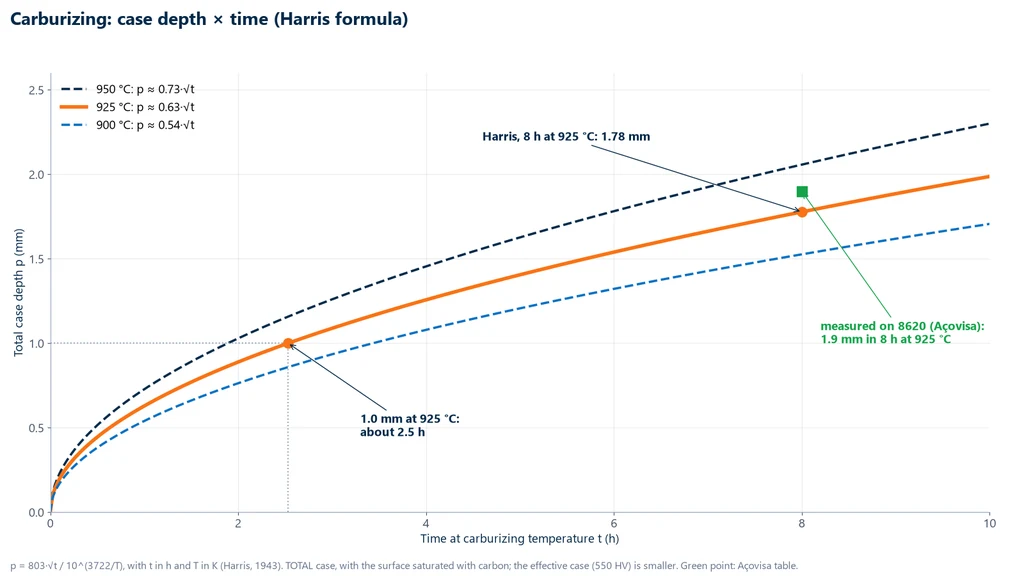
Harris estimates the total case depth, down to where the carbon returns to the core content, with a saturated surface; it does not account for alloying, controlled carbon potential or two-stage cycles. It is useful for planning the first cycle. The part specification, the effective case depth measured by hardness, is smaller and is confirmed by testing.
The carbon profile of the case
Applied to 8620 (0.20% C) carburized at 925 °C with the surface at 0.80% C, Fick's law predicts carbon that falls continuously from the surface to the core and goes deeper with time: after 8 h, at 0.5 mm the content is still 0.48%, and near 1.8 mm it returns to the 0.20% of the core, the same total case depth Harris gives for that time. The chart below shows the profiles after 2, 4 and 8 h, calculated with Callister's D (a model, not a measurement).
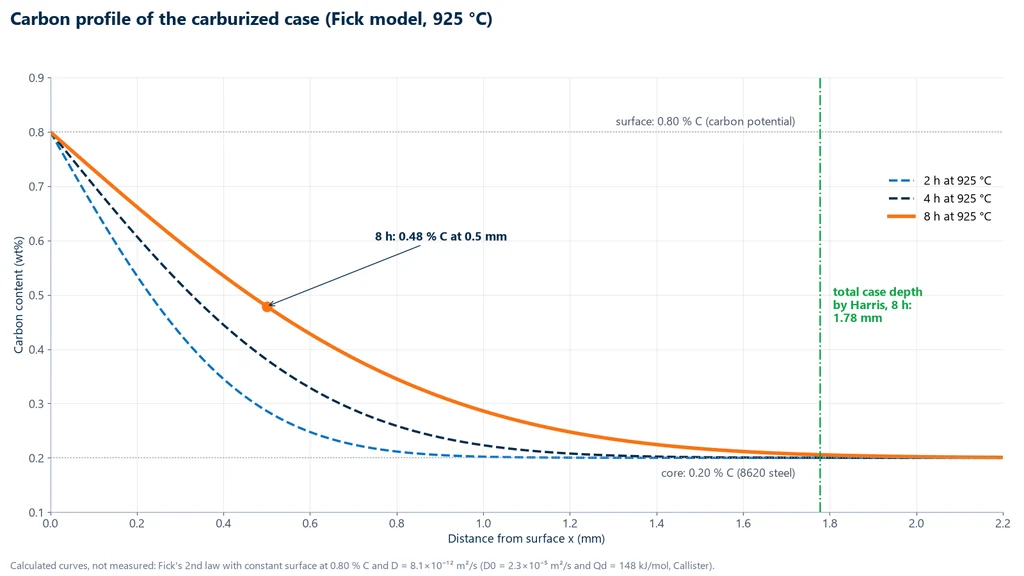
After quenching, this carbon gradient becomes a hardness gradient: where there is more carbon, the martensite is harder. That is why the case has no sharp boundary, and why case depth needs a stated criterion to be measured.
Carburizing steels and expected hardness
Carburizing steels have 0.10 to 0.25% carbon. In a medium- or high-carbon steel the core would quench hard and brittle, and the advantage of the process would be lost. Within that range, what distinguishes the steels is alloying: nickel, chromium and molybdenum increase hardenability, and with it the core hardness and the case hardness in thick parts.
- SAE 1020 and 1018: inexpensive carbon steels for pins, bushings and small parts. They have low hardenability: the case hardens in thin sections, and the core retains ferrite and pearlite. On heating, austenite starts to form at about 730 °C (Ac1) and the steel is fully austenitic at about 840 °C (Ac3), according to the Lucefin data sheet for C22E, equivalent to 1020.
- SAE 8620 (Ni-Cr-Mo): the most common carburizing steel in Brazil, used in gears, ring gears, pinions and shafts. It has 0.18 to 0.23% C.
- SAE 5115 and 20MnCr5 (Mn-Cr): 5115 is equivalent to the European 16MnCr5; both Mn-Cr steels are used in automotive gears.
- SAE 4320 (Ni-Cr-Mo, higher nickel): tougher core, for high-load gears; Perussatto and coworkers (ABM, 2024) studied 8620 and 4320 in differential gears for electric vehicles.
The table gathers published hardness values for 8620, the steel with the most complete manufacturer data. Core hardness depends on the section size, because a thick bar cools more slowly at the center:
| 8620 condition | Surface | Core | Source |
|---|---|---|---|
| carburized and quenched (usual range) | 58 to 62 HRC | about 30 to 45 HRC, depending on section size | GGD Metals; Açovisa; Lucefin |
| 925 °C for 8 h, reheated to 845 °C, oil, tempered at 230 °C | 61 HRC, 1.9 mm case | 341 HB (about 36 HRC) | Açovisa |
| 10 mm bar, oil quenched, tempered at 50 °C | 64 HRC | 44.5 HRC | Lucefin 20NiCrMo2-2 |
Quenching and tempering after carburizing
The carburized case only becomes hard with quenching, and there are three ways to do it. The choice balances cost, distortion and grain size, because hours at 900 °C or more make the austenite grain grow, and coarse grain makes the martensite more brittle.
- Direct quenching: the part goes from the carburizing furnace into oil, usually after the temperature is lowered to the steel's quenching temperature. It is the most economical method and requires fine-grained steel. It was the method used on the Fertig and Pimenta gears.
- Single quenching with reheating: the part cools after carburizing and is reheated for quenching. Reheating refines the grain. For 8620, quenching is done from 830 to 860 °C, in oil; the Açovisa cycle uses 845 °C.
- Double quenching: the first, above the Ac3 of the core (about 820 °C for 8620), refines the core; the second, slightly above the critical temperature of the carbon-rich case, refines the case. It gives the best microstructure, at higher cost and with more distortion.
Quenching is always followed by low-temperature tempering, in the 150 to 250 °C range, which relieves stresses and reduces the risk of cracking without bringing down the surface hardness: 8620 tempered at 230 °C retains 61 HRC in the Açovisa table. The tempering ranges and what changes in the martensite are covered in the article on tempering. When the steel arrives with coarse grain or an as-forged structure, normalizing before machining and carburizing homogenizes the structure; annealing can be used to make machining easier.
Effective case depth (CHD) and part inspection
Because hardness drops continuously, case depth only makes sense with a defined criterion. Total case depth runs to the point where the hardness, or the carbon content, equals that of the core. Effective case depth runs to the point where the hardness falls to a fixed value. The effective depth is the one that goes on the drawing, because it is the part of the case that carries the load.
The current standard is ISO 18203:2026 (2nd edition, January 2026), which replaced ISO 18203:2016. The 2016 edition had already absorbed the former ISO 2639, the standard for carburized cases. As the standard defines it, the effective case hardening depth (CHD) is the perpendicular distance from the surface to the point where the hardness is 550 HV, measured by Vickers per ISO 6507-1 or by an equivalent Knoop test per ISO 4545-1. In the United States, SAE J423 uses a different cutoff, 50 HRC, which equals 513 HV according to ASTM E140. 550 HV corresponds to about 52 HRC. The two criteria are not interchangeable, so the specification must state which one applies and at what test load.
Total case depth is always greater than effective case depth, usually by a factor of 1.3 to 2.0, depending on how steep the gradient is (UTEC, Effective vs. total case depth). For this reason the Harris formula, which gives total depth, cannot by itself give the CHD on the drawing. The specified CHD depends on the part: on the module 2 gears studied by Fertig and Pimenta it was 0.40 to 0.60 mm, and larger, more heavily loaded gears call for deeper cases.
The photo shows a section of a carburized gear, polished and chemically etched. The darker band that follows the tooth profile is the carbon-enriched case, and the lighter core stays tough.
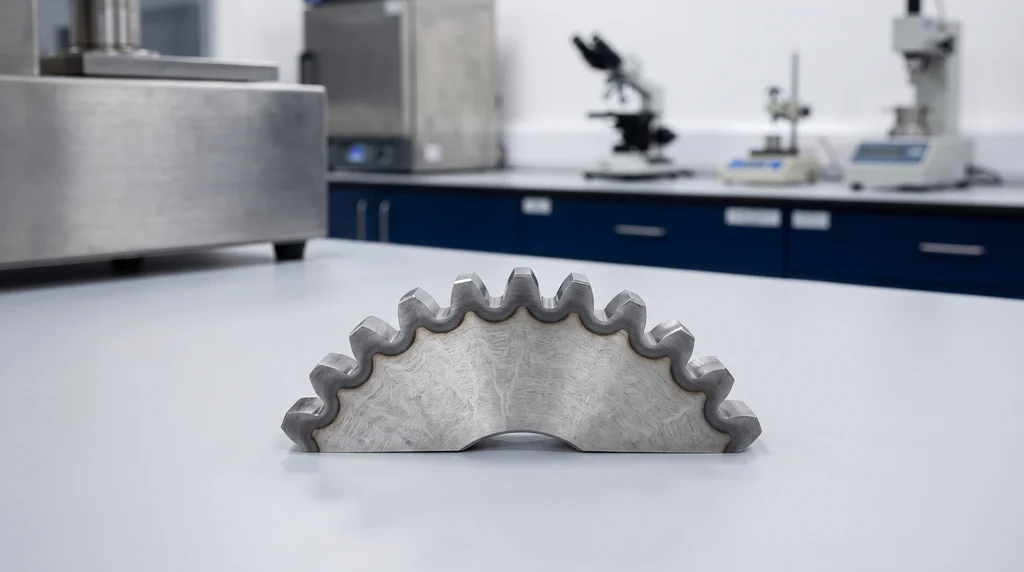
Etching reveals the case, but CHD is measured with a Vickers microhardness traverse on a polished cross section. The procedure (loads, indent spacing and a profile interpolated to 550 HV) is covered in the article on hardness testing.
Inspecting a carburized batch combines three checks. Surface hardness and the microhardness profile verify the case. Metallography shows the case microstructure and the defects described below: the sample is cut without heating on the metallographic cutting machine, ground and polished on the grinding and polishing machine and examined under the metallurgical microscope. Finally, a tensile test on a witness specimen of the same steel, run through the same cycle, confirms the core properties. The Biopdi M2 line universal testing machine, electromechanical, from 200 N to 1,000 kN, with class 1 load cells and extensometers, performs this test, and the BioLab software calculates yield strength, tensile strength and elongation in the report.
Carbonitriding
Carbonitriding is a variant of gas carburizing with ammonia (NH3) added to the atmosphere. The surface takes up both carbon and nitrogen, the temperature is slightly lower, and the nitrogen raises the hardenability of the case, which makes it possible to harden carbon steels with a less severe quench. On the other hand, it promotes retained austenite. Borges et al. (Matéria, 2021) carbonitrided SAE 1015 steel motorcycle gears at 880 °C for 6 h, with a carbon potential of 1%, oil quenching and tempering at 180 °C for 1 h. They measured a maximum hardness of 949 HV0.1 and a case of 0.8 mm, with retained austenite detected by X-ray diffraction. A carbonitrided case is also measured by CHD at 550 HV.
Carburizing defects
Defects almost always come from the carbon potential, the atmosphere or the temperature, and they show up in the hardness profile and in metallography.
- Retained austenite: carbon and alloying elements lower the martensite start temperature (Ms). In 8620, the Ms of the core is about 380 °C, and that of the carburized surface drops to about 200 °C (Lucefin datasheet). With too much carbon, part of the austenite does not transform during quenching: hardness drops, and the austenite can transform in service, changing dimensions. It shows up as lower hardness just below the surface and is confirmed by X-ray diffraction.
- Carbide network: when the carbon potential is too high, the surface exceeds the eutectoid content and cementite precipitates at the grain boundaries, forming a brittle network that promotes cracking during grinding and in fatigue.
- Intergranular oxidation: oxygen, water vapor and CO2 in the endothermic atmosphere oxidize elements such as chromium, manganese and silicon at the grain boundaries, in a thin layer at the surface. This layer loses hardenability and may not transform to martensite. It does not occur in vacuum carburizing.
- Decarburization: loss of carbon at the surface due to an oxidizing atmosphere or a low potential during cooling. It produces low surface hardness and shortens fatigue life.
- Coarse grain and distortion: high temperature without grain refinement embrittles the case, and quenching distorts the part. The grinding that corrects the distortion removes part of the case.
A defective case can have the right hardness and still fail early. Retained austenite, intergranular oxidation and decarburization reduce contact and bending fatigue strength, which is evaluated in the fatigue test. The core, in turn, provides the toughness of the part.
Carburizing or nitriding
Both harden the surface by diffusion, but under opposite conditions. Carburizing works in the austenite range, around 900 °C. It requires quenching afterward and forms cases from a few tenths of a millimeter up to about 2 mm, suited to high contact loads, as in gears. Nitriding works in the ferrite range (about 495 to 565 °C for gas nitriding). It needs no quench and distorts the part much less, but the case is thinner, with a diffusion zone of about 0.1 to 0.6 mm. The full comparison between the two processes is in the nitriding article.
Worked examples
The examples use the Harris formula, Fick's law and the relationship between total and effective case depth covered above.
Example 1: time for 1 mm of total case depth
An 8620 gear needs 1.0 mm of total case depth. How long does gas carburizing take at 900, 925 and 950 °C?
- By the Harris formula, t = (p / f)², with f = 803 / 10(3722/T).
- 900 °C = 1,173.15 K: 3722 / 1,173.15 = 3.173; 103.173 = 1,488; f = 803 / 1,488 = 0.540 mm/√h; t = (1 / 0.540)² = 3.4 h.
- 925 °C = 1,198.15 K: f = 0.628 mm/√h; t = (1 / 0.628)² = 2.5 h.
- 950 °C = 1,223.15 K: f = 0.727 mm/√h; t = (1 / 0.727)² = 1.9 h.
Example 2: doubling the case depth
At 925 °C, how long do 0.5 mm and 1.0 mm of total case depth take?
- 0.5 mm: t = (0.5 / 0.628)² = 0.63 h.
- 1.0 mm: t = (1.0 / 0.628)² = 2.5 h.
- The case depth doubled and the time quadrupled: t2 = t1·(p2/p1)² = 0.63 × 4 = 2.5 h.
Example 3: from the CHD on the drawing to furnace time
The drawing of an 8620 pinion calls for a CHD of 0.8 mm at 550 HV. What time should be planned at 925 °C?
- Total case depth is between 1.3 and 2.0 times the effective depth: 0.8 × 1.3 = 1.04 mm and 0.8 × 2.0 = 1.60 mm.
- By Harris: (1.04 / 0.628)² = 2.7 h and (1.60 / 0.628)² = 6.5 h.
- The range is wide because the ratio depends on the gradient. The cycle is set with a pilot batch: carburize, quench, measure the microhardness profile and correct the time with the square-root rule. If the pinion is ground, add the grinding allowance.
Example 4: carbon content at 0.5 mm by Fick's law
An 8620 steel (C0 = 0.20%) is carburized at 925 °C for 8 h with the surface at 0.80% C. What is the carbon content at 0.5 mm?
- D = 2.3×10⁻⁵ × exp[−148,000 / (8.314 × 1,198.15)] = 2.3×10⁻⁵ × exp(−14.86) = 8.1×10⁻¹² m²/s.
- t = 8 × 3,600 = 28,800 s; D·t = 2.34×10⁻⁷ m²; √(D·t) = 4.83×10⁻⁴ m; 2√(D·t) = 0.967 mm.
- x / (2√(D·t)) = 0.5 / 0.967 = 0.517; erf(0.517) = 0.535.
- Cx = 0.20 + (0.80 − 0.20) × (1 − 0.535) = 0.20 + 0.60 × 0.465 = 0.48% C, the point marked on the carbon profile chart.
Carburizing standards
No standard sets carburizing temperature and time: they come from the steel datasheet and the part specification. The standards cover how the case is measured and the hardness tests behind that measurement. The table lists those cited in this article:
| Standard | Scope | Edition |
|---|---|---|
| ISO 18203 | thickness of hardened cases (CHD at 550 HV, surface hardening, nitriding); replaced ISO 2639 | 2026 |
| ISO 6507-1 | Vickers hardness, test method | 2023 |
| ISO 4545-1 | Knoop hardness, test method | 2023 |
| ASTM E384 | microindentation hardness (Vickers and Knoop) | E384-22 |
| ASTM E140 | hardness conversion tables (HV and HRC) | E140-12B(2019)e1 |
| ISO 18265 | conversion of hardness values | 2013 |
| SAE J423 | methods of measuring case depth (50 HRC cutoff) | not stated |
Other tests and technical references
Nitriding: what it is, processes (gas, plasma and salt bath), white layer, NHD and difference from carburizing
Nitriding is a thermochemical treatment that diffuses nitrogen into the steel surface below the austenitizing temperature, with no quenching: 495 to 565 °C for gas nitriding, 430 to 595 °C for plasma nitriding and about 570 to 580 °C in a salt bath. It forms a white layer of 10 to 20 µm on top of a diffusion zone of 0.1 to 0.6 mm, with 600 to over 1,000 HV depending on the steel. See the processes, the steels, how to measure the NHD per ISO 18203 and the comparison with carburizing.
Tempering steel: what it is, temperatures, hardness curve and temper embrittlement
Tempering is the reheating of quenched (hardened) steel below the critical temperature, usually between 150 and 650 °C, to trade part of the hardness of martensite for toughness and to relieve quenching stresses. See what happens in martensite, the temperature ranges, the hardness and impact curve of 4140 steel, the Hollomon-Jaffe parameter, the two types of embrittlement, temper colors and how to check the result.
Annealing of steel: what it is, types, temperatures and effects on properties
Annealing is the heat treatment that heats the metal, holds it at temperature and cools it slowly, usually inside the furnace, to reduce hardness and internal stresses and restore ductility and machinability. In steel, full annealing austenitizes about 30 to 50 °C above Ac3, and the subcritical types stay below Ac1 (stress relief annealing at 550 to 650 °C, spheroidizing at 700 to 720 °C). See the types, temperatures, microstructure, effects with numbers and how to check the result.
Sintering: what it is, powder metallurgy steps, temperature, density and testing of sintered parts
Sintering is the consolidation of a compacted powder by heating below the melting point, usually at 70 to 85% of the absolute melting temperature: diffusion forms necks between the particles and reduces porosity. It is not a heat treatment of steel in the classic sense. Fe-Cu-C sintered steel: 1,120 to 1,150 °C for 20 to 30 min and 6.8 to 7.2 g/cm³. See the steps, mechanisms, stages, liquid phase, porosity, testing to ISO 2738, ISO 3325 and ISO 2739, and solved exercises.
Frequently asked questions
What is the carburizing process?
It is a thermochemical treatment in which a low-carbon steel is heated into the austenite range, usually between 900 and 930 °C, in a carbon-rich medium. Carbon diffuses into the surface up to about 0.8%. This is followed by quenching and low-temperature tempering, which leave the surface at 58 to 62 HRC and the core tough.
What is the difference between quenching and carburizing?
Carburizing changes the chemical composition of the surface by adding carbon. Quenching changes the microstructure, transforming austenite into martensite through rapid cooling. In a carburized part the two happen in sequence: without quenching, the carbon-rich case does not become hard.
What does carburizing mean?
Carburizing means enriching the surface of a steel with carbon (cementação in Portuguese). The Portuguese term comes from "cemento", the carbonaceous medium used in pack carburizing, and has nothing to do with the cement used in construction.
What are the types of carburizing?
The main ones are gas carburizing, the most widely used, with controlled carbon potential; pack carburizing, in a box with charcoal and an energizer; liquid carburizing, in a cyanide salt bath; and vacuum carburizing, with low-pressure acetylene pulses and no intergranular oxidation. There is also plasma carburizing, which is used more narrowly.
What is the carburizing temperature?
The general range is 850 to 1,000 °C, and the usual range is 900 to 930 °C. For 8620, datasheets recommend 900 to 925 °C (GGD Metals). About 50 °C more nearly doubles the diffusion rate of carbon, but it increases grain growth.
How long does it take to carburize 1 mm?
By the Harris formula, about 2.5 h at 925 °C for 1 mm of total case depth, 3.4 h at 900 °C and 1.9 h at 950 °C. The effective case depth, measured at 550 HV, is smaller than the total, so a CHD of 1 mm takes longer, confirmed by a microhardness profile on a pilot batch.
How is carburized case depth measured?
With a Vickers microhardness traverse on a polished cross section. The effective case depth (CHD) is the distance from the surface to the point at 550 HV, per ISO 18203:2026. In the United States, SAE J423 uses 50 HRC as the cutoff.
Which steels are used for carburizing?
Low-carbon steels, with 0.10 to 0.25% C, such as SAE 1020, 8620 (the most common for gears), 5115, 20MnCr5 and 4320. Alloy steels give a stronger core: 8620 reaches about 30 to 45 HRC in the core, depending on the section size.
Is tempering needed after carburizing?
Yes. Low-temperature tempering, between 150 and 250 °C, relieves quenching stresses and reduces the risk of cracking without bringing down surface hardness. 8620 tempered at 230 °C keeps 61 HRC at the surface (Açovisa).
Carburizing or nitriding: which should you choose?
Carburizing gives a deeper case for high contact loads, but it requires quenching and causes more distortion. Nitriding is done below about 600 °C, without quenching, with minimal distortion and a thinner case. The full comparison is in the nitriding article.
What is retained austenite in carburizing?
It is austenite that does not transform into martensite during quenching, because the excess carbon and alloying elements at the surface lower the martensite start temperature. It reduces hardness and can transform in service. Limiting the carbon potential to about 0.8% helps prevent it.