
ABNT NBR 6457:2024 is the Brazilian standard that defines how to prepare soil samples for compaction and characterization tests and how to determine moisture content. Moisture content is the ratio of the mass of water to the mass of dry soil, obtained by oven-drying at 105 °C to 110 °C to constant mass. The standard requires at least three moisture determinations, with the result reported to the nearest 0.1%, and 3 kg to 35 kg of dry mass for the compaction test, depending on the mold and on whether the material is reused.
It is the first step of almost every laboratory geotechnical test: the Proctor test, the Atterberg limits, particle size distribution and the specific gravity of soil solids all start from a sample prepared under it, and the moisture content of each specimen is measured by its method. Below are the current edition (checked on October 7, 2026), the apparatus, the step-by-step sample preparation, the coarse material table, the masses required for each test, moisture content with a worked example, the rapid methods that are not in this standard, and the most common mistakes. These are the figures a laboratory looks up most often:
- Edition: 3rd edition, dated January 9, 2024, which canceled the 2016 edition;
- Oven: 105 °C to 110 °C; 60 °C to 65 °C for organic soils, peat soils or soils containing gypsum;
- Result: average of at least three determinations, to the nearest 0.1%;
- Compaction: 3 kg or 7 kg of dry mass with reuse; 15 kg or 35 kg without reuse;
- Liquid limit and plastic limit: about 200 g passing the 0.42 mm sieve;
- No prior drying: only when the sample has no more than 10% retained on the 0.42 mm sieve.
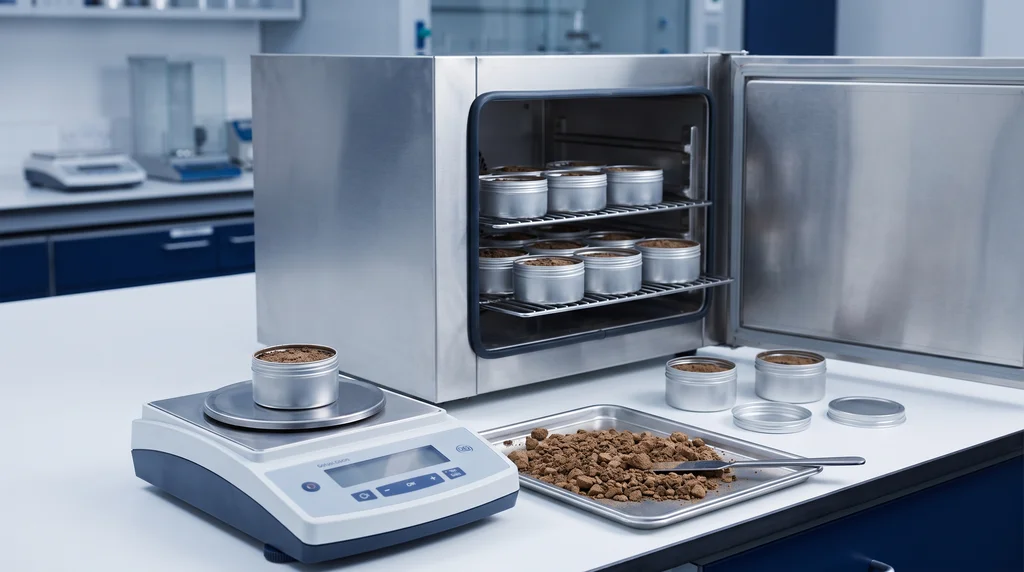
The photo shows the final stage of a moisture content determination: the aluminum moisture cans go into the oven open, with the lids kept outside, the balance weighs a can with soil and, on the tray, the air-dried, disaggregated soil waits to be split among the tests.
What NBR 6457:2024 is and what it covers
ABNT NBR 6457:2024, "Soils: Preparation of samples for compaction and characterization tests and determination of moisture content", is the Brazilian standard that standardizes the path from the sample arriving from the field to the portion that goes into each test, and that defines the reference method for moisture content. It is the 3rd edition, dated January 9, 2024, prepared by the Special Study Committee on Soils (ABNT/CEE-221) of ABNT, the Brazilian Association of Technical Standards, and it cancels and replaces NBR 6457:2016.
Two parts: sample preparation and moisture content
The scope has two parts. The first is sample preparation: drying, disaggregation, sample reduction, sieving, what to do with coarse particles and how much material to set aside for each test. The second is oven-dry moisture content determination, with the apparatus, the quantities, the procedure, the formula and how to report the result.
What the standard is not also matters. It is not the test method for the liquid and plastic limits, particle size distribution, specific gravity of solids or compaction: each of those tests has its own standard, and NBR 6457 only delivers the sample ready and in the right quantity. When a liquid limit report cites NBR 6457, it is stating how the sample was prepared and how the moisture content of each point was measured, not how the test was performed.
History and what changed from the 2016 edition
The standard had editions in 1984, 1986 and 2016, the latter with an erratum and a new edition in July 2016 and confirmation in 2020, according to the history in the ABNT catalog on Target (the Brazilian standards distribution platform). The 2024 edition describes itself as "technically revised" and does not list what changed. The most visible difference for the reader is structural: in the 2016 edition, moisture content was in an annex, Annex A, and many web pages still cite it that way; in the 2024 edition, it is Section 4 of the body of the standard. Claims about content changes that are not in the text of the standard should be treated with caution.
Standards related to NBR 6457
NBR 6457 is referenced by practically every ABNT soil testing standard, and some moisture content methods it does not include are found in other standards. The table brings together those that appear in this guide, with their status checked on October 7, 2026: ABNT standards in the full text or in the catalog entry (Target), DNIT standards (DNIT is Brazil's National Department of Transport Infrastructure) in the agency's collection (gov.br), and ASTM standards in the ASTM store.
| Standard | Subject | Status on October 7, 2026 |
|---|---|---|
| ABNT NBR 6457:2024 | Sample preparation and oven-dry moisture content | Current; 3rd edition, dated January 9, 2024 |
| ABNT NBR 7182:2025 | Compaction test (Proctor) | Current; 3rd edition, dated February 17, 2025 |
| ABNT NBR 6459:2025 and NBR 7180:2025 | Liquid limit; plastic limit and plasticity index | Current; 3rd edition, dated September 18, 2025 |
| ABNT NBR 7181:2025 | Particle size analysis | Current; 3rd edition, dated January 15, 2025, corrected version 2 dated July 13, 2026 |
| ABNT NBR 16097:2012 | Soil moisture content: rapid methods | Current; confirmed in January 2025 |
| DNIT 456/2025-ME | Moisture content of soils and aggregates: rapid and laboratory methods | Current; approved on June 10, 2025, cancels DNER-ME 052/94, 196/98 and 213/94 |
| ASTM D2216-19 | Oven-dry moisture content (ASTM reference method) | Active |
| ASTM D4643-25 | Moisture content by microwave oven | Active |
| ASTM D4944-25a | Moisture content by calcium carbide gas pressure tester (speedy) | Active |
The Target catalog shows a generic notice on every entry saying the standard "has been canceled"; the actual status is in the entry's history, which lists the January 2024 edition as the current one.
Apparatus and sieves
The apparatus required by NBR 6457:2024 is simple and found in any soil laboratory: mortar, sample splitter (riffle), trays, sieves, balances of three capacities, oven, desiccator and containers with lids. What the standard adds are the specifications that make a difference to the result, such as the rubber-covered pestle and the two oven temperature ranges.
| Item | For sample preparation | For moisture content |
|---|---|---|
| Balances | 1.5 kg with 0.1 g resolution; 10 kg with 1 g; 20 kg with 5 g | 200 g with 0.01 g resolution; 1.5 kg with 0.1 g; 5 kg with 0.5 g |
| Sieves | 76.2, 50.8, 19.1, 4.8, 2.0 and 0.42 mm | Not applicable |
| Disaggregation and reduction | Mortar, rubber-covered pestle, sample splitter, metal trays | Not applicable |
| Drying and weighing | Not applicable (air drying) | Oven at 60 °C to 65 °C and at 105 °C to 110 °C; desiccator with silica gel; metal or glass containers with lids; tongs about 30 cm long |
Two details have a physical reason. The rubber on the pestle is there to break up clods without fracturing grains: a bare porcelain pestle crushes friable sand grains and concretions, creates fines that did not exist and alters the particle size distribution and the limits. The lidded container is there because moist soil loses water to the air and dry soil absorbs water from the air; the lid protects the weighings at both ends. The sieves comply with ABNT NBR NM ISO 3310-1 and 3310-2 (the Brazilian adoptions of ISO 3310-1 and ISO 3310-2), and the sieving terminology with NBR NM ISO 2395.
Step-by-step sample preparation: air drying, disaggregation, quartering and sieving
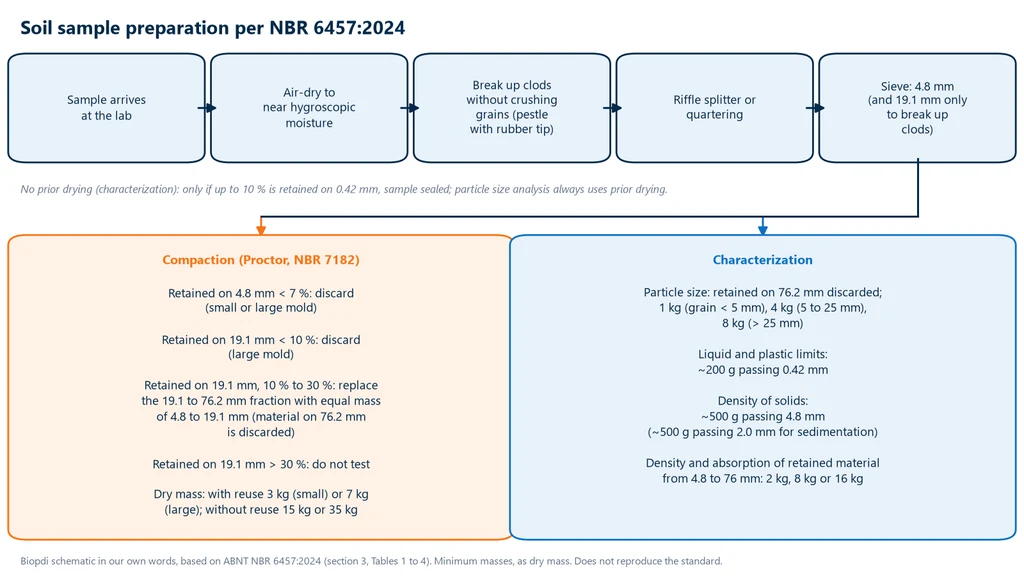
Soil sample preparation under NBR 6457:2024 follows a fixed sequence: air-dry to near the hygroscopic moisture content, break up the clods without crushing grains, homogenize, reduce the sample with a splitter or by quartering, and sieve. These steps are common to compaction and characterization; what changes afterwards is what happens to the retained material and how much is set aside for each test. The flowchart below summarizes the sequence and the two branches, with the masses for each test:
Air drying to near the hygroscopic moisture content
The prior drying in NBR 6457 is done in air, spreading the soil on trays, not in an oven. The goal is to make the soil dry enough to be disaggregated and sieved, but not so dry that it changes. The oven removes all free and adsorbed water, and in tropical soils and soils with sensitive clay minerals this complete drying can alter particle aggregation and, with it, the limits and the compaction curve. That is why, in the soil laboratory, the oven is used only to measure moisture content, never to prepare the sample.
The stopping point is "near the hygroscopic moisture content", defined later in this guide: the moisture the soil retains in equilibrium with the air after drying at room conditions. In sand it is almost zero; in clay it can reach a few percentage points, and it must be measured, because it enters the dry mass calculation.
Disaggregate without crushing grains
Disaggregating means breaking up the aggregates of particles, the clods, until the sample is loose and homogeneous. The rule of the standard is to avoid crushing grains: the operator breaks the clod in the mortar with the rubber-covered pestle and stops when only individual grains remain. Crushing a gravel particle or a lateritic concretion turns coarse material into sand and fines, and the particle size distribution, the limits and the compaction curve then describe a different soil.
Quartering and sample splitter
Reducing the sample means taking a smaller portion from it that still represents the whole. NBR 6457 accepts two methods. In the sample splitter, a box with alternating chutes, the poured soil is divided into two equal trays, and the operation is repeated until the desired mass is reached. In manual quartering, the homogenized soil is formed into a conical pile, which is flattened and divided into four equal parts; two opposite quarters are kept, the other two are discarded, and the process is repeated. What is not done is scooping the top portion out of the bag with a shovel: fine grains tend to settle and coarse grains to stay on top during transport, and a sample taken that way is biased.
Soil sample preparation in the agronomic sense is a different procedure: for chemical and fertility analysis, sampling, drying and sieving follow the manuals of Embrapa (the Brazilian Agricultural Research Corporation) and of soil fertility laboratories, not NBR 6457. This guide covers geotechnical preparation, for engineering tests.
Sieving on the 4.8 mm and 19.1 mm sieves
After reduction, the sample is passed through the 4.8 mm sieve. If it all passes, it goes on to the test. If material is retained, it is passed through the 19.1 mm sieve, but only to break up the remaining clods, and without forcing the material against the mesh, again to avoid crushing grains. What is still retained is true gravel, and how it is handled depends on its percentage, as the next section shows.
Preparation for the compaction test (Proctor)
Preparation for the compaction test sets the moisture content at which the sample starts, what to do with the coarse particles and how much soil to set aside. It follows ABNT NBR 7182:2025 (the Brazilian standard for the Proctor test), which combines the preparation procedures of NBR 6457:2024 (the Brazilian standard for soil sample preparation and moisture content) with testing either with or without reuse of the material. The test itself, with compaction energies, the curve and field control, is covered in the guide to soil compaction and the Proctor test.
Three procedures: prior drying, 5% below and 3% above optimum
NBR 6457:2024 allows three preparation procedures for compaction, which differ in the initial moisture content of the sample:
- Prior drying to near the hygroscopic moisture content: the procedure described in the previous section, followed by adding water for each point of the curve;
- At about 5% below the estimated optimum moisture content: the sample arrives sealed so it does not lose moisture and is air-dried only down to that level; if it is already drier, water is added;
- At about 3% above the estimated optimum moisture content: also sealed, and air-dried down to that level. No water is added in this procedure, so it is ruled out for soils whose natural moisture content is already below the estimated optimum plus 3%.
The estimated optimum moisture content is an estimate made before the test, based on experience with similar soils. The two procedures that start from the moist sample exist for soils that change when dried, the same soils for which oven drying would be harmful. Once the initial moisture content is reached, all three procedures follow the same breaking up of clods, sample reduction and sieving.
What to do with the retained material
The material retained on the 4.8 mm and 19.1 mm sieves determines the mold used in the test and whether the coarse fraction is discarded, replaced or prevents the test. The table summarizes, in our own wording, the rule in NBR 6457:2024 (Table 1 of the standard):
| Retained | Mold | What to do |
|---|---|---|
| Less than 7% on the 4.8 mm sieve | Small or large | Discard the retained material |
| Less than 10% on the 19.1 mm sieve | Large | Discard the retained material |
| 10% to 30% on the 19.1 mm sieve | Large | Pass the retained material over the 76.2 mm sieve and discard what stays on it; replace the material between 19.1 and 76.2 mm with an equal mass of material between 4.8 and 19.1 mm |
| More than 30% on the 19.1 mm sieve | None | The standard recommends not testing to NBR 7182 |
The logic of the table is to protect the mold and the meaning of the result. Particles that are too large jam the rammer, create voids along the wall and distort the volume; replacing them with smaller particles of equal mass keeps roughly the same proportion of coarse material without those defects. Above 30% retained on the 19.1 mm sieve, the replacement would change the material so much that the test would no longer represent the soil on site. The small mold accepts up to 7% retained on the 4.8 mm sieve because that retained fraction is discarded: once prepared, the sample that goes into the mold passes entirely through the 4.8 mm sieve, as NBR 7182:2025 requires.
How much material to set aside
The quantity for the compaction test is given as dry mass and depends on the mold and on whether the material is reused (Table 2 of the standard):
| Test | Sample passes entirely through | Mold | Dry mass |
|---|---|---|---|
| With reuse | 4.8 mm | Small | 3 kg |
| With reuse | 4.8 mm or 19.1 mm | Large | 7 kg |
| Without reuse | 4.8 mm | Small | 15 kg |
| Without reuse | 4.8 mm or 19.1 mm | Large | 35 kg |
The test without reuse needs five times the mass because each of the five points of the curve uses a fresh portion, compacted once and discarded. That is what makes the test with reuse so common, and also why reuse is avoided in soils with particles that break: each cycle of compacting, breaking up and recompacting fragments the material a little more. Since the soil coming out of the laboratory is never completely dry, the mass to weigh is the dry mass from the table multiplied by (1 + w), with the hygroscopic moisture content w as a fraction.
Worked examples of the preparation
The three examples below apply the rules of this section. The numbers are Biopdi's, and the calculations were redone for this guide.
Example 1: how much air-dried soil to set aside. The test will be run with reuse, in the small mold, and the measured hygroscopic moisture content is 4.0%. The table calls for 3 kg of dry mass, so the mass to weigh is 3.000 × 1.040 = 3.12 kg of air-dried soil. Without reuse, it would be 15 × 1.040 = 15.6 kg.
Example 2: preparation at 5% below optimum. The estimated optimum moisture content is 20%, and the preparation target is 15%. The sample from example 1 has 3.000 kg of solids at 4.0%, below the target, so water is added: 3.000 × (0.15 − 0.04) = 0.330 kg, or 330 g of water, mixed in and kept with the sample sealed.
Example 3: replacing coarse particles. A sample for the large mold has 7.00 kg of dry mass, of which 1.26 kg was retained on the 19.1 mm sieve: 1.26 / 7.00 = 18%, within the replacement range. Passed over the 76.2 mm sieve, the retained material leaves 0.10 kg on that sieve, which is discarded. The fraction between 19.1 and 76.2 mm is 1.26 − 0.10 = 1.16 kg, replaced with 1.16 kg of material between 4.8 and 19.1 mm; the usual practice is to take it from the surplus of the same soil, so as not to change the nature of the material. Since 0.10 kg was removed, the sample is left with 6.90 kg, and the laboratory should set aside a little more soil from the start to reach the 7 kg in the table. If the material retained on the 19.1 mm sieve were 2.45 kg, or 2.45 / 7.00 = 35%, the recommendation would be not to test to NBR 7182.
The prepared sample goes into the mold, and the specimen compacted at the optimum moisture content often goes on to the CBR test, molded in the large mold.
Preparation for the characterization tests
Characterization tests describe the soil: particle size distribution, liquid and plastic limits and the density of soil solids. For these, NBR 6457:2024 (the Brazilian standard for soil sample preparation) defines two preparation procedures and a minimum quantity for each test, which depends on the size of the largest particles.
With or without prior drying
The standard procedure uses prior air drying, with the same breaking up of clods and the same sample reduction as for compaction. The procedure without prior drying, with the sample kept sealed at its natural moisture content, may only be used when the sample has at most 10% retained on the 0.42 mm sieve, that is, in predominantly fine-grained soils. The particle size distribution sample is always prepared with prior drying.
In the procedure without prior drying, the sample for the limits, about 200 g of dry mass, is cleaned by hand of shells, roots, twigs and coarse particles. If it is very wet, half is air-dried to the moisture content of the first liquid limit point and the rest to near the estimated plastic limit. For the density of soil solids, about 500 g of dry material passing the 4.8 mm sieve is set aside.
Masses per test
The table brings together, in our own wording, the quantities in NBR 6457:2024 for characterization with prior drying (Tables 3 and 4 and items 3.3.2.3 and 3.3.2.4 of the standard):
| Test | Material | Quantity |
|---|---|---|
| Particle size distribution | Material retained on 76.2 mm discarded; largest particle smaller than 5 mm, from 5 to 25 mm or larger than 25 mm | 1 kg, 4 kg or 8 kg |
| Density of soil solids for the sedimentation (hydrometer) analysis | Passing the 2.0 mm sieve | About 500 g |
| Liquid and plastic limits | Passing the 0.42 mm sieve | About 200 g |
| Density of soil solids | Passing the 4.8 mm sieve | About 500 g |
| Density and water absorption of retained particles | Between 4.8 and 76 mm; largest particle smaller than 25 mm, from 25 to 50 mm or from 50 to 76 mm | 2 kg, 8 kg or 16 kg |
The size of the largest particle sets the mass because a large particle weighs a lot: in a small sample, a single extra or missing gravel particle changes the percentage retained at several points. That is why the quantity for particle size analysis rises from 1 kg to 8 kg as the soil contains gravel. The density of solids of the fraction passing the 2.0 mm sieve now has its own standard, ABNT NBR 17212:2025; NBR 6457:2024 still describes the density sample as the material passing the 4.8 mm sieve, and the laboratory should prepare the portion that the test standard requires.
Where each test continues
The sample prepared here goes on to three tests, each with its own guide. The Atterberg limits, to NBR 6459:2025 and NBR 7180:2025 (the Brazilian standards for the liquid limit and plastic limit), use the roughly 200 g passing the 0.42 mm sieve and measure the moisture content of each point to NBR 6457. The soil particle size analysis, to NBR 7181:2025 (the Brazilian standard for particle size analysis of soils), uses the air-dried sample and the hygroscopic moisture content to reach the dry mass. And the Proctor test uses the sample from the previous section.
Example: hygroscopic moisture in particle size analysis
A sample for particle size analysis has 1,000.0 g of air-dried soil. The material retained on the 2.0 mm sieve, washed and oven-dried, weighs 120.0 g, and the hygroscopic moisture content of the material passing the 2.0 mm sieve is 3.5%. According to NBR 7181:2025, the total dry mass is Ms = (Mt − Mg) / (1 + w) + Mg = 880.0 / 1.035 + 120.0 = 850.2 + 120.0 = 970.2 g. If the laboratory took the 1,000.0 g as the dry mass, every percentage on the particle size distribution curve would be calculated on a base 29.8 g larger, an error of 3.1%. That is why the hygroscopic moisture content, which seems like a detail, enters every characterization.
Soil moisture content: definition and hygroscopic moisture
Soil moisture content, in geotechnical engineering, is the ratio of the mass of water in the voids to the mass of solid particles, expressed as a percentage. It is a dry-basis moisture content: the denominator is the dry soil, not the moist soil. This choice makes the mass of solids a fixed reference that does not change when the soil gains or loses water.
Definition and formula
According to NBR 6457:2024, the moisture content is w = (M1 − M2) / (M2 − M3) × 100, in %, where:
- M1: mass of the container with lid and moist soil, in g;
- M2: mass of the container with lid and dry soil, in g;
- M3: mass of the container with lid, in g.
The numerator, M1 − M2, is the water driven off in the oven; the denominator, M2 − M3, is the dry soil. Since the denominator is the mass of solids and not the total mass, the moisture content can exceed 100%: the soil only needs to contain more water than solids by mass, which happens in very soft clays and in peats.
Natural moisture content and hygroscopic moisture content
The natural moisture content is the one the soil has in the field, measured on a sample that arrived sealed at the laboratory without losing water. The hygroscopic moisture content is the water the soil still holds after air drying, in equilibrium with the ambient humidity: a film of water adsorbed on the particle surfaces that air drying does not remove. It is higher the finer and more clayey the soil, because the specific surface of clays is much larger, and practically zero in sands and gravels.
In practice, the hygroscopic moisture content is used to convert air-dried mass into dry mass, with the correction factor 100 / (100 + w): an air-dried soil with w = 3.5% has 100 / 103.5 = 0.966 of solids in each unit of mass weighed. This is the conversion that appeared in the particle size example and in the calculation of the mass to set aside for compaction.
Gravimetric moisture content and volumetric moisture content
Anyone searching for "soil moisture content" finds two worlds. Geotechnical engineering uses gravimetric moisture content, by mass, as in NBR 6457. Agronomy and irrigation often use volumetric moisture content, θ, the volume of water per volume of soil, which is what field sensors measure. The two are linked by the dry density: θ = w × ρd / ρw, with ρw = 1.00 g/cm³.
| Quantity | Definition | Where it is used |
|---|---|---|
| Gravimetric moisture content, dry basis (w) | Mass of water / mass of solids | Geotechnical engineering: NBR 6457, compaction, limits, index properties |
| Moisture content, wet basis | Mass of water / total mass | Some moisture meters and industrial sectors; not the geotechnical moisture content |
| Volumetric moisture content (θ) | Volume of water / volume of soil | Agronomy, irrigation, field soil moisture sensors |
The conversion from wet basis to dry basis is w = u / (100 − u) × 100, with u the wet-basis moisture content, in %. A result of 12.0% on a wet basis corresponds to 12.0 / 88.0 × 100 = 13.6% on a dry basis (Biopdi calculation). Using a number on the wrong basis in a compaction calculation shifts the moisture target on site.
What 30% moisture content means
A soil with 30% gravimetric moisture content has 30 g of water for every 100 g of solids. In a moist sample of 520.0 g, the dry mass is 520.0 / 1.30 = 400.0 g and the water is 120.0 g: 30% of the dry mass, but only 23.1% of the total mass. If the 30% comes from a volumetric moisture sensor, the reading is different: in a soil with ρd = 1.50 g/cm³, θ = 30% is equivalent to w = 30 / 1.50 = 20% by mass (Biopdi calculations). Before comparing two moisture content values, you need to know the basis of each.
How to determine moisture content by oven drying (the standard method)
The moisture content method of NBR 6457:2024 (the Brazilian standard for soil sample preparation and moisture content determination) is oven drying to constant mass. You weigh the moist soil in a lidded container, dry it without the lid at 105 °C to 110 °C, let it cool in a desiccator and weigh it again. It is the only method in the standard, and it is the reference that rapid methods are checked against.
Sample size and balance
The mass of soil and the balance depend on the size of the largest particles, for the same reason as in particle size distribution: the larger the particle, the larger the sample needed for it to represent the soil. The table summarizes Table 5 of the standard in our own words:
| Largest particles | Soil mass | Balance |
|---|---|---|
| Smaller than 2 mm | 30 g | 200 g, 0.01 g resolution |
| From 2 to 20 mm | 30 g to 300 g | 1.5 kg, 0.1 g resolution |
| From 20 to 76 mm | 300 g to 3,000 g | 5 kg, 0.5 g resolution |
For the liquid limit and plastic limit, the masses are much smaller, because the test only yields small portions of soil: at least 8.0 g of moist soil per determination for the liquid limit and 1.5 g for the plastic limit, or 4.0 g and 1.0 g in soils with high limits, always on the 0.01 g balance (Table 6 of the standard).
Procedure
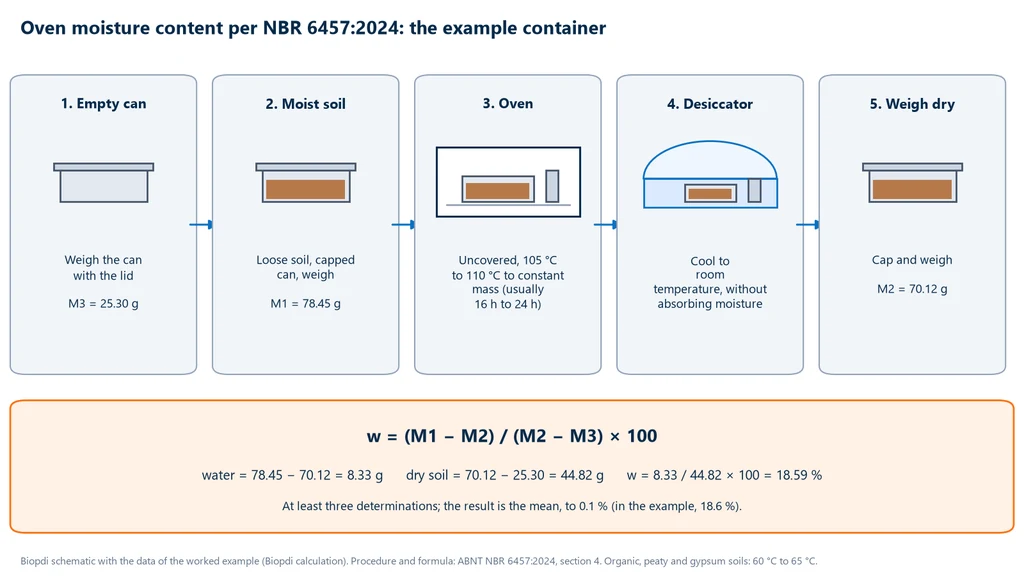
The general procedure of NBR 6457:2024 has five steps, and each one protects the measurement against a specific error. The diagram below shows the sequence with the numbers from container 1 of the worked example, from the tare to the formula:
- Tare the container: weigh the clean, dry container with its lid (M3).
- Weigh the moist soil: break up the lumps, place the portion loosely in the container, without compacting it, put the lid on and weigh (M1). Loose soil dries evenly; the lid prevents it from losing water before weighing.
- Dry in the oven: remove the lid and place the container in the oven at 105 °C to 110 °C until constant mass. In general, 16 h to 24 h is enough, but the criterion is the mass no longer dropping, not the clock. The lid does not go back on the container while it is in the oven.
- Cool in the desiccator: transfer the container to a desiccator with silica gel and let it cool to room temperature. Weighing it hot gives a wrong reading because of convection currents over the balance, and cooling it in open air lets the dry soil absorb moisture.
- Weigh the dry soil: put the lid on and weigh (M2).
At least three determinations are made per sample, and the result is their average, reported to the nearest 0.1%. The 105 °C to 110 °C range removes free and adsorbed water without attacking, in most soils, the water that is part of the mineral structure.
Organic soils, peat and gypsum-bearing soils
Organic soils, peat and gypsum-bearing soils are dried at 60 °C to 65 °C, with longer times, and the result must report that temperature. The lower temperature has a chemical reason: gypsum loses water of crystallization well below 105 °C, and that water, which belongs to the mineral, would be counted as moisture; organic matter can decompose and lose mass in the heat, which also inflates the result. ASTM D2216-19, the equivalent standard in the United States, which uses 110 ± 5 °C, gives the same warning for these materials.
Worked example: three containers
A sample of fine-grained soil, with all particles smaller than 2 mm, had three moisture determinations, with about 45 g of dry soil in each container, on the 0.01 g balance. The numbers are Biopdi's, and the calculations were redone for this guide:
| Container | M3; M1; M2 (g) | Water; dry soil (g) | w (%) |
|---|---|---|---|
| 1 | 25.30; 78.45; 70.12 | 8.33; 44.82 | 18.59 |
| 2 | 24.80; 80.10; 71.50 | 8.60; 46.70 | 18.42 |
| 3 | 25.10; 76.90; 68.70 | 8.20; 43.60 | 18.81 |
In container 1, the water is 78.45 − 70.12 = 8.33 g, the dry soil is 70.12 − 25.30 = 44.82 g and w = 8.33 / 44.82 × 100 = 18.59%. The others follow the same calculation. The average is (18.59 + 18.42 + 18.81) / 3 = 18.61%, and the result, rounded as the standard requires, is w = 18.6%. The difference between the highest and lowest determination, 0.39 percentage points, is small; a container far off from the others points to a weighing error, poorly homogenized soil or a container that was left open.
Rapid methods: speedy, frying pan, alcohol and microwave
Rapid moisture methods give the result in minutes, instead of the 16 h to 24 h of the oven, at the cost of lower accuracy. They serve field control on the job site, when the decision to compact a layer or not cannot wait until the next day. NBR 6457:2024 does not include any of them: the only method in the standard is the oven.
Where the rapid methods are
Within ABNT (the Brazilian standards body), the rapid methods are in NBR 16097:2012, which sets out two rapid methods for the moisture content of soil and soil-cement mixtures. On the highway side, DNIT (Brazil's federal highway agency) brought the methods together in DNIT 456/2025-ME, approved on 06/10/2025, which covers the frying pan, the speedy and the laboratory oven, and canceled DNER-ME 052/94 (speedy), DNER-ME 196/98 and DNER-ME 213/94. A new report that cites DNER-ME 052/94 has an outdated reference. DNIT 456/2025-ME itself states that the rapid methods are less accurate than the laboratory method.
Speedy
The speedy, or calcium carbide moisture tester, mixes the soil sample with calcium carbide in a closed vessel. The water in the soil reacts with the carbide and releases acetylene gas (CaC2 + 2 H2O → C2H2 + Ca(OH)2), and the gas pressure, read on a pressure gauge, is converted to moisture content through the instrument's calibration curve. Under DNIT 456/2025-ME, the method is recommended for sandy materials, the sample mass follows the manufacturer's instructions, a reading below 20 kPa calls for a repeat with more mass and one above 150 kPa with less, and acetylene is flammable, so the test is done away from any flame. In clays, the water trapped in the lumps does not always react, and the speedy tends to read lower than the oven. In the United States, the equivalent method is ASTM D4944-25a.
Frying pan
In the frying pan method, the sample is dried in a pan over low heat, stirred until it stops releasing vapor and weighed until constant mass; a glass plate held over the soil shows, by condensation, whether vapor is still coming off. DNIT 456/2025-ME uses about 200 g, at least 300 g when more than 20% of the material is retained on the 4.8 mm sieve, and 500 g when more than 20% is retained on the 19 mm sieve. The risk of the method is high heat: when overheated, the soil loses organic matter and mineral water, and the moisture content comes out higher than the real value.
Alcohol and microwave
The alcohol method burns alcohol over the sample to evaporate the water. It has its own Brazilian highway standard, DNER-ME 088/94, which is not among the standards canceled by DNIT 456/2025-ME; before citing it in a report, it is worth checking its status in the DNIT standards collection. The method is not suitable for organic soils, for the same reason as the frying pan.
The microwave oven is not covered by the ABNT standards. It is standardized by ASTM D4643-25, which presents it as an alternative to the oven when a faster result is needed and slightly lower accuracy is acceptable; in case of disagreement, the reference method is the ASTM D2216 oven method.
How much the methods differ
The difference between the methods depends on the soil. An undergraduate thesis from UFOP (Federal University of Ouro Preto, Brazil) (Aguiar, 2024), cited in the bibliography of DNIT 456/2025-ME, compared the oven, frying pan, speedy and infrared moisture balance on two soils. The chart below shows the averages: in the silty sand soil, all four methods were within 1 percentage point of the oven; in the clayey sand, the frying pan read 3.2 points higher and the speedy 7.7 points lower.
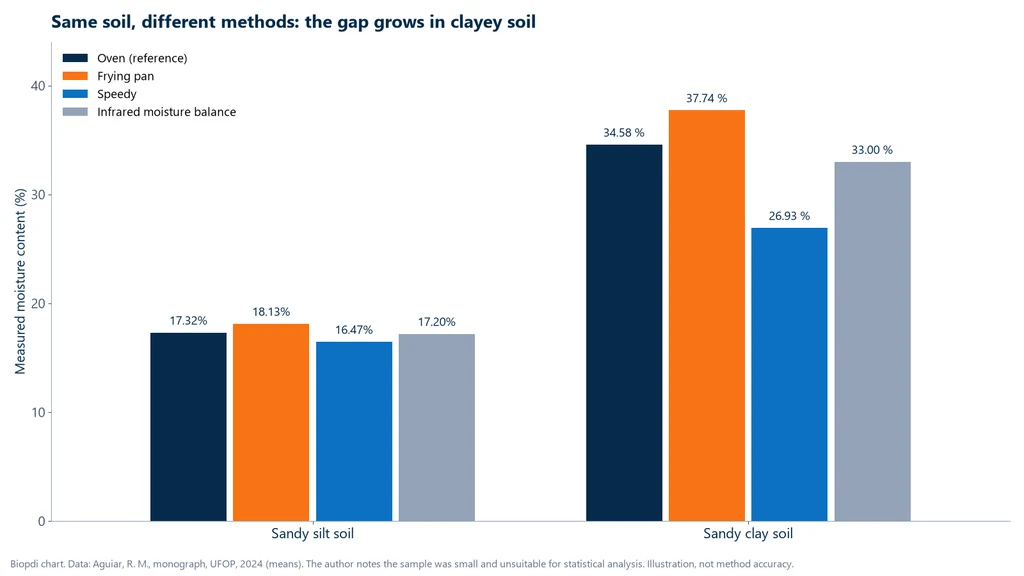
The author himself notes that the sampling was small and that the results should not be used for statistical analysis, so the numbers illustrate trends, not the accuracy of each method. The trends, however, match the physics: the frying pan overheats and counts as water what is not water, and the speedy does not reach the water trapped in clay lumps. In the same study, the frying pan stabilized in about 50 minutes and the infrared balance took 10 to 20 minutes, against 24 hours for the oven.
When to use each one
The oven is the laboratory method and the reference method: it is the one that counts for the Proctor test, the Atterberg limits, particle size distribution and any result that goes into a characterization report. The rapid methods serve field control, to decide on the spot whether a layer is within the specified moisture range before compacting it, and they should be checked periodically against the oven using the same soil. In clayey soils, this check is mandatory in practice, because that is where the deviations grow.
From the prepared sample to the mechanical test
The sample prepared under NBR 6457:2024 (the Brazilian standard for soil sample preparation and moisture content) is the starting point of mechanical soil tests, and the moisture content measured by its method is an input to all of them. In each test, the standard shows up in a different way:
- Compaction: the prepared sample is compacted at five moisture contents, and each one is measured in the oven, as explained in the guide to the Proctor test;
- CBR: the test specimen is molded at optimum moisture content in the large mold, and the molding moisture content is measured by NBR 6457, as detailed in the article on the CBR test;
- Triaxial and direct shear: the moisture content of the specimen goes into the index properties and the degree of saturation, as shown in the articles on the triaxial test and the direct shear test;
- Consolidation: the initial and final moisture contents of the specimen go into the void ratio calculation, as explained in the article on the consolidation test.
The Biopdi CBR test press
Biopdi manufactures equipment for these mechanical tests, not the sample preparation accessories: the oven, balance, sieves, sample splitter and speedy are not Biopdi products. The specimen compacted in the large mold goes to the CBR/Marshall test press, a 50 kN (11,240 lbf) press available in two models, manual and automatic electric; in the automatic version, speed control ranges from 0.001 to 50 mm/min, which includes the 1.27 mm/min of CBR penetration. The panel below shows the press and what each part does in the test that follows compaction:
The CBR/Marshall test press after preparation and compaction
The sample prepared under NBR 6457 is compacted at optimum moisture content in the large mold, and the specimen goes to the 50 kN (11,240 lbf) press. Each part has a role in CBR penetration:
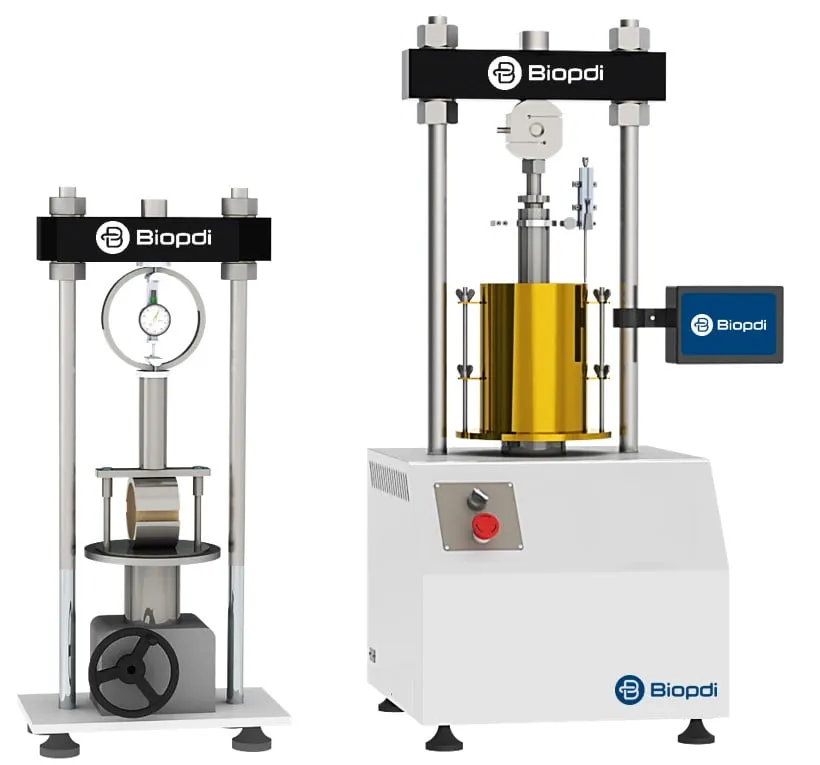
- Two models manual and automatic electric, both with the CBR and Marshall fixtures
- Speed control from 0.001 to 50 mm/min in the automatic version, which includes the 1.27 mm/min of the CBR test
- Interchangeable load cell from 5 to 5,000 kgf (0.05 to 50 kN)
- 50 mm LVDT with 0.01 mm resolution, for penetration
- 100 mm stroke with automatic return at the end of the test
Biopdi's consolidation, direct shear and triaxial systems are listed under soil testing equipment.
How to interpret the standard
The text of NBR 6457:2024 is short, and some points raise questions when reading it. The questions below are the ones laboratory technicians ask most often, and the answers stay within what the text of the standard allows us to state.
Do the 10% and 30% ranges in the retained material table overlap?
In the text, yes: one row refers to "more than 10%" retained on the 19.1 mm sieve, with replacement, and another to "more than 30%", with the recommendation not to test. The consistent reading is by ranges: below 10%, the retained material is discarded; from 10% to 30%, it is replaced; above 30%, the soil is not tested under NBR 7182 (the Brazilian soil compaction standard).
What does "3% of the presumed optimum moisture content" mean?
The note on the 3%-above-optimum procedure excludes materials whose natural moisture content is below "3% of the presumed optimum moisture content". Since this procedure adds no water, the reading that makes sense is moisture content below the presumed optimum plus 3 percentage points: a soil that is already drier than the target cannot be prepared that way.
Are the 19.1 mm and 19 mm sieves the same?
Yes. NBR 6457:2024 writes 19.1 mm and NBR 7182:2025 writes 19 mm, for the same nominal opening. The same applies to the 76.2 mm sieve, sometimes cited as 76 mm in the standard itself.
Which weighing is M1 for the liquid and plastic limits?
It is the moist soil weighing, as in the general procedure. The clause of the standard on the limits calls the moist weighing M2, but the calculation formula defines M1 as the container with the moist soil; the formula prevails. The text also writes "hydroscopic moisture" instead of hygroscopic in one clause on sample preparation.
What counts as constant mass?
Constant mass is the condition in which the soil no longer loses mass with more time in the oven. The standard indicates that 16 h to 24 h is generally enough and allows longer times; when in doubt, the laboratory puts the container back in the oven and weighs it again. A useful precaution, which DNIT 456/2025-ME includes for the laboratory method, is to remove samples that are already dry from the oven before putting in new, moist samples.
Common laboratory errors
Most sample preparation and moisture content errors are not in the calculation but in details of execution and in outdated references. The most frequent:
- Oven-drying the sample during preparation. The preliminary drying is air drying; the oven can alter tropical soils and is used only to measure the moisture content.
- Crushing grains while breaking up clods. A pestle without a rubber tip, or material forced through the sieve, produces fines that did not exist and changes the particle size distribution and the Atterberg limits.
- Taking the sample from the top of the bag. Without a riffle splitter or quartering, the portion is biased, because the grains segregate during transport.
- Separating less mass than the standard requires. In gravelly soil, a small sample gives an unrepresentative moisture content and particle size distribution.
- Forgetting the hygroscopic moisture. Treating air-dried soil as oven-dry puts the basis of every percentage off, by 3.1% in the particle size distribution example.
- Leaving the lid on the container in the oven, or weighing it hot. The lid traps vapor; a hot container reads wrong and, as it cools in the open air, the soil absorbs water.
- Drying organic or gypsum-bearing soil at 105 °C to 110 °C. The correct temperature is 60 °C to 65 °C, and it must be reported with the result.
- Making a single determination. The standard requires at least three and their average.
- Confusing dry basis with wet basis, or gravimetric moisture content with volumetric moisture content. A number on the wrong basis shifts the compaction target.
- Attributing the speedy moisture tester or the frying pan method to NBR 6457. They are in NBR 16097:2012 (the Brazilian standard for rapid moisture content methods) and in DNIT 456/2025-ME (a test method of DNIT, Brazil's federal highway agency).
- Citing DNER-ME 052/94 as current, or the "Annex A" of NBR 6457. The former was canceled by DNIT 456/2025-ME; the annex belonged to the 2016 edition.
- Using the frying pan over high heat. Overheating burns organic matter and overestimates the moisture content.
- Using the speedy moisture tester on clay without checking it against the oven. The method is recommended for sandy materials and tends to read low in clays.
- Looking for a universal "ideal moisture content". On site, the reference moisture content is the Proctor optimum moisture content of that soil at that compaction energy.
Conclusion
NBR 6457:2024 is the standard that comes before all others in the soil laboratory: it defines how the sample is dried, broken up, reduced and sieved, how much material goes to each test and how the moisture content is measured. Following the standard means air drying, not crushing grains, respecting the coarse material table, separating the right mass and measuring the moisture content in the oven, with three determinations, a desiccator and the right temperature for each soil. Rapid methods have their place in the field, under other standards and always checked against the oven.
The tests that use the prepared sample have their own guides: the Proctor test, the Atterberg limits, the soil particle size distribution and the CBR test. To choose the equipment for soil mechanics testing in your laboratory, talk to one of our specialists.
Other tests and technical references
Soil compaction and the Proctor test per ABNT NBR 7182:2025
Soil compaction on site and the Proctor test per NBR 7182:2025: compaction energies, worked curve example, optimum moisture content and degree of compaction.
Direct shear test: ASTM D3080 standard, step-by-step procedure and how to calculate c' and φ'
The direct shear test measures soil shear strength and gives the cohesion c' and friction angle φ'. ASTM D3080-23, step by step, with a worked example.
Marshall test: stability, flow, Vv, VMA (VAM) and VFA (RBV) per DNIT 447/2024-ME
The Marshall test measures the stability and flow of asphalt mixtures at 60 °C per DNIT 447/2024-ME. Procedure, Vv, VMA, VFA and a worked example.
CBR test and the California Bearing Ratio
CBR test (California Bearing Ratio): NBR 9895:2025 and DNIT 172 standards, procedure, formula with 6.9 and 10.35 MPa, worked example and CBR by layer.
Frequently asked questions
What is NBR 6457?
ABNT NBR 6457 is the Brazilian standard for preparing soil samples for compaction and characterization tests and for determining the moisture content in an oven. The current edition is NBR 6457:2024, 3rd edition, of January 9, 2024, which canceled the 2016 edition; in it, the moisture content is in section 4 and no longer in an annex.
What is the moisture content formula?
According to NBR 6457:2024, w = (M1 − M2) / (M2 − M3) × 100, in %, where M1 is the container with the wet soil, M2 the container with the dry soil and M3 the container, all with the lid. The result is the average of at least three determinations, to the nearest 0.1%.
What are the oven-drying temperature and time?
The oven operates at 105 °C to 110 °C until constant mass, which usually takes 16 to 24 h. Organic soils, peaty soils or soils containing gypsum are dried at 60 °C to 65 °C, with longer times, and this temperature must be reported with the result.
What is hygroscopic moisture?
Hygroscopic moisture is the water the soil still retains after air drying, in equilibrium with the ambient humidity. It is higher in clays and practically zero in sands, and it is used to convert air-dried mass into dry mass, with the factor 100 / (100 + w).
What does a soil with 30% moisture content mean?
In gravimetric moisture content, it means 30 g of water for every 100 g of dry soil: in a wet sample of 520.0 g, there are 400.0 g of solids and 120.0 g of water. The water is 30% of the dry mass but only 23.1% of the total mass, which is why the moisture content can exceed 100% in soft clays and peats.
What is the ideal soil moisture content?
There is no single value. On site, the ideal moisture content for compaction is the optimum moisture content from the Proctor test for that soil, at the energy in the specification, within the tolerance it allows. In agriculture, adequate moisture is a different quantity, usually volumetric, related to the water available to plants.
How much soil should be prepared for the compaction test?
According to NBR 6457:2024, 3 kg of dry mass for the small mold and 7 kg for the large mold, with reuse of the material; without reuse, 15 kg and 35 kg. Since air-dried soil still holds hygroscopic moisture, the mass to weigh is the standard's mass multiplied by (1 + w): at 4.0%, 3 kg becomes 3.12 kg.
Are the speedy moisture tester and the frying pan method in NBR 6457?
No. NBR 6457:2024 covers only the oven method. The rapid methods are in ABNT NBR 16097:2012 and, for highway works in Brazil, in DNIT 456/2025-ME, which includes the speedy moisture tester and the frying pan method and canceled DNER-ME 052/94. The microwave method is standardized by ASTM D4643-25.
What did the DNER-ME 129/94 standard establish?
DNER-ME 129/94 (a test method of DNER, Brazil's former federal highway department) covered soil compaction with unworked samples, without reuse of the material. It was revised and replaced by DNIT 164/2013-ME, the current DNIT standard for this test, in which the standard, intermediate and modified energies are called methods A, B and C.
What is the standard for collecting soil samples?
NBR 6457 starts when the sample arrives at the laboratory: it covers preparation, not field sampling. Geotechnical sampling follows the site investigation program of the project, and sampling for soil fertility analysis follows the manuals of Embrapa (the Brazilian Agricultural Research Corporation) and of soil analysis laboratories, which use a different procedure.